service KIA K900 2019 Owner's Manual
[x] Cancel search | Manufacturer: KIA, Model Year: 2019, Model line: K900, Model: KIA K900 2019Pages: 580, PDF Size: 15.11 MB
Page 459 of 580
75
Maintenance
MAINTENANCE SERVICES
You should exercise the utmost care
to prevent damage to your vehicle
and injury to yourself whenever per-
forming any maintenance or inspec-
tion procedures.
Should you have any doubts con-
cerning the inspection or servicing of
your vehicle, we strongly recom-
mend that you have an authorized
K900 Kia dealer perform this work.
An authorized K900 Kia dealer has
factory-trained technicians and gen-
uine Kia parts to service your vehicle
properly. For expert advice and qual-
ity service, see an authorized K900
Kia dealer.
Inadequate, incomplete or insuffi-
cient servicing may result in opera-
tional problems with your vehicle that
could lead to vehicle damage, an
accident, or bodily injury.Owner’s responsibility
✽ ✽NOTICE
Maintenance Service and Record
Retention are the owner's responsi-
bility.
You should retain documents that
show proper maintenance has been
performed on your vehicle in accor-
dance with the scheduled mainte-
nance service charts shown on the
following pages. You need this infor-
mation to establish your compliance
with the servicing and maintenance
requirements of your vehicle war-
ranties.
Detailed warranty information is
provided in your Warranty &
Consumer Information manual.
Repairs and adjustments required as
a result of improper maintenance or
a lack of required maintenance are
not covered.
We recommend you have your vehi-
cle maintained and repaired by an
authorized K900 Kia dealer. An
authorized K900 Kia dealer meets
Kia’s high service quality standards
and receives technical support from
Kia in order to provide you with a
high level of service satisfaction.
Page 460 of 580
Maintenance
67
✽ ✽NOTICE - NHTSA Safety
Corrosion Alert
The National Highway Traffic
Safety Administration (NHTSA) has
issued a general warning to all vehi-
cle owners of all brands regarding
the risks associated with vehicle
underbody corrosion. From your
initial purchase, take the following
steps to prevent unsafe corrosion
damage to your vehicle:
• Wash the undercarriage of your
vehicle regularly during the win-
ter and whenever your vehicle has
been exposed to such salts or
chemicals.
• Do a thorough washing of the undercarriage at the end of the
winter.
• Use professional service techni- cians or governmental inspection
stations to annually inspect for
corrosion. (Continued)(Continued)
• Immediately seek an inspection of
your vehicle if you become visual-
ly aware of corrosion flaking or
scaling or if you become aware of
a change in vehicle performance,
such as soft or spongy brakes, flu-
ids leaking, impairment of direc-
tional control, suspension noises
or rattling metal straps.
NHTSA further advises that after
a vehicle is 7 years old, it is essen-
tial that you take these indicated
maintenance steps to ensure that
you protect yourself from unsafe
corrosion conditions.
Owner maintenance precau-
tions
Improper or incomplete service may
result in problems. This section gives
instructions only for the maintenance
items that are easy to perform.
As explained earlier in this section,
several procedures can be done only
by an authorized K900 Kia dealer
with special tools.
✽ ✽ NOTICE
Improper owner maintenance dur-
ing the warranty period may affect
warranty coverage. For details, read
the separate Warranty & Consumer
Information manual provided with
the vehicle. If you're unsure about
any servicing or maintenance proce-
dure, have it done by an authorized
K900 Kia dealer.
Page 464 of 580
Maintenance
10
7
SCHEDULED MAINTENANCE SERVICE
Follow the Normal Maintenance
Schedule if the vehicle is usually
operated where none of the following
conditions apply. If any of the following
conditions apply, follow the
Maintenance Under Severe Usage
Conditions.
Repeated driving short distance of
less than 5 miles (8 km) in normal
temperature or less than 10 miles
(16 km) in freezing temperature
Extensive engine idling or low speed driving for long distances
Driving on rough, dusty, muddy, unpaved, graveled or salt-spread
roads
Driving in areas using salt or other corrosive materials or in very cold
weather
Driving in heavy dust condition
Driving in heavy traffic area
Driving on uphill, downhill, or mountain road repeatedly Towing a trailer or using a camper,
or roof rack
Driving as a patrol car, taxi, other commercial use of vehicle towing
Driving over 106 mph (170 km/h)
Frequently driving in stop-and-go conditionIf your vehicle is operated in any ofthe prior listed conditions, you shouldinspect, replace or refill more fre-quently, using the severe usagemaintenance schedule instead of thenormal usage maintenance sched-ule.
Page 465 of 580
711
Maintenance
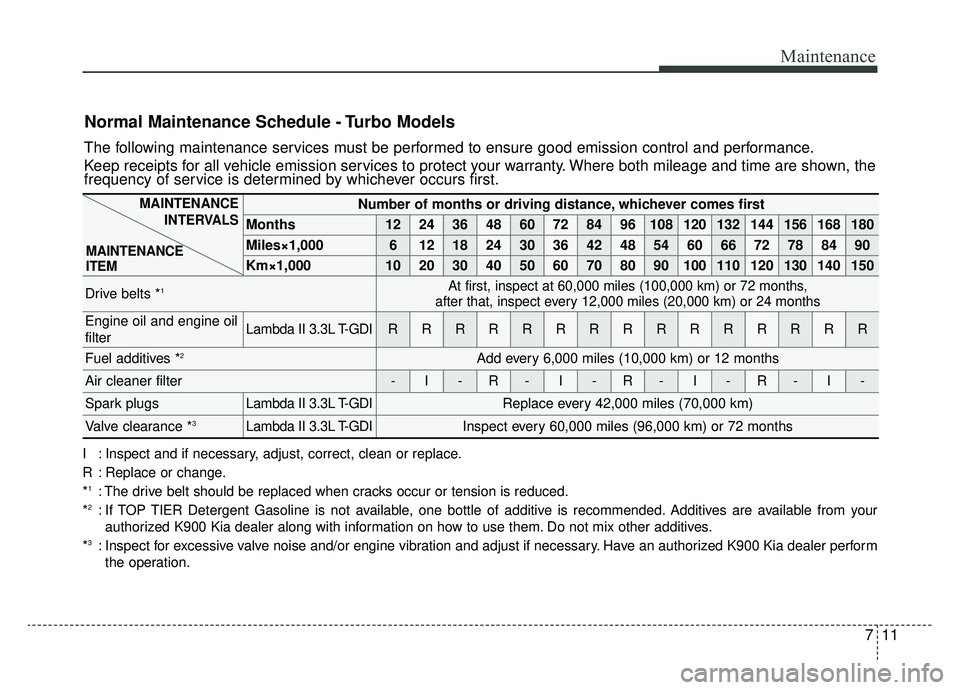
Normal Maintenance Schedule - Turbo Models
The following maintenance services must be performed to ensure good emission control and performance.
Keep receipts for all vehicle emission services to protect your warranty. Where both mileage and time are shown, the
frequency of service is determined by whichever occurs first.
Number of months or driving distance, whichever comes first
Months1224364860728496108120132144156168180
Miles×1,00061218243036424854606672788490
Km×1,000102030405060708090100110120130140150
Drive belts *1At first, inspect at 60,000 miles (100,000 km) or 72 months,
after that, inspect every 12,000 miles (20,000 km) or 24 months
Engine oil and engine oil
filterLambda II 3.3L T-GDIRRRRRRRRRRRRRRR
Fuel additives *2Add every 6,000 miles (10,000 km) or 12 months
Air cleaner filter-I-R-I-R-I-R-I-
Spark plugsLambda II 3.3L T-GDIReplace every 42,000 miles (70,000 km)
Valve clearance *3Lambda II 3.3L T-GDIInspect every 60,000 miles (96,000 km) or 72 months
MAINTENANCE
INTERVALS
MAINTENANCE
ITEM
I : Inspect and if necessary, adjust, correct, clean or replace.
R : Replace or change.
*
1: The drive belt should be replaced when cracks occur or tension is reduced.
*2: If TOP TIER Detergent Gasoline is not available, one bottle of additive is recommended. Additives are available from your authorized K900 Kia dealer along with information on how to use them. Do not mix other additives.
*
3: Inspect for excessive valve noise and/or engine vibration and adjust if necessary. Have an authorized K900 Kia dealer perform the operation.
Page 467 of 580
713
Maintenance
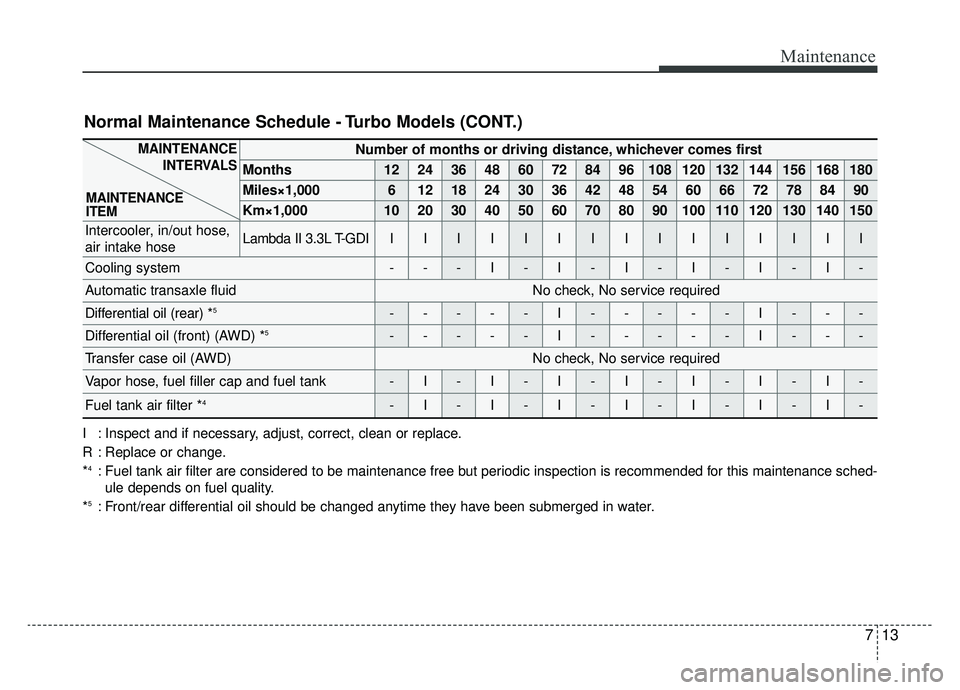
Normal Maintenance Schedule - Turbo Models (CONT.)
Number of months or driving distance, whichever comes first
Months1224364860728496108120132144156168180
Miles×1,00061218243036424854606672788490
Km×1,000102030405060708090100110120130140150
Intercooler, in/out hose,
air intake hoseLambda II 3.3L T-GDIIIIIIIIIIIIIIII
Cooling system---I-I-I-I-I-I-
Automatic transaxle fluidNo check, No service required
Differential oil (rear) *5-----I-----I---
Differential oil (front) (AWD) *5-----I-----I---
Transfer case oil (AWD)No check, No service required
Vapor hose, fuel filler cap and fuel tank-I-I-I-I-I-I-I-
Fuel tank air filter *4-I-I-I-I-I-I-I-
MAINTENANCEINTERVALS
MAINTENANCE
ITEM
I : Inspect and if necessary, adjust, correct, clean or replace.
R : Replace or change.
*
4: Fuel tank air filter are considered to be maintenance free but periodic inspection is recommended for this maintenance sched- ule depends on fuel quality.
*
5: Front/rear differential oil should be changed anytime they have been submerged in water.
Page 469 of 580
715
Maintenance
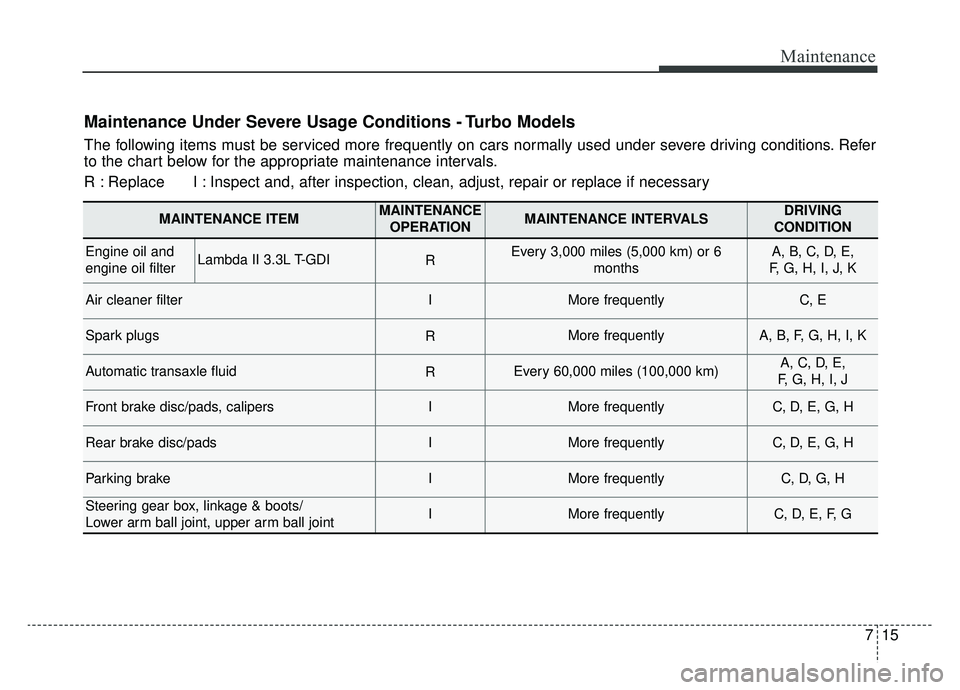
Maintenance Under Severe Usage Conditions - Turbo Models
The following items must be serviced more frequently on cars normally used under severe driving conditions. Refer
to the chart below for the appropriate maintenance intervals.
R : Replace I : Inspect and, after inspection, clean, adjust, repair or replace if neces\
sary
MAINTENANCE ITEMMAINTENANCEOPERATIONMAINTENANCE INTERVALSDRIVING
CONDITION
Engine oil and
engine oil filterLambda II 3.3L T-GDIREvery 3,000 miles (5,000 km) or 6 monthsA, B, C, D, E,
F, G, H, I, J, K
Air cleaner filterIMore frequentlyC, E
Spark plugs RMore frequentlyA, B, F, G, H, I, K
Automatic transaxle fluidREvery 60,000 miles (100,000 km) A, C, D, E,
F, G, H, I, J
Front brake disc/pads, calipersIMore frequentlyC, D, E, G, H
Rear brake disc/padsIMore frequentlyC, D, E, G, H
Parking brakeIMore frequentlyC, D, G, H
Steering gear box, linkage & boots/
Lower arm ball joint, upper arm ball jointIMore frequentlyC, D, E, F, G
Page 486 of 580
Maintenance
32
7
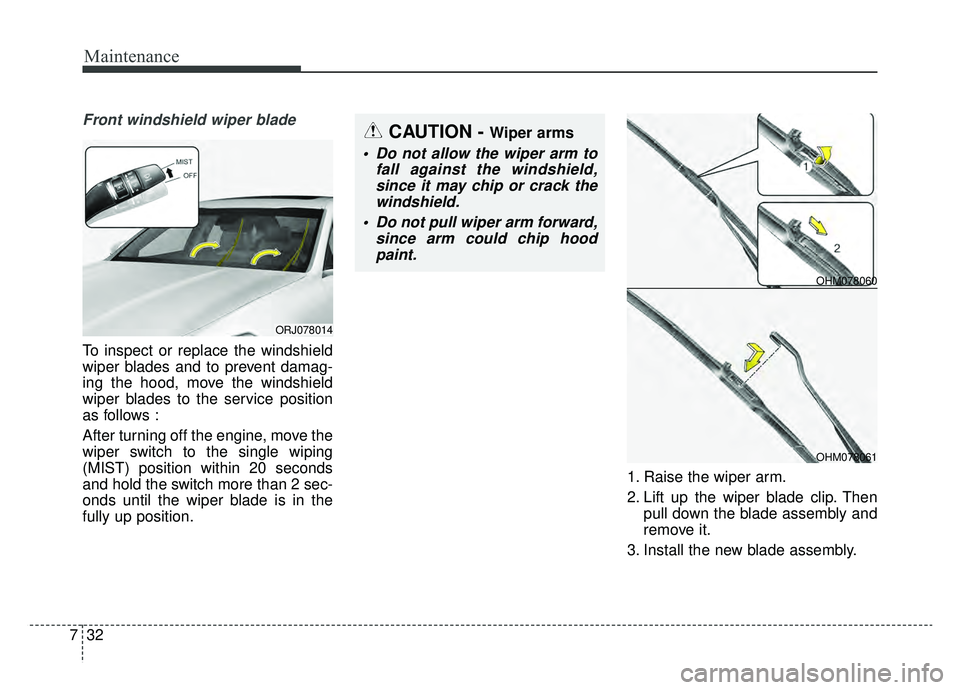
Front windshield wiper blade
To inspect or replace the windshield
wiper blades and to prevent damag-
ing the hood, move the windshield
wiper blades to the service position
as follows :
After turning off the engine, move the
wiper switch to the single wiping
(MIST) position within 20 seconds
and hold the switch more than 2 sec-
onds until the wiper blade is in the
fully up position. 1. Raise the wiper arm.
2. Lift up the wiper blade clip. Then
pull down the blade assembly and
remove it.
3. Install the new blade assembly.
ORJ078014
OHM078060
OHM078061
CAUTION - Wiper arms
Do not allow the wiper arm to fall against the windshield,since it may chip or crack thewindshield.
Do not pull wiper arm forward, since arm could chip hoodpaint.
Page 488 of 580
Maintenance
34
7
BATTERY
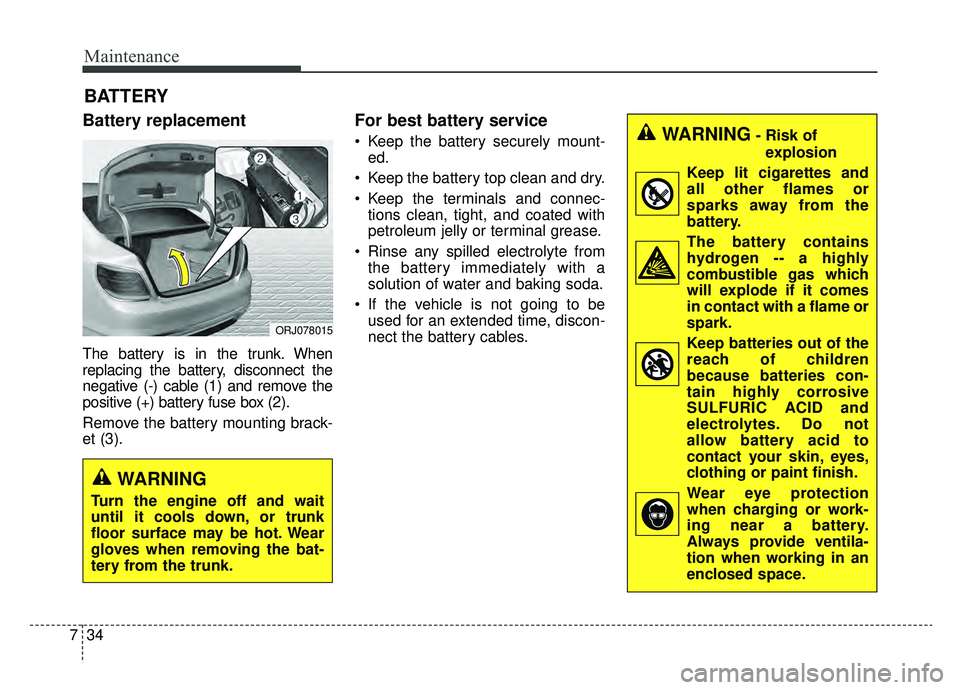
Battery replacement
The battery is in the trunk. When
replacing the battery, disconnect the
negative (-) cable (1) and remove the
positive (+) battery fuse box (2).
Remove the battery mounting brack-
et (3).
For best battery service
Keep the battery securely mount-
ed.
Keep the battery top clean and dry.
Keep the terminals and connec- tions clean, tight, and coated with
petroleum jelly or terminal grease.
Rinse any spilled electrolyte from the battery immediately with a
solution of water and baking soda.
If the vehicle is not going to be used for an extended time, discon-
nect the battery cables.WARNING- Risk of
explosion
Keep lit cigarettes and
all other flames or
sparks away from the
battery.
The battery contains hydrogen -- a highly
combustible gas which
will explode if it comes
in contact with a flame or
spark.
Keep batteries out of the reach of children
because batteries con-
tain highly corrosive
SULFURIC ACID and
electrolytes. Do not
allow battery acid to
contact your skin, eyes,
clothing or paint finish.
Wear eye protection when charging or work-
ing near a battery.
Always provide ventila-
tion when working in an
enclosed space.
ORJ078015
WARNING
Turn the engine off and wait
until it cools down, or trunk
floor surface may be hot. Wear
gloves when removing the bat-
tery from the trunk.
Page 500 of 580
Maintenance
46
7
Tread wear
The tread wear grade is a compara-
tive rating based on the wear rate of
the tire when tested under controlled
conditions on a specified govern-
ment test course. For example, a tire
graded 150 would wear one-and-a-
half times (1½) as well on the gov-
ernment course as a tire graded 100.
The relative performance of tires
depends upon the actual conditions
of their use, however, and may
depart significantly from the norm
due to variations in driving habits,
service practices and differences in
road characteristics and climate. Tires degrade over time, even when
they are not being used. Regardless
of the remaining tread, we recom-
mend that tires be replaced after
approximately six (6) years of normal
service. Heat caused by hot climates
or frequent high loading conditions
can accelerate the aging process.
These grades are molded on the
side-walls of passenger vehicle tires.
The tires available as standard or
optional equipment on your vehicles
may vary with respect to grade.
Traction - AA, A, B & C
The traction grades, from highest to
lowest, are AA, A, B and C. Those
grades represent the tires ability to
stop on wet pavement as measured
under controlled conditions on spec-
ified government test surfaces of
asphalt and concrete. A tire marked
C may have poor traction perform-
ance.
The traction grade assigned to this
tire is based on straight-ahead brak-
ing traction tests, and does not
include acceleration, cornering,
hydroplaning, or peak traction char-
acteristics.
Page 531 of 580
777
Maintenance
LIGHT BULBS
Lamp (LED type) bulb replace-
ment
Only LED lamps are used in this
vehicle.
If the LED lamp does not operate,
have the vehicle checked by an
authorized K900 Kia dealer.
The LED lamp cannot be replaced
as a single component because it is
an integrated unit.The LED lamp has
to be replaced with the unit.
A skilled technician should check or
repair the license plate lamp (LED),
for it may damage related parts of
the vehicle.
net-work failure
The headlamp, taillight, and fog light
may light up when the head lamp
switch is turned ON, and not light up
when the taillight or for light switch is
turned ON. This may be cause by
network failure or vehicle electrical
control system malfunction. If there is
a problem, we recommend the sys-
tem be serviced by an authorized
K900 Kia dealer.
trical control system stabilization
A normally functioning lamp may
flicker momentarily. This momentary
occurrence is due to the stabilization
function of the vehicle's electrical
control system. If the lamp stops
flickering after a few moments, the
vehicle does not require service.
However, if the lamp goes out after
the momentary flickering, or the flick-
ering continues, we recommend the
system be serviced by an authorized
K900 Kia dealer.
CAUTION -Headlamp
Lens
To prevent damage, do not clean the headlamp lens withchemical solvents or strongdetergents.