ABS KIA K900 2020 User Guide
[x] Cancel search | Manufacturer: KIA, Model Year: 2020, Model line: K900, Model: KIA K900 2020Pages: 593, PDF Size: 14.99 MB
Page 392 of 593
Driving your vehicle
126
5
Your vehicle may be equipped with
the ISG system, which reduces fuel
consumption by automatically shut-
ting down the engine, when the vehi-
cle is at a standstill. (For example :
red light, stop sign and traffic jam)
The engine starts automatically as
soon as the starting conditions are
met.
The ISG system is ON whenever the
engine is running.
✽ ✽
NOTICE
When the engine automatically
starts by the ISG system, some
warning lights (ABS, ESC, ESC
OFF, EPS or Parking brake warn-
ing light) may turn on for a few sec-
onds.
This happens because of low battery
voltage. It does not mean the system
has malfunctioned.
Auto stop
To stop the engine in idle stop
mode
Stop the vehicle completely by
pressing the brake pedal when the
shift lever is in the D (Drive) or N
(Neutral) position.
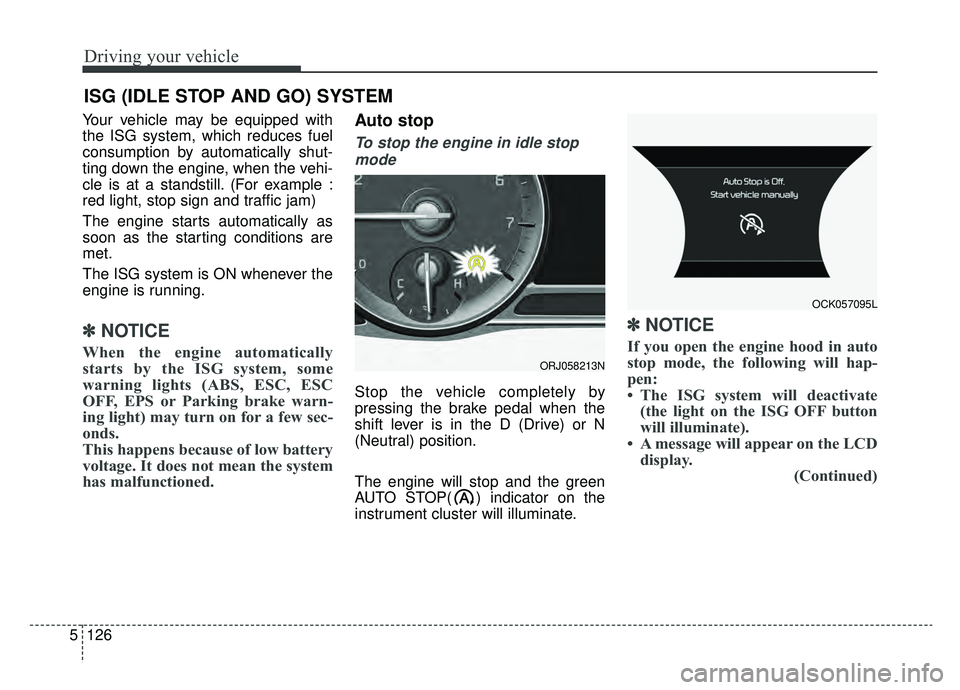
The engine will stop and the green
AUTO STOP( ) indicator on the
instrument cluster will illuminate.
✽ ✽ NOTICE
If you open the engine hood in auto
stop mode, the following will hap-
pen:
• The ISG system will deactivate
(the light on the ISG OFF button
will illuminate).
• A message will appear on the LCD display. (Continued)
ISG (IDLE STOP AND GO) SYSTEM
ORJ058213N
OCK057095L
Page 429 of 593
5163
Driving your vehicle
Hazardous driving conditions
When hazardous driving conditions
are encountered such as water,
snow, ice, mud, sand, or similar haz-
ards, follow these suggestions:
Drive cautiously and allow extradistance for braking.
Avoid sudden braking or steering.
When braking with non-ABS brakes, pump the brake pedal with
a light up-and-down motion until
the vehicle is stopped.
Do not pump the brake pedal on a
vehicle equipped with ABS. If stalled in snow, mud, or sand,
use the second gear. Accelerate
slowly to avoid spinning the drive
wheels.
Use sand, rock salt, or other non- slip material under the drive
wheels to provide traction when
stalled in ice, snow, or mud.
Rocking the vehicle
If it is necessary to rock the vehicle
to free it from snow, sand, or mud,
first turn the steering wheel right and
left to clear the area around your
front wheels. Then, shift back and
forth between R (Reverse) and any
forward gear in vehicles equipped
with an Automatic Transmission. Do
not race the engine, and spin the
wheels as little as possible. If you are
still stuck after a few tries, have the
vehicle pulled out by a tow vehicle to
avoid engine overheating and possi-
ble damage to the transmission.
SPECIAL DRIVING CONDITIONS
WARNING- Downshifting
Do not downshift with an auto-
matic transmission while driv-
ing on slippery surfaces. The
sudden change in tire speed
could cause the tires to skid
and result in an accident.
WARNING- Sudden
Vehicle Movement
Do not attempt to rock the vehi-
cle if people or objects are near-
by. The vehicle may suddenly
move forward or backwards as it
becomes unstuck.
Page 459 of 593
617
What to do in an emergency
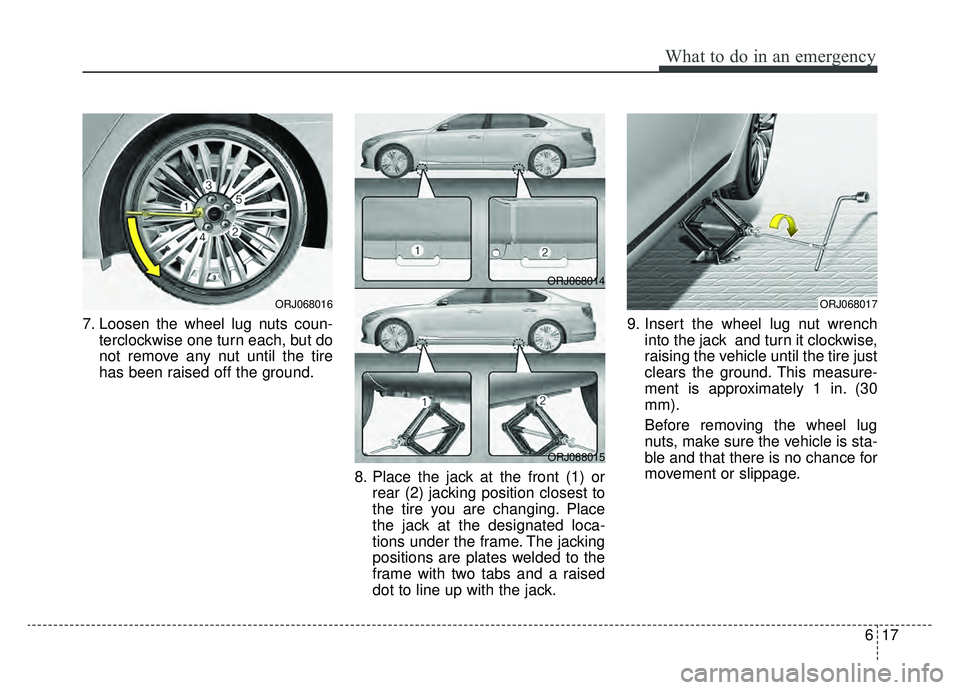
7. Loosen the wheel lug nuts coun-terclockwise one turn each, but do
not remove any nut until the tire
has been raised off the ground.
8. Place the jack at the front (1) orrear (2) jacking position closest to
the tire you are changing. Place
the jack at the designated loca-
tions under the frame. The jacking
positions are plates welded to the
frame with two tabs and a raised
dot to line up with the jack. 9. Insert the wheel lug nut wrench
into the jack and turn it clockwise,
raising the vehicle until the tire just
clears the ground. This measure-
ment is approximately 1 in. (30
mm).
Before removing the wheel lug
nuts, make sure the vehicle is sta-
ble and that there is no chance for
movement or slippage.
ORJ068017ORJ068016
ORJ068014
ORJ068015
Page 512 of 593
Maintenance
42
7
Tire replacement
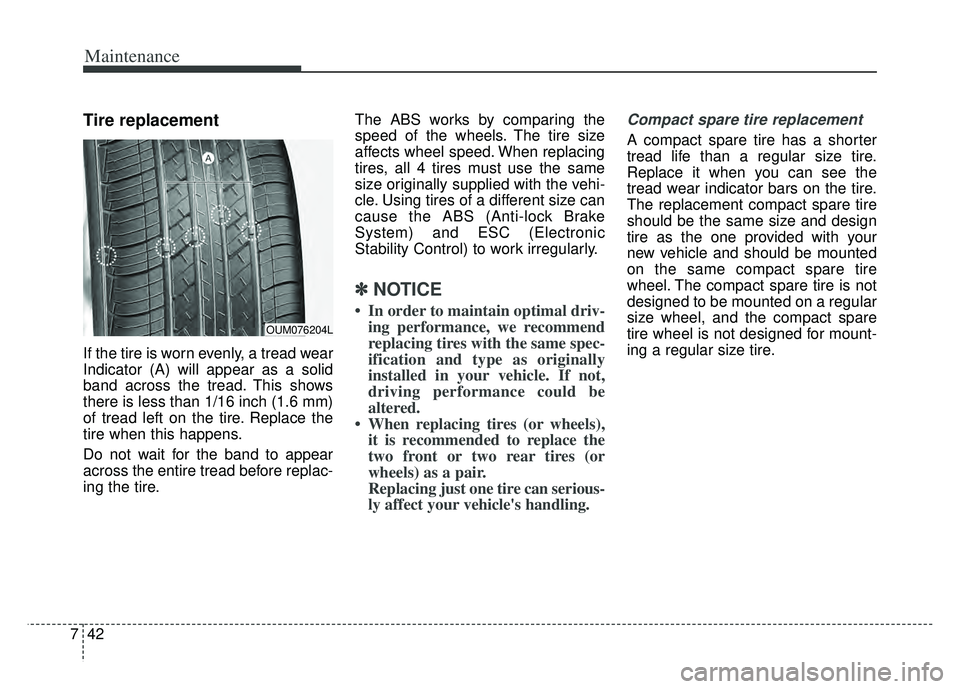
If the tire is worn evenly, a tread wear
Indicator (A) will appear as a solid
band across the tread. This shows
there is less than 1/16 inch (1.6 mm)
of tread left on the tire. Replace the
tire when this happens.
Do not wait for the band to appear
across the entire tread before replac-
ing the tire. The ABS works by comparing the
speed of the wheels. The tire size
affects wheel speed. When replacing
tires, all 4 tires must use the same
size originally supplied with the vehi-
cle. Using tires of a different size can
cause the ABS (Anti-lock Brake
System) and ESC (Electronic
Stability Control) to work irregularly.
✽ ✽
NOTICE
• In order to maintain optimal driv-
ing performance, we recommend
replacing tires with the same spec-
ification and type as originally
installed in your vehicle. If not,
driving performance could be
altered.
• When replacing tires (or wheels), it is recommended to replace the
two front or two rear tires (or
wheels) as a pair.
Replacing just one tire can serious-
ly affect your vehicle's handling.
Compact spare tire replacement
A compact spare tire has a shorter
tread life than a regular size tire.
Replace it when you can see the
tread wear indicator bars on the tire.
The replacement compact spare tire
should be the same size and design
tire as the one provided with your
new vehicle and should be mounted
on the same compact spare tire
wheel. The compact spare tire is not
designed to be mounted on a regular
size wheel, and the compact spare
tire wheel is not designed for mount-
ing a regular size tire.
OUM076204L
Page 561 of 593
791
Maintenance
Taking care of leather seats (if equipped)
Vacuum the seat periodically to remove dust and sand on the seat.
It will prevent abrasion or damage of
the leather and maintain its quality.
Wipe the natural leather seat cover often with dry or soft cloth.
Sufficient use of a leather protec- tive may prevent abrasion of the
cover and helps maintain the color.
Be sure to read the instructions
and consult a specialist when
using leather coating or protective
agents.
Leather with bright colors(beige, cream beige) is easily contaminat-
ed. Clean the seats frequently.
Avoid wiping with a wet cloth. It may cause the surface to crack.
Cleaning the leather seats
(if equipped)
Remove all contaminations instant- ly. Refer to instructions below for
removal of each contaminant.
Cosmetic products(sunscreen, foundation, etc.)
- Apply cleansing cream on a clothand wipe the contaminated point.
Wipe off the cream with a wet
cloth and remove water with a dry
cloth.
Beverages(coffee, soft drink, etc.) - Apply a small amount of neutraldetergent and wipe until contami-
nations do not smear.
Oil - Remove oil instantly withabsorbable cloth and wipe with
stain remover for natural leather
only.
Chewing gum - Harden the gum with ice andremove gradually.
Fabric seat cover using precau-
tions (if equipped)
Please clean the fabric seats regu-
larly with a vacuum cleaner. If they
are heavily soiled with beverage
stains, etc., use a suitable interior
cleaner. To prevent damage to seat
covers, wipe off the seat covers
down to the seams with a large wip-
ing motion and moderate pressure
using a soft sponge or microfiber
cloth.
Velcro closures on clothing or sharp
objects may cause snagging or
scratches on the surface of the
seats. Make sure not to rub such
objects against the surface.
Page 563 of 593
793
Maintenance
Canister
Fuel vapors generated inside the fuel
tank are absorbed and stored in the
onboard canister. When the engine is
running, the fuel vapors absorbed in
the canister are drawn into the surge
tank through the purge control sole-
noid valve.
Purge Control Solenoid Valve(PCSV)
The purge control solenoid valve is
controlled by the Engine Control
Module (ECM); when the engine
coolant temperature is low during
idling, the PCSV closes so that evap-
orated fuel is not taken into the
engine. After the engine warms up
during ordinary driving, the PCSV
opens to introduce evaporated fuel to
the engine.
3. Exhaust emission control system
The Exhaust Emission Control
System is a highly effective system
which controls exhaust emissions
while maintaining good vehicle per-
formance.
Vehicle modifications
This vehicle should not be modified.
Modification of your vehicle could
affect its performance, safety or
durability and may even violate gov-
ernmental safety and emissions reg-
ulations.
In addition, damage or performance
problems resulting from any modifi-
cation may not be covered under
warranty.
If you use unauthorized electronic
devices, it may cause the vehicle to
operate abnormally, wire damage,
battery discharge and fire. For your
safety, do not use unauthorized
electronic devices.
Engine exhaust gas precautions
(carbon monoxide)
Carbon monoxide can be present with other exhaust fumes.
Therefore, if you smell exhaust
fumes of any kind inside your vehi-
cle, have it inspected and repaired
immediately. If you ever suspect
exhaust fumes are coming into
your vehicle, drive it only with all
the windows fully open. Have your
vehicle checked and repaired
immediately.
WARNING - Exhaust
Engine exhaust gases contain
carbon monoxide (CO). Though
colorless and odorless, it is
dangerous and could be lethal if
inhaled. Follow the instructions
on this page to avoid CO poi-
soning.
Page 584 of 593
/Blind-Spot Collision-Avoidance Assist (BCA)
system . . . . . . . . . . . . . . . . . . . . . . . . . . . . . . . . . . . . \
5-80
System description . . .")
I3
Index
Blind-Spot Collision Warning (BCW)/Blind-Spot Collision-Avoidance Assist (BCA)
system . . . . . . . . . . . . . . . . . . . . . . . . . . . . . . . . . . . . \
5-80
System description . . . . . . . . . . . . . . . . . . . . . . . . . . 5-80
System setting and activation . . . . . . . . . . . . . . . . . . 5-81
Warning message and system control . . . . . . . . . . . 5-84
Brake fluid . . . . . . . . . . . . . . . . . . . . . . . . . . . . . . . . . . 7-26\
Checking the brake fluid level . . . . . . . . . . . . . . . . . 7-26
Brake system. . . . . . . . . . . . . . . . . . . . . . . . . . . . . . . . . 5-31 Power brakes . . . . . . . . . . . . . . . . . . . . . . . . . . . . . . 5-31
Electronic Parking Brake (EPB) . . . . . . . . . . . . . . . 5-33
Auto hold . . . . . . . . . . . . . . . . . . . . . . . . . . . . . . . . . 5-39
Warning messages . . . . . . . . . . . . . . . . . . . . . . . . . . 5-42
Anti-lock Brake System (ABS) . . . . . . . . . . . . . . . . 5-43
Electronic Stability Control (ESC) system . . . . . . . 5-45
Vehicle Stability Management (VSM) . . . . . . . . . . . 5-49
Hill-start Assist Control (HAC) . . . . . . . . . . . . . . . . 5-51
Good braking practices . . . . . . . . . . . . . . . . . . . . . . 5-51
Electronic Control Suspension (ECS) . . . . . . . . . . . 5-52
Bulb wattage . . . . . . . . . . . . . . . . . . . . . . . . . . . . . . . . . . 5-3
California perchlorate notice . . . . . . . . . . . . . . . . . . . . 7-95
Checking fluid levels . . . . . . . . . . . . . . . . . . . . . . . . . . 7-20 Child Restraint System (CRS) . . . . . . . . . . . . . . . . . . . 3-39
Children always in the rear . . . . . . . . . . . . . . . . . . . 3-39
Selecting a Child Restraint System (CRS) . . . . . . . 3-40
Installing a Child Restraint System (CRS) . . . . . . . 3-43
Climate control air filter . . . . . . . . . . . . . . . . . . . . . . . . 7-29 Filter inspection . . . . . . . . . . . . . . . . . . . . . . . . . . . . 7-29
Consumer assistance (U.S. only) . . . . . . . . . . . . . . . . . 8-12 Toll free consumer assistance . . . . . . . . . . . . . . . . . 8-12
Emergency roadside assistance . . . . . . . . . . . . . . . . 8-12
Trip interruption . . . . . . . . . . . . . . . . . . . . . . . . . . . . 8-13
Registering your vehicle in a foreign country . . . . . 8-14
Declaration of Conformity . . . . . . . . . . . . . . . . . . . . . 4-172 FCC . . . . . . . . . . . . . . . . . . . . . . . . . . . . . . . . . . . . \
4-172
Defroster . . . . . . . . . . . . . . . . . . . . . . . . . . . . . . . . . . . 4-\
131 Rear window defroster . . . . . . . . . . . . . . . . . . . . . . 4-131
Dimensions . . . . . . . . . . . . . . . . . . . . . . . . . . . . . . . . . . . 8-\
2
Door locks. . . . . . . . . . . . . . . . . . . . . . . . . . . . . . . . . . . 4-\
17 Operating door locks from outside the vehicle . . . . 4-17
Operating door locks from inside the vehicle . . . . . 4-18
Door lock/unlock features . . . . . . . . . . . . . . . . . . . . 4-20
Auto door lock/unlock feature . . . . . . . . . . . . . . . . . 4-20
Child-protector rear door lock . . . . . . . . . . . . . . . . . 4-21
Drive mode integrated control system . . . . . . . . . . . . 5-130
C
D