key KIA Magnetis 2006 2.G User Guide
[x] Cancel search | Manufacturer: KIA, Model Year: 2006, Model line: Magnetis, Model: KIA Magnetis 2006 2.GPages: 225, PDF Size: 3.77 MB
Page 52 of 225
3-43
THE IMPORTANCE OF
USING SAFETY BELTSThere are four very important reasons to
use safety belts even with an air bag
system, they:
• Help keep you in the proper position
(away from the air bag) when it
inflates.
• Reduce the risk of harm in rollover,
side or rear impact collisions,
because an air bag is not designed to
inflate in such situations.
• Reduce the risk of harm in frontal
collisions that are not severe enough
to activate the supplemental restraint
system.
• Reduce the risk of being thrown from
your vehicle.
WARNING - Air Bags &
Safety Belts
Even in vehicles with air bags,
you and your passengers
must always wear the safety
belts provided in order to
minimize the risk and severity
of injury in the event of a
collision or rollover.
Always wear your safety belt.
It can help keep you away
from the air bags during
heavy braking just before a
collision.
Air bags are designed to
inflate only in severe frontal
collisions and will generally
not provide protection in side
or rear impacts, rollovers or
less severe frontal collisions.
They will also not provide
protection from later impacts
in a multi-impact collision.
If your vehicle has been
subjected to flood conditions
(e.g. soaked carpeting/
standing water on the floor of
the vehicle, etc.) or if your
vehicle has become flood
damaged in any way, do not
attempt to start the vehicle or
put the key in the ignition
before disconnecting the
battery. This may cause air
bag deployment, which could
result in serious personal
injury or death. Have the
vehicle towed to an
Authorized Kia Dealer for
inspection and necessary
repairs.
MS-CNA-Eng 3.QXD 7/25/2005 5:17 PM Page 43
Page 59 of 225
KNOWING YOUR VEHICLE
3-50
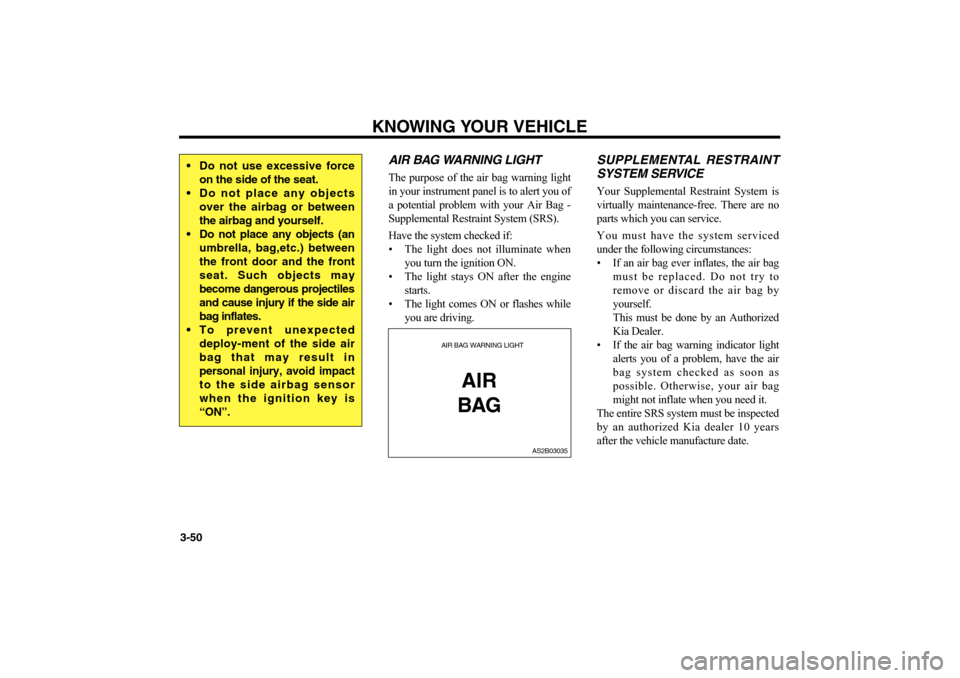
AIR BAG WARNING LIGHTThe purpose of the air bag warning light
in your instrument panel is to alert you of
a potential problem with your Air Bag -
Supplemental Restraint System (SRS).
Have the system checked if:
• The light does not illuminate when
you turn the ignition ON.
• The light stays ON after the engine
starts.
• The light comes ON or flashes while
you are driving.
SUPPLEMENTAL RESTRAINT
SYSTEM SERVICEYour Supplemental Restraint System is
virtually maintenance-free. There are no
parts which you can service.
You must have the system serviced
under the following circumstances:
• If an air bag ever inflates, the air bag
must be replaced. Do not try to
remove or discard the air bag by
yourself.
This must be done by an Authorized
Kia Dealer.
• If the air bag warning indicator light
alerts you of a problem, have the air
bag system checked as soon as
possible. Otherwise, your air bag
might not inflate when you need it.
The entire SRS system must be inspected
by an authorized Kia dealer 10 years
after the vehicle manufacture date.
AIR BAG WARNING LIGHT
AIR
BAG
AS2B03035
Do not use excessive force
on the side of the seat.
Do not place any objects
over the airbag or between
the airbag and yourself.
Do not place any objects (an
umbrella, bag,etc.) between
the front door and the front
seat. Such objects may
become dangerous projectiles
and cause injury if the side air
bag inflates.
To prevent unexpected
deploy-ment of the side air
bag that may result in
personal injury, avoid impact
to the side airbag sensor
when the ignition key is
“ON”.
MS-CNA-Eng 3.QXD 7/25/2005 5:17 PM Page 50
Page 61 of 225
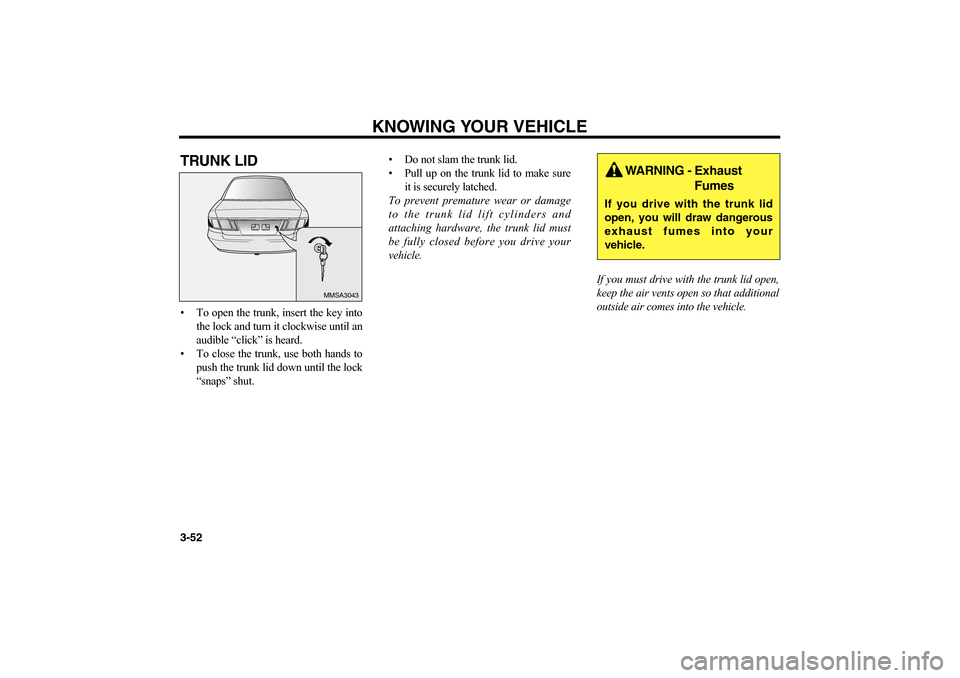
TRUNK LID• To open the trunk, insert the key into
the lock and turn it clockwise until an
audible “click” is heard.
• To close the trunk, use both hands to
push the trunk lid down until the lock
“snaps” shut.• Do not slam the trunk lid.
• Pull up on the trunk lid to make sure
it is securely latched.
To prevent premature wear or damage
to the trunk lid lift cylinders and
attaching hardware, the trunk lid must
be fully closed before you drive your
vehicle.
If you must drive with the trunk lid open,
keep the air vents open so that additional
outside air comes into the vehicle.
KNOWING YOUR VEHICLE
3-52
MMSA3043
WARNING - Exhaust
Fumes
If you drive with the trunk lid
open, you will draw dangerous
exhaust fumes into your
vehicle.
MS-CNA-Eng 3.QXD 7/25/2005 5:17 PM Page 52
Page 63 of 225

KNOWING YOUR VEHICLE
3-54TRUNK LID KNOB LOCKThe trunk lid lock knob (located near the
latch) is in the “LOCK” position when
the trunk lid is closed, it will not be
possible to open the trunk lid by using
the remote release. In this instance, use
the master key to unlock and open the
trunk lid. To allow the trunk lid to be
opened with the remote release, push the
trunk lid lock knob down, then to the
opposite direction of the “LOCK”
position.
HOODOPENING THE HOOD1. Inside the vehicle, pull the hood
release handle located at the bottom
left corner of the instrument panel.
MMSA3047
Release
handle
MMSA3046A
with the remote
release
✻
NOTICE :
• If a person is locked in the trunk
by choice, by accident or by
another person, the trunk lid
can be opened by pushing the lid
lock knob down.
• While unattended, vehicles
should be locked and the keys
kept out of the reach of children.
Children should be taught about
the dangers of playing in a
vehicle trunk.
MS-CNA-Eng 3.QXD 7/25/2005 5:17 PM Page 54
Page 76 of 225
If the sunroof does not electrically
operate.
1. Remove the retangular plastic lens in
the front of the roof panel.
2. Turn the cross bolt with a phillips
screw driver counterclockwise to
remove the front dome light
assembly.
3. Insert the hexagonal head wrench
provided with the vehicle into the
socket. This wrench can be found in
the glove box.
4. Turn the wrench clockwise to open
or counterclockwise to close.
RESETTING THE SUNROOFWhen your battery happens to be
disconnected or you use the hexagonal
head wrench to operate the sunroof, you
have to reset your sunroof motor as
follows :
• Turn the ignition key to the ON
position.
• Pull the sunroof fuse out from the
main fuse box in engine
compartment and reinstall it.
• Depress the front portion of sunroof
switch and hold it during 5 seconds.
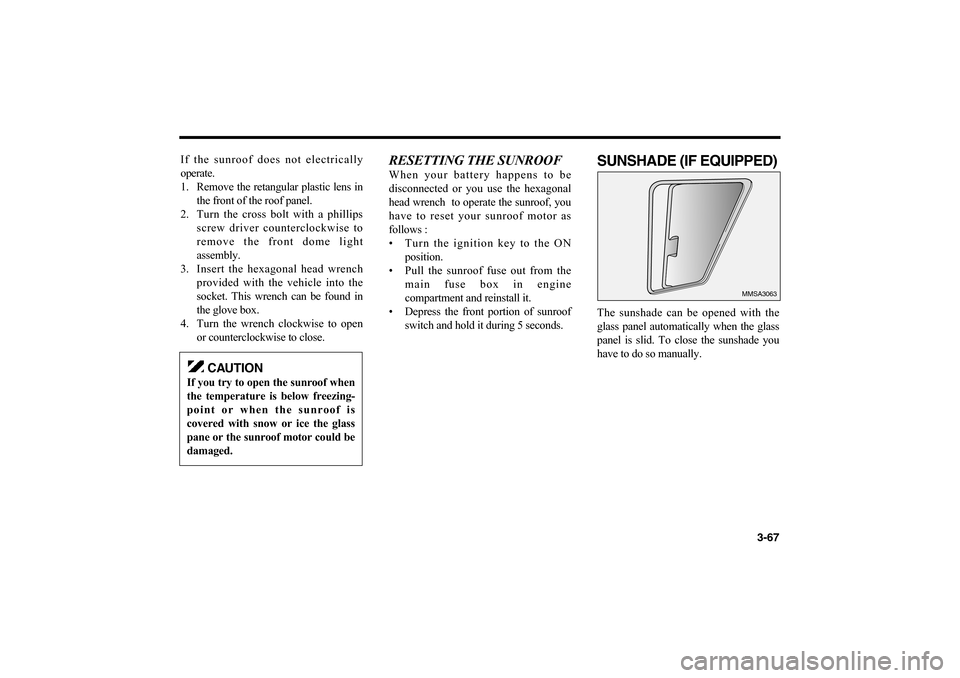
SUNSHADE (IF EQUIPPED)The sunshade can be opened with the
glass panel automatically when the glass
panel is slid. To close the sunshade you
have to do so manually.
MMSA3063
3-67
CAUTION
If you try to open the sunroof when
the temperature is below freezing-
point or when the sunroof is
covered with snow or ice the glass
pane or the sunroof motor could be
damaged.
MS-CNA-Eng 3.QXD 7/25/2005 5:17 PM Page 67
Page 77 of 225
KNOWING YOUR VEHICLE
3-68ANTENNAMANUAL ANTENNA
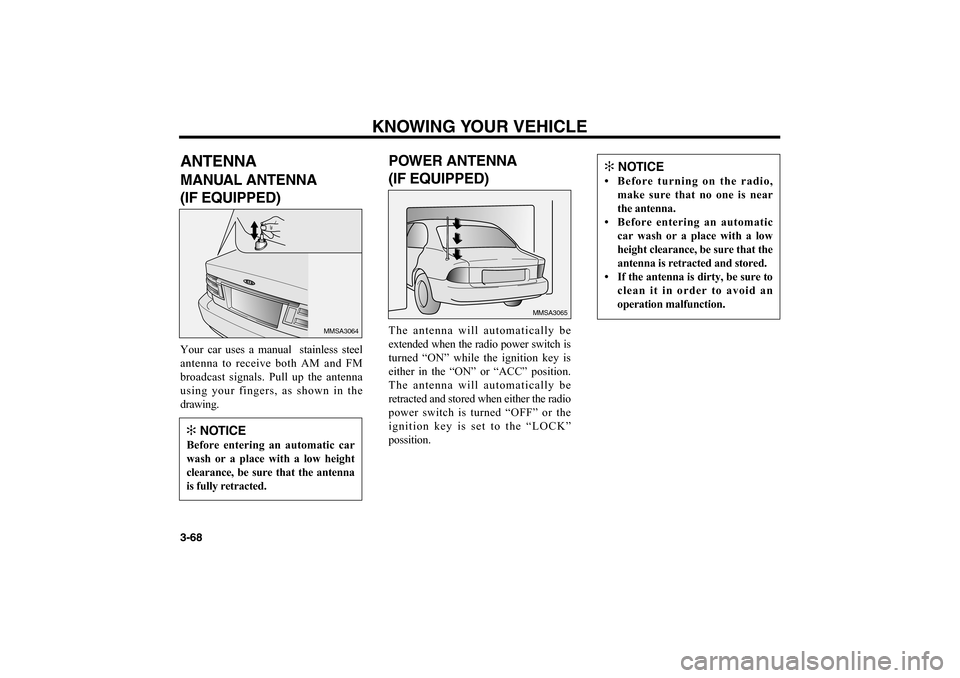
(IF EQUIPPED)Your car uses a manual stainless steel
antenna to receive both AM and FM
broadcast signals. Pull up the antenna
using your fingers, as shown in the
drawing.
POWER ANTENNA
(IF EQUIPPED)The antenna will automatically be
extended when the radio power switch is
turned “ON” while the ignition key is
either in the “ON” or “ACC” position.
The antenna will automatically be
retracted and stored when either the radio
power switch is turned “OFF” or the
ignition key is set to the “LOCK”
possition.
MMSA3064
MMSA3065
✻
NOTICE
Before entering an automatic car
wash or a place with a low height
clearance, be sure that the antenna
is fully retracted.
✻
NOTICE
• Before turning on the radio,
make sure that no one is near
the antenna.
• Before entering an automatic
car wash or a place with a low
height clearance, be sure that the
antenna is retracted and stored.
• If the antenna is dirty, be sure to
clean it in order to avoid an
operation malfunction.
MS-CNA-Eng 3.QXD 7/25/2005 5:17 PM Page 68
Page 81 of 225
IGNITION SWITCH ILLUMINATED IGNITION
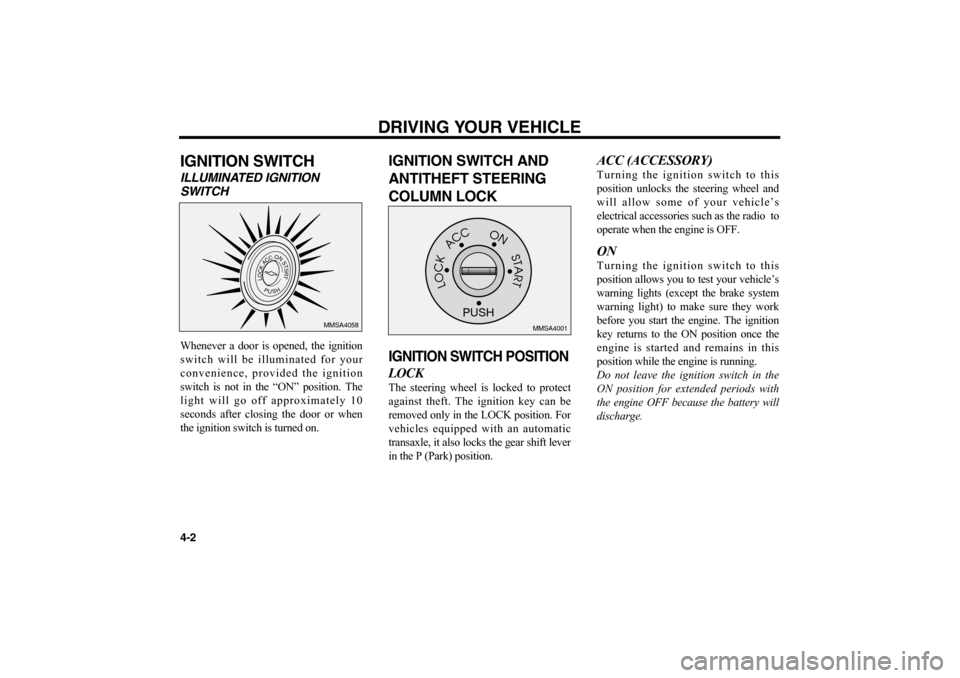
SWITCHWhenever a door is opened, the ignition
switch will be illuminated for your
convenience, provided the ignition
switch is not in the “ON” position. The
light will go off approximately 10
seconds after closing the door or when
the ignition switch is turned on.
IGNITION SWITCH AND
ANTITHEFT STEERING
COLUMN LOCK IGNITION SWITCH POSITIONLOCKThe steering wheel is locked to protect
against theft. The ignition key can be
removed only in the LOCK position. For
vehicles equipped with an automatic
transaxle, it also locks the gear shift lever
in the P (Park) position.
ACC (ACCESSORY)Turning the ignition switch to this
position unlocks the steering wheel and
will allow some of your vehicle’s
electrical accessories such as the radio to
operate when the engine is OFF.ONTurning the ignition switch to this
position allows you to test your vehicle’s
warning lights (except the brake system
warning light) to make sure they work
before you start the engine. The ignition
key returns to the ON position once the
engine is started and remains in this
position while the engine is running.
Do not leave the ignition switch in the
ON position for extended periods with
the engine OFF because the battery will
discharge.
DRIVING YOUR VEHICLE
4-2
PUSH
LOCKACCONSTSRT
MMSA4058
PUSH
MMSA4001
MS-CNA-Eng 4(~39).QXD 7/25/2005 5:16 PM Page 2
Page 82 of 225
STARTTurn the ignition key to the START
position to start the engine. The engine
will crank until you release the key, then
it returns to the ON position. Also, the
brake warning indicator illuminates to
check the bulb in this position.
Difficulty in turning the ignition key to
the START position can be caused by
pressure on the switch from the steering
column. To allow the ignition key to turn,
move the steering wheel right or left to
release the tension and then turn the key.
AUTOMATIC TRANSAXLEWhen turning the ignition switch to the
LOCK position, the shift lever must be
in the P (Park) position.MANUAL TRANSAXLEWhen turning the ignition switch to the
LOCK position, push the key inward at
the ACC position and turn the key
toward the LOCK position.
4-3
✻
NOTICE
For safety, the engine will not start
if the clutch pedal is not depressed
fully on manual transaxle equipped
models.
WARNING
• Never turn the ignition switch
to LOCK or ACC while the
vehicle is moving. This could
result in loss of directional
control and braking function,
which could cause an
immediate accident.
Never reach for the ignition
switch, or any other controls,
through the steering wheel
while the vehicle is in motion.
Failure to observe this
warning can result in loss of
vehicle steering and braking
control, which may result in
an accident.
MS-CNA-Eng 4(~39).QXD 7/25/2005 5:16 PM Page 3
Page 83 of 225
STARTING THE ENGINE1. Make sure the parking brake is applied.
2.Manual Transaxle- Depress the
clutch pedal fully and shift the
transaxle into NEUTRAL. Keep the
clutch pedal depressed while
cranking the engine.
(For safety, the engine will not start if
the clutch pedal is not depressed fully
on manual transaxle equipped
models.)
Automatic Transaxle- Place the
transaxle shift lever in P (Park).
Depress the brake pedal fully.
You can also start the engine if the
shift lever is in the N (Neutral)
position.
3. Turn the ignition switch to START
and hold it until the engine starts (a
maximum of 10 seconds), then
release the key.In extremely cold weather, below 0ºF
(minus 18ºC), or after the vehicle has not
been operated for several days, let it
warm up without depressing the
accelerator.
Whether the engine is cold or warm, it
should be started without depressing the
accelerator.If the engine fails to start using this
procedure, attempt the following.
The engine fails to start when the engine
is cold (engine coolant temperature is
below 32ºF/0ºC):
A no start condition may be caused by an
engine that has become flooded (has
excessive fuel in the cylinders). If this is
the case, follow the starting procedure
below.
1. Make sure the parking brake is applied.
2.Manual Transaxle- Depress the
clutch pedal fully and shift the
transaxle into N (Neutral). Keep the
clutch pedal depressed while
cranking the engine.
Automatic Transaxle- Place the
transaxle shift lever in P (Park) or N
(Neutral). Depress the brake pedal
fully.
3. Depress the accelerator fully and
hold it.
DRIVING YOUR VEHICLE
4-4
CAUTION
If the engine stalls while you are in
motion, do not attempt to move the
shift lever to P (Park).
If it is safe to do so considering traf-
fic and road conditions, you may
put the shift lever in the N
(Neutral) position while still mov-
ing and turn the ignition switch to
the START position in an attempt
to restart the engine.
MS-CNA-Eng 4(~39).QXD 7/25/2005 5:16 PM Page 4
Page 84 of 225
4. While holding the accelerator fully
depressed, turn the ignition switch to
the START position and hold it (a
maximum of 10 seconds) to discharge
the excess fuel.
If the engine starts, the engine speed
will increase suddenly; immediately
release the ignition key and the
accelerator.
If the engine has not yet started,
release the accelerator after cranking
the engine.
5. Without depressing the accelerator,
crank the engine until it starts (a max-
imum of 10 seconds).
If the engine fails to start when the
engine is warm:If the engine is unusually difficult to
restart when it is warm (fails to start
after repeated attempts without
depressing the accelerator):
1. Make sure the parking brake is
applied.
2.Manual Transaxle- Depress the
clutch pedal fully and shift the
transaxle into N (Neutral). Keep the
clutch pedal depressed while
cranking the engine.
Automatic Transaxle- Place the
transaxle shift lever in P (Park) or N
(Neutral). Depress the brake pedal fully.
3. While depressing the accelerator
pedal about halfway down, turn the
ignition switch to the START
position and hold it (a maximum of
10 seconds).
4. After the engine has started, let it idle
for about 10 seconds before driving.In some models, the starter may not
operate if:
• In an automatic transaxle, the shift lever
is NOT in P (Park) or N (Neutral).
• In a manual transaxle, the clutch
pedal is not fully depressed.
Excessive engine noise (from valve
tappets) may occur if the engine has not
been operated for an extended period.
The noise should stop after the engine has
reached normal operating temperature.
If the noise does not stop, have the vehicle
inspected by an Authorized Kia Dealer.
4-5
✻
NOTICE
Do not engage the starter for more
than 10 seconds. If the engine stalls
or fails to start, wait 5 to 10 seconds
before re-engaging the starter.
Excessive or improper use of the
starter may damage it.
MS-CNA-Eng 4(~39).QXD 7/25/2005 5:16 PM Page 5