mirror KIA Magnetis 2006 2.G User Guide
[x] Cancel search | Manufacturer: KIA, Model Year: 2006, Model line: Magnetis, Model: KIA Magnetis 2006 2.GPages: 225, PDF Size: 3.77 MB
Page 140 of 225
DRIVING TIPS
5-4 Do not operate the vehicle when
there are signs of engine malfunction,
such as misfire or a noticeable loss of
performance.
Do not misuse or abuse the engine.
Examples of misuse are coasting
with the ignition off and descending
steep grades in gear with the ignition
off.
Do not operate the engine at high idle
speed for extended periods (5
minutes or more).
Do not modify or tamper with any
part of the engine or emission control
system. All inspections and
adjustments must be made by a
qualified technician.
Failure to observe the above precautions
could result in damage to the catalytic
converter and to your vehicle and could
void your warranties.
BEFORE DRIVINGBefore entering vehicle:
Be sure that all windows, outside
mirror(s), and outside lights are clean.
Check the condition of the tires.
Check under the vehicle for any sign
of leaks.
Be sure there are no obstacles behind
you if you intend to back up.NECESSARY
INSPECTIONSFluid levels, such as engine oil, engine
coolant, brake/clutch fluid, and washer
fluid should be checked on a regular
basis, with the exact interval depending
on the fluid. Further details are provided
in Maintenance, Section 7.
BEFORE STARTING Close and lock all doors.
Position the seat so that all controls
are easily reached.
Adjust the inside and outside
rearview mirrors.
Be sure that all lights work.
Check all gauges.
Check the operation of warning
lights when the ignition switch is
turned to the ON position.
Release the parking brake and make
sure the brake warning light goes out.
For safe operation, be sure you are
familiar with your vehicle and its
equipment.
MS-CNA-Eng 5 New.qxd 7/25/2005 5:21 PM Page 4
Page 144 of 225
DRIVING TIPS
5-8
DRIVING AT NIGHTBecause night driving presents many
more hazards than driving in the
daylight, here are some important tips to
remember:
Slow down and keep more distance
between you and other vehicles as it
may be more difficult to see at night,
especially in rural areas where there
may not be any street lights.
Adjust your mirrors to reduce the
glare from other driver’s headlights.
Keep your headlights clean and
properly aimed. Dirty or misaimed
headlights will make it much more
difficult to see at night.
Avoid staring directly at the
headlights of oncoming vehicles.
You could be temporarily blinded
and it will take several seconds for
your eyes to readjust to the darkness.
DRIVING IN THE RAINRain and wet roads can make driving
dangerous, especially if you’re not
prepared for the slick pavement. Here are
a few things to consider when driving in
the rain:
Be sure your windshield wipers are
in good condition.
A heavy rainfall will make it harder
to see and will increase the distance
needed to stop your vehicle, so slow
down.
If your tires aren’t in good condition,
making a quick stop on wet
pavement can cause a skid and
possibly lead to an accident. Be sure
your tires and windshield wipers are
in good shape.
Turn on your headlights to make it
easier for others to see you.
Driving too fast through large
puddles can affect your brakes. If
you must go through puddles, try to
drive through them slowly.
WARNING -
Spinning
Tires
Do not spin the wheels
especially at speeds more than
35 mph (56 km/h). Spinning the
wheels at high speeds when the
vehicle is stationary could
cause a tire to overheat,
explode and injure by standers.
MS-CNA-Eng 5 New.qxd 7/25/2005 5:21 PM Page 8
Page 148 of 225

DRIVING TIPS
5-12Vehicle Emission Control Information
and Vacuum Hose Routing Diagram
HOMELINK® WIRELESS
CONTROL SYSTEM (IF
EQUIPPED)Your new mirror also comes with an
integrated HomeLink Universal
Transceiver, which allows you to
program the mirror to activate your
garage door(s), estate gate, home
lighting, etc. The mirror actually learns
the codes from your various existing
transmitters.
HOMELINK PROGRAMMING
MMSA5002
MMSA5007
Underside of hood
Emission Control
Information Vacuum Hose
Routing Diagram
CAUTION
Make sure people and/or objects
are out of the way of any garage
doors or gates you may be
operating during the
programming procedures.
Keep original transmitters for
potential future programming
needs, or in case you sell the
vehicle.
In the event you do sell your
vehicle, it's recommended you
erase your programmed
HomeLink mirror buttons.
Homelink buttonsGlare detection sensorIndicator light
MS-CNA-Eng 5 New.qxd 7/25/2005 5:21 PM Page 12
Page 149 of 225
5-13
ProgrammingYour vehicles may require the ignition
switch to be turned to the "ACC"
position for programming and/or
operation of HomeLink. It is also
recommended that a new battery be
replaced in the hand-held transmitter of
the device being programmed to
HomeLink for quicker training and
accurate transmission of the radio-
frequency.
Follow these steps to train your
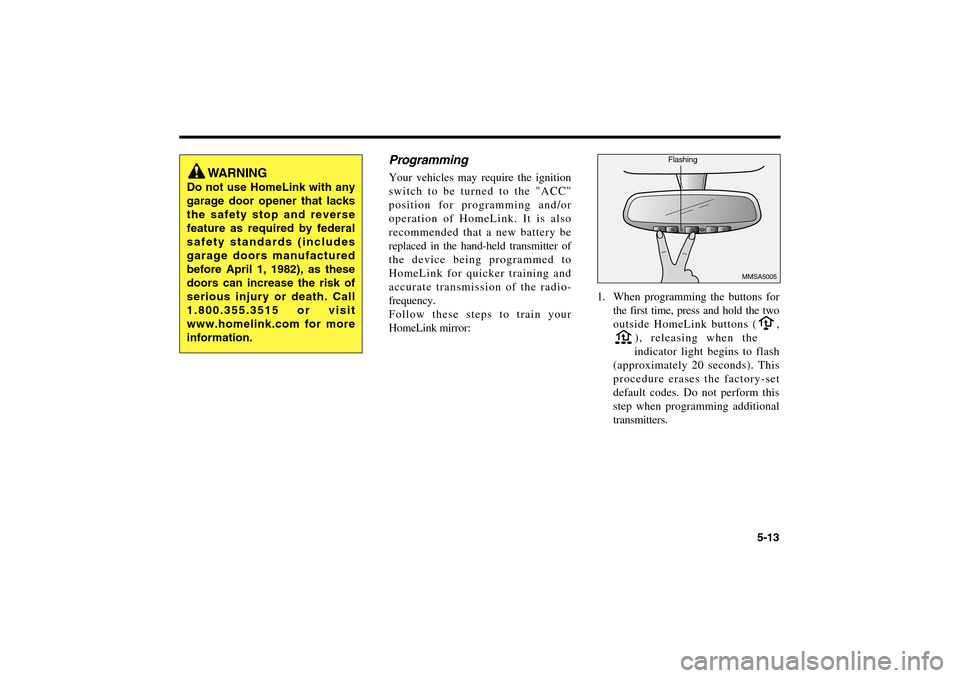
HomeLink mirror:1. When programming the buttons for
the first time, press and hold the two
outside HomeLink buttons ( ,
), releasing when the
indicator light begins to flash
(approximately 20 seconds). This
procedure erases the factory-set
default codes. Do not perform this
step when programming additional
transmitters.
MMSA5005
WARNING
Do not use HomeLink with any
garage door opener that lacks
the safety stop and reverse
feature as required by federal
safety standards (includes
garage doors manufactured
before April 1, 1982), as these
doors can increase the risk of
serious injury or death. Call
1.800.355.3515 or visit
www.homelink.com for more
information.
Flashing
MS-CNA-Eng 5 New.qxd 7/25/2005 5:21 PM Page 13
Page 150 of 225
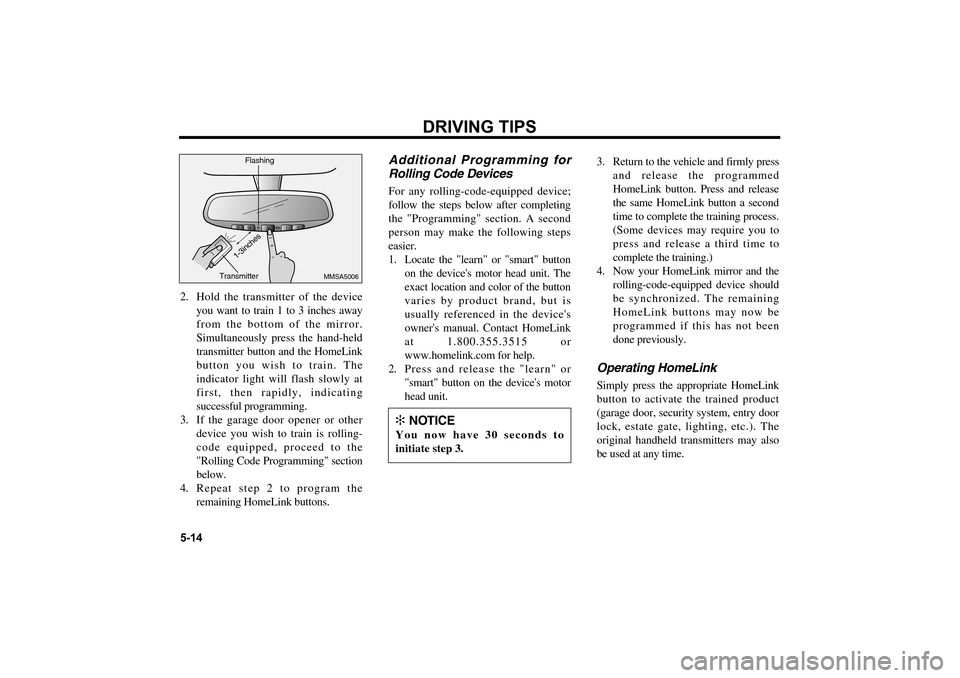
2. Hold the transmitter of the device
you want to train 1 to 3 inches away
from the bottom of the mirror.
Simultaneously press the hand-held
transmitter button and the HomeLink
button you wish to train. The
indicator light will flash slowly at
first, then rapidly, indicating
successful programming.
3. If the garage door opener or other
device you wish to train is rolling-
code equipped, proceed to the
"Rolling Code Programming" section
below.
4. Repeat step 2 to program the
remaining HomeLink buttons.
Additional Programming for
Rolling Code DevicesFor any rolling-code-equipped device;
follow the steps below after completing
the "Programming" section. A second
person may make the following steps
easier.
1. Locate the "learn" or "smart" button
on the device's motor head unit. The
exact location and color of the button
varies by product brand, but is
usually referenced in the device's
owner's manual. Contact HomeLink
at 1.800.355.3515 or
www.homelink.com for help.
2. Press and release the "learn" or
"smart" button on the device's motor
head unit.3. Return to the vehicle and firmly press
and release the programmed
HomeLink button. Press and release
the same HomeLink button a second
time to complete the training process.
(Some devices may require you to
press and release a third time to
complete the training.)
4. Now your HomeLink mirror and the
rolling-code-equipped device should
be synchronized. The remaining
HomeLink buttons may now be
programmed if this has not been
done previously.
Operating HomeLinkSimply press the appropriate HomeLink
button to activate the trained product
(garage door, security system, entry door
lock, estate gate, lighting, etc.). The
original handheld transmitters may also
be used at any time.
DRIVING TIPS
5-14
MMSA5006
✻
NOTICE
You now have 30 seconds to
initiate step 3.
Flashing
Transmitter
1-3inches
MS-CNA-Eng 5 New.qxd 7/25/2005 5:21 PM Page 14
Page 151 of 225
5-15
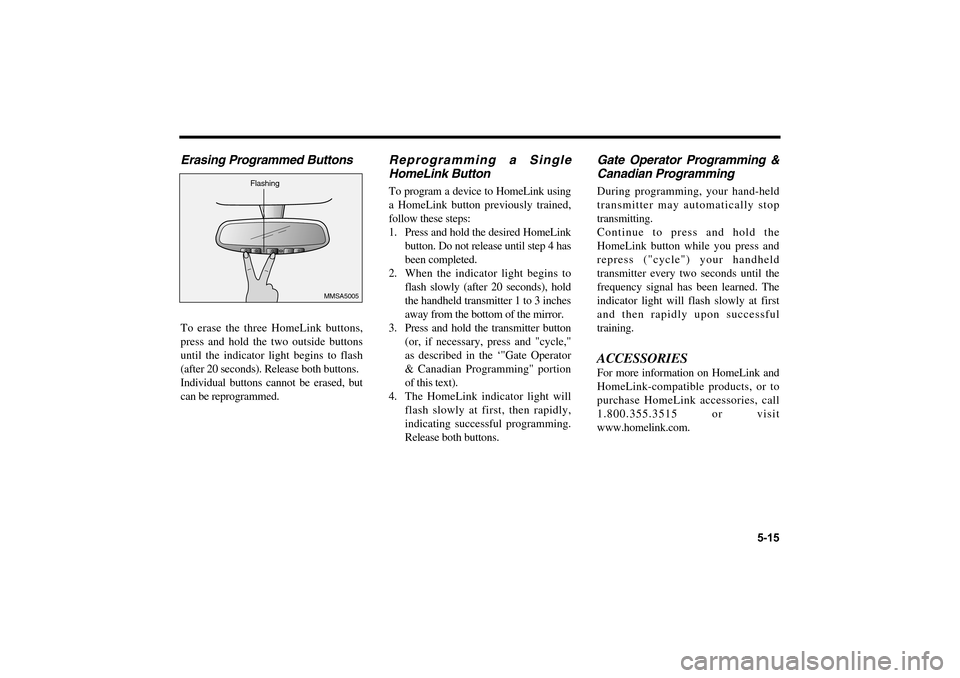
Erasing Programmed ButtonsTo erase the three HomeLink buttons,
press and hold the two outside buttons
until the indicator light begins to flash
(after 20 seconds). Release both buttons.
Individual buttons cannot be erased, but
can be reprogrammed.
Reprogramming a Single
HomeLink ButtonTo program a device to HomeLink using
a HomeLink button previously trained,
follow these steps:
1. Press and hold the desired HomeLink
button. Do not release until step 4 has
been completed.
2. When the indicator light begins to
flash slowly (after 20 seconds), hold
the handheld transmitter 1 to 3 inches
away from the bottom of the mirror.
3. Press and hold the transmitter button
(or, if necessary, press and "cycle,"
as described in the ‘"Gate Operator
& Canadian Programming" portion
of this text).
4. The HomeLink indicator light will
flash slowly at first, then rapidly,
indicating successful programming.
Release both buttons.
Gate Operator Programming &
Canadian ProgrammingDuring programming, your hand-held
transmitter may automatically stop
transmitting.
Continue to press and hold the
HomeLink button while you press and
repress ("cycle") your handheld
transmitter every two seconds until the
frequency signal has been learned. The
indicator light will flash slowly at first
and then rapidly upon successful
training.ACCESSORIESFor more information on HomeLink and
HomeLink-compatible products, or to
purchase HomeLink accessories, call
1.800.355.3515 or visit
www.homelink.com.
MMSA5005
Flashing
MS-CNA-Eng 5 New.qxd 7/25/2005 5:21 PM Page 15
Page 161 of 225
IN CASE OF EMERGENCY
6-10
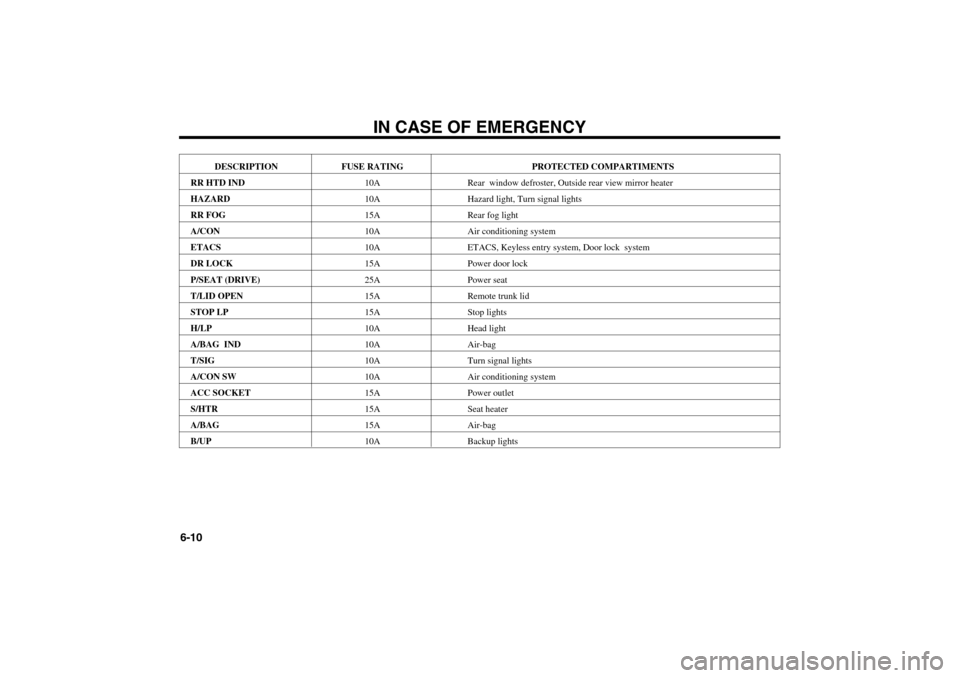
DESCRIPTION FUSE RATING PROTECTED COMPARTIMENTS
RR HTD IND10A Rear window defroster, Outside rear view mirror heater
HAZARD10A Hazard light, Turn signal lights
RR FOG15A Rear fog light
A/CON10A Air conditioning system
ETACS10A ETACS, Keyless entry system, Door lock system
DR LOCK15A Power door lock
P/SEAT (DRIVE)25A Power seat
T/LID OPEN15A Remote trunk lid
STOP LP15A Stop lights
H/LP10A Head light
A/BAG IND10A Air-bag
T/SIG10A Turn signal lights
A/CON SW10A Air conditioning system
ACC SOCKET15A Power outlet
S/HTR15A Seat heater
A/BAG15A Air-bag
B/UP10A Backup lights
MS-CNA-Eng 6.QXD 7/25/2005 5:13 PM Page 10
Page 225 of 225
INDEX
9-2M
aintenance Schedule ...............................................................7-3
Maintenance Services ...................................................................7-2
Manual Transaxle ..........................................................................4-6
Mirrors ........................................................................................3-58
O
verheating ................................................................................6-2
Overloading .................................................................................5-11
Owner Maintenance ......................................................................7-8
P
arking Brake ...........................................................................7-18
Power Steering ...................................................................4-18, 7-18
R
ear Window Defroster ...........................................................4-32
Road Warning ...............................................................................6-2
Safety Belts ...............................................................................3-22
Seats ............................................................................................3-14
Special Driving Conditions ...........................................................5-7
Specifications ................................................................................8-2
Starting the Engine ........................................................................4-4
Steering Wheel ............................................................................3-58
Suggestions for Economical Operation.........................................5-5
Sunglass Holder ..........................................................................3-64
Sunroof ........................................................................................3-65T
heft-alarm system .....................................................................3-5
Tilt Steering.................................................................................4-18Tires and Wheels .........................................................................7-25
Towing ........................................................................................6-14
Traction control system ...............................................................4-40
Trailer Towing ............................................................................5-11
Trunk Lid ....................................................................................3-52
V
ehicle Break-In Process ...........................................................1-3
W
arnings and Indicators..........................................................4-21
Windows .....................................................................................3-11
Windshield Defrosting and Defogging (Automatic type) ...........4-56
Windshield Defrosting and Defogging (Manual Type) ..............4-54
Wiper Blades ...............................................................................7-22
Wipers and Washers....................................................................4-30
Ms-CNA-Eng-INDEX.qxd 7/25/2005 5:07 PM Page 2