ECU KIA Magnetis 2006 2.G Owner's Guide
[x] Cancel search | Manufacturer: KIA, Model Year: 2006, Model line: Magnetis, Model: KIA Magnetis 2006 2.GPages: 225, PDF Size: 3.77 MB
Page 167 of 225
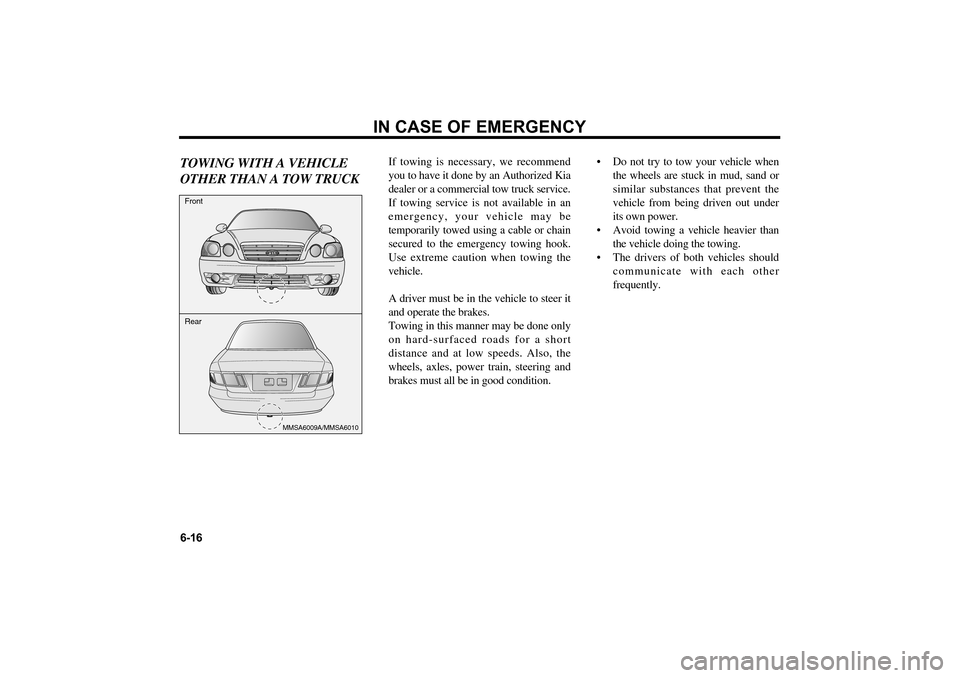
TOWING WITH A VEHICLE
OTHER THAN A TOW TRUCK
If towing is necessary, we recommend
you to have it done by an Authorized Kia
dealer or a commercial tow truck service.
If towing service is not available in an
emergency, your vehicle may be
temporarily towed using a cable or chain
secured to the emergency towing hook.
Use extreme caution when towing the
vehicle.
A driver must be in the vehicle to steer it
and operate the brakes.
Towing in this manner may be done only
on hard-surfaced roads for a short
distance and at low speeds. Also, the
wheels, axles, power train, steering and
brakes must all be in good condition. Do not try to tow your vehicle when
the wheels are stuck in mud, sand or
similar substances that prevent the
vehicle from being driven out under
its own power.
Avoid towing a vehicle heavier than
the vehicle doing the towing.
The drivers of both vehicles should
communicate with each other
frequently.
IN CASE OF EMERGENCY
6-16Front
MMSA6009A/MMSA6010
Rear
MS-CNA-Eng 6.QXD 7/25/2005 5:13 PM Page 16
Page 168 of 225
Before emergency towing, check that
the hook is not broken or damaged.
Fasten the towing cable or chain
securely to the hook.
Do not jerk the hook. Apply steady
and even force.
To avoid damaging the hook, do not
pull from the side or at a vertical
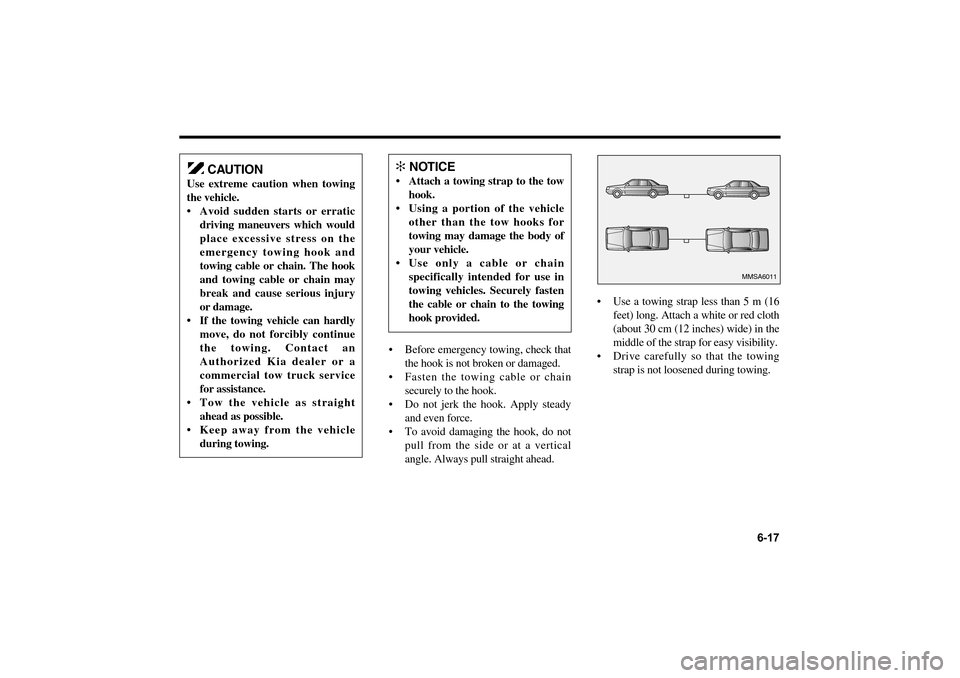
angle. Always pull straight ahead. Use a towing strap less than 5 m (16
feet) long. Attach a white or red cloth
(about 30 cm (12 inches) wide) in the
middle of the strap for easy visibility.
Drive carefully so that the towing
strap is not loosened during towing.
6-17
✻
NOTICE
• Attach a towing strap to the tow
hook.
Using a portion of the vehicle
other than the tow hooks for
towing may damage the body of
your vehicle.
Use only a cable or chain
specifically intended for use in
towing vehicles. Securely fasten
the cable or chain to the towing
hook provided.
CAUTION
Use extreme caution when towing
the vehicle.
Avoid sudden starts or erratic
driving maneuvers which would
place excessive stress on the
emergency towing hook and
towing cable or chain. The hook
and towing cable or chain may
break and cause serious injury
or damage.
If the towing vehicle can hardly
move, do not forcibly continue
the towing. Contact an
Authorized Kia dealer or a
commercial tow truck service
for assistance.
Tow the vehicle as straight
ahead as possible.
Keep away from the vehicle
during towing.
MMSA6011
MS-CNA-Eng 6.QXD 7/25/2005 5:13 PM Page 17
Page 175 of 225
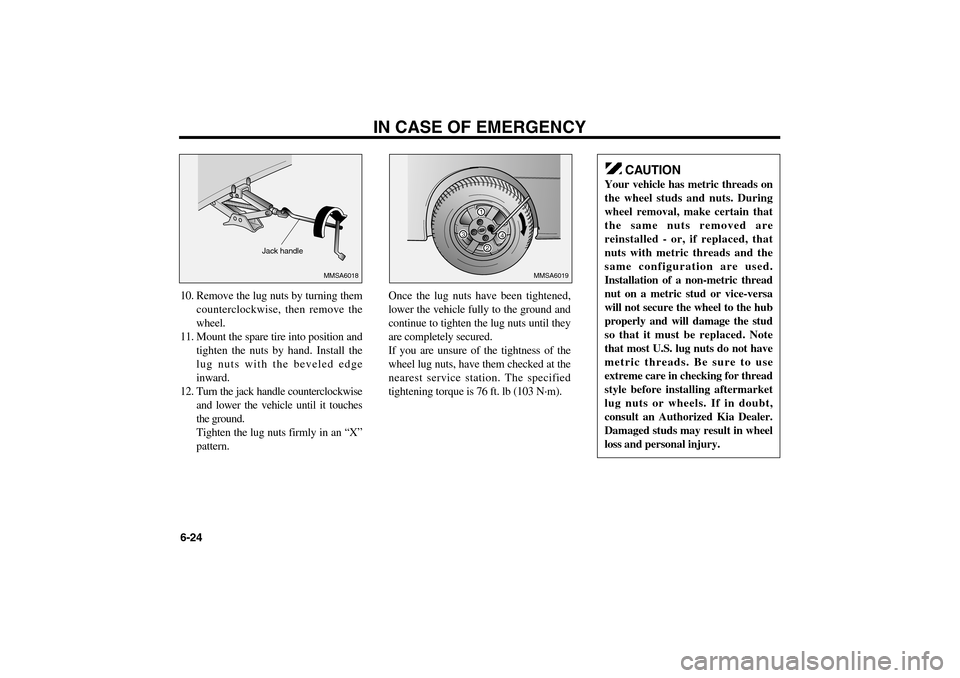
10. Remove the lug nuts by turning them
counterclockwise, then remove the
wheel.
11. Mount the spare tire into position and
tighten the nuts by hand. Install the
lug nuts with the beveled edge
inward.
12. Turn the jack handle counterclockwise
and lower the vehicle until it touches
the ground.
Tighten the lug nuts firmly in an “X”
pattern.Once the lug nuts have been tightened,
lower the vehicle fully to the ground and
continue to tighten the lug nuts until they
are completely secured.
If you are unsure of the tightness of the
wheel lug nuts, have them checked at the
nearest service station. The specified
tightening torque is 76 ft. lb (103 N·m).
IN CASE OF EMERGENCY
6-24
1
3
2
4
MMSA6019
MMSA6018
Jack handle
CAUTION
Your vehicle has metric threads on
the wheel studs and nuts. During
wheel removal, make certain that
the same nuts removed are
reinstalled - or, if replaced, that
nuts with metric threads and the
same configuration are used.
Installation of a non-metric thread
nut on a metric stud or vice-versa
will not secure the wheel to the hub
properly and will damage the stud
so that it must be replaced. Note
that most U.S. lug nuts do not have
metric threads. Be sure to use
extreme care in checking for thread
style before installing aftermarket
lug nuts or wheels. If in doubt,
consult an Authorized Kia Dealer.
Damaged studs may result in wheel
loss and personal injury.
MS-CNA-Eng 6.QXD 7/25/2005 5:13 PM Page 24
Page 189 of 225
7-13
3. Remove the engine oil filter with an
oil filter wrench.
4. Use a clean rag to clean the oil filter
mounting surface on the engine.
5. Apply a small amount of engine oil
to the new oil filter O-ring seal.6. Install the oil filter and tighten it.
(Refer to the oil filter caution label
for tightening instructions.)
7. Replace the drain plug tightly after
the oil has thoroughly drained.
8. Refill the engine with new oil to the
F mark on the dipstick. Do not
overfill.
9. Re-install the oil filler cap securely.
10. Start the engine and inspect around
the oil filter seal for leaks.
Stop the engine.
Check the oil level and fill to the F
mark, if necessary.
OIL CAPACITY
2400cc Engine
- Without filter change : 4.0 liters
- With filter change : 4.3 liters
2700cc Engine
- Without filter change : 4.5 liters
- With filter change : 4.8 liters
Use only the specified engine oil. (Refer
to “Recommended Lubricants” later in
this section)
CAUTION
Both the oil and engine are hot. Do
not burn yourself.✻
NOTICE
When installing the replacement oil
filter, do not allow the oil filter
gasket to remain on the oil filter
mounting surface. This will cause
oil leakage and engine damage.
Remove the old gasket completely
so that a new gasket will properly
seat and seal.
✻
NOTICE
• Follow these instructions
carefully. An improper oil filter
installation can cause oil leakage
and engine damage.
• Although oil filters may have the
same external appearance, their
internal designs differ
significantly. These filters are not
interchangeable. To avoid
potential engine damage, use only
the specified filter. Consult an
Authorized Kia Dealer.
MS-CNA-Eng 7.QXD 7/25/2005 5:09 PM Page 13
Page 194 of 225
MAINTENANCE
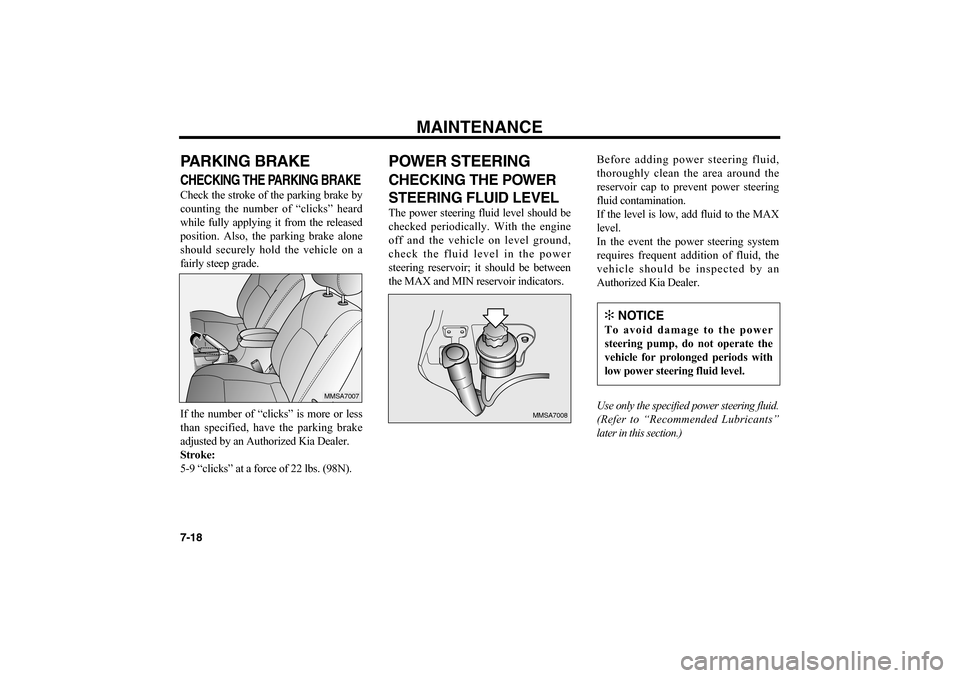
7-18PARKING BRAKECHECKING THE PARKING BRAKECheck the stroke of the parking brake by
counting the number of “clicks” heard
while fully applying it from the released
position. Also, the parking brake alone
should securely hold the vehicle on a
fairly steep grade.
If the number of “clicks” is more or less
than specified, have the parking brake
adjusted by an Authorized Kia Dealer.
Stroke:
5-9 “clicks” at a force of 22 lbs. (98N).
POWER STEERINGCHECKING THE POWER
STEERING FLUID LEVELThe power steering fluid level should be
checked periodically. With the engine
off and the vehicle on level ground,
check the fluid level in the power
steering reservoir; it should be between
the MAX and MIN reservoir indicators.Before adding power steering fluid,
thoroughly clean the area around the
reservoir cap to prevent power steering
fluid contamination.
If the level is low, add fluid to the MAX
level.
In the event the power steering system
requires frequent addition of fluid, the
vehicle should be inspected by an
Authorized Kia Dealer.
Use only the specified power steering fluid.
(Refer to “Recommended Lubricants”
later in this section.)
MMSA7007
MMSA7008
✻
NOTICE
To avoid damage to the power
steering pump, do not operate the
vehicle for prolonged periods with
low power steering fluid level.
MS-CNA-Eng 7.QXD 7/25/2005 5:09 PM Page 18
Page 200 of 225
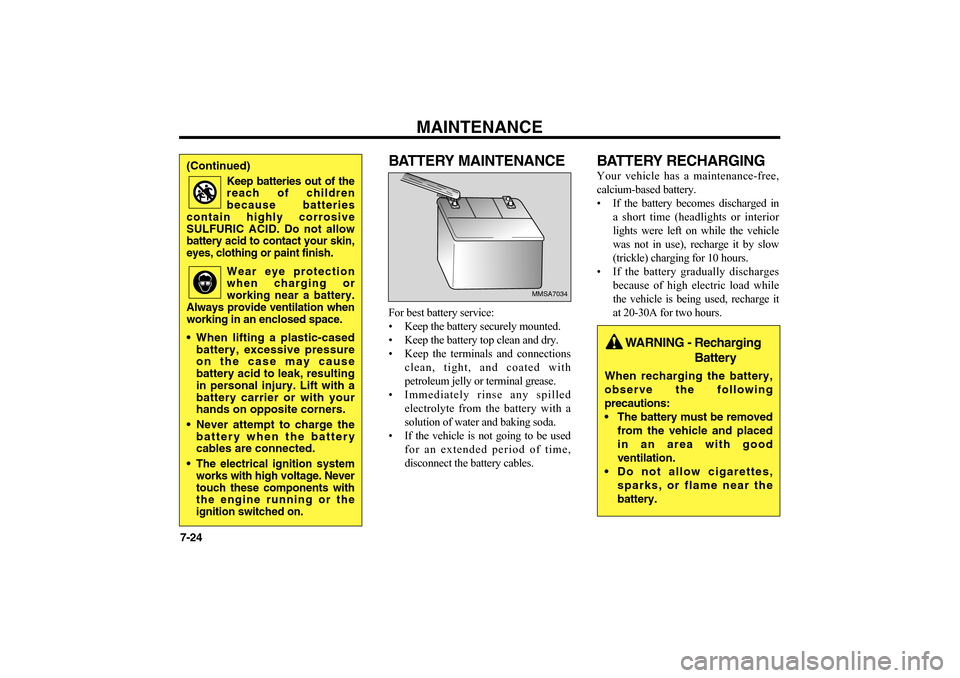
BATTERY MAINTENANCEFor best battery service:
• Keep the battery securely mounted.
• Keep the battery top clean and dry.
• Keep the terminals and connections
clean, tight, and coated with
petroleum jelly or terminal grease.
• Immediately rinse any spilled
electrolyte from the battery with a
solution of water and baking soda.
• If the vehicle is not going to be used
for an extended period of time,
disconnect the battery cables.
BATTERY RECHARGINGYour vehicle has a maintenance-free,
calcium-based battery.
• If the battery becomes discharged in
a short time (headlights or interior
lights were left on while the vehicle
was not in use), recharge it by slow
(trickle) charging for 10 hours.
• If the battery gradually discharges
because of high electric load while
the vehicle is being used, recharge it
at 20-30A for two hours.
MAINTENANCE
7-24
MMSA7034
(Continued)
Keep batteries out of the
reach of children
because batteries
contain highly corrosive
SULFURIC ACID. Do not allow
battery acid to contact your skin,
eyes, clothing or paint finish.
Wear eye protection
when charging or
working near a battery.
Always provide ventilation when
working in an enclosed space.
When lifting a plastic-cased
battery, excessive pressure
on the case may cause
battery acid to leak, resulting
in personal injury. Lift with a
battery carrier or with your
hands on opposite corners.
Never attempt to charge the
battery when the battery
cables are connected.
The electrical ignition system
works with high voltage. Never
touch these components with
the engine running or the
ignition switched on.
WARNING - Recharging
Battery
When recharging the battery,
observe the following
precautions:
The battery must be removed
from the vehicle and placed
in an area with good
ventilation.
Do not allow cigarettes,
sparks, or flame near the
battery.
MS-CNA-Eng 7.QXD 7/25/2005 5:09 PM Page 24