battery KIA Magnetis 2006 2.G Owner's Guide
[x] Cancel search | Manufacturer: KIA, Model Year: 2006, Model line: Magnetis, Model: KIA Magnetis 2006 2.GPages: 225, PDF Size: 3.77 MB
Page 186 of 225
MAINTENANCE
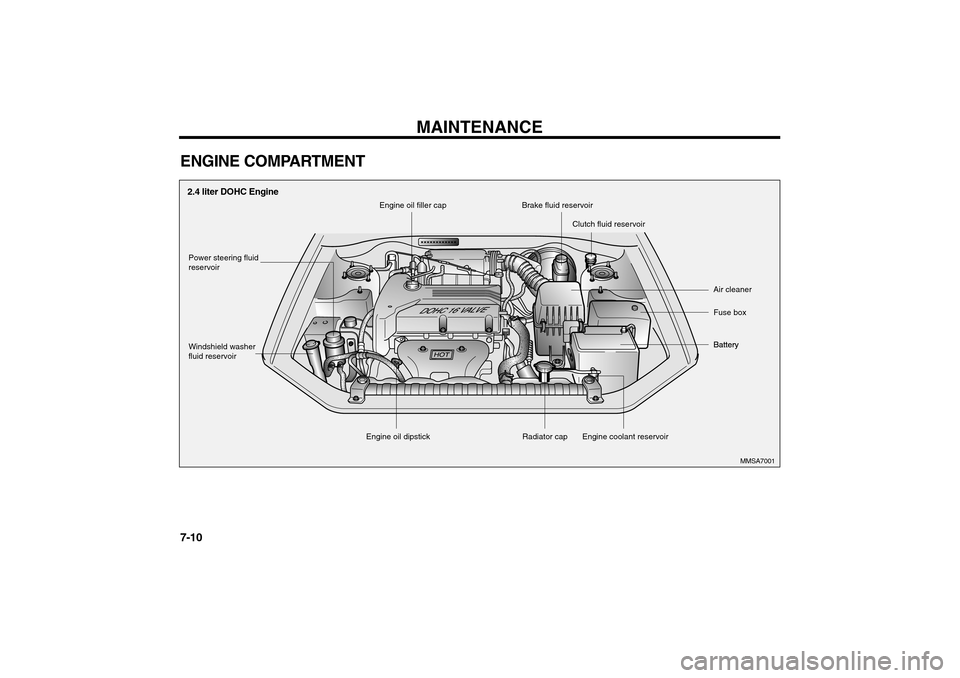
7-10ENGINE COMPARTMENT
MMSA7001
Air cleaner
Fuse box
Battery Battery
Windshield washer
fluid reservoir Power steering fluid
reservoirBrake fluid reservoir
Clutch fluid reservoir
Engine coolant reservoir Radiator cap Engine oil filler cap
Engine oil dipstick
2.4 liter DOHC Engine
MS-CNA-Eng 7.QXD 7/25/2005 5:09 PM Page 10
Page 187 of 225
7-11
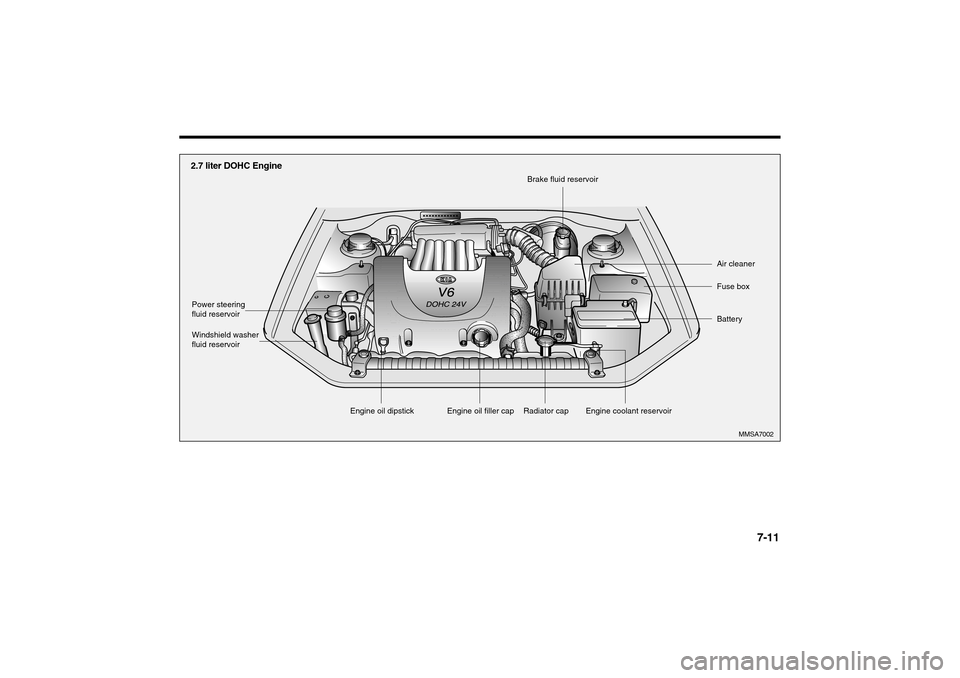
MMSA7002
2.7 liter DOHC Engine
Air cleaner
Fuse box
Battery
Windshield washer
fluid reservoir Power steering
fluid reservoirBrake fluid reservoir
Engine coolant reservoir Radiator cap Engine oil dipstick
Engine oil filler cap
MS-CNA-Eng 7.QXD 7/25/2005 5:09 PM Page 11
Page 199 of 225
7-23
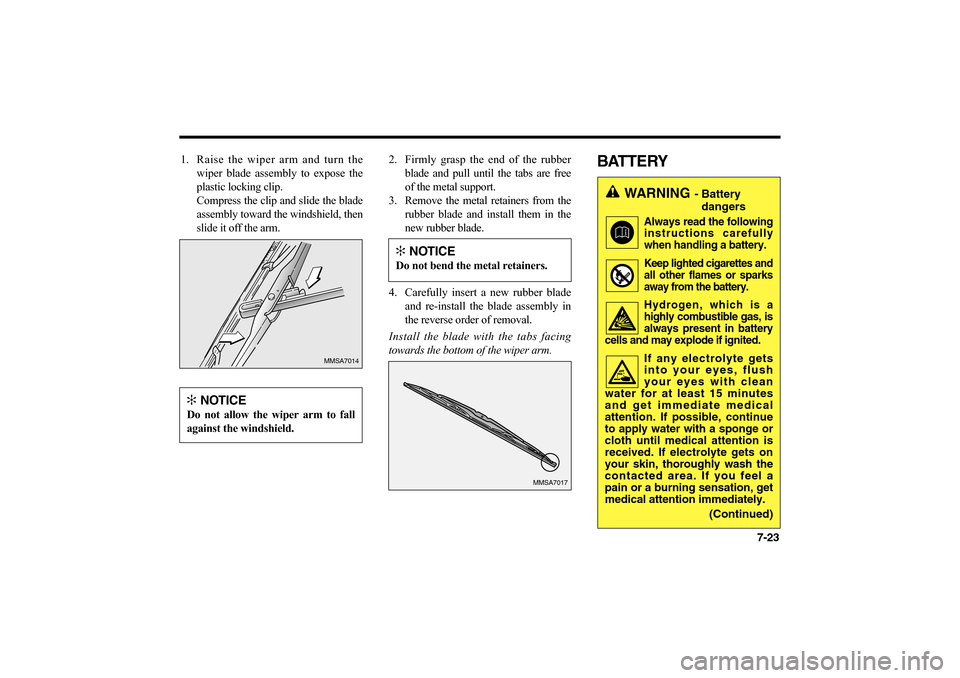
1. Raise the wiper arm and turn the
wiper blade assembly to expose the
plastic locking clip.
Compress the clip and slide the blade
assembly toward the windshield, then
slide it off the arm.2. Firmly grasp the end of the rubber
blade and pull until the tabs are free
of the metal support.
3. Remove the metal retainers from the
rubber blade and install them in the
new rubber blade.
4. Carefully insert a new rubber blade
and re-install the blade assembly in
the reverse order of removal.
Install the blade with the tabs facing
towards the bottom of the wiper arm.
BATTERY
MMSA7014
MMSA7017
✻
NOTICE
Do not allow the wiper arm to fall
against the windshield.
✻
NOTICE
Do not bend the metal retainers.
WARNING
- Battery
dangers
Always read the following
instructions carefully
when handling a battery.Keep lighted cigarettes and
all other flames or sparks
away from the battery.Hydrogen, which is a
highly combustible gas, is
always present in battery
cells and may explode if ignited.If any electrolyte gets
into your eyes, flush
your eyes with clean
water for at least 15 minutes
and get immediate medical
attention. If possible, continue
to apply water with a sponge or
cloth until medical attention is
received. If electrolyte gets on
your skin, thoroughly wash the
contacted area. If you feel a
pain or a burning sensation, get
medical attention immediately.
(Continued)
MS-CNA-Eng 7.QXD 7/25/2005 5:09 PM Page 23
Page 200 of 225
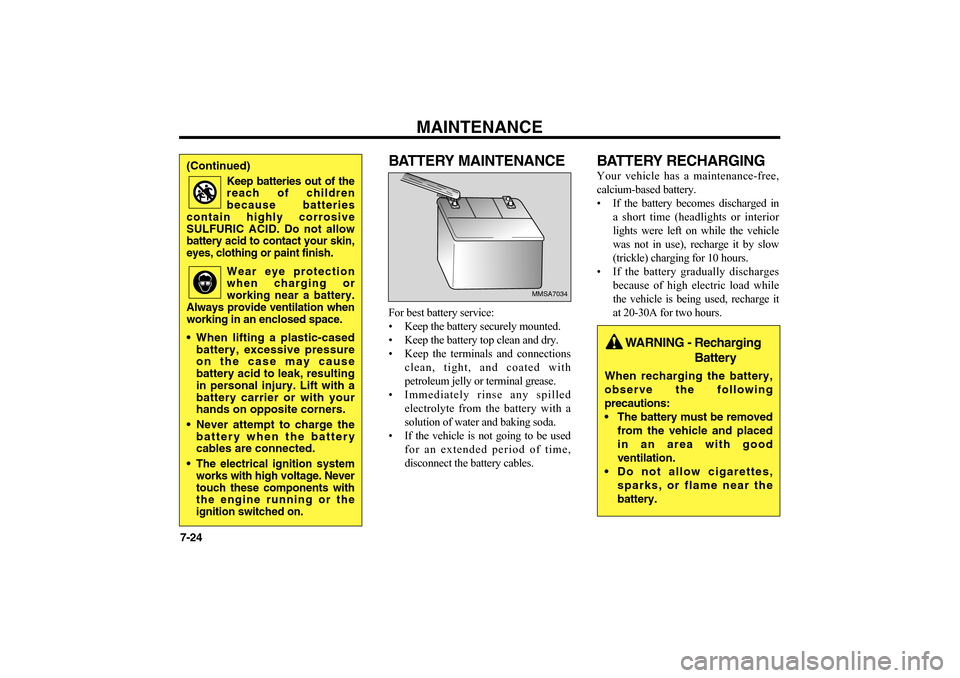
BATTERY MAINTENANCEFor best battery service:
• Keep the battery securely mounted.
• Keep the battery top clean and dry.
• Keep the terminals and connections
clean, tight, and coated with
petroleum jelly or terminal grease.
• Immediately rinse any spilled
electrolyte from the battery with a
solution of water and baking soda.
• If the vehicle is not going to be used
for an extended period of time,
disconnect the battery cables.
BATTERY RECHARGINGYour vehicle has a maintenance-free,
calcium-based battery.
• If the battery becomes discharged in
a short time (headlights or interior
lights were left on while the vehicle
was not in use), recharge it by slow
(trickle) charging for 10 hours.
• If the battery gradually discharges
because of high electric load while
the vehicle is being used, recharge it
at 20-30A for two hours.
MAINTENANCE
7-24
MMSA7034
(Continued)
Keep batteries out of the
reach of children
because batteries
contain highly corrosive
SULFURIC ACID. Do not allow
battery acid to contact your skin,
eyes, clothing or paint finish.
Wear eye protection
when charging or
working near a battery.
Always provide ventilation when
working in an enclosed space.
When lifting a plastic-cased
battery, excessive pressure
on the case may cause
battery acid to leak, resulting
in personal injury. Lift with a
battery carrier or with your
hands on opposite corners.
Never attempt to charge the
battery when the battery
cables are connected.
The electrical ignition system
works with high voltage. Never
touch these components with
the engine running or the
ignition switched on.
WARNING - Recharging
Battery
When recharging the battery,
observe the following
precautions:
The battery must be removed
from the vehicle and placed
in an area with good
ventilation.
Do not allow cigarettes,
sparks, or flame near the
battery.
MS-CNA-Eng 7.QXD 7/25/2005 5:09 PM Page 24
Page 201 of 225
7-25
TIRES AND WHEELSTIRE CAREFor proper maintenance, safety, and
maximum fuel economy, you must
always maintain recommended tire
inflation pressures and stay within the
load limits and weight distribution
recommended for your vehicle.INFLATION PRESSURESCheck all tire pressures (including the
spare) monthly when the tires are cold.
“Cold tires” means the car has not been
driven for at least three hours or driven
less than one mile (1.6 km).
Recommended pressures must be
maintained to ensure ride quality, vehicle
handling, and minimum tire wear.
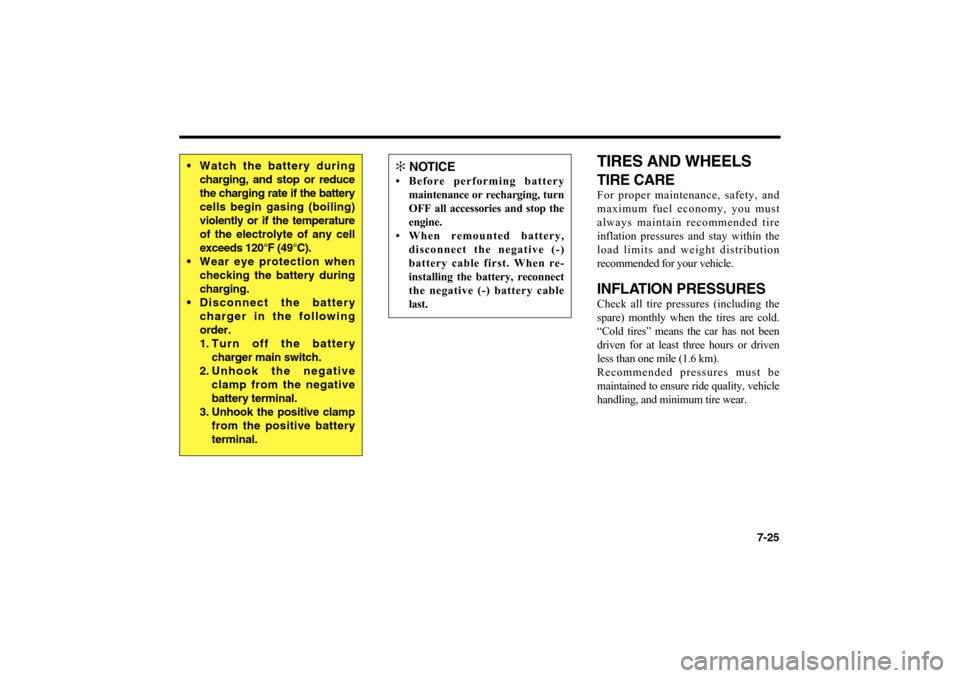
Watch the battery during
charging, and stop or reduce
the charging rate if the battery
cells begin gasing (boiling)
violently or if the temperature
of the electrolyte of any cell
exceeds 120°F (49°C).
Wear eye protection when
checking the battery during
charging.
Disconnect the battery
charger in the following
order.
1. Turn off the battery
charger main switch.
2. Unhook the negative
clamp from the negative
battery terminal.
3. Unhook the positive clamp
from the positive battery
terminal.
✻
NOTICE
• Before performing battery
maintenance or recharging, turn
OFF all accessories and stop the
engine.
• When remounted battery,
disconnect the negative (-)
battery cable first. When re-
installing the battery, reconnect
the negative (-) battery cable
last.
MS-CNA-Eng 7.QXD 7/25/2005 5:09 PM Page 25
Page 223 of 225
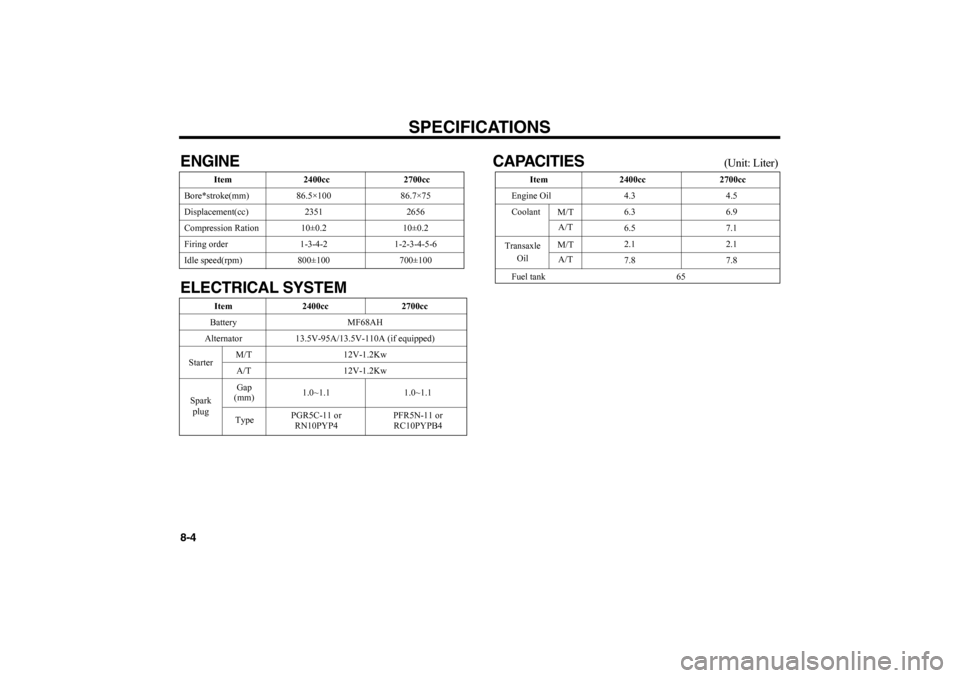
ENGINE
ELECTRICAL SYSTEMCAPACITIES
(Unit: Liter)
SPECIFICATIONS
8-4
Item 2400cc 2700cc
Battery MF68AH
Alternator 13.5V-95A/13.5V-110A (if equipped)
M/T 12V-1.2Kw
A/T 12V-1.2Kw
1.0~1.1 1.0~1.1
PGR5C-11 or PFR5N-11 or
RN10PYP4 RC10PYPB4 Starter
Gap
(mm)
Type Spark
plugItem 2400cc 2700cc
Bore*stroke(mm) 86.5×100 86.7×75
Displacement(cc) 2351 2656
Compression Ration 10±0.2 10±0.2
Firing order 1-3-4-2 1-2-3-4-5-6
Idle speed(rpm) 800±100 700±100
Item 2400cc 2700cc
Engine Oil 4.3 4.5
Coolant 6.3 6.9
6.5 7.1
2.1 2.1
7.8 7.8
Fuel tank 65
Transaxle
OilM/T
A/T
M/T
A/T
MS-CNA-Eng 8.QXD 7/25/2005 5:07 PM Page 4