belt KIA Magnetis 2006 2.G Owner's Guide
[x] Cancel search | Manufacturer: KIA, Model Year: 2006, Model line: Magnetis, Model: KIA Magnetis 2006 2.GPages: 225, PDF Size: 3.77 MB
Page 45 of 225
KNOWING YOUR VEHICLE
3-36 Once you have installed the ISOFIX
child restraint, assure that the seat is
properly attached to the ISOFIX and
tether anchors. Also, test the child
restraint seat before you place the child
in it. Tilt the seat from side to side. Also
try to tug the seat forward. Check to see
if the anchors hold the seat in place.
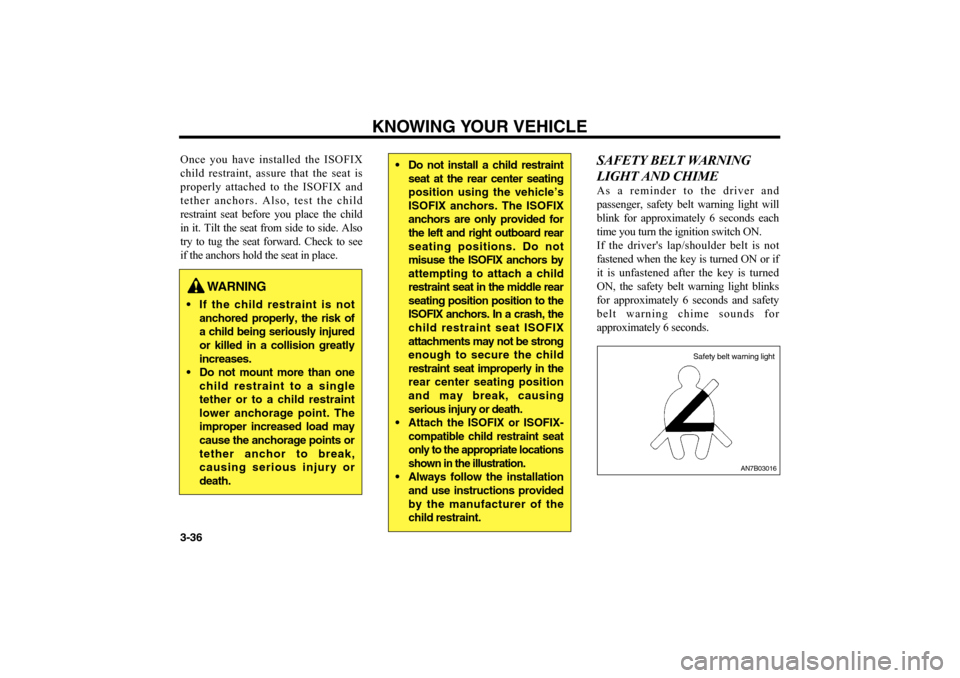
SAFETY BELT WARNING
LIGHT AND CHIMEAs a reminder to the driver and
passenger, safety belt warning light will
blink for approximately 6 seconds each
time you turn the ignition switch ON.
If the driver's lap/shoulder belt is not
fastened when the key is turned ON or if
it is unfastened after the key is turned
ON, the safety belt warning light blinks
for approximately 6 seconds and safety
belt warning chime sounds for
approximately 6 seconds.
AN7B03016
Safety belt warning light
WARNING
If the child restraint is not
anchored properly, the risk of
a child being seriously injured
or killed in a collision greatly
increases.
Do not mount more than one
child restraint to a single
tether or to a child restraint
lower anchorage point. The
improper increased load may
cause the anchorage points or
tether anchor to break,
causing serious injury or
death.
Do not install a child restraint
seat at the rear center seating
position using the vehicle’s
ISOFIX anchors. The ISOFIX
anchors are only provided for
the left and right outboard rear
seating positions. Do not
misuse the ISOFIX anchors by
attempting to attach a child
restraint seat in the middle rear
seating position position to the
ISOFIX anchors. In a crash, the
child restraint seat ISOFIX
attachments may not be strong
enough to secure the child
restraint seat improperly in the
rear center seating position
and may break, causing
serious injury or death.
Attach the ISOFIX or ISOFIX-
compatible child restraint seat
only to the appropriate locations
shown in the illustration.
Always follow the installation
and use instructions provided
by the manufacturer of the
child restraint.
MS-CNA-Eng 3.QXD 7/25/2005 5:17 PM Page 36
Page 46 of 225
3-37
FRONT LAP/SHOULDER
BELTTO FASTEN THE FRONT
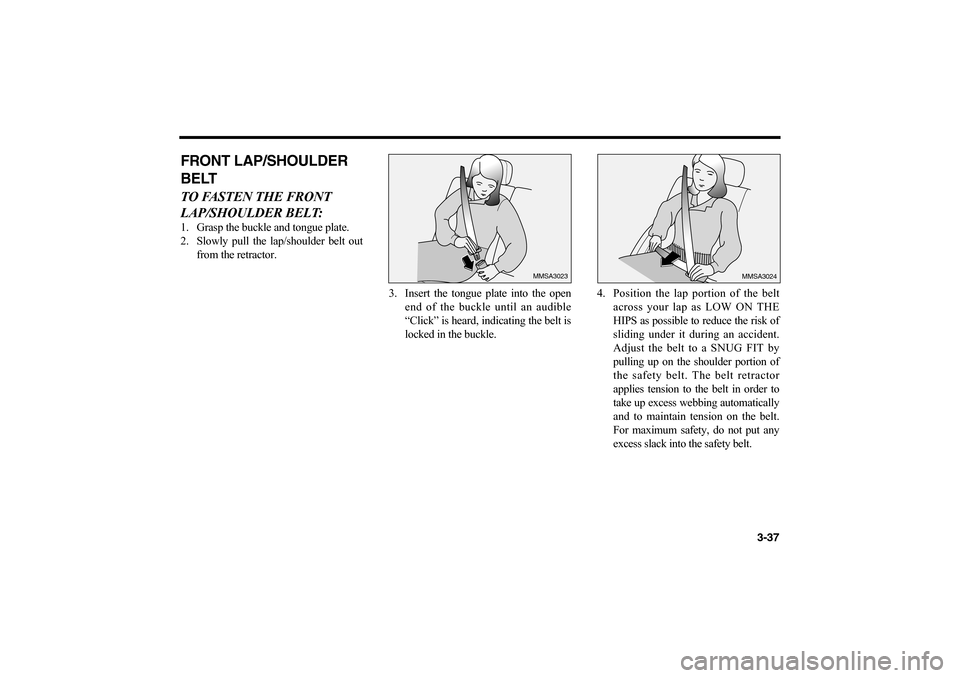
LAP/SHOULDER BELT:1. Grasp the buckle and tongue plate.
2. Slowly pull the lap/shoulder belt out
from the retractor.
3. Insert the tongue plate into the open
end of the buckle until an audible
“Click” is heard, indicating the belt is
locked in the buckle.4. Position the lap portion of the belt
across your lap as LOW ON THE
HIPS as possible to reduce the risk of
sliding under it during an accident.
Adjust the belt to a SNUG FIT by
pulling up on the shoulder portion of
the safety belt. The belt retractor
applies tension to the belt in order to
take up excess webbing automatically
and to maintain tension on the belt.
For maximum safety, do not put any
excess slack into the safety belt.
MMSA3024
MMSA3023
MS-CNA-Eng 3.QXD 7/25/2005 5:17 PM Page 37
Page 47 of 225
KNOWING YOUR VEHICLE
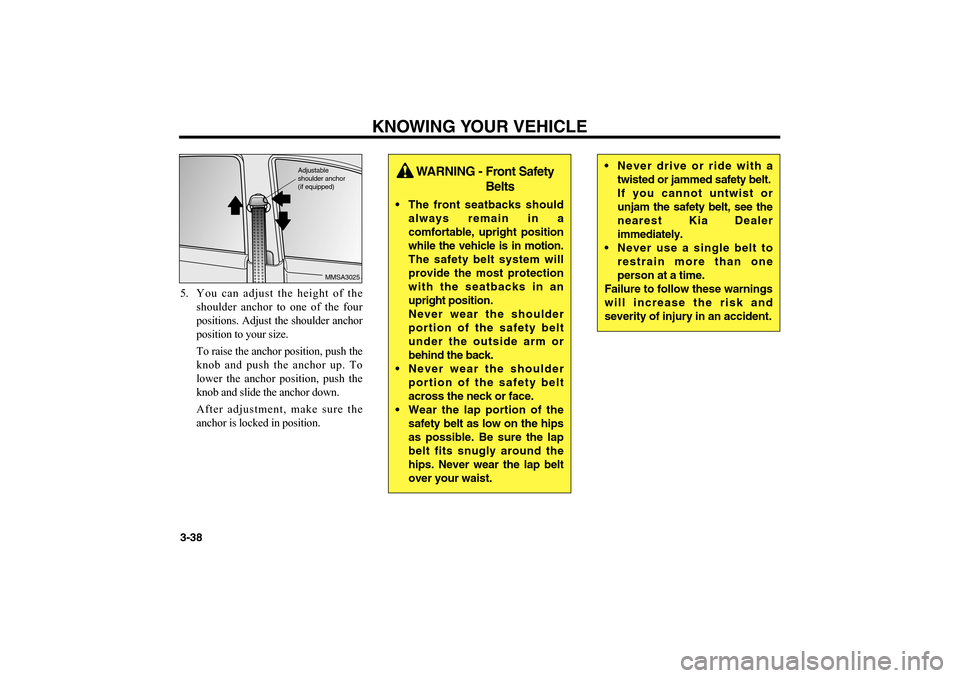
3-38 5. You can adjust the height of the
shoulder anchor to one of the four
positions. Adjust the shoulder anchor
position to your size.
To raise the anchor position, push the
knob and push the anchor up. To
lower the anchor position, push the
knob and slide the anchor down.
After adjustment, make sure the
anchor is locked in position.
MMSA3025 Adjustable
shoulder anchor
(if equipped)
WARNING - Front Safety
Belts
The front seatbacks should
always remain in a
comfortable, upright position
while the vehicle is in motion.
The safety belt system will
provide the most protection
with the seatbacks in an
upright position.
Never wear the shoulder
portion of the safety belt
under the outside arm or
behind the back.
Never wear the shoulder
portion of the safety belt
across the neck or face.
Wear the lap portion of the
safety belt as low on the hips
as possible. Be sure the lap
belt fits snugly around the
hips. Never wear the lap belt
over your waist.
Never drive or ride with a
twisted or jammed safety belt.
If you cannot untwist or
unjam the safety belt, see the
nearest Kia Dealer
immediately.
Never use a single belt to
restrain more than one
person at a time.
Failure to follow these warnings
will increase the risk and
severity of injury in an accident.
MS-CNA-Eng 3.QXD 7/25/2005 5:17 PM Page 38
Page 48 of 225
3-39
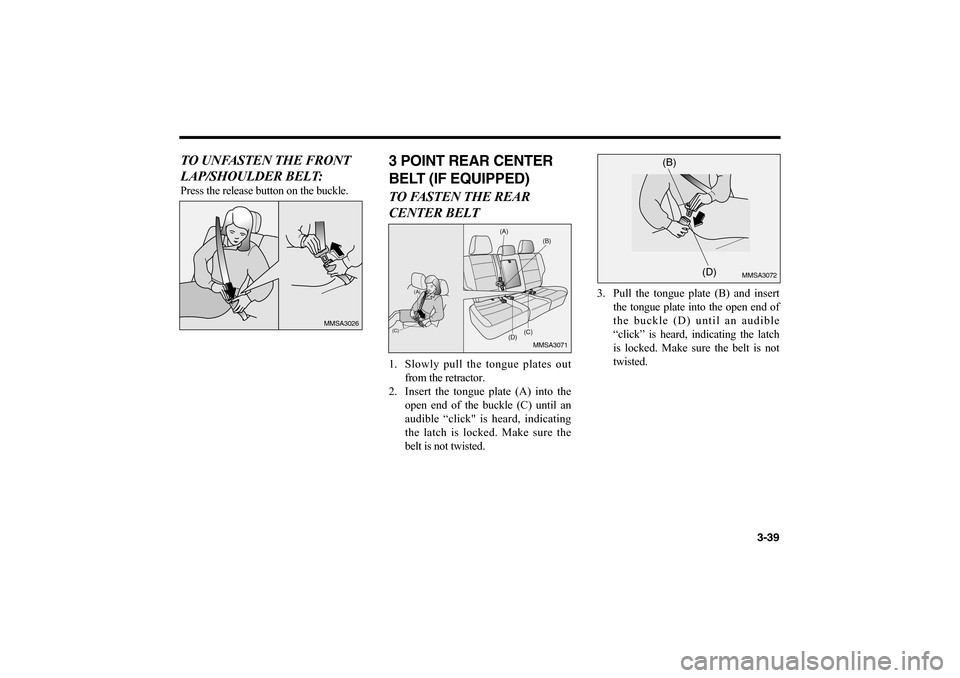
TO UNFASTEN THE FRONT
LAP/SHOULDER BELT:Press the release button on the buckle.
3 POINT REAR CENTER
BELT (IF EQUIPPED) TO FASTEN THE REAR
CENTER BELT1. Slowly pull the tongue plates out
from the retractor.
2. Insert the tongue plate (A) into the
open end of the buckle (C) until an
audible “click" is heard, indicating
the latch is locked. Make sure the
belt is not twisted.3. Pull the tongue plate (B) and insert
the tongue plate into the open end of
the buckle (D) until an audible
“click” is heard, indicating the latch
is locked. Make sure the belt is not
twisted.
(C)(B)
(D) (A)
(C)(A)
MMSA3071
(B)
(D)
MMSA3072
MMSA3026
MS-CNA-Eng 3.QXD 7/25/2005 5:17 PM Page 39
Page 49 of 225
There will be an audible “click” when
the tab locks in the buckle. The seat belt
automatically adjusts to the proper length
only after the lap belt is adjusted
manually so that it fits snugly around
your hips, if you lean forward in a slow,
easy motion, the belt will extend and let
you move around. If there is a sudden
stop or impact, the belt will lock into
position. It will also lock if you try to
lean forward too quickly.
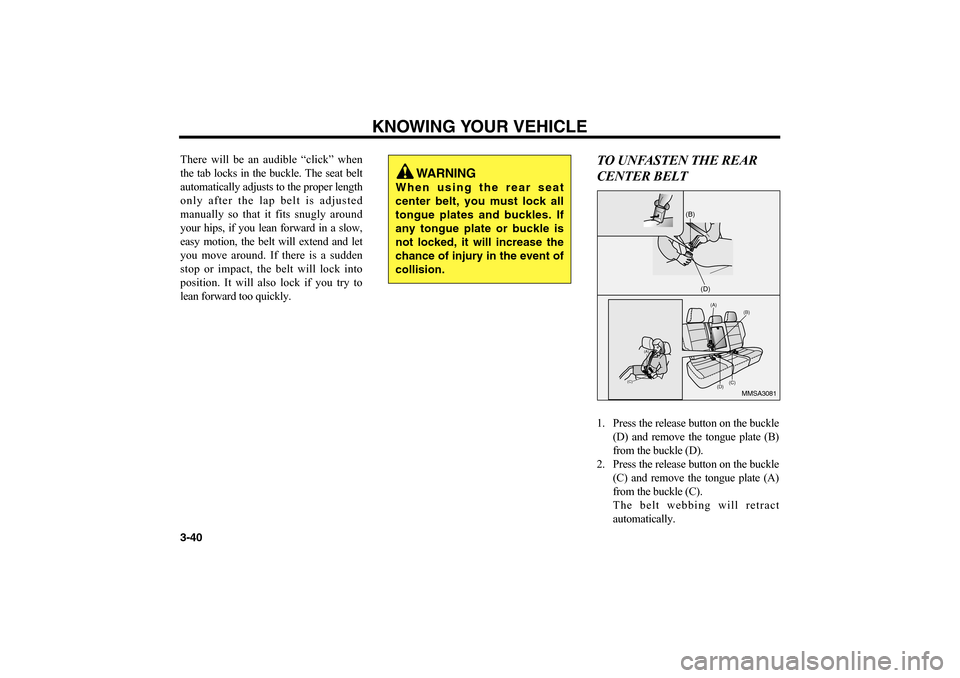
TO UNFASTEN THE REAR
CENTER BELT1. Press the release button on the buckle
(D) and remove the tongue plate (B)
from the buckle (D).
2. Press the release button on the buckle
(C) and remove the tongue plate (A)
from the buckle (C).
The belt webbing will retract
automatically.
KNOWING YOUR VEHICLE
3-40
(B)
(D)
(C)(B)
(D) (A)
(C)(A)
MMSA3081
WARNING
When using the rear seat
center belt, you must lock all
tongue plates and buckles. If
any tongue plate or buckle is
not locked, it will increase the
chance of injury in the event of
collision.
MS-CNA-Eng 3.QXD 7/25/2005 5:17 PM Page 40
Page 50 of 225
3-41
PROPER USE AND CARE
OF THE SAFETY BELT
SYSTEMTo ensure that the safety belts provide
the maximum protection, please follow
these instructions:
• Use the belts at all times - even on
short trips.
• If the safety belt is twisted, straighten
it prior to use.
• Keep sharp edges and damaging
objects away from the belts.
• Periodically inspect belt webbing,
anchors, buckles, and all other parts
for signs of wear and damage.
Replace damaged, excessively worn
or questionable parts immediately.• To clean the belt webbing, use any
mild soap solution recommended for
cleaning upholstery or carpets.
Follow the instructions provided with
the soap.
Do not bleach or dye the webbing
because this may weaken the
webbing fibers and allow them to fail
when loaded in a collision.
• Do not make modifications or
additions to the safety belt.
• After wearing a safety belt, make
sure it fully retracts to the stowed
position. Do not allow the belt to get
caught in the door when you close it.
MS-CNA-Eng 3.QXD 7/25/2005 5:17 PM Page 41
Page 51 of 225
KNOWING YOUR VEHICLE
3-42AIR BAG -
SUPPLEMENTAL
RESTRAINT SYSTEM WHAT YOUR AIR BAG
SYSTEM DOESYour vehicle is equipped with a dual
Supplemental Restraint System (SRS),
which includes an air bag for the driver
and another air bag for the front
passenger.
WHAT YOUR AIR BAG
SYSTEM DOES NOT DOThe air bag system is designed to
supplement or add to the protection
provided to properly BELTED
occupants in moderate to severe frontal
collisions. It is not a substitute for the
driver’s or front passenger’s safety belt
and it does not provide restraint to the
lower body.
WHY DIDN’T MY AIR BAG
GO OFF IN A COLLISION?There are many types of accidents in
which the air bag would not be expected
to provide additional protection. These
include side or rear impacts, rollovers,
and second or third impacts in multiple-
impact accidents as well as low speed
impacts. Remember: air bags are only
designed to inflate when the impact
would throw the occupant into the air
bags -generally from a little to the left to
a little to the right of straight ahead. In
other words, just because your vehicle is
damaged end even if it is totally
unusable, don’t be surprised that the
airbag(s) did not inflate.
MS-CNA-Eng 3.QXD 7/25/2005 5:17 PM Page 42
Page 52 of 225
3-43
THE IMPORTANCE OF
USING SAFETY BELTSThere are four very important reasons to
use safety belts even with an air bag
system, they:
• Help keep you in the proper position
(away from the air bag) when it
inflates.
• Reduce the risk of harm in rollover,
side or rear impact collisions,
because an air bag is not designed to
inflate in such situations.
• Reduce the risk of harm in frontal
collisions that are not severe enough
to activate the supplemental restraint
system.
• Reduce the risk of being thrown from
your vehicle.
WARNING - Air Bags &
Safety Belts
Even in vehicles with air bags,
you and your passengers
must always wear the safety
belts provided in order to
minimize the risk and severity
of injury in the event of a
collision or rollover.
Always wear your safety belt.
It can help keep you away
from the air bags during
heavy braking just before a
collision.
Air bags are designed to
inflate only in severe frontal
collisions and will generally
not provide protection in side
or rear impacts, rollovers or
less severe frontal collisions.
They will also not provide
protection from later impacts
in a multi-impact collision.
If your vehicle has been
subjected to flood conditions
(e.g. soaked carpeting/
standing water on the floor of
the vehicle, etc.) or if your
vehicle has become flood
damaged in any way, do not
attempt to start the vehicle or
put the key in the ignition
before disconnecting the
battery. This may cause air
bag deployment, which could
result in serious personal
injury or death. Have the
vehicle towed to an
Authorized Kia Dealer for
inspection and necessary
repairs.
MS-CNA-Eng 3.QXD 7/25/2005 5:17 PM Page 43
Page 55 of 225
KNOWING YOUR VEHICLE
3-46NOISE AND SMOKEWhen the air bags inflate, they make a
loud noise and they leave smoke and
powder in the air inside of the vehicle.
This is normal and is a result of the
ignition of the air bag inflator.
After the air bags inflate, you may feel
substantial discomfort in breathing due
both to the contact by your chest with
both the safety belt and the air bag, as
well as from breathing the smoke and
powder.
We strongly urge you to open your
doors and/or windows as promptly as
possible after impact in order to
reduce discomfort and prevent
prolonged exposure to the smoke and
powder.
WARNING - Hot Metal
Parts
When the air bags deploy, the
air bag inflators in the steering
wheel and/or in the dashboard
are very hot. To prevent injury,
do not touch the air bag storage
area’s internal components
immediately after an air bag has
inflated.
MS-CNA-Eng 3.QXD 7/25/2005 5:17 PM Page 46
Page 56 of 225
3-47
THE IMPORTANCE OF THE
PASSENGER BEING
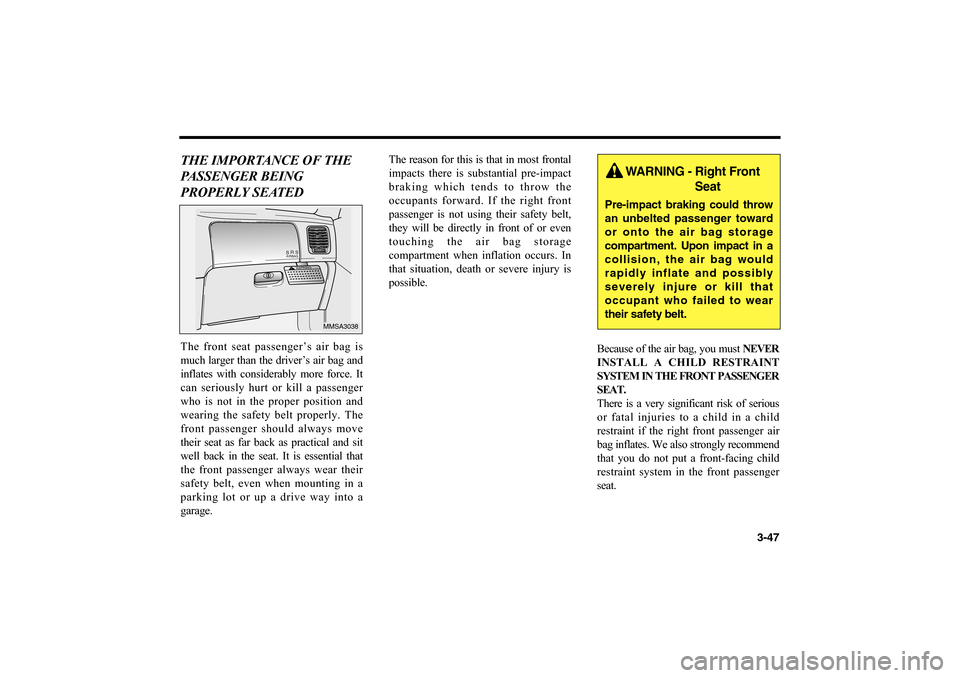
PROPERLY SEATEDThe front seat passenger’s air bag is
much larger than the driver’s air bag and
inflates with considerably more force. It
can seriously hurt or kill a passenger
who is not in the proper position and
wearing the safety belt properly. The
front passenger should always move
their seat as far back as practical and sit
well back in the seat. It is essential that
the front passenger always wear their
safety belt, even when mounting in a
parking lot or up a drive way into a
garage.The reason for this is that in most frontal
impacts there is substantial pre-impact
braking which tends to throw the
occupants forward. If the right front
passenger is not using their safety belt,
they will be directly in front of or even
touching the air bag storage
compartment when inflation occurs. In
that situation, death or severe injury is
possible.
Because of the air bag, you must NEVER
INSTALL A CHILD RESTRAINT
SYSTEM IN THE FRONT PASSENGER
SEAT.
There is a very significant risk of serious
or fatal injuries to a child in a child
restraint if the right front passenger air
bag inflates. We also strongly recommend
that you do not put a front-facing child
restraint system in the front passenger
seat.
S R SAIRBAGWARNING
MMSA3038
WARNING - Right Front
Seat
Pre-impact braking could throw
an unbelted passenger toward
or onto the air bag storage
compartment. Upon impact in a
collision, the air bag would
rapidly inflate and possibly
severely injure or kill that
occupant who failed to wear
their safety belt.
MS-CNA-Eng 3.QXD 7/25/2005 5:17 PM Page 47