change time KIA Magnetis 2007 2.G User Guide
[x] Cancel search | Manufacturer: KIA, Model Year: 2007, Model line: Magnetis, Model: KIA Magnetis 2007 2.GPages: 294, PDF Size: 3.37 MB
Page 258 of 294
711
Maintenance
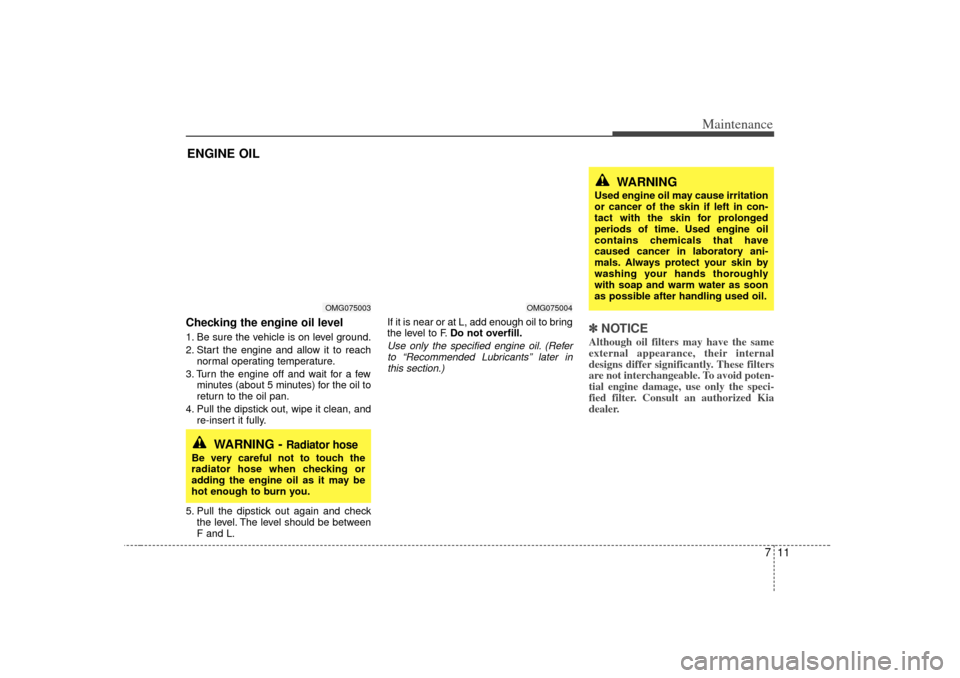
ENGINE OILChecking the engine oil level 1. Be sure the vehicle is on level ground.
2. Start the engine and allow it to reachnormal operating temperature.
3. Turn the engine off and wait for a few minutes (about 5 minutes) for the oil to
return to the oil pan.
4. Pull the dipstick out, wipe it clean, and re-insert it fully.
5. Pull the dipstick out again and check the level. The level should be between
F and L. If it is near or at L, add enough oil to bring
the level to F.
Do not overfill.
Use only the specified engine oil. (Refer
to “Recommended Lubricants” later in this section.)
✽ ✽ NOTICEAlthough oil filters may have the same
external appearance, their internal
designs differ significantly. These filters
are not interchangeable. To avoid poten-
tial engine damage, use only the speci-
fied filter. Consult an authorized Kia
dealer.
WARNING -
Radiator hose
Be very careful not to touch the
radiator hose when checking or
adding the engine oil as it may be
hot enough to burn you.
WARNING
Used engine oil may cause irritation
or cancer of the skin if left in con-
tact with the skin for prolonged
periods of time. Used engine oil
contains chemicals that have
caused cancer in laboratory ani-
mals. Always protect your skin by
washing your hands thoroughly
with soap and warm water as soon
as possible after handling used oil.
OMG075003
OMG075004
Page 264 of 294
717
Maintenance
New automatic transaxle fluid should
be red. The red dye is added so the
assembly plant can identify it as auto-
matic transaxle fluid and distinguish it
from engine oil or antifreeze. The red
dye, which is not an indicator of fluid
quality, is not permanent. As the vehi-
cle is driven, the automatic transaxle
fluid will begin to look darker. The
color may eventually appear light
brown.✽ ✽NOTICEHave an Authorized Kia dealer inspect
or change the automatic transaxle fluid
according to the Scheduled
Maintenance at the beginning of this
section.Changing automatic transaxle
fluidHave automatic transaxle fluid changed
by an authorized Kia dealer according to
the Maintenance Schedule at the begin-
ning of this section.
Use only the specified automatic
transaxle fluid. (Refer to "Recommended
Lubricants" later in this section.)
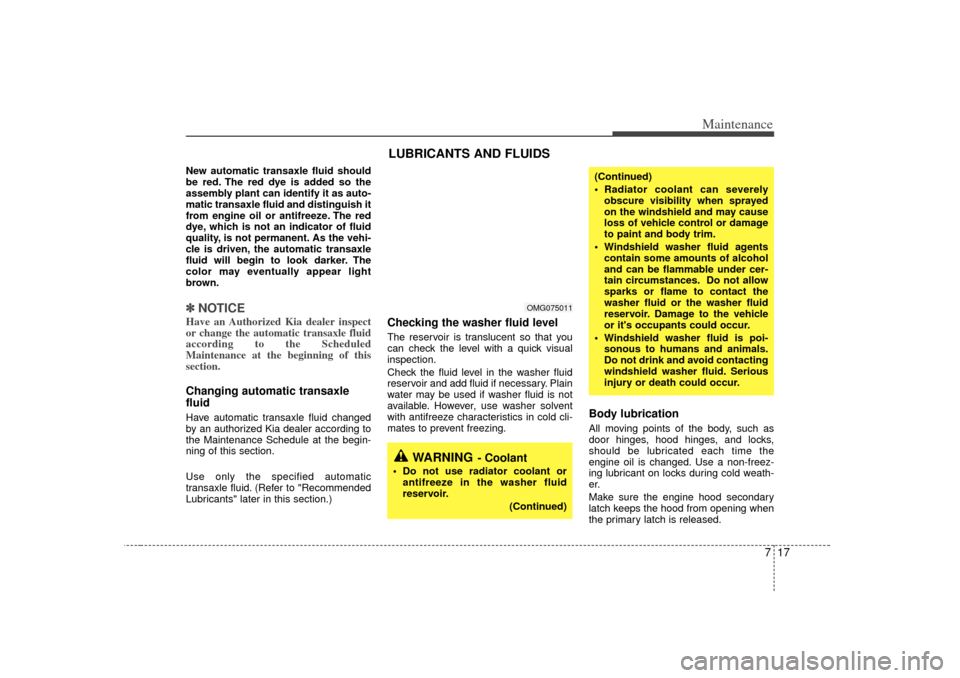
Checking the washer fluid level The reservoir is translucent so that you
can check the level with a quick visual
inspection.
Check the fluid level in the washer fluid
reservoir and add fluid if necessary. Plain
water may be used if washer fluid is not
available. However, use washer solvent
with antifreeze characteristics in cold cli-
mates to prevent freezing.
Body lubrication All moving points of the body, such as
door hinges, hood hinges, and locks,
should be lubricated each time the
engine oil is changed. Use a non-freez-
ing lubricant on locks during cold weath-
er.
Make sure the engine hood secondary
latch keeps the hood from opening when
the primary latch is released.
LUBRICANTS AND FLUIDS
WARNING
- Coolant
Do not use radiator coolant or
antifreeze in the washer fluid
reservoir.
(Continued)
(Continued)
Radiator coolant can severelyobscure visibility when sprayed
on the windshield and may cause
loss of vehicle control or damage
to paint and body trim.
Windshield washer fluid agents contain some amounts of alcohol
and can be flammable under cer-
tain circumstances. Do not allow
sparks or flame to contact the
washer fluid or the washer fluid
reservoir. Damage to the vehicle
or it's occupants could occur.
Windshield washer fluid is poi- sonous to humans and animals.
Do not drink and avoid contacting
windshield washer fluid. Serious
injury or death could occur.
OMG075011
Page 282 of 294
735
Maintenance
LUBRICANT SPECIFICATIONSRecommended lubricants To help achieve proper engine and powertrain performance and
durability, use only lubricants of the proper quality. The correct
lubricants also help promote engine efficiency that results in
improved fuel economy.
Engine oils labeled Energy Conserving Oil are now available.
Along with other additional benefits, they contribute to fuel
economy by reducing the amount of fuel necessary to over-
come engine friction. Often, these improvements are difficult to
measure in everyday driving, but in a year’s time, they can offer
significant cost and energy savings.
Recommended SAE viscosity number ✽ ✽NOTICEAlways be sure to clean the area around any filler plug, drain
plug, or dipstick before checking or draining any lubricant.
This is especially important in dusty or sandy areas and when
the vehicle is used on unpaved roads. Cleaning the plug and
dipstick areas will prevent dirt and grit from entering the
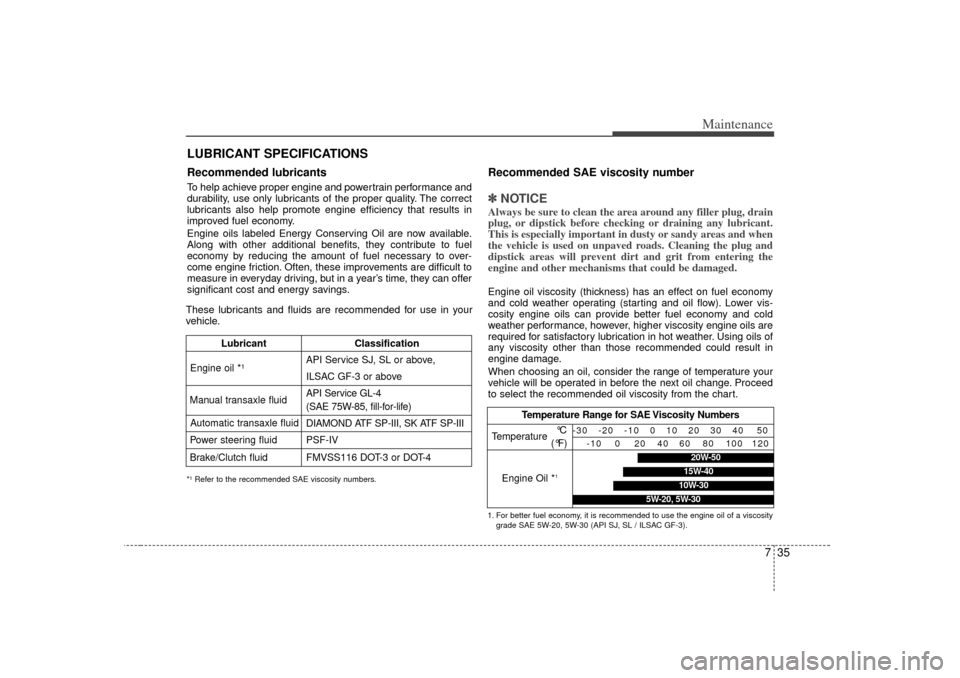
engine and other mechanisms that could be damaged. Engine oil viscosity (thickness) has an effect on fuel economy
and cold weather operating (starting and oil flow). Lower vis-
cosity engine oils can provide better fuel economy and cold
weather performance, however, higher viscosity engine oils are
required for satisfactory lubrication in hot weather. Using oils of
any viscosity other than those recommended could result in
engine damage.
When choosing an oil, consider the range of temperature your
vehicle will be operated in before the next oil change. Proceed
to select the recommended oil viscosity from the chart.
*¹ Refer to the recommended SAE viscosity numbers.These lubricants and fluids are recommended for use in your
vehicle.
Lubricant Classification
API Service SJ, SL or above,
ILSAC GF-3 or above
Manual transaxle fluid API Service GL-4
(SAE 75W-85, fill-for-life)
DIAMOND ATF SP-III, SK ATF SP-III
Power steering fluid PSF-IV
Brake/Clutch fluid FMVSS116 DOT-3 or DOT-4
Engine oil
*¹
Automatic transaxle fluid
Temperature Range for SAE Viscosity Numbers
Temperature
Engine Oil *
1°C
(°F)
-30 -20 -10 0 10 20 30 40 50
-10 0 20 40 60 80 100 120
1. For better fuel economy, it is recommended to use the engine oil of a viscositygrade SAE 5W-20, 5W-30 (API SJ, SL / ILSAC GF-3).
20W-5015W-4010W-30
5W-20, 5W-30
Page 287 of 294
Specifications28
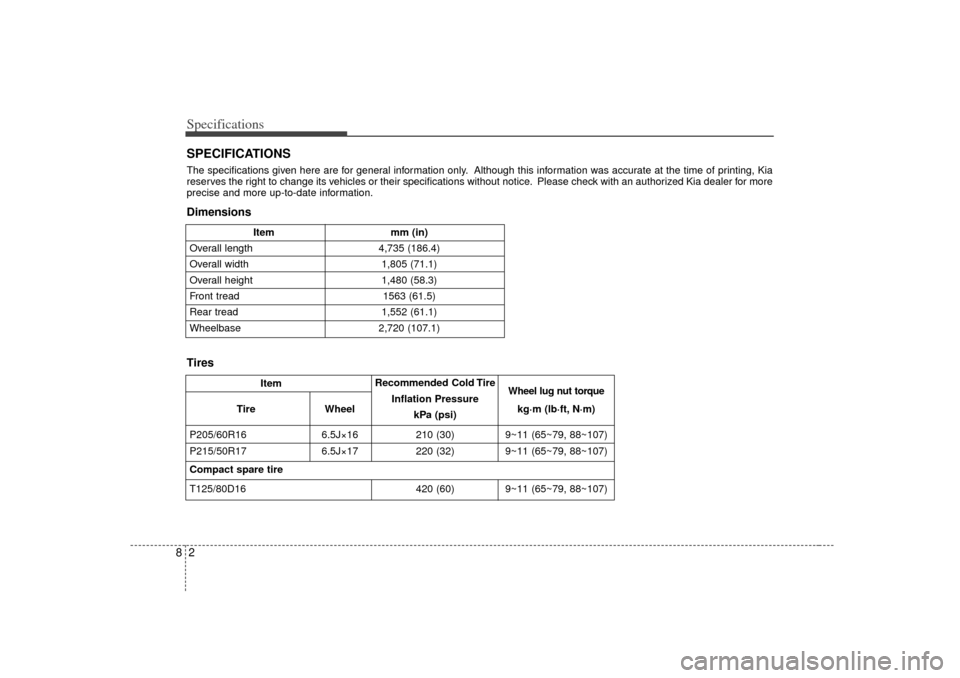
Itemmm (in)
Overall length 4,735 (186.4)
Overall width 1,805 (71.1)
Overall height 1,480 (58.3)
Front tread 1563 (61.5)
Rear tread 1,552 (61.1)
Wheelbase 2,720 (107.1)
SPECIFICATIONSThe specifications given here are for general information only. Although this information was accurate at the time of printing, Kia
reserves the right to change its vehicles or their specifications without notice. Please check with an authorized Kia dealer for more
precise and more up-to-date information.Dimensions
Tires
Item Recommended Cold Tire
Wheel lug nut torque
Tire Wheel Inflation Pressure
kPa (psi) kg·m (lb·ft, N·m)
P205/60R16 6.5J×16 210 (30) 9~11 (65~79, 88~107)
P215/50R17 6.5J×17 220 (32) 9~11 (65~79, 88~107)
Compact spare tire
T125/80D16 420 (60) 9~11 (65~79, 88~107)