wheel KIA Magnetis 2007 2.G Owner's Guide
[x] Cancel search | Manufacturer: KIA, Model Year: 2007, Model line: Magnetis, Model: KIA Magnetis 2007 2.GPages: 294, PDF Size: 3.37 MB
Page 218 of 294
Driving tips14
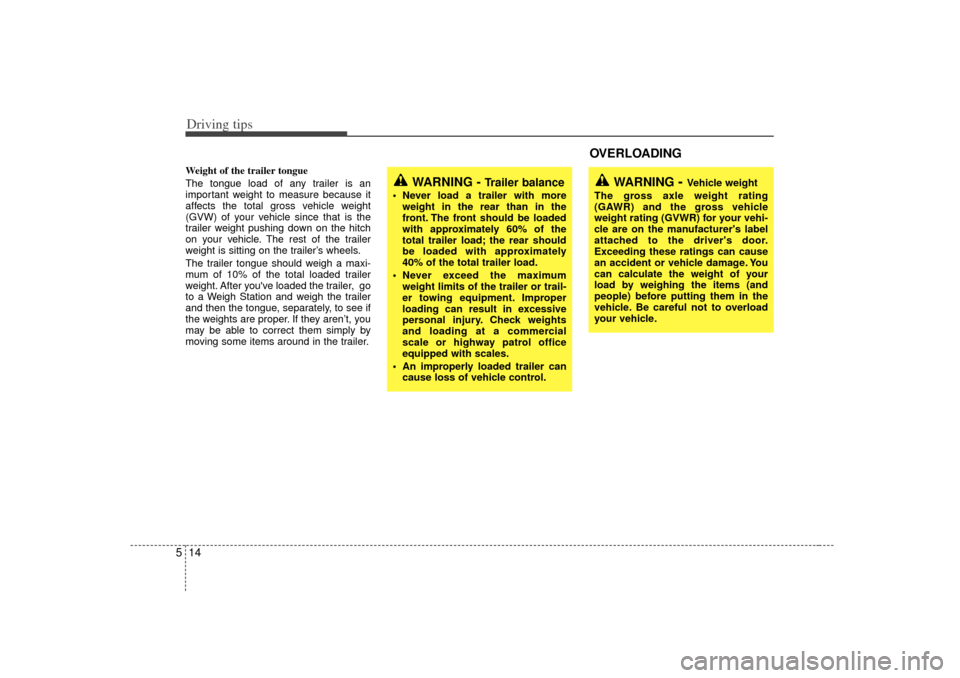
5Weight of the trailer tongue
The tongue load of any trailer is an
important weight to measure because it
affects the total gross vehicle weight
(GVW) of your vehicle since that is the
trailer weight pushing down on the hitch
on your vehicle. The rest of the trailer
weight is sitting on the trailer’s wheels.
The trailer tongue should weigh a maxi-
mum of 10% of the total loaded trailer
weight. After you've loaded the trailer, go
to a Weigh Station and weigh the trailer
and then the tongue, separately, to see if
the weights are proper. If they aren’t, you
may be able to correct them simply by
moving some items around in the trailer.
WARNING -
Trailer balance
Never load a trailer with more
weight in the rear than in the
front. The front should be loaded
with approximately 60% of the
total trailer load; the rear should
be loaded with approximately
40% of the total trailer load.
Never exceed the maximum weight limits of the trailer or trail-
er towing equipment. Improper
loading can result in excessive
personal injury. Check weights
and loading at a commercial
scale or highway patrol office
equipped with scales.
An improperly loaded trailer can cause loss of vehicle control.
WARNING
- Vehicle weight
The gross axle weight rating
(GAWR) and the gross vehicle
weight rating (GVWR) for your vehi-
cle are on the manufacturer's label
attached to the driver's door.
Exceeding these ratings can cause
an accident or vehicle damage. You
can calculate the weight of your
load by weighing the items (and
people) before putting them in the
vehicle. Be careful not to overload
your vehicle.
OVERLOADING
Page 231 of 294
611
In case of an emergency
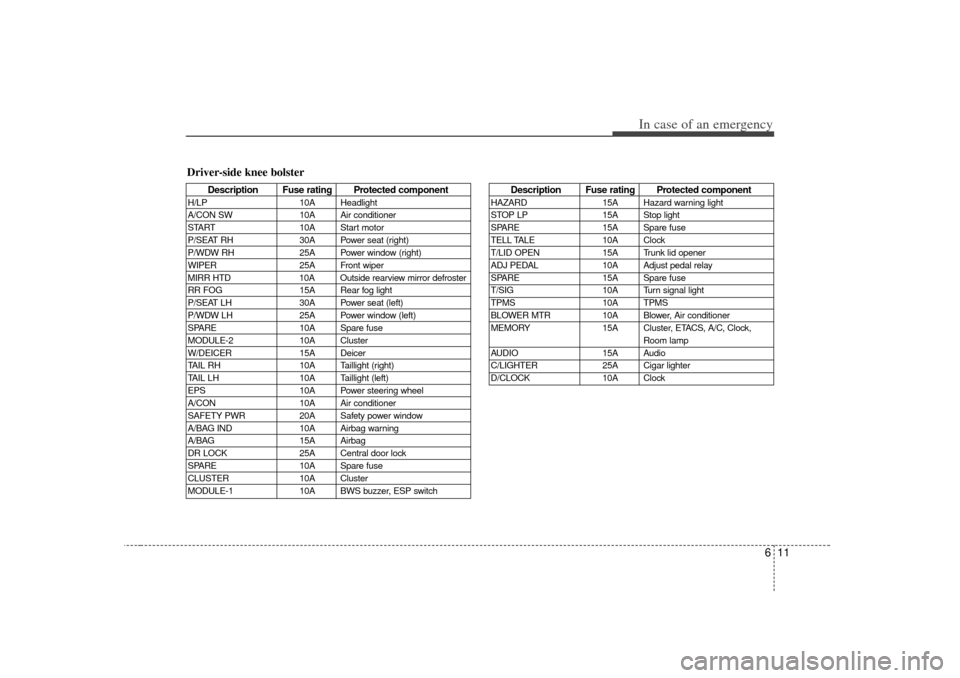
Driver-side knee bolster
Description Fuse rating Protected component
H/LP10A Headlight
A/CON SW 10A Air conditioner
START 10A Start motor
P/SEAT RH 30A Power seat (right)
P/WDW RH 25A Power window (right)
WIPER 25A Front wiper
MIRR HTD 10A Outside rearview mirror defroster
RR FOG 15A Rear fog light
P/SEAT LH 30A Power seat (left)
P/WDW LH 25A Power window (left)
SPARE 10A Spare fuse
MODULE-2 10A Cluster
W/DEICER 15A Deicer
TAIL RH 10A Taillight (right)
TAIL LH 10A Taillight (left)
EPS 10A Power steering wheel
A/CON 10A Air conditioner
SAFETY PWR 20A Safety power window
A/BAG IND 10A Airbag warning
A/BAG 15A Airbag
DR LOCK 25A Central door lock
SPARE 10A Spare fuse
CLUSTER 10A Cluster
MODULE-1 10A BWS buzzer, ESP switch
Description Fuse rating Protected component
HAZARD15A Hazard warning light
STOP LP 15A Stop light
SPARE 15A Spare fuse
TELL TALE 10A Clock
T/LID OPEN 15A Trunk lid opener
ADJ PEDAL 10A Adjust pedal relay
SPARE 15A Spare fuse
T/SIG 10A Turn signal light
TPMS 10A TPMS
BLOWER MTR 10A Blower, Air conditioner
MEMORY 15A Cluster, ETACS, A/C, Clock,
Room lamp
AUDIO 15A Audio
C/LIGHTER 25A Cigar lighter
D/CLOCK 10A Clock
Page 233 of 294
613
In case of an emergency
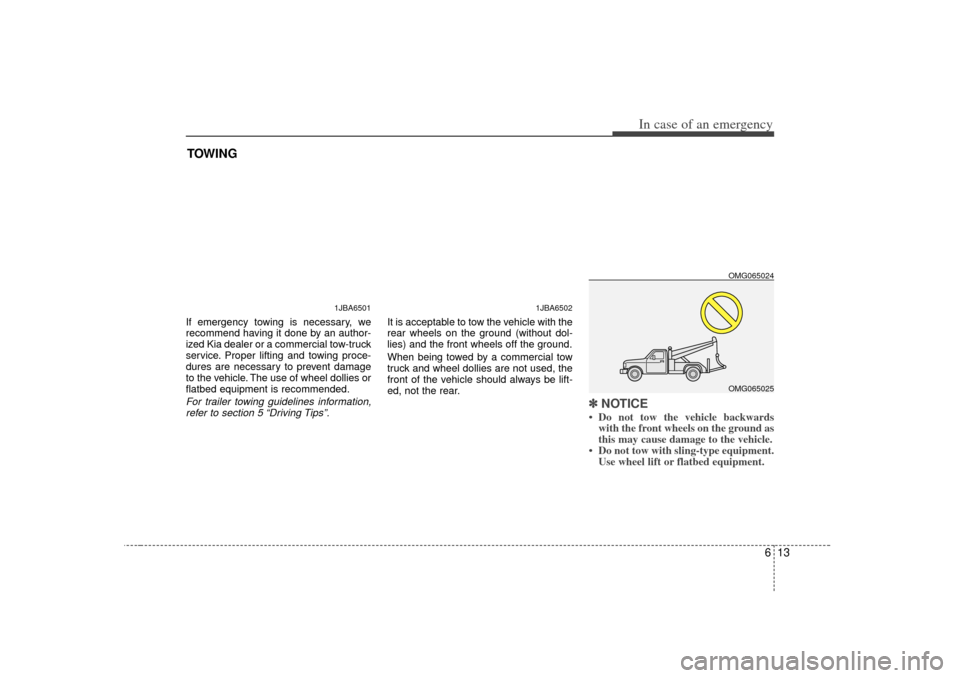
TOWINGIf emergency towing is necessary, we
recommend having it done by an author-
ized Kia dealer or a commercial tow-truck
service. Proper lifting and towing proce-
dures are necessary to prevent damage
to the vehicle. The use of wheel dollies or
flatbed equipment is recommended.For trailer towing guidelines information,refer to section 5 “Driving Tips”.
It is acceptable to tow the vehicle with the
rear wheels on the ground (without dol-
lies) and the front wheels off the ground.
When being towed by a commercial tow
truck and wheel dollies are not used, the
front of the vehicle should always be lift-
ed, not the rear.
✽ ✽ NOTICE• Do not tow the vehicle backwards
with the front wheels on the ground as
this may cause damage to the vehicle.
• Do not tow with sling-type equipment. Use wheel lift or flatbed equipment.
1JBA6502
1JBA6501
OMG065025 OMG065024
Page 234 of 294
In case of an emergency14
6When towing your vehicle in an emer-
gency without wheel dollies :
1. Set the ignition switch in the ACC posi-
tion.
2. Place the transaxle shift lever in N (Neutral).
3. Release the parking brake.✽ ✽ NOTICEFailure to place the transaxle shift lever
in N (Neutral) may cause internal dam-
age to the transaxle.
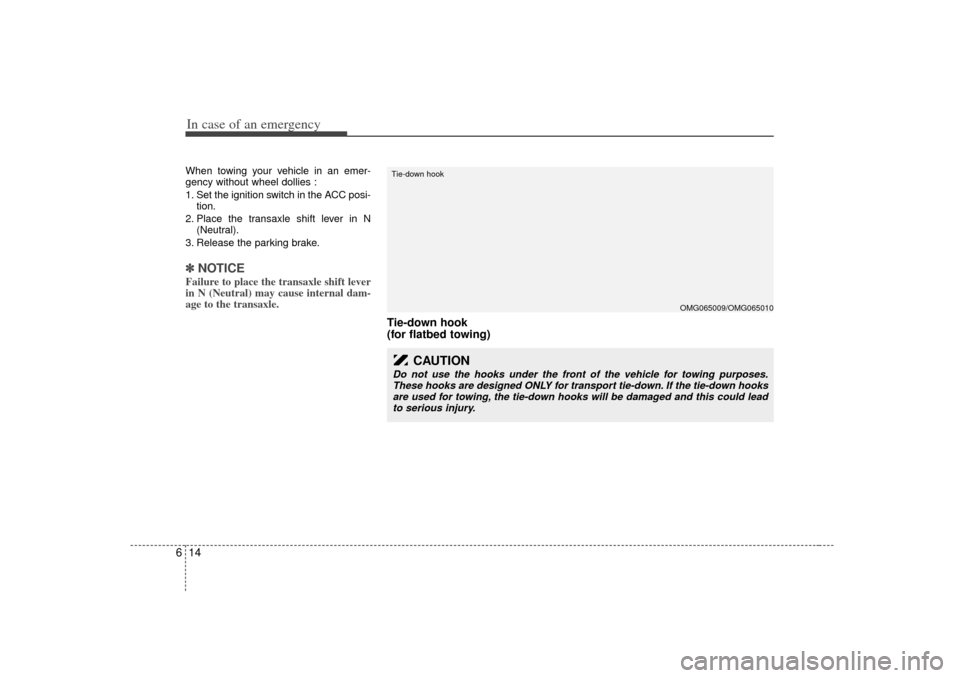
Tie-down hook
(for flatbed towing)
CAUTION
Do not use the hooks under the front of the vehicle for towing purposes.
These hooks are designed ONLY for transport tie-down. If the tie-down hooks are used for towing, the tie-down hooks will be damaged and this could leadto serious injury.Tie-down hook
OMG065009/OMG065010
Page 236 of 294
In case of an emergency16
6If towing service is not available in an
emergency, your vehicle may be tem-
porarily towed using a cable or chain
secured to the emergency towing hook
under the front or rear of the vehicle. Use
extreme caution when towing the vehicle.
A driver must be in the vehicle to steer it
and operate the brakes.
Towing in this manner may be done only
on hard-surfaced roads for a short dis-
tance and at low speeds. Also, the
wheels, axles, power train, steering and
brakes must all be in good condition.
Do not use the tow hooks to pull a vehi-
cle out of mud, sand or other condi-
tions from which the vehicle cannot be
driven out under its own power.
Avoid towing a vehicle heavier than the vehicle doing the towing.
The drivers of both vehicles should com- municate with each other frequently.✽ ✽ NOTICE• Attach a towing strap to the tow hook.
• Using a portion of the vehicle other
than the tow hooks for towing may
damage the body of your vehicle.
• Use only a cable or chain specifically intended for use in towing vehicles.
Securely fasten the cable or chain to
the towing hook provided.
Before emergency towing, check that
the hook is not broken or damaged.
Fasten the towing cable or chain securely to the hook.
Do not jerk the hook. Apply steady and even force.
To avoid damaging the hook, do not pull from the side or at a vertical angle.
Always pull straight ahead.
Use a towing strap less than 5 m (16feet) long. Attach a white or red cloth
(about 30 cm (12 inches) wide) in the
middle of the strap for easy visibility.
Drive carefully so that the towing strap is not loosened during towing.
CAUTION
Use extreme caution when towingthe vehicle.
Avoid sudden starts or erratic driving maneuvers which wouldplace excessive stress on theemergency towing hook and tow- ing cable or chain. The hook andtowing cable or chain may break and cause serious injury or dam-age.
If the towing vehicle does not move easily, do not forcibly continue thetowing. Contact an authorized Kiadealer or a commercial tow truckservice for assistance.
Tow the vehicle as straight ahead as possible.
Keep away from the vehicle dur- ing towing.
1JBA4124
Page 237 of 294
617
In case of an emergency
When your vehicle is being towed
by another vehicle other than a tow
truck (in case of an emergency) Turn the ignition switch to ACC so thesteering wheel isn’t locked.
Place the transaxle shift lever in N (Neutral).
Release the parking bake.
Vehicles equipped with automatic transaxles should not exceed 45 km/h
(28 mph) and should not be towed
more than 80 km (50 miles).
Vehicles equipped with manual transaxle should not be towed in
excess of 88 km/h (55 mph) and
should not be towed more than 645 km
(400 miles).
Press the brake pedal with more force than normal since you will have
reduced brake performance.
More steering effort will be required because the power steering system
will be disabled.
If you are driving down a long hill, the brakes may overheat and brake per-
formance will be reduced. Stop often
and let the brakes cool off.
✽ ✽ NOTICETo prevent internal damage to the
transaxle, never tow your vehicle from
the rear (backwards) with all four tires
in contact with the surface. Tips for towing a stuck vehicleThe following methods are effective
when your vehicle is stuck in mud, sand
or similar substances that prevent the
vehicle from being driven out under its
own power.
Remove the soil and sand, etc. from
the front and the back of the tires.
Place a stone or wood under the tires.
Page 238 of 294
In case of an emergency18
6TIRES PRESSURE MONITORING SYSTEM (TPMS) (IF EQUIPPED)
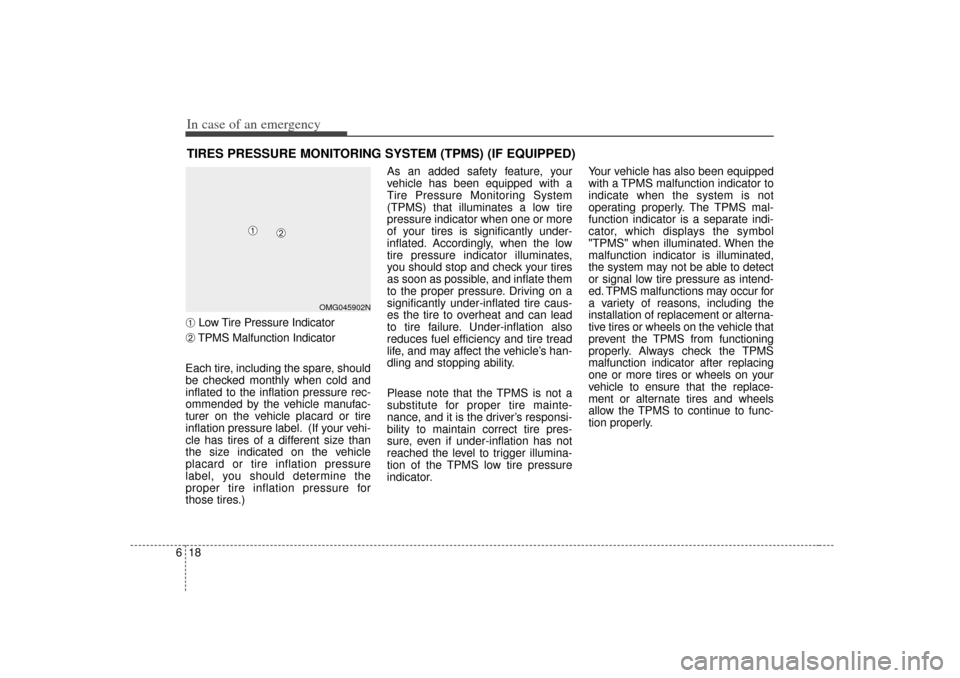
➀
Low Tire Pressure Indicator
➁
TPMS Malfunction Indicator
Each tire, including the spare, should
be checked monthly when cold and
inflated to the inflation pressure rec-
ommended by the vehicle manufac-
turer on the vehicle placard or tire
inflation pressure label. (If your vehi-
cle has tires of a different size than
the size indicated on the vehicle
placard or tire inflation pressure
label, you should determine the
proper tire inflation pressure for
those tires.) As an added safety feature, your
vehicle has been equipped with a
Tire Pressure Monitoring System
(TPMS) that illuminates a low tire
pressure indicator when one or more
of your tires is significantly under-
inflated. Accordingly, when the low
tire pressure indicator illuminates,
you should stop and check your tires
as soon as possible, and inflate them
to the proper pressure. Driving on a
significantly under-inflated tire caus-
es the tire to overheat and can lead
to tire failure. Under-inflation also
reduces fuel efficiency and tire tread
life, and may affect the vehicle’s han-
dling and stopping ability.
Please note that the TPMS is not a
substitute for proper tire mainte-
nance, and it is the driver’s responsi-
bility to maintain correct tire pres-
sure, even if under-inflation has not
reached the level to trigger illumina-
tion of the TPMS low tire pressure
indicator.
Your vehicle has also been equipped
with a TPMS malfunction indicator to
indicate when the system is not
operating properly. The TPMS mal-
function indicator is a separate indi-
cator, which displays the symbol
"TPMS" when illuminated. When the
malfunction indicator is illuminated,
the system may not be able to detect
or signal low tire pressure as intend-
ed. TPMS malfunctions may occur for
a variety of reasons, including the
installation of replacement or alterna-
tive tires or wheels on the vehicle that
prevent the TPMS from functioning
properly. Always check the TPMS
malfunction indicator after replacing
one or more tires or wheels on your
vehicle to ensure that the replace-
ment or alternate tires and wheels
allow the TPMS to continue to func-
tion properly.
OMG045902N
➀
➁
Page 240 of 294
In case of an emergency20
6✽
✽
NOTICEThe TPMS malfunction indicator
may be illuminated if the vehicle is
moving around electric power sup-
ply cable or radio transmitter such
as police stations, government and
public offices, broadcasting stations,
military installations, airports, or
transmitting tower, etc. which can
interfere with normal operation of
the Tire Monitoring System
(TPMS).
Changing a tire with TPMSIf you have a flat tire, the Low Tire
Pressure indicator will come on.
Have the flat tire repaired by an
authorized Kia dealer as soon as
possible or replace the flat tire with
the compact spare tire.✽ ✽NOTICENEVER use a puncture-repairing
agent to repair and/or inflate a low
pressure tire. If used, you will have
to replace the tire pressure sensor. Each wheel is equipped with a tire
pressure sensor mounted inside the
tire behind the valve stem. You must
use TPMS specific wheels. It is rec-
ommended that you always have
your tires serviced by an authorized
Kia dealer as soon as possible. After you replace the low pressure
tire with the compact spare tire, the
TPMS malfunction indicator may illu-
minate after restarting and about 20
minutes of continuous driving
because the compact spare tire does
not have a sensor.
Once the low pressure tire is re-inflat-
ed to the recommended pressure
and installed on the vehicle, the
TPMS malfunction indicator and the
low tire pressure indicator will be
extinguished. If the low pressure and
TPMS malfunction indicators are not
extinguished after about 20 minutes
of continuous driving, please visit an
authorized Kia dealer.
You may not be able to identify a low
tire by simply looking at it. Always use
a good quality tire pressure gauge to
measure the tire's inflation pressure.
Please note that a tire that is hot
(from being driven) will have a higher
pressure measurement than a tire
that is cold (from sitting stationary for
at least 3 hours and driven less than
1.6 km (1 mile) during that 3 hour
period). Allow the tire to cool before
measuring the inflation pressure.
Page 242 of 294
In case of an emergency22
6IF YOU HAVE A FLAT TIRE The spare tire, jack, jack handle,
wheel lug nut wrench are stored in
the luggage compartment. Remove
the luggage under tray out of the way
to reach this equipment.
Removing the spare tire Turn the tire hold-down wing bolt
counterclockwise.
Store the tire in the reverse order of
removal.
To prevent the spare tire and tools
from “rattling” while the vehicle is in
motion, store them properly.
Important - use of compact
spare tireyour vehicle is equipped with a com-
pact spare tire. This compact spare
tire takes up less space than a regu-
lar-size tire. This tire is smaller than a
conventional tire and is designed for
temporary use only.
CAUTION
- Compact
spare
You should drive carefully when the compact spare is inuse. The compact spareshould be replaced by theproper conventional tire andrim at the first opportunity.
The operation of this vehicle is not recommended withmore than one compact sparetire in use at the same time.
OMG065014
OMG065015
Page 243 of 294
623
In case of an emergency
The compact spare should be inflat-
ed to 420 kPa (60 psi).✽ ✽NOTICECheck the inflation pressure after
installing the spare tire. Adjust it to
the specified pressure, as necessary.
When using a compact spare tire,
observe the following precautions:
Under no circumstances should
you exceed 80 km/h (50 mph); a
higher speed could damage the
tire.
Ensure that you drive slowly enough for the road conditions to
avoid all hazards. Any road hazard,
such as a pothole or debris, could
seriously damage the compact
spare.
Any continuous road use of this tire could result in tire failure, loss of
vehicle control, and possible per-
sonal injury.
Do not exceed the vehicle’s maxi- mum load rating or the load-carry-
ing capacity shown on the sidewall
of the compact spare tire.
Avoid driving over obstacles. The compact spare tire diameter is
smaller than the diameter of a con-
ventional tire and reduces the
ground clearance approximately
25 mm (1 inch), which could result
in damage to the vehicle. Do not take the vehicle through an
automatic car wash with a compact
spare.
Do not use tire chains on this tire. Because of the smaller size, a tire
chain will not fit properly. This could
damage the vehicle and result in
loss of the chain.
This tire should not be installed on the front axle if the vehicle must be
driven in snow or on ice.
Do not use the compact spare tire on any other vehicle because this
tire has been designed especially
for your vehicle.
The compact spare tire’s tread life is shorter than a regular tire.
Inspect your compact spare tire
regularly and replace worn com-
pact spare tires with the same size
and design, mounted on the same
wheel.
CAUTION
- Compact
spare
This spare tire should be usedonly for VERY short distances.Compact spares should NEVERbe used for long drives orextended distances.