power steering fluid KIA Magnetis 2010 3.G Owner's Manual
[x] Cancel search | Manufacturer: KIA, Model Year: 2010, Model line: Magnetis, Model: KIA Magnetis 2010 3.GPages: 336, PDF Size: 6.46 MB
Page 13 of 336
Your vehicle at a glance
42
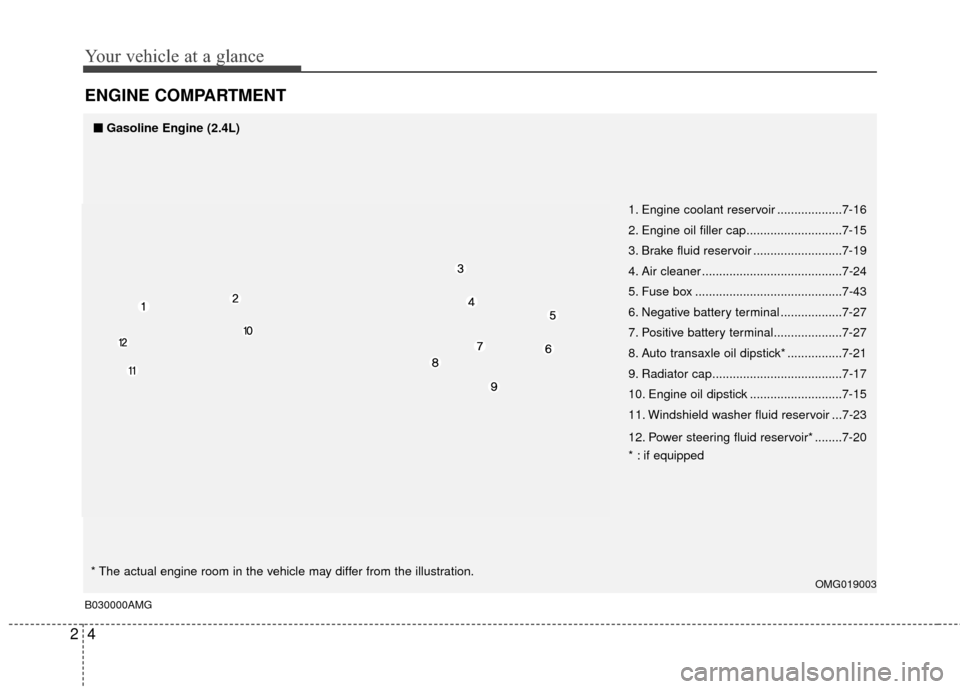
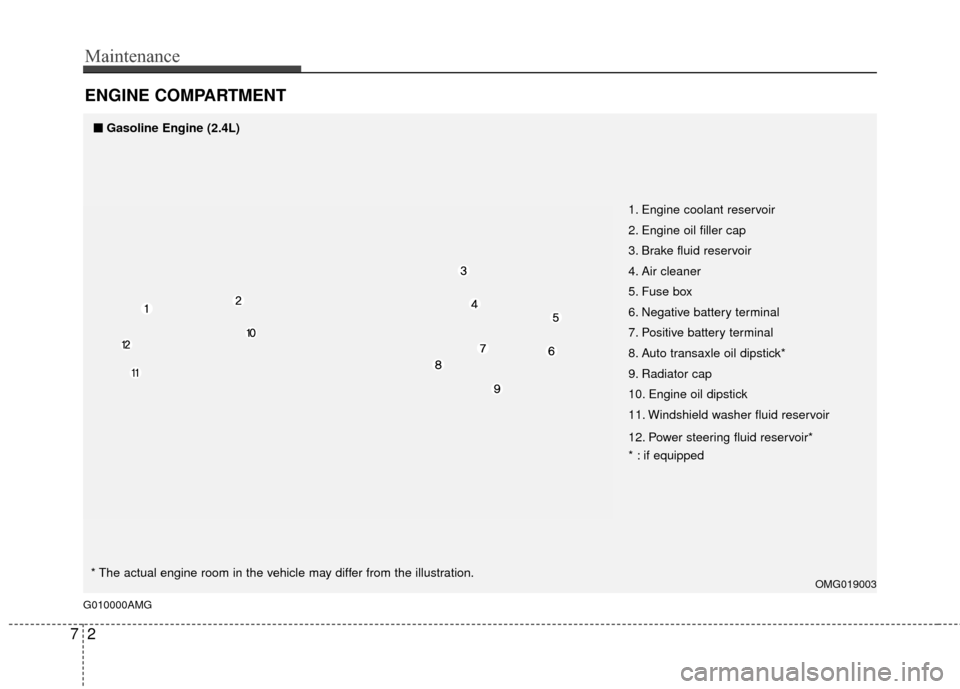
ENGINE COMPARTMENT
B030000AMG
OMG019003
■
■Gasoline Engine (2.4L)
1. Engine coolant reservoir ...................7-16
2. Engine oil filler cap............................7-15
3. Brake fluid reservoir ..........................7-19
4. Air cleaner .........................................7-24
5. Fuse box ...........................................7-43
6. Negative battery terminal ..................7-27
7. Positive battery terminal....................7-27
8. Auto transaxle oil dipstick* ................7-21
9. Radiator cap......................................7-17
10. Engine oil dipstick ...........................7-15
11. Windshield washer fluid reservoir ...7-23
12. Power steering fluid reservoir* ........7-20
* : if equipped
* The actual engine room in the vehicle may differ from the illustration.
Page 14 of 336
25
Your vehicle at a glance
OMG079002N
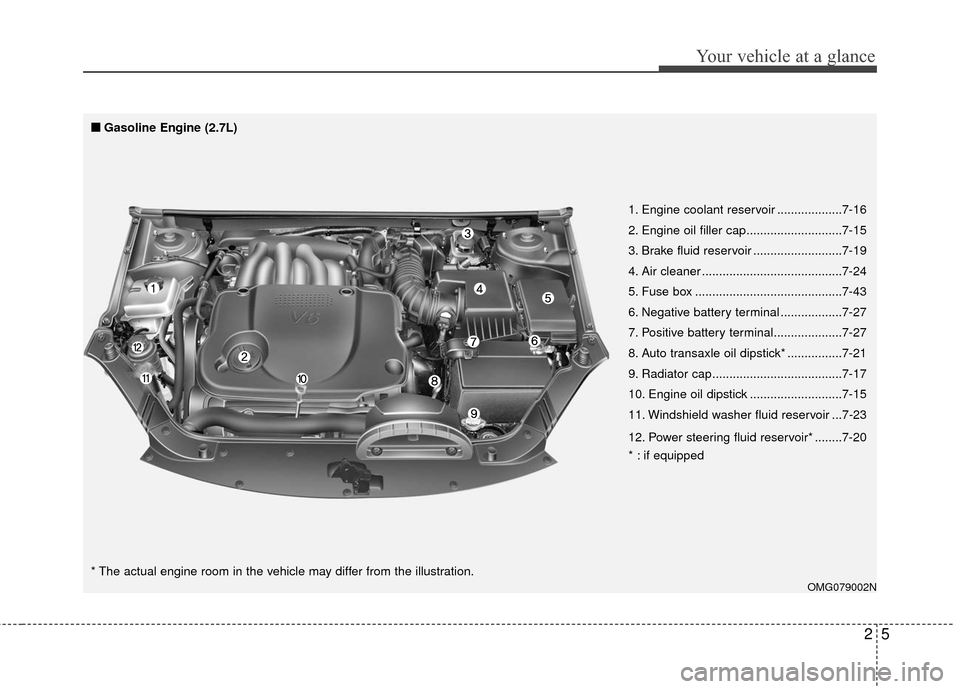
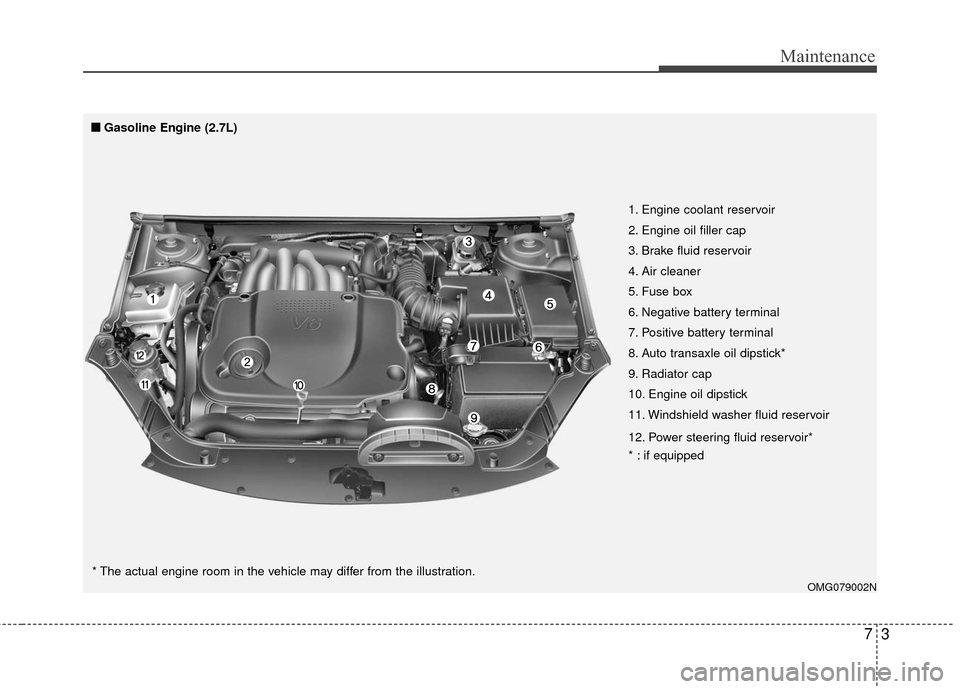
1. Engine coolant reservoir ...................7-16
2. Engine oil filler cap............................7-15
3. Brake fluid reservoir ..........................7-19
4. Air cleaner .........................................7-24
5. Fuse box ...........................................7-43
6. Negative battery terminal ..................7-27
7. Positive battery terminal....................7-27
8. Auto transaxle oil dipstick* ................7-21
9. Radiator cap......................................7-17
10. Engine oil dipstick ...........................7-15
11. Windshield washer fluid reservoir ...7-23
12. Power steering fluid reservoir* ........7-20
* : if equipped
■ ■
Gasoline Engine (2.7L)
* The actual engine room in the vehicle may differ from the illustration.
Page 100 of 336
Features of your vehicle
34
4
D130100AUN
Power steering
Power steering uses energy from the
engine to assist you in steering the vehi-
cle. If the engine is off or if the power
steering system becomes inoperative,
the vehicle may still be steered, but it will
require increased steering effort.
Should you notice any change in the
effort required to steer during normal
vehicle operation, have the power steer-
ing checked by an authorized KIA dealer.
✽ ✽
NOTICE
If the power steering drive belt breaks
or if the power steering pump malfunc-
tions, the steering effort will greatly
increase.
✽ ✽NOTICE
If the vehicle is parked for extended
periods outside in cold weather (below -
10°C/14°F), the power steering may
require increased effort when the engine
is first started. This is caused by
increased fluid viscosity due to the cold
weather and does not indicate a mal-
function.
When this happens, increase the engine
RPM by depressing accelerator until the
RPM reaches 1,500 rpm then release or
let the engine idle for two or three min-
utes to warm up the fluid.
D130300AFD
Tilt steering
Tilt steering allows you to adjust the
steering wheel before you drive. You can
also raise it to give your legs more room
when you exit and enter the vehicle.
The steering wheel should be positioned
so that it is comfortable for you to drive,
while permitting you to see the instru-
ment panel warning lights and gauges.
STEERING WHEEL
CAUTION
Never hold the steering wheel
against a stop (extreme right or leftturn) for more than 5 seconds withthe engine running. Holding the steering wheel for more than 5 sec-onds in either position may causedamage to the power steeringpump.
WARNING
Never adjust the angle of the steering wheel while driving. You
may lose steering control and
cause severe personal injury,
death or accidents.
After adjusting, push the steering wheel both up and down to be
certain it is locked in position.
Page 266 of 336
7
Engine compartment / 7-2
Maintenance services / 7-4
Owner maintenance / 7-5
Normal maintenance schedule / 7-8
Explanation of scheduled maintenance items / 7-12
Engine oil / 7-15
Engine coolant / 7-16
Brake fluid / 7-19
Power steering fluid / 7-20
Automatic transaxle fluid / 7-21
Washer fluid / 7-23
Parking brake / 7-23
Air cleaner / 7-24
Climate control air filter / 7-24
Wiper blades / 7-25
Battery / 7-27
Tires and wheels / 7-30
Fuses / 7-43
Appearance care / 7-52
Emission control system / 7-58
Maintenance
Page 267 of 336
Maintenance
27
ENGINE COMPARTMENT
G010000AMGOMG019003
■
■
Gasoline Engine (2.4L)
1. Engine coolant reservoir
2. Engine oil filler cap
3. Brake fluid reservoir
4. Air cleaner
5. Fuse box
6. Negative battery terminal
7. Positive battery terminal
8. Auto transaxle oil dipstick*
9. Radiator cap
10. Engine oil dipstick
11. Windshield washer fluid reservoir
12. Power steering fluid reservoir*
* : if equipped
* The actual engine room in the vehicle may differ from the illustration.
Page 268 of 336
73
Maintenance
OMG079002N
1. Engine coolant reservoir
2. Engine oil filler cap
3. Brake fluid reservoir
4. Air cleaner
5. Fuse box
6. Negative battery terminal
7. Positive battery terminal
8. Auto transaxle oil dipstick*
9. Radiator cap
10. Engine oil dipstick
11. Windshield washer fluid reservoir
12. Power steering fluid reservoir*
* : if equipped
■ ■
Gasoline Engine (2.7L)
* The actual engine room in the vehicle may differ from the illustration.
Page 272 of 336
77
Maintenance
G030103AUN
At least monthly:
Check coolant level in the enginecoolant reservoir.
Check the operation of all exterior lights, including the stoplights, turn sig-
nals and hazard warning flashers.
Check the inflation pressures of all tires including the spare.
G030104AUN
At least twice a year (i.e., every Spring and Fall):
Check radiator, heater and air condi- tioning hoses for leaks or damage.
Check windshield washer spray and wiper operation. Clean wiper blades
with clean cloth dampened with wash-
er fluid.
Check headlight alignment.
Check muffler, exhaust pipes, shields and clamps.
Check the lap/shoulder belts for wear and function.
Check for worn tires and loose wheel lug nuts.
G030105AUN-EU
At least once a year:
Clean body and door drain holes.
Lubricate door hinges and checks, andhood hinges.
Lubricate door and hood locks and latches.
Lubricate door rubber weatherstrips.
Check the air conditioning system.
Check the power steering fluid level.
Inspect and lubricate automatic transaxle linkage and controls.
Clean battery and terminals.
Check the brake fluid level.
Page 275 of 336

Maintenance
10
7
NORMAL MAINTENANCE SCHEDULE (CONTINUED)
Chassis and body (Continued)
Kilometers or time in months, whichever comes first
× 1,000 km 8 16 24 32 40 48 56 64 72 80 88 96 104 112 120 128
# Months 4 8 12 16 20 24 28 32 36 40 44 48 52 56 60 64
Automatic transaxle fluid (1) I I I R I I I R I I I R I I I R
Chassis & underbody bolts & nuts I I I I I I IIIIIII III
Tire condition & inflation pressure I I I I I I IIIIIII III
Wheel alignment (5)
Tire rotation
Steering operation & linkage I I I I I I IIIIIII III
Power steering fluid & lines I I I IIIII
Driveshaft dust boots I I I I I
Seat belts, buckles & anchors I I I I I I IIIIIII III
Lock, hinges & hood latch L L L L L L LLLLLLL LLL
MAINTENANCE
INTERVALS
MAINTENANCE
ITEM
Inspect when abnormal condition noted
Rotate the tires every 12,000 km
Page 279 of 336

Maintenance
14
7
G051700AUN
Parking brake
Inspect the parking brake system includ-
ing the parking brake pedal and cables.
G051900AUN
Brake discs, pads, calipers and
rotors
Check the pads for excessive wear, discs
for run out and wear, and calipers for fluid
leakage.
G052000AUN
Exhaust pipe and muffler
Visually inspect the exhaust pipes, muf-
fler and hangers for cracks, deterioration,
or damage. Start the engine and listen
carefully for any exhaust gas leakage.
Tighten connections or replace parts as
necessary.
G052100AUN
Suspension mounting bolts
Check the suspension connections for
looseness or damage. Retighten to the
specified torque.
G052200AUN
Steering gear box, linkage &
boots/lower arm ball joint
With the vehicle stopped and engine off,
check for excessive free-play in the
steering wheel.
Check the linkage for bends or damage.
Check the dust boots and ball joints for
deterioration, cracks, or damage.
Replace any damaged parts.
G052300AEN
Power steering pump, belt and
hoses
Check the power steering pump and
hoses for leakage and damage. Replace
any damaged or leaking parts immedi-
ately. Inspect the power steering belt (or
drive belt) for evidence of cuts, cracks,
excessive wear, oiliness and proper ten-
sion. Replace or adjust it if necessary.
G052400AUN
Drive shafts and boots
Check the drive shafts, boots and clamps
for cracks, deterioration, or damage.
Replace any damaged parts and, if nec-
essary, repack the grease.
G052500AUN
Air conditioning refrigerant
Check the air conditioning lines and con-
nections for leakage and damage.
Page 285 of 336

Maintenance
20
7
POWER STEERING FLUID (IF EQUIPPED)
G090100AMG
Checking the power steering fluid
level
With the vehicle on level ground, check
the fluid level in the power steering reser-
voir periodically. The fluid should be
between MAX and MIN marks on the
side of the reservoir at the normal tem-
perature.
Before adding power steering fluid, thor-
oughly clean the area around the reser-
voir cap to prevent power steering fluid
contamination.
If the level is low, add fluid to the MAX
level.
✽ ✽
NOTICE - (if equipped)
Check that the fluid level is in the
"HOT" range on the reservoir. If the
fluid is cold, check that it is in the
"COLD" range (if equipped).
In the event the power steering system
requires frequent addition of fluid, the
vehicle should be inspected by an
authorized KIA dealer.
Use only the specified power steering
fluid. (Refer to "Recommended lubricantsor capacities" in section 8.)
G090200AEN
Checking the power steering
hose
Check the connections for oil leaks, dam-
age and twists in the power steering
hose before driving.
CAUTION
To avoid damage to the power steering pump, do not operate thevehicle for prolonged periods with a low power steering fluidlevel.
Never start the engine when the reservoir tank is empty.
When adding fluid, be careful that dirt does not get into the tank.
Too little fluid can result in increased steering effort and/ornoise from the power steering system.
The use of the non-specified fluid could reduce the effectiveness ofthe power steering system andcause damage to it.
OMG079007