ignition KIA MOHAVE 2014 Owners Manual
[x] Cancel search | Manufacturer: KIA, Model Year: 2014, Model line: MOHAVE, Model: KIA MOHAVE 2014Pages: 417, PDF Size: 38.72 MB
Page 311 of 417
What to do in an emergency
4
6
EMERGENCY STARTING
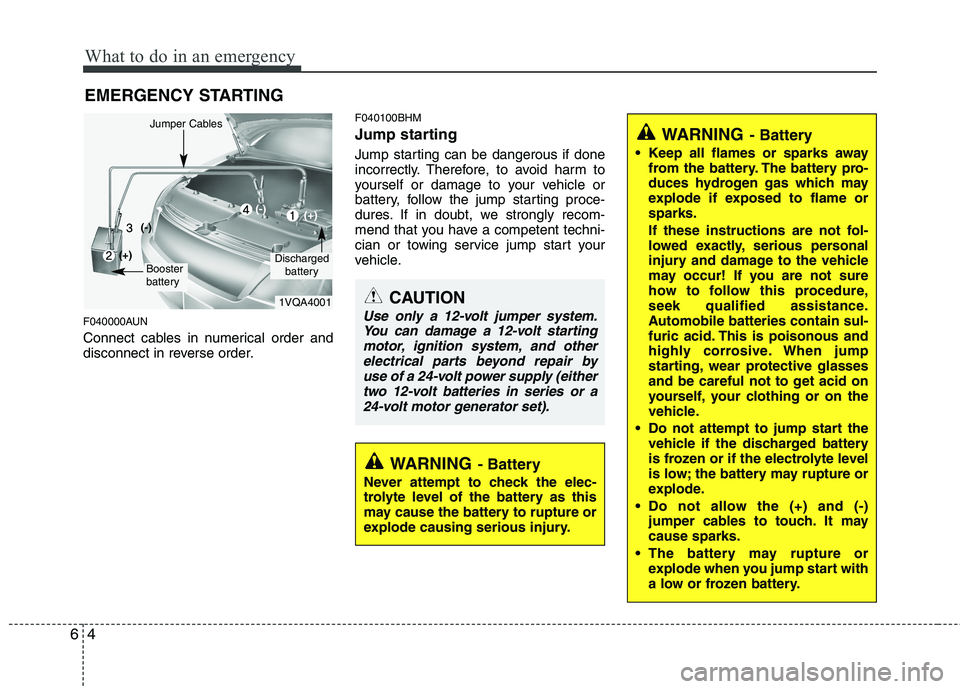
F040000AUN
Connect cables in numerical order and
disconnect in reverse order. F040100BHM
Jump starting
Jump starting can be dangerous if done
incorrectly. Therefore, to avoid harm to
yourself or damage to your vehicle or
battery, follow the jump starting proce-
dures. If in doubt, we strongly recom-
mend that you have a competent techni-
cian or towing service jump start your
vehicle.
CAUTION
Use only a 12-volt jumper system.
You can damage a 12-volt starting
motor, ignition system, and otherelectrical parts beyond repair by use of a 24-volt power supply (eithertwo 12-volt batteries in series or a24-volt motor generator set).
WARNING - Battery
• Keep all flames or sparks away from the battery. The battery pro-
duces hydrogen gas which may
explode if exposed to flame orsparks.
If these instructions are not fol-
lowed exactly, serious personal
injury and damage to the vehicle
may occur! If you are not sure
how to follow this procedure,
seek qualified assistance.
Automobile batteries contain sul-
furic acid. This is poisonous and
highly corrosive. When jump
starting, wear protective glasses
and be careful not to get acid on
yourself, your clothing or on the
vehicle.
Do not attempt to jump start the vehicle if the discharged battery
is frozen or if the electrolyte level
is low; the battery may rupture or
explode.
Do not allow the (+) and (-) jumper cables to touch. It maycause sparks.
The battery may rupture or explode when you jump start with
a low or frozen battery.
WARNING - Battery
Never attempt to check the elec-
trolyte level of the battery as this
may cause the battery to rupture or
explode causing serious injury.
1VQA4001
Discharged battery
Jumper Cables
Booster
battery
(-)
(+)
(+)(-)
Page 324 of 417
617
What to do in an emergency
When towing your vehicle in an emer- gency without wheel dollies :
1. Set the ignition switch in the ACC posi-tion.
2. Place the transmission shift lever in N (Neutral).
3. For part-time 4WD vehicle, set the transfer shift knob to 2H.
4. Release the parking brake.
F080300AHM
Emergency towing
If towing is necessary, we recommend
you to have it done by an authorized
Kia dealer or a commercial tow truck
service.If towing service is not available in an
emergency, your vehicle may be tem-
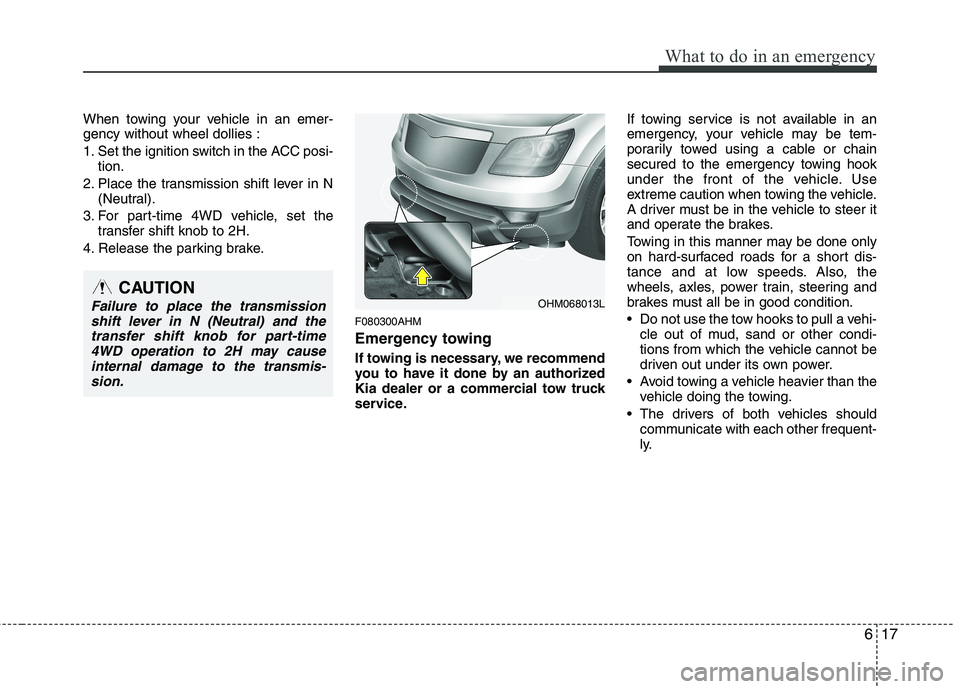
porarily towed using a cable or chain
secured to the emergency towing hook
under the front of the vehicle. Use
extreme caution when towing the vehicle.
A driver must be in the vehicle to steer it
and operate the brakes.
Towing in this manner may be done only
on hard-surfaced roads for a short dis-
tance and at low speeds. Also, the
wheels, axles, power train, steering and
brakes must all be in good condition.
Do not use the tow hooks to pull a vehi-
cle out of mud, sand or other condi-
tions from which the vehicle cannot be
driven out under its own power.
Avoid towing a vehicle heavier than the vehicle doing the towing.
The drivers of both vehicles should communicate with each other frequent-
ly.
OHM068013LCAUTION
Failure to place the transmission
shift lever in N (Neutral) and thetransfer shift knob for part-time
4WD operation to 2H may causeinternal damage to the transmis-sion.
Page 326 of 417
619
What to do in an emergency
F080301AHM
Emergency towing precautions
Turn the ignition switch to ACC so thesteering wheel isn’t locked.
Place the transmission shift lever in N (Neutral).
Release the parking bake.
Press the brake pedal with more force than usual since you will have reduced
brake performance.
More steering effort will be required because the power steering system
will be disabled.
If you are driving down a long hill, the brakes may overheat and brake per-
formance will be reduced. Stop often
and let the brakes cool off. F080400AHM
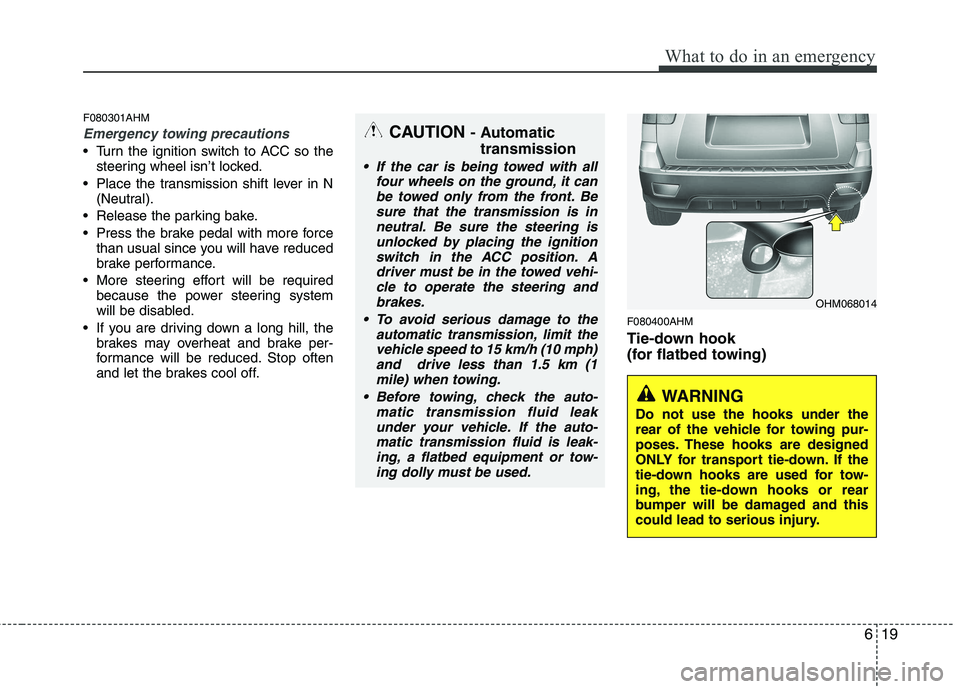
Tie-down hook
(for flatbed towing)
OHM068014
WARNING
Do not use the hooks under the
rear of the vehicle for towing pur-
poses. These hooks are designed
ONLY for transport tie-down. If the
tie-down hooks are used for tow-
ing, the tie-down hooks or rear
bumper will be damaged and this
could lead to serious injury.
CAUTION - Automatic
transmission
If the car is being towed with all four wheels on the ground, it can
be towed only from the front. Besure that the transmission is inneutral. Be sure the steering is unlocked by placing the ignition
switch in the ACC position. Adriver must be in the towed vehi-cle to operate the steering and
brakes.
To avoid serious damage to the automatic transmission, limit thevehicle speed to 15 km/h (10 mph)and drive less than 1.5 km (1
mile) when towing.
Before towing, check the auto- matic transmission fluid leakunder your vehicle. If the auto- matic transmission fluid is leak-
ing, a flatbed equipment or tow-ing dolly must be used.
Page 342 of 417
715
Maintenance
EXPLANATION OF SCHEDULED MAINTENANCE ITEMS
G050100AHM Engine oil and filter The engine oil and filter should be
changed at the intervals specified in the
maintenance schedule. If the vehicle is
being driven in severe conditions, morefrequent oil and filter changes arerequired.
G050200BUN Drive belts
Inspect all drive belts for evidence of
cuts, cracks, excessive wear or oil satu-
ration and replace if necessary. Drive
belts should be checked periodically forproper tension and adjusted as neces-
sary. G050300AUN
Fuel filter (cartridge) A clogged filter can limit the speed at
which the vehicle may be driven, damage
the emission system and cause multiple
issues such as hard starting. If an exces-
sive amount of foreign matter accumu-
lates in the fuel tank, the filter may
require replacement more frequently.
After installing a new filter, run the engine
for several minutes, and check for leaks
at the connections. Fuel filters should be
installed by an authorized Kia dealer.
G050400AHM
Fuel lines, fuel hoses and con- nections
Check the fuel lines, fuel hoses and con-
nections for leakage and damage. Have
an authorized Kia dealer replace any
damaged or leaking parts immediately.
WARNING -
Diesel only
Never work on the injection system with the engine running or within30 seconds after shutting off the
engine. High pressure pump, rail,
injectors and high pressure pipes
are subject to high pressure even
after the engine stopps. The fuel jet
produced by fuel leaks may cause
serious injury, if it touches the
body. People using pacemakers
should not more move than 30cm
closer to the ECU or wiring harness
within the engine room while the
engine is running, since the highcurrents in the Common Rail sys-
tem produce considerable magnet-ic fields.
CAUTION
When you are inspecting the belt, place the ignition switch in theLOCK/OFF or ACC position.
Page 352 of 417
725
Maintenance
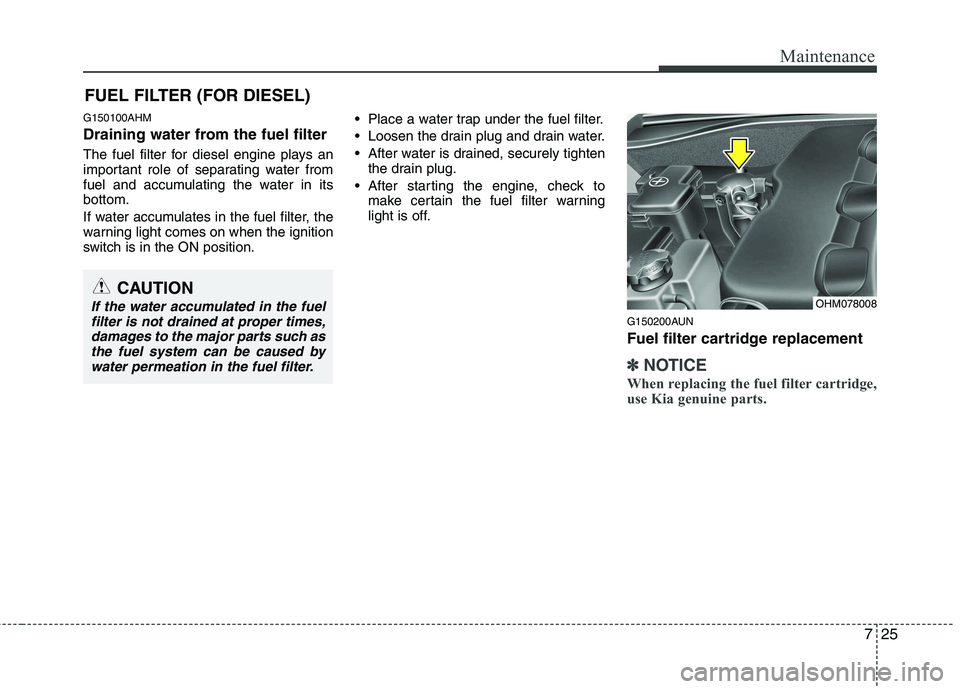
FUEL FILTER (FOR DIESEL)
G150100AHM
Draining water from the fuel filter
The fuel filter for diesel engine plays an
important role of separating water from
fuel and accumulating the water in itsbottom.
If water accumulates in the fuel filter, the
warning light comes on when the ignition
switch is in the ON position. Place a water trap under the fuel filter.
Loosen the drain plug and drain water.
After water is drained, securely tighten
the drain plug.
After starting the engine, check to make certain the fuel filter warning
light is off.
G150200AUN
Fuel filter cartridge replacement
✽✽NOTICE
When replacing the fuel filter cartridge,
use Kia genuine parts.
OHM078008CAUTION
If the water accumulated in the fuel filter is not drained at proper times,damages to the major parts such as
the fuel system can be caused bywater permeation in the fuel filter.
Page 360 of 417
733
Maintenance
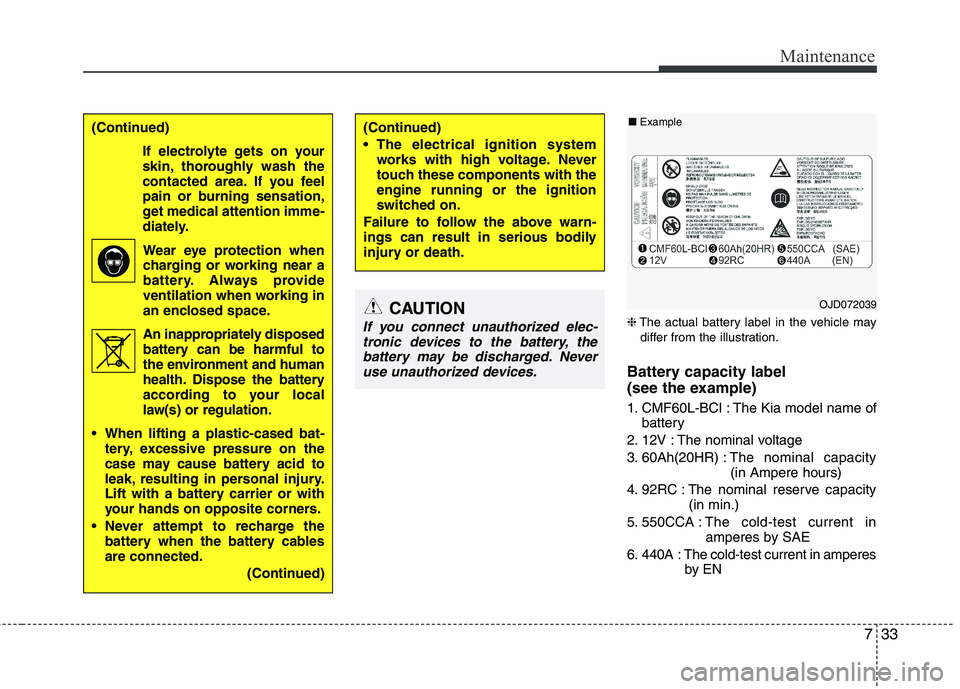
❈The actual battery label in the vehicle may
differ from the illustration.
Battery capacity label
(see the example)
1. CMF60L-BCI : The Kia model name of battery
2. 12V : The nominal voltage
3. 60Ah(20HR) : The nominal capacity
(in Ampere hours)
4. 92RC : The nominal reserve capacity (in min.)
5. 550CCA : The cold-test current in
amperes by SAE
6. 440A : The cold-test current in amperes by EN
OJD072039
■
Example
(Continued)
The electrical ignition system
works with high voltage. Never
touch these components with theengine running or the ignition
switched on.
Failure to follow the above warn-
ings can result in serious bodily
injury or death.(Continued)
If electrolyte gets on your
skin, thoroughly wash the
contacted area. If you feel
pain or burning sensation,
get medical attention imme-
diately.Wear eye protection whencharging or working near a
battery. Always provide
ventilation when working in
an enclosed space.
An inappropriately disposed battery can be harmful to
the environment and human
health. Dispose the battery
according to your local
law(s) or regulation.
When lifting a plastic-cased bat- tery, excessive pressure on the
case may cause battery acid to
leak, resulting in personal injury.
Lift with a battery carrier or with
your hands on opposite corners.
Never attempt to recharge the battery when the battery cablesare connected.
(Continued)
CAUTION
If you connect unauthorized elec-tronic devices to the battery, the
battery may be discharged. Neveruse unauthorized devices.
Page 373 of 417
Maintenance
46
7
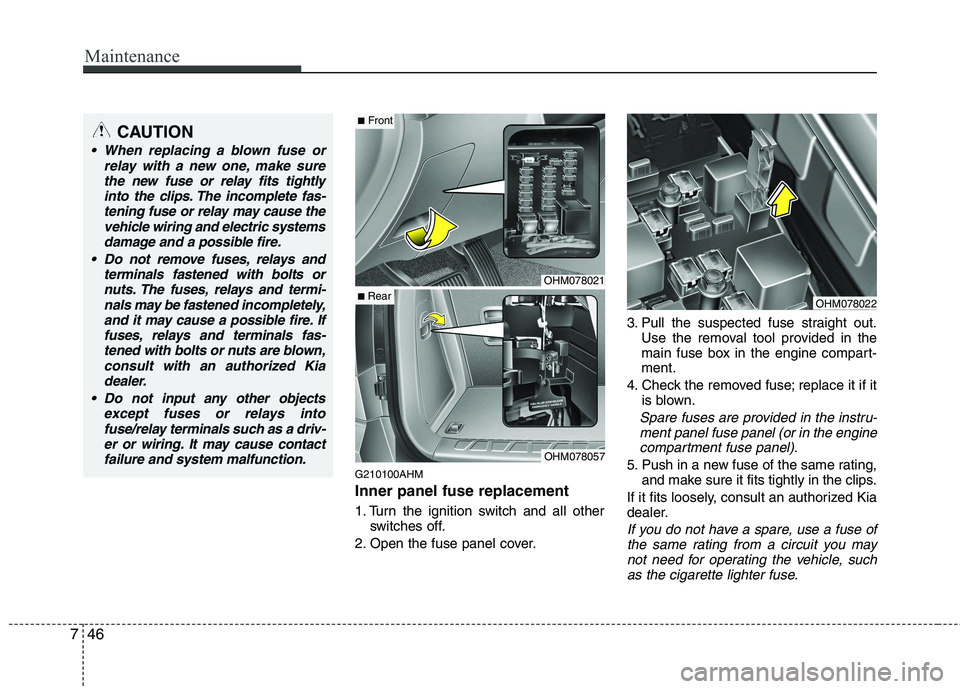
G210100AHM Inner panel fuse replacement
1. Turn the ignition switch and all other
switches off.
2. Open the fuse panel cover. 3. Pull the suspected fuse straight out.
Use the removal tool provided in the
main fuse box in the engine compart-ment.
4. Check the removed fuse; replace it if it is blown.
Spare fuses are provided in the instru-
ment panel fuse panel (or in the engine compartment fuse panel).
5. Push in a new fuse of the same rating, and make sure it fits tightly in the clips.
If it fits loosely, consult an authorized Kia
dealer.
If you do not have a spare, use a fuse of the same rating from a circuit you may not need for operating the vehicle, such as the cigarette lighter fuse.
OHM078022
OHM078021
OHM078057
■ Front
■ Rear
CAUTION
When replacing a blown fuse or
relay with a new one, make surethe new fuse or relay fits tightlyinto the clips. The incomplete fas-tening fuse or relay may cause the vehicle wiring and electric systemsdamage and a possible fire.
Do not remove fuses, relays and terminals fastened with bolts ornuts. The fuses, relays and termi-nals may be fastened incompletely, and it may cause a possible fire. Iffuses, relays and terminals fas-tened with bolts or nuts are blown,consult with an authorized Kia dealer.
Do not input any other objects except fuses or relays intofuse/relay terminals such as a driv-er or wiring. It may cause contactfailure and system malfunction.
Page 375 of 417
Maintenance
48
7
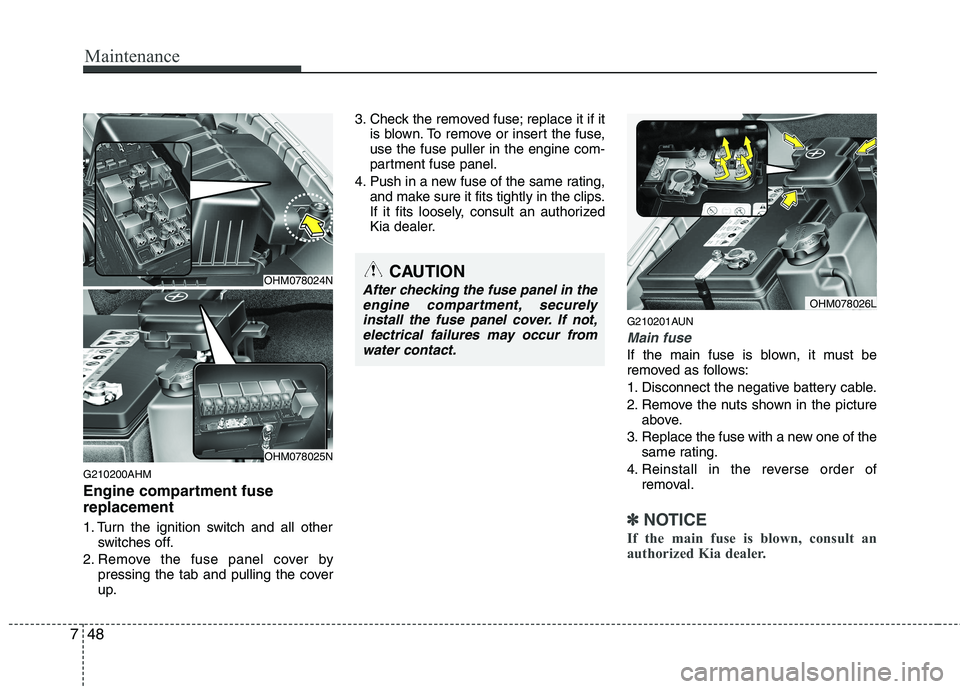
G210200AHM
Engine compartment fuse replacement
1. Turn the ignition switch and all other
switches off.
2. Remove the fuse panel cover by pressing the tab and pulling the cover
up. 3. Check the removed fuse; replace it if it
is blown. To remove or insert the fuse,use the fuse puller in the engine com-
partment fuse panel.
4. Push in a new fuse of the same rating, and make sure it fits tightly in the clips.
If it fits loosely, consult an authorized
Kia dealer.
G210201AUN
Main fuse
If the main fuse is blown, it must be
removed as follows:
1. Disconnect the negative battery cable.
2. Remove the nuts shown in the pictureabove.
3. Replace the fuse with a new one of the same rating.
4. Reinstall in the reverse order of removal.
✽✽ NOTICE
If the main fuse is blown, consult an
authorized Kia dealer.
CAUTION
After checking the fuse panel in the engine compartment, securely
install the fuse panel cover. If not,electrical failures may occur fromwater contact.OHM078026L
OHM078024N
OHM078025N
Page 380 of 417
753
Maintenance
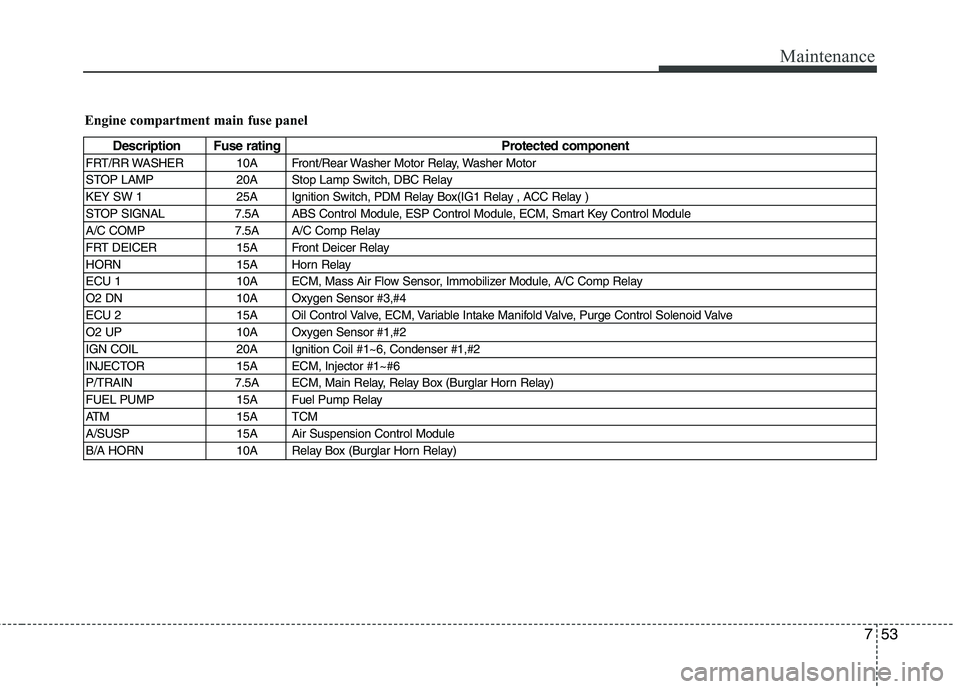
Engine compartment main fuse panel
Description Fuse ratingProtected component
FRT/RR WASHER 10A Front/Rear Washer Motor Relay, Washer Motor
STOP LAMP 20A Stop Lamp Switch, DBC Relay
KEY SW 1 25A Ignition Switch, PDM Relay Box(IG1 Relay , ACC Relay )
STOP SIGNAL 7.5A ABS Control Module, ESP Control Module, ECM, Smart Key Control Module
A/C COMP 7.5A A/C Comp Relay
FRT DEICER 15A Front Deicer Relay
HORN 15A Horn Relay
ECU 1 10A ECM, Mass Air Flow Sensor, Immobilizer Module, A/C Comp Relay
O2 DN 10A Oxygen Sensor #3,#4
ECU 2 15A Oil Control Valve, ECM, Variable Intake Manifold Valve, Purge Control Solenoid Valve
O2 UP 10A Oxygen Sensor #1,#2
IGN COIL 20A Ignition Coil #1~6, Condenser #1,#2
INJECTOR 15A ECM, Injector #1~#6
P/TRAIN 7.5A ECM, Main Relay, Relay Box (Burglar Horn Relay)
FUEL PUMP 15A Fuel Pump Relay
ATM 15A TCM
A/SUSP 15A Air Suspension Control Module
B/A HORN 10A Relay Box (Burglar Horn Relay)
Page 381 of 417
Maintenance
54
7
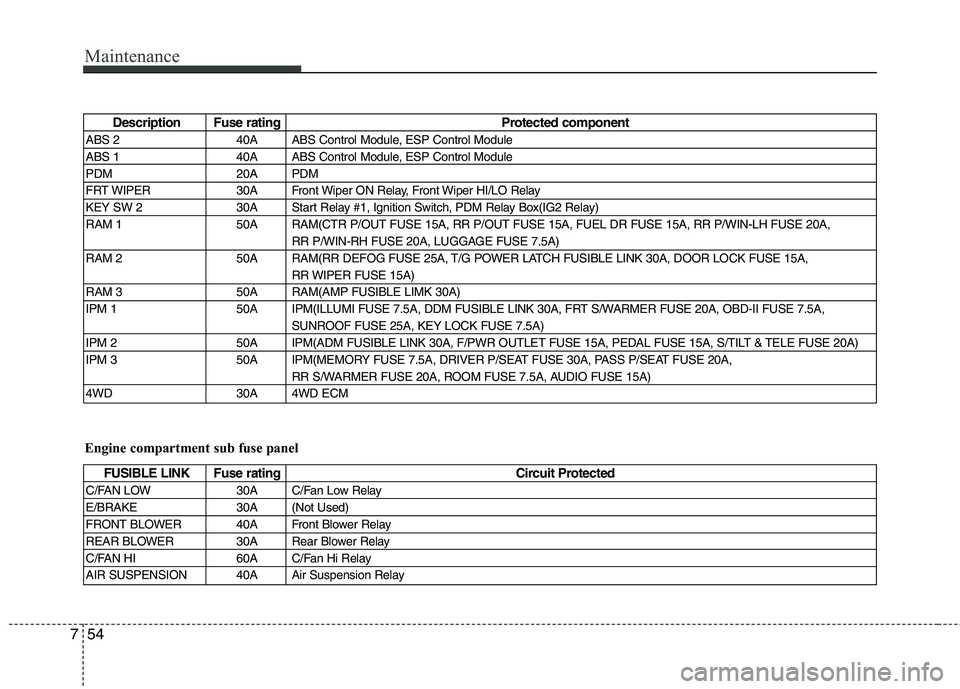
Description Fuse rating Protected component
ABS 2 40A ABS Control Module, ESP Control Module
ABS 1 40A ABS Control Module, ESP Control Module
PDM 20A PDM
FRT WIPER 30A Front Wiper ON Relay, Front Wiper HI/LO Relay
KEY SW 2 30A Start Relay #1, Ignition Switch, PDM Relay Box(IG2 Relay)
RAM 1 50A RAM(CTR P/OUT FUSE 15A, RR P/OUT FUSE 15A, FUEL DR FUSE 15A, RR P/WIN-LH FUSE 20A, RR P/WIN-RH FUSE 20A, LUGGAGE FUSE 7.5A)
RAM 2 50A RAM(RR DEFOG FUSE 25A, T/G POWER LATCH FUSIBLE LINK 30A, DOOR LOCK FUSE 15A, RR WIPER FUSE 15A)
RAM 3 50A RAM(AMP FUSIBLE LIMK 30A)
IPM 1 50A IPM(ILLUMI FUSE 7.5A, DDM FUSIBLE LINK 30A, FRT S/WARMER FUSE 20A, OBD-II FUSE 7.5A, SUNROOF FUSE 25A, KEY LOCK FUSE 7.5A)
IPM 2 50A IPM(ADM FUSIBLE LINK 30A, F/PWR OUTLET FUSE 15A, PEDAL FUSE 15A, S/TILT & TELE FUSE 20A)
IPM 3 50A IPM(MEMORY FUSE 7.5A, DRIVER P/SEAT FUSE 30A, PASS P/SEAT FUSE 20A, RR S/WARMER FUSE 20A, ROOM FUSE 7.5A, AUDIO FUSE 15A)
4WD 30A 4WD ECM
Engine compartment sub fuse panel
FUSIBLE LINK Fuse rating Circuit Protected
C/FAN LOW 30A C/Fan Low Relay
E/BRAKE 30A (Not Used)
FRONT BLOWER 40A Front Blower Relay
REAR BLOWER 30A Rear Blower Relay
C/FAN HI 60A C/Fan Hi Relay
AIR SUSPENSION 40A Air Suspension Relay