engine oil KIA MOHAVE 2014 User Guide
[x] Cancel search | Manufacturer: KIA, Model Year: 2014, Model line: MOHAVE, Model: KIA MOHAVE 2014Pages: 417, PDF Size: 38.72 MB
Page 294 of 417
553
Driving your vehicle
E110700AHM
Highway driving
Tires
Adjust the tire inflation pressures to
specification. Low tire inflation pressures
will result in overheating and possible
failure of the tires.
Avoid using worn or damaged tires which
may result in reduced traction or tire fail-
ure.
✽✽NOTICE
Never exceed the maximum tire inflation
pressure shown on the tires.
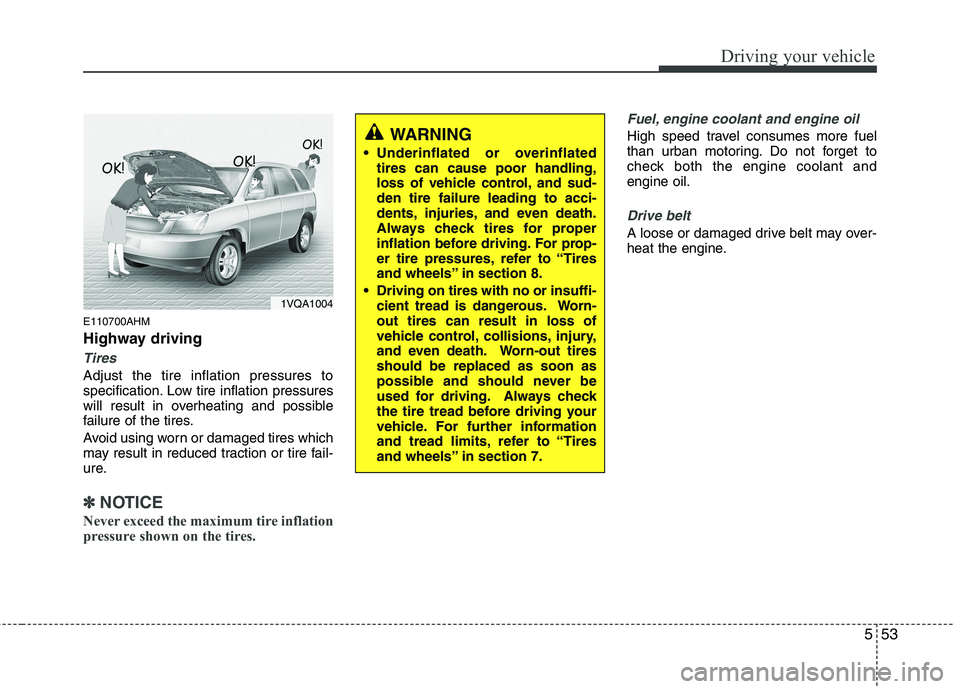
Fuel, engine coolant and engine oil
High speed travel consumes more fuel
than urban motoring. Do not forget to
check both the engine coolant andengine oil.
Drive belt
A loose or damaged drive belt may over-
heat the engine.
WARNING
Underinflated or overinflated tires can cause poor handling,
loss of vehicle control, and sud-den tire failure leading to acci-
dents, injuries, and even death.
Always check tires for proper
inflation before driving. For prop-
er tire pressures, refer to “Tires
and wheels” in section 8.
Driving on tires with no or insuffi- cient tread is dangerous. Worn-out tires can result in loss of
vehicle control, collisions, injury,
and even death. Worn-out tiresshould be replaced as soon as
possible and should never be
used for driving. Always check
the tire tread before driving your
vehicle. For further information
and tread limits, refer to “Tires
and wheels” in section 7.
1VQA1004
Page 304 of 417
563
Driving your vehicle
Maintenance when trailer towing
Your vehicle will need service more often
when you regularly pull a trailer.
Important items to pay particular atten-tion to include engine oil, automatic
transmission fluid, mission lubricant and
cooling system fluid. Brake condition is
another important item to frequently
check. Each item is covered in this man-
ual, and the Index will help you find them
quickly. If you’re trailering, it’s a good idea
to review these sections before you start
your trip.
Don’t forget to also maintain your trailer
and hitch. Follow the maintenance
schedule that accompanied your trailer
and check it periodically. Preferably, con-
duct the check at the start of each day’s
driving. Most importantly, all hitch nutsand bolts should be tight.If you do decide to pull a trailer
Here are some important points if you
decide to pull a trailer:
Consider using a sway control. You can
ask a hitch dealer about sway control.
Do not do any towing with your car dur- ing its first 2,000 km (1,200 miles) in
order to allow the engine to properly
break in. Failure to heed this caution
may result in serious engine or trans-
mission damage.
When towing a trailer, be sure to con- sult an authorized Kia dealer for further
information on additional requirements
such as a towing kit, etc.
Always drive your vehicle at a moder- ate speed (less than 100 km/h / 60mph).
On a long uphill grade, do not exceed 70 km/h (45 mph) or the posted towing
speed limit, whichever is lower.CAUTION
Due to higher load during trailer
usage, overheating might occurin hot days or during uphill driv-ing. If the coolant gauge indicatesover-heating, switch off the A/C
and stop the vehicle in a safe area to cool down the engine.
When towing, check the transmis- sion fluid more frequently.
If your vehicle is not equipped with an air conditioner, youshould install a condenser fan to improve engine performancewhen towing a trailer.
Page 310 of 417
63
What to do in an emergency
3. Have all passengers get out of thevehicle. Be sure they all get out on the
side of the vehicle that is away from the
traffic.
4. When changing a flat tire, follow the instruction provided later in this sec-tion.
F020300APB If the engine stalls while driving
1. Reduce your speed gradually, keeping a straight line. Move cautiously off the
road to a safe place.
2. Turn on your emergency flashers.
3. Try to start the engine again. If your vehicle will not start, contact an
authorized Kia dealer or seek other
qualified assistance. F030100AHM
If the engine doesn't turn over or
turns over slowly
1. If your vehicle has an automatic trans-
mission, be sure the gear shift lever is
in N (Neutral) or P (Park) and the
parking brake is set.
2. Check the battery connections to be sure they are clean and tight.
3. Turn on the interior light. If the light dims or goes out when you operate the
starter, the battery is discharged.
4. Check the starter connections to be sure they are securely tightened.
5. Do not push or pull the vehicle to start it. See instructions for "Jump starting". F030200AHM
If the engine turns over normally
but does not start
1. Check the fuel level.
2. With the ignition switch in the LOCK
position, check all connectors at the
ignition coils and spark plugs.
Reconnect any that may be discon-
nected or loose.
3. Check the fuel line in the engine com- partment.
4. If the engine still does not start, call an authorized Kia dealer or seek other
qualified assistance.
IF THE ENGINE WILL NOT START
WARNING
If the engine does not start, do not
push or pull the vehicle to start it.This could result in a collision or
cause other damage. In addition,
push or pull starting may cause the
catalytic converter to overload and
create a fire.
Page 328 of 417
7
Engine compartment / 7-2
Maintenance services / 7-4
Owner maintenance / 7-6
Scheduled maintenance service / 7-8
Explanation of scheduled maintenance items / 7-15
Engine oil / 7-18
Engine coolant / 7-19
Brake fluid / 7-22
Power steering fluid / 7-23
Washer fluid / 7-24
Parking brake / 7-24
Fuel filter / 7-25
Air cleaner / 7-26
Climate control air filter / 7-27
Wiper blades / 7-29
Battery / 7-32
Tires and wheels / 7-35
Fuses / 7-45
Light bulbs / 7-55
Appearance care / 7-62
Emission control system / 7-68
Maintenance
Page 329 of 417
Maintenance
2
7
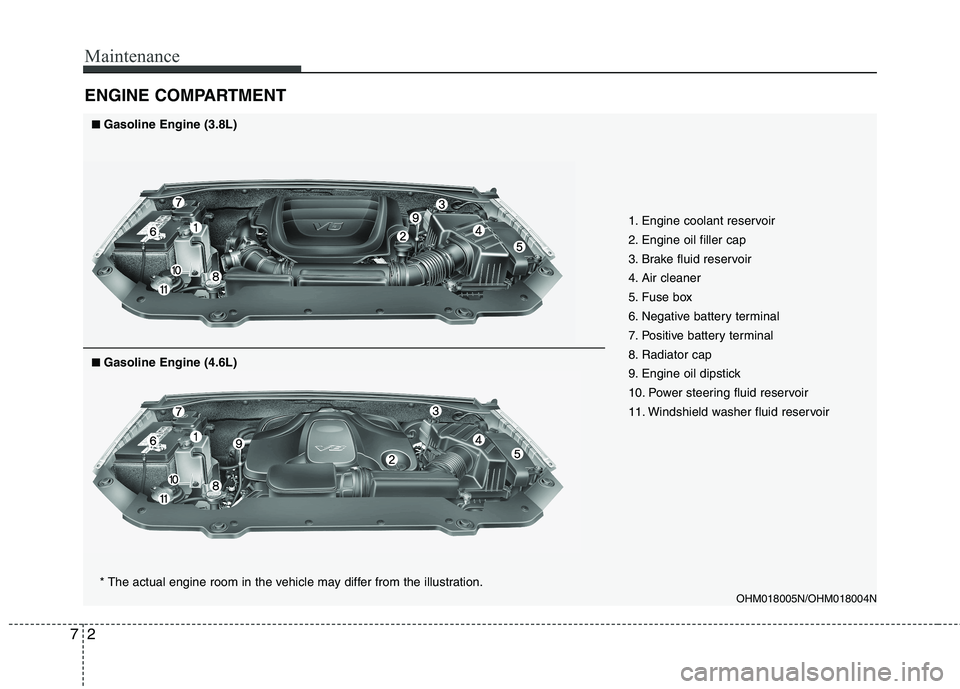
ENGINE COMPARTMENT
1. Engine coolant reservoir
2. Engine oil filler cap
3. Brake fluid reservoir
4. Air cleaner
5. Fuse box
6. Negative battery terminal
7. Positive battery terminal
8. Radiator cap
9. Engine oil dipstick
10. Power steering fluid reservoir
11. Windshield washer fluid reservoir
OHM018005N/OHM018004N
* The actual engine room in the vehicle may differ from the illustration.
■
■
Gasoline Engine (3.8L)
■■Gasoline Engine (4.6L)
Page 330 of 417
73
Maintenance
OHM013003
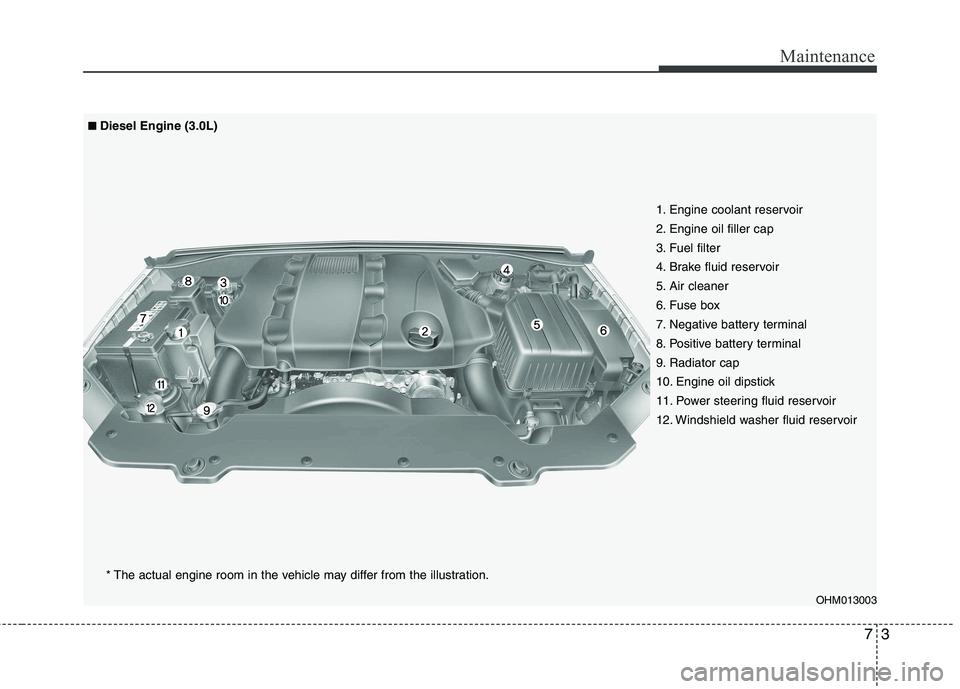
1. Engine coolant reservoir
2. Engine oil filler cap
3. Fuel filter
4. Brake fluid reservoir
5. Air cleaner
6. Fuse box
7. Negative battery terminal
8. Positive battery terminal
9. Radiator cap
10. Engine oil dipstick
11. Power steering fluid reservoir
12. Windshield washer fluid reservoir
■■
Diesel Engine (3.0L)
* The actual engine room in the vehicle may differ from the illustration.
Page 332 of 417
75
Maintenance
G020300AHM
Engine compartment precautions (Diesel engine)
The piezo injector operates at highvoltage (maximum 200v). Therefore,
the following accidents may occur.
- Direct contact with the injector orinjector wiring may cause electric
shock or damage your muscle or
nerve system.
- The electromagnetic wave from the operating injector may cause the arti-
ficial heart pacemaker to malfunction.
Follow the safety tips provided below, when you are checking the engine
room while the engine is running.
- Do not touch the injector, injectorwirings, and the engine computer
while the engine is running.
- Do not remove the injector connector while the engine is running.
- People using pacemakers must not go near the engine while the engine
is starting or running.
CAUTION
Do not put heavy objects or apply
excessive force on top of the
engine cover (if equipped) or fuelrelated parts.
When you inspect the fuel system (fuel lines and fuel injection
devices), we recommend that you contact an authorized Kia dealer.
Do not drive long time with the engine cover (if equipped)removed.
When checking the engine room, do not go near fire.
Fuel, washer fluid, etc. are flam-mable oils that may cause fire.
Before touching the battery, igni- tion cables and electrical wiring,
you should disconnect the battery"-" terminal. You may get an elec- tric shock from the electric current.
When you remove the interior trim cover with a flat head (-) driver, be
careful not to damage the cover.
Be careful when you replace and clean bulbs to avoid burns orelectrical shock.WARNING - Maintenance
work
Performing maintenance work on a vehicle can be dangerous. You
can be seriously injured while
performing some maintenance
procedures. If you lack sufficient
knowledge and experience or the
proper tools and equipment to do
the work, have it done by an
authorized Kia dealer.
Working under the hood with the engine running is dangerous. It
becomes even more dangerous
when you wear jewelry or loose
clothing. These can become
entangled in moving parts and
result in injury.
Therefore, if you must run the
engine while working under the
hood, make certain that you
remove all jewelry (especially
rings, bracelets, watches, and
necklaces) and all neckties,
scarves, and similar loose cloth-
ing before getting near theengine or cooling fans.
Page 333 of 417
Maintenance
6
7
G030000AHM
The following lists are vehicle checks and
inspections that should be performed by
the owner or an authorized Kia dealer atthe frequencies indicated to help ensure
safe, dependable operation of your vehi-
cle.
Any adverse conditions should be
brought to the attention of your dealer as
soon as possible.
These Owner Maintenance Checks are
generally not covered by warranties and
you may be charged for labor, parts and
lubricants used. Owner maintenance schedule G030101AHM
When you stop for fuel:
Check the engine oil level.
Check the coolant level in the coolant
reservoir.
Check the windshield washer fluid level.
Look for low or under-inflated tires.
WARNING
Be careful when checking your
engine coolant level when the
engine is hot. Scalding hot coolant
and steam may blow out under
pressure. This could cause burns
or other serious injury.
OWNER MAINTENANCE
WARNING - Diesel Engine
Never work on the injection system with the engine running or within30 seconds after shutting off the
engine. High-pressure pump, rail,
injectors and high-pressure pipes
are subject to high pressure even
after the engine stopped. The fuel
jet produced by fuel leaks may
cause serious injury, if it touches
the body. People using pacemakers
should not move more than 30cm
closer to the ECU or wiring harness
within the engine room while the
engine is running, since the high
currents in the electronic engine
control system produce consider-
able magnetic fields.
Page 336 of 417
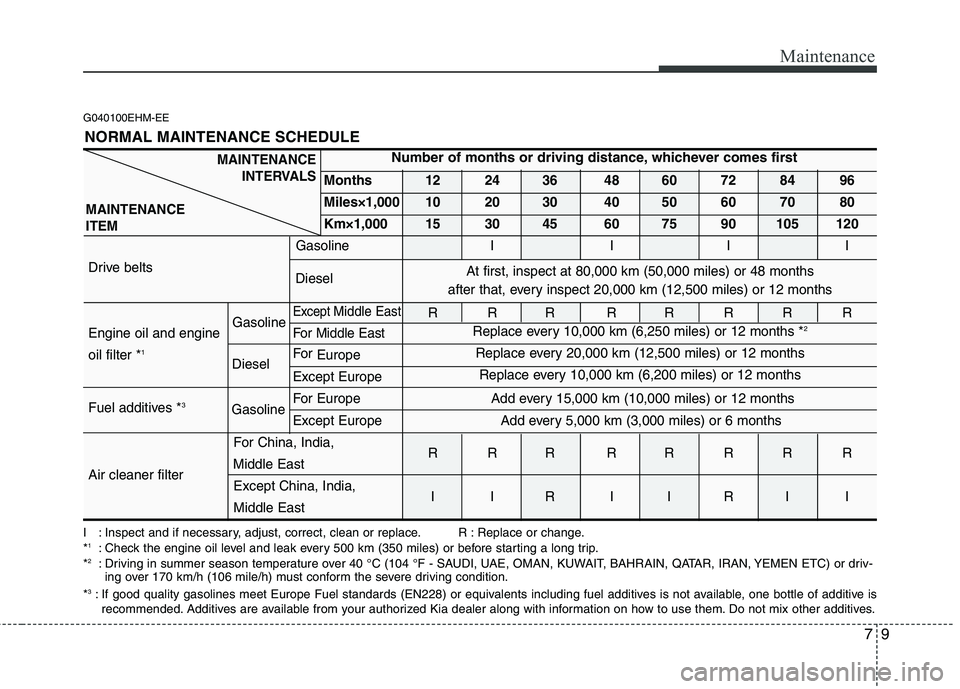
79
Maintenance
G040100EHM-EE
I : Inspect and if necessary, adjust, correct, clean or replace. R : Replace or change. *1
: Check the engine oil level and leak every 500 km (350 miles) or before starting a long trip.
* 2
: Driving in summer season temperature over 40 °C (104 °F - SAUDI, UAE, OMAN, KUWAIT, BAHRAIN, QATAR, IRAN, YEMEN ETC) or driv-
ing over 170 km/h (106 mile/h) must conform the severe driving condition.
* 3
: If good quality gasolines meet Europe Fuel standards (EN228) or equivalents including fuel additives is not available, one bottle of additive is
recommended. Additives are available from your authorized Kia dealer along with information on how to use them. Do not mix other additives.
MAINTENANCE
INTERVALS
MAINTENANCE ITEMNumber of months or driving distance, whichever comes first
Months 12 24 36 48 60 72 84 96
Miles×1,000 10 20 30 40 50 60 70 80
Km×1,000 15 30 45 60 75 90 105 120
Gasoline I I I I
Drive belts Diesel
Except Middle EastRRR RRRRR
Engine oil and engine Gasoline
For Middle East
oil filter *
1
DieselFor
Europe
Except Europe
Fuel additives * 3
For Europe Add every 15,000 km (10,000 miles) or 12 months
Gasoline Except Europe Add every 5,000 km (3,000 miles) or 6 months
For China, India, RRR RRRRR
Air cleaner filter Middle East
Except China, India, IIRIIRII
Middle East Replace every 20,000 km (12,500 miles) or 12 months
Replace every 10,000 km (6,200 miles) or 12 months
Replace every 10,000 km (6,250 miles) or 12 months *
2
At first, inspect at 80,000 km (50,000 miles) or 48 months
after that, every inspect 20,000 km (12,500 miles) or 12 months
NORMAL MAINTENANCE SCHEDULE
Page 340 of 417
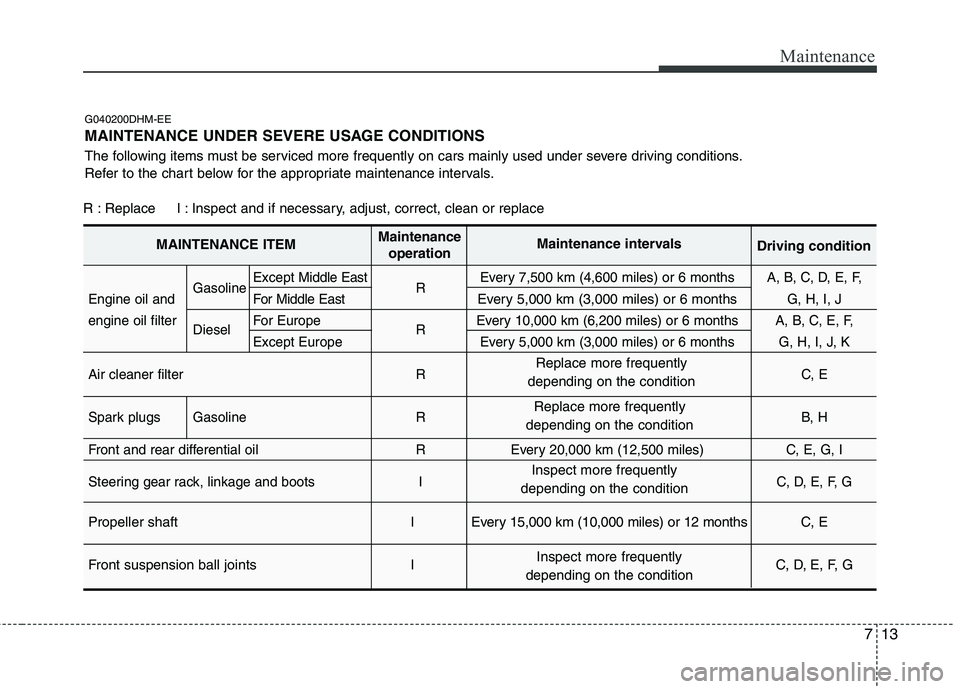
713
Maintenance
G040200DHM-EE
MAINTENANCE UNDER SEVERE USAGE CONDITIONS
The following items must be serviced more frequently on cars mainly used under severe driving conditions.
Refer to the chart below for the appropriate maintenance intervals.
R : Replace I : Inspect and if necessary, adjust, correct, clean or replace
Except Middle East Every 7,500 km (4,600 miles) or 6 months A, B, C, D, E, F,
Engine oil and Gasoline
For Middle East R
Every 5,000 km (3,000 miles) or 6 monthsG, H, I, J
engine oil filter DieselFor Europe Every 10,000 km (6,200 miles) or 6 months A, B, C, E, F, Except Europe R
Every 5,000 km (3,000 miles) or 6 months G, H, I, J, K
Air cleaner filter R C, E
Spark plugs Gasoline R B, H
Front and rear differential oil R Every 20,000 km (12,500 miles) C, E, G, I
Steering gear rack, linkage and boots I C, D, E, F, G
Propeller shaftI Every 15,000 km (10,000 miles) or 12 months C, E
Front suspension ball joints I C, D, E, F, G
MAINTENANCE ITEMMaintenance
operation Maintenance intervals
Driving condition
Replace more frequently
depending on the condition
Inspect more frequently
depending on the condition Replace more frequently
depending on the condition
Inspect more frequently
depending on the condition