engine overheat KIA MOHAVE 2014 User Guide
[x] Cancel search | Manufacturer: KIA, Model Year: 2014, Model line: MOHAVE, Model: KIA MOHAVE 2014Pages: 417, PDF Size: 38.72 MB
Page 302 of 417
561
Driving your vehicle
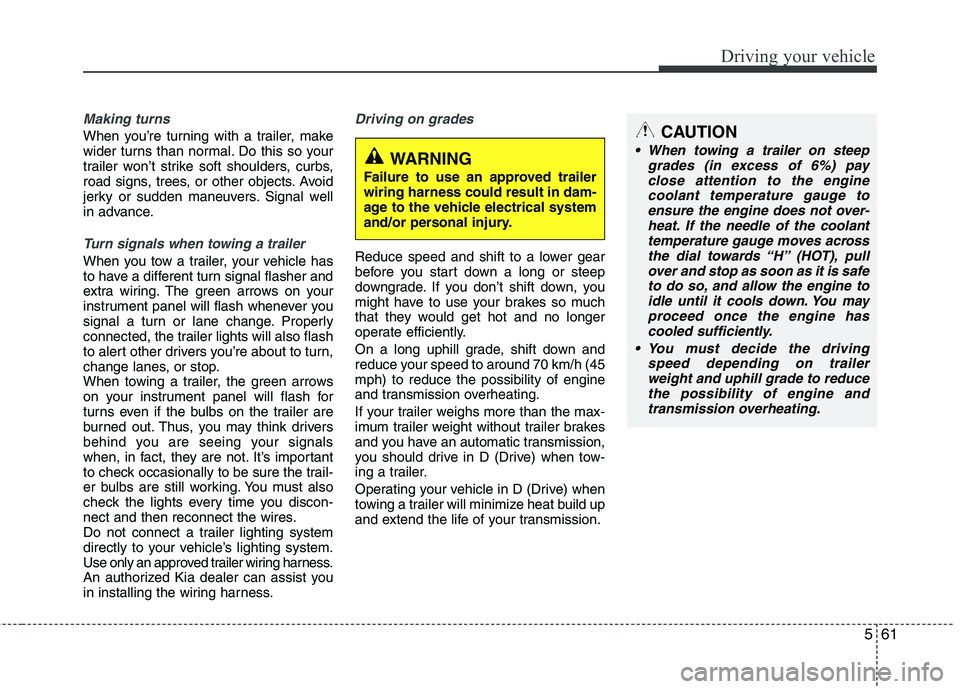
Making turns
When you’re turning with a trailer, make
wider turns than normal. Do this so your
trailer won’t strike soft shoulders, curbs,
road signs, trees, or other objects. Avoid
jerky or sudden maneuvers. Signal well
in advance.
Turn signals when towing a trailer
When you tow a trailer, your vehicle has
to have a different turn signal flasher and
extra wiring. The green arrows on your
instrument panel will flash whenever you
signal a turn or lane change. Properly
connected, the trailer lights will also flash
to alert other drivers you’re about to turn,
change lanes, or stop.
When towing a trailer, the green arrows
on your instrument panel will flash for
turns even if the bulbs on the trailer are
burned out. Thus, you may think drivers
behind you are seeing your signals
when, in fact, they are not. It’s important
to check occasionally to be sure the trail-
er bulbs are still working. You must also
check the lights every time you discon-
nect and then reconnect the wires.
Do not connect a trailer lighting system
directly to your vehicle’s lighting system.
Use only an approved trailer wiring harness.
An authorized Kia dealer can assist you
in installing the wiring harness.
Driving on grades
Reduce speed and shift to a lower gear
before you start down a long or steep
downgrade. If you don’t shift down, you
might have to use your brakes so much
that they would get hot and no longer
operate efficiently.
On a long uphill grade, shift down and
reduce your speed to around 70 km/h (45mph) to reduce the possibility of engine
and transmission overheating.
If your trailer weighs more than the max-
imum trailer weight without trailer brakes
and you have an automatic transmission,
you should drive in D (Drive) when tow-
ing a trailer.
Operating your vehicle in D (Drive) when
towing a trailer will minimize heat build up
and extend the life of your transmission.
WARNING
Failure to use an approved trailer wiring harness could result in dam-
age to the vehicle electrical system
and/or personal injury.
CAUTION
When towing a trailer on steep grades (in excess of 6%) pay
close attention to the engine coolant temperature gauge toensure the engine does not over-heat. If the needle of the coolant
temperature gauge moves acrossthe dial towards “H” (HOT), pull over and stop as soon as it is safe
to do so, and allow the engine to idle until it cools down. You mayproceed once the engine hascooled sufficiently.
You must decide the driving speed depending on trailerweight and uphill grade to reduce the possibility of engine andtransmission overheating.
Page 304 of 417
563
Driving your vehicle
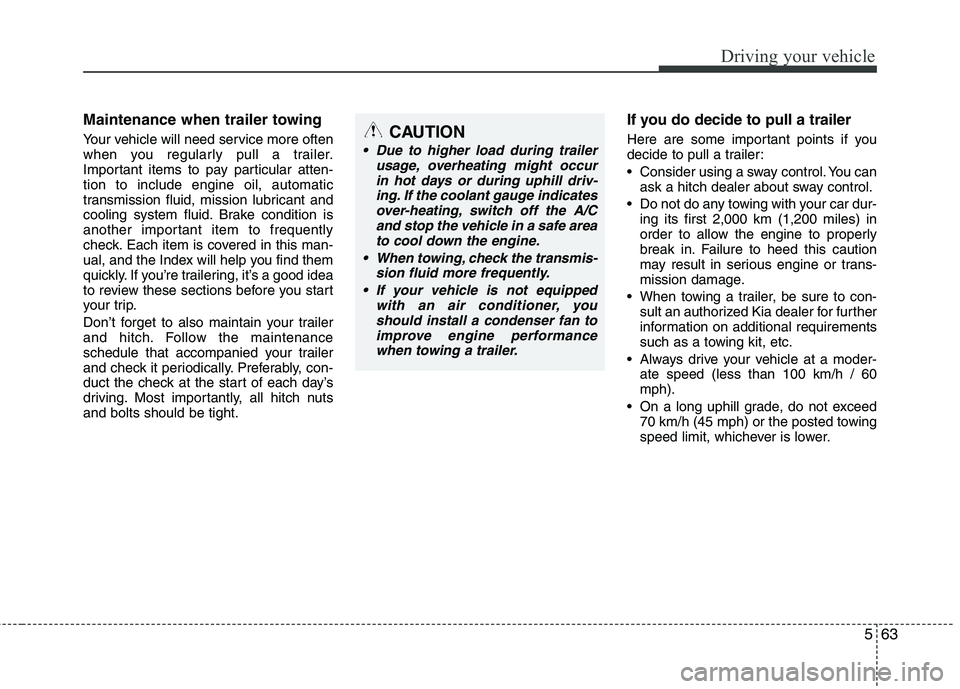
Maintenance when trailer towing
Your vehicle will need service more often
when you regularly pull a trailer.
Important items to pay particular atten-tion to include engine oil, automatic
transmission fluid, mission lubricant and
cooling system fluid. Brake condition is
another important item to frequently
check. Each item is covered in this man-
ual, and the Index will help you find them
quickly. If you’re trailering, it’s a good idea
to review these sections before you start
your trip.
Don’t forget to also maintain your trailer
and hitch. Follow the maintenance
schedule that accompanied your trailer
and check it periodically. Preferably, con-
duct the check at the start of each day’s
driving. Most importantly, all hitch nutsand bolts should be tight.If you do decide to pull a trailer
Here are some important points if you
decide to pull a trailer:
Consider using a sway control. You can
ask a hitch dealer about sway control.
Do not do any towing with your car dur- ing its first 2,000 km (1,200 miles) in
order to allow the engine to properly
break in. Failure to heed this caution
may result in serious engine or trans-
mission damage.
When towing a trailer, be sure to con- sult an authorized Kia dealer for further
information on additional requirements
such as a towing kit, etc.
Always drive your vehicle at a moder- ate speed (less than 100 km/h / 60mph).
On a long uphill grade, do not exceed 70 km/h (45 mph) or the posted towing
speed limit, whichever is lower.CAUTION
Due to higher load during trailer
usage, overheating might occurin hot days or during uphill driv-ing. If the coolant gauge indicatesover-heating, switch off the A/C
and stop the vehicle in a safe area to cool down the engine.
When towing, check the transmis- sion fluid more frequently.
If your vehicle is not equipped with an air conditioner, youshould install a condenser fan to improve engine performancewhen towing a trailer.
Page 308 of 417
6
Road warning / 6-2
In case of an emergency while driving / 6-2
If the engine will not start / 6-3
Emergency starting / 6-4
If the engine overheats / 6-6
If you have a flat tire / 6-7
Towing / 6-16
Emergency commodity / 6-20
What to do in an emergency
Page 312 of 417
65
What to do in an emergency
F040101AHM
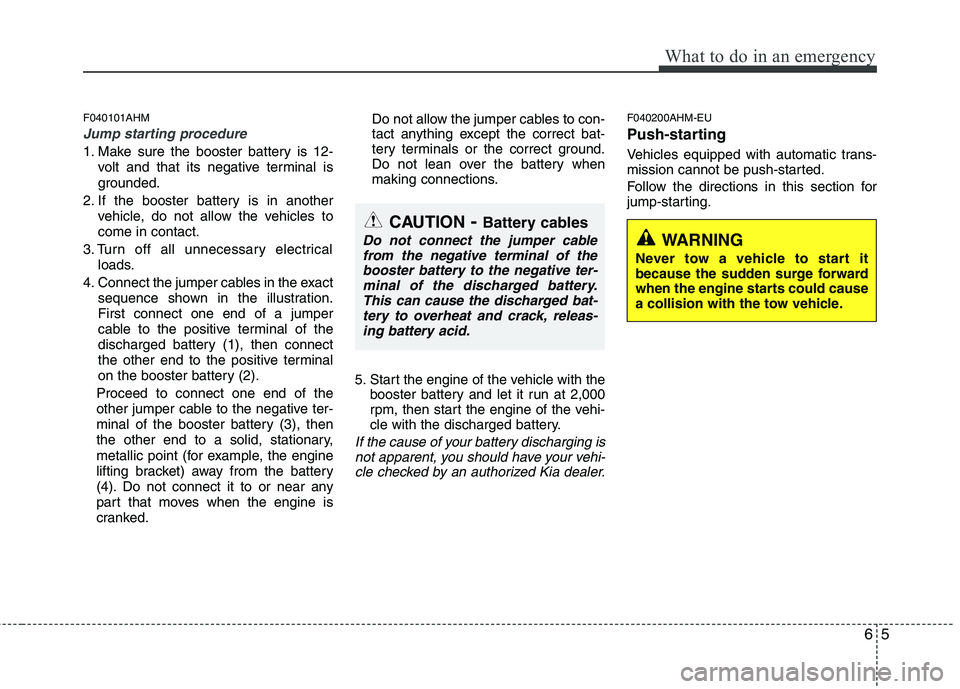
Jump starting procedure
1. Make sure the booster battery is 12-volt and that its negative terminal is
grounded.
2. If the booster battery is in another vehicle, do not allow the vehicles tocome in contact.
3. Turn off all unnecessary electrical loads.
4. Connect the jumper cables in the exact sequence shown in the illustration.First connect one end of a jumper
cable to the positive terminal of the
discharged battery (1), then connect
the other end to the positive terminal
on the booster battery (2).
Proceed to connect one end of the
other jumper cable to the negative ter-
minal of the booster battery (3), then
the other end to a solid, stationary,
metallic point (for example, the engine
lifting bracket) away from the battery
(4). Do not connect it to or near any
part that moves when the engine is
cranked. Do not allow the jumper cables to con-
tact anything except the correct bat-
tery terminals or the correct ground.
Do not lean over the battery when
making connections.
5. Start the engine of the vehicle with the booster battery and let it run at 2,000
rpm, then start the engine of the vehi-
cle with the discharged battery.
If the cause of your battery discharging is
not apparent, you should have your vehi-
cle checked by an authorized Kia dealer.
F040200AHM-EU
Push-starting
Vehicles equipped with automatic trans-
mission cannot be push-started.
Follow the directions in this section for
jump-starting.
CAUTION - Battery cables
Do not connect the jumper cable
from the negative terminal of thebooster battery to the negative ter- minal of the discharged battery.
This can cause the discharged bat- tery to overheat and crack, releas-ing battery acid.WARNING
Never tow a vehicle to start it
because the sudden surge forward
when the engine starts could cause
a collision with the tow vehicle.
Page 313 of 417
What to do in an emergency
6
6
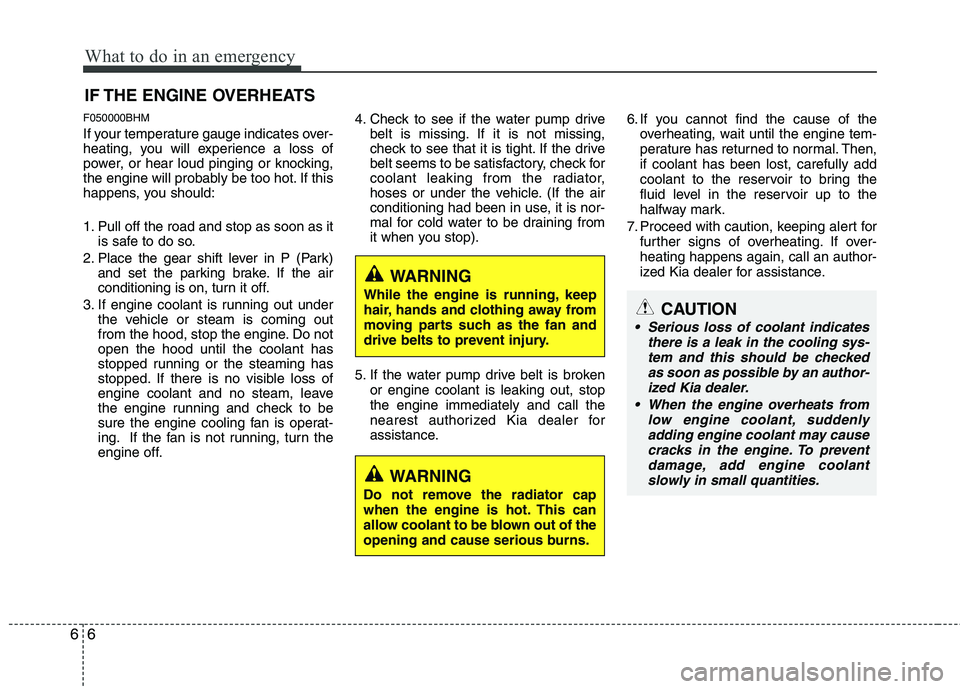
IF THE ENGINE OVERHEATS
F050000BHM
If your temperature gauge indicates over-
heating, you will experience a loss of
power, or hear loud pinging or knocking,
the engine will probably be too hot. If this
happens, you should:
1. Pull off the road and stop as soon as it is safe to do so.
2. Place the gear shift lever in P (Park) and set the parking brake. If the air
conditioning is on, turn it off.
3. If engine coolant is running out under the vehicle or steam is coming out
from the hood, stop the engine. Do notopen the hood until the coolant has
stopped running or the steaming has
stopped. If there is no visible loss of
engine coolant and no steam, leave
the engine running and check to be
sure the engine cooling fan is operat-
ing. If the fan is not running, turn the
engine off. 4. Check to see if the water pump drive
belt is missing. If it is not missing,
check to see that it is tight. If the drive
belt seems to be satisfactory, check for
coolant leaking from the radiator,
hoses or under the vehicle. (If the air
conditioning had been in use, it is nor-
mal for cold water to be draining from
it when you stop).
5. If the water pump drive belt is broken or engine coolant is leaking out, stop the engine immediately and call the
nearest authorized Kia dealer for
assistance. 6. If you cannot find the cause of the
overheating, wait until the engine tem-
perature has returned to normal. Then,if coolant has been lost, carefully add
coolant to the reservoir to bring the
fluid level in the reservoir up to the
halfway mark.
7. Proceed with caution, keeping alert for further signs of overheating. If over-heating happens again, call an author-
ized Kia dealer for assistance.
WARNING
While the engine is running, keep
hair, hands and clothing away from
moving parts such as the fan and
drive belts to prevent injury.
WARNING
Do not remove the radiator cap
when the engine is hot. This can
allow coolant to be blown out of the
opening and cause serious burns.
CAUTION
Serious loss of coolant indicates there is a leak in the cooling sys-
tem and this should be checked as soon as possible by an author-ized Kia dealer.
When the engine overheats from low engine coolant, suddenly
adding engine coolant may causecracks in the engine. To prevent damage, add engine coolantslowly in small quantities.
Page 346 of 417
719
Maintenance
G060200ASA Changing the engine oil and filter
Have engine oil and filter changed by an
authorized Kia dealer according to theMaintenance Schedule at the beginningof this section.G070000BHM The high-pressure cooling system has a
reservoir filled with year round antifreeze
coolant. The reservoir is filled at the fac-
tory.
Check the antifreeze protection and
coolant level at least once a year, at thebeginning of the winter season, and
before traveling to a colder climate.G070100BFD
Checking the coolant level
WARNING
Used engine oil may cause skin irri- tation or cancer if left in contact
with the skin for prolonged periods
of time. Used engine oil contains
chemicals that have caused cancer
in laboratory animals. Always pro-
tect your skin by washing your
hands thoroughly with soap and
warm water as soon as possibleafter handling used oil.
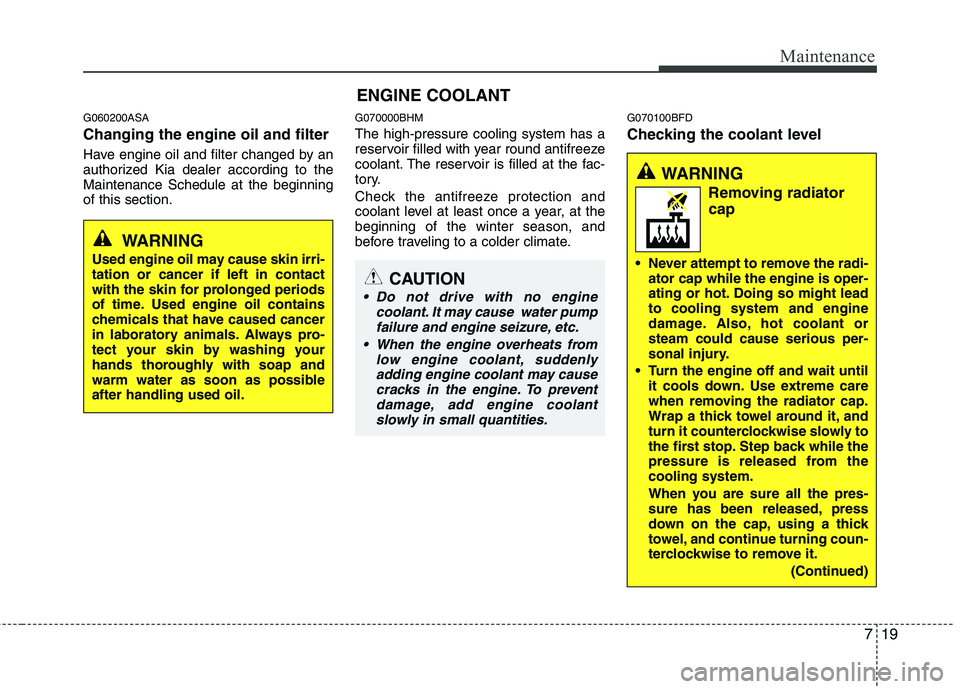
ENGINE COOLANT
WARNING
Removing radiatorcap
Never attempt to remove the radi- ator cap while the engine is oper-
ating or hot. Doing so might leadto cooling system and engine
damage. Also, hot coolant orsteam could cause serious per-
sonal injury.
Turn the engine off and wait until it cools down. Use extreme care
when removing the radiator cap.
Wrap a thick towel around it, and
turn it counterclockwise slowly to
the first stop. Step back while the
pressure is released from thecooling system.
When you are sure all the pres-
sure has been released, press
down on the cap, using a thick
towel, and continue turning coun-
terclockwise to remove it.
(Continued)
CAUTION
Do not drive with no enginecoolant. It may cause water pumpfailure and engine seizure, etc.
When the engine overheats from low engine coolant, suddenlyadding engine coolant may causecracks in the engine. To preventdamage, add engine coolant
slowly in small quantities.
Page 411 of 417
Index
4
I
Defroster (Rear window) ···············································4-84
Defrosting (Windshield) ··············································4-110
Digital clock ·································································4-119Dimensions ······································································8-2
Displays, see instrument cluster ····································4-47
Display illumination, see instrument panel illumination ··· 4-49
Door courtesy lamp bulb replacement ····························7-60
Door locks ·······································································4-14 Central door lock switch ··········································4-15
Child-protector rear door lock ·································4-17
Downhill brake control (DBC) ······································5-37
Drinks holders, see cup holders ···································4-117
Driver's air bag ·······························································3-48
Driver position memory system······································4-33
Driving at night ······························································5-51
Driving in flooded areas ················································5-52
Driving in the rain ··························································5-52
Economical operation ····················································5-48
Electric chromic mirror (ECM) ·····································4-40
Electric chromic mirror (ECM) with compass ··············4-41
Electronic stability program (ESP) ·································5-33
Emergency starting ··························································6-4 Jump starting ······························································6-4
Push starting ·······························································6-5
Emergency tailgate safety release ··································4-19 Emergency towing ·························································6-17
Emergency while driving ·················································6-2
Emergency commodity ··················································6-20
Emission control system ················································7-68
Crankcase emission control system ·························7-68
Evaporative emission control system ·······················7-68
Exhaust emission control system ·····························7-69
Engine compartment ················································2-4, 7-2
Engine coolant ·······························································7-19
Engine number ·································································8-8
Engine oil ·······································································7-18
Engine overheats ······························································6-6
Engine start/stop button ···················································5-6
Engine temperature gauge ·············································4-50
Engine will not start ·························································6-3
Evaporative emission control system ····························7-68
Exhaust emission control system ···································7-69Explanation of scheduled maintenance items ················7-15
Exterior care ···································································7-62
Exterior features ···························································4-124 Roof rack ································································4-124
Side step ··································································4-125
Flat tire ·············································································6-7 Changing tires ····························································6-9
Compact spare tire ···················································6-14
E
F
Page 414 of 417
I7
Index
Lighting ··········································································4-71
Battery saver function ··············································4-71
Rescue mode function ···············································4-71
Locking differential ························································5-40
Lubricants and capacities ·················································8-4
Luggage box ·································································4-115Luggage net (holder) ····················································4-122
Luggage rack, see roof rack ·········································4-124
Lumbar support ······················································3-8, 3-13
Main fuse ········································································7-48 Maintenance Explanation of scheduled maintenance items ···········7-15Maintenance services ················································· 7-4
Maintenance under severe usage conditions ·············7-13 Normal maintenance schedule ····································7-9
Owner maintenance ····················································7-6
Scheduled maintenance service ·································7-8
Tire maintenance ······················································7-40
Maintenance services ·······················································7-4
Manual climate control system ······································4-86 Air conditioning ·······················································4-92
Climate control air filter ···········································4-98
Heating and air conditioning ····································4-88
Manual heating and air conditioning ···························4-102
Memory fuse ··································································7-47 Mirrors ···········································································4-40
Day/night rearview mirror ·······································4-40
Electric chromic mirror (ECM) ·······························4-40
Electric chromic mirror (ECM) with compass ········4-41
Inside rearview mirror ··············································4-40
Outside rearview mirror ···········································4-45
Moonroof, see panorama sunroof ··································4-29
Multi box·······································································4-115
Neck restraints, see headrest ··································3-5, 3-14Odometer ·······································································4-52
Oil (Engine) ···································································7-18
Outside rearview mirror ·················································4-45
Outside thermometer·····················································4-120
Overheats ·········································································6-6
Owner maintenance ·························································7-6
O
M
N