towing KIA MOHAVE 2014 User Guide
[x] Cancel search | Manufacturer: KIA, Model Year: 2014, Model line: MOHAVE, Model: KIA MOHAVE 2014Pages: 417, PDF Size: 38.72 MB
Page 306 of 417
565
Driving your vehicle
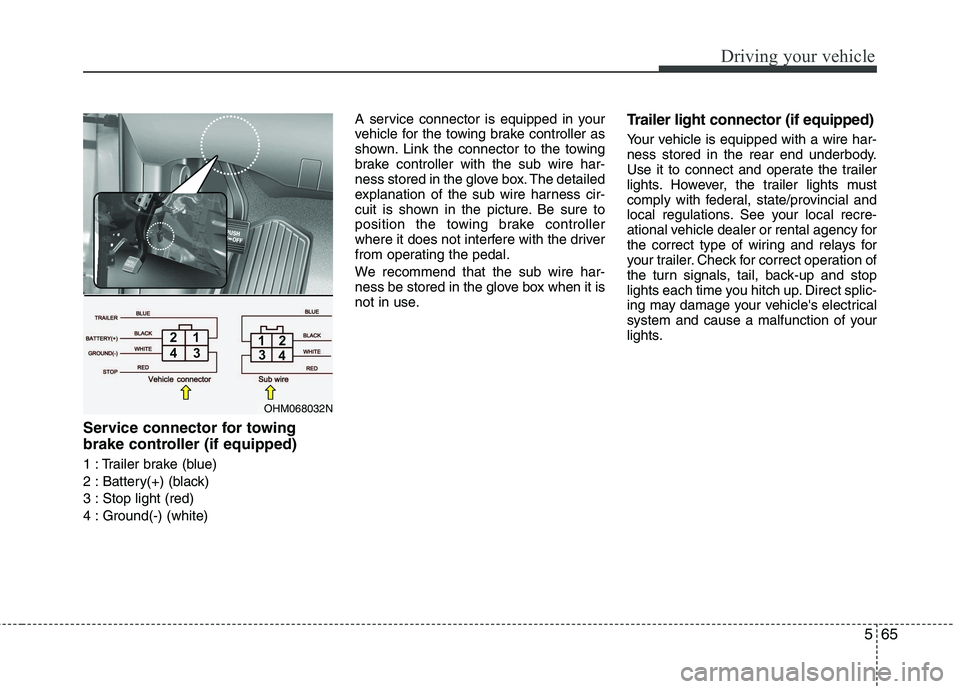
Service connector for towing
brake controller (if equipped)
1 : Trailer brake (blue)
2 : Battery(+) (black)
3 : Stop light (red)
4 : Ground(-) (white)A service connector is equipped in your
vehicle for the towing brake controller as
shown. Link the connector to the towing
brake controller with the sub wire har-
ness stored in the glove box. The detailed
explanation of the sub wire harness cir-
cuit is shown in the picture. Be sure to
position the towing brake controller
where it does not interfere with the driver
from operating the pedal.
We recommend that the sub wire har-
ness be stored in the glove box when it is
not in use.
Trailer light connector (if equipped)
Your vehicle is equipped with a wire har-
ness stored in the rear end underbody.
Use it to connect and operate the trailer
lights. However, the trailer lights must
comply with federal, state/provincial and
local regulations. See your local recre-
ational vehicle dealer or rental agency for
the correct type of wiring and relays for
your trailer. Check for correct operation of
the turn signals, tail, back-up and stop
lights each time you hitch up. Direct splic-
ing may damage your vehicle's electrical
system and cause a malfunction of your
lights.
OHM068032N
Page 308 of 417
6
Road warning / 6-2
In case of an emergency while driving / 6-2
If the engine will not start / 6-3
Emergency starting / 6-4
If the engine overheats / 6-6
If you have a flat tire / 6-7
Towing / 6-16
Emergency commodity / 6-20
What to do in an emergency
Page 311 of 417
What to do in an emergency
4
6
EMERGENCY STARTING
F040000AUN
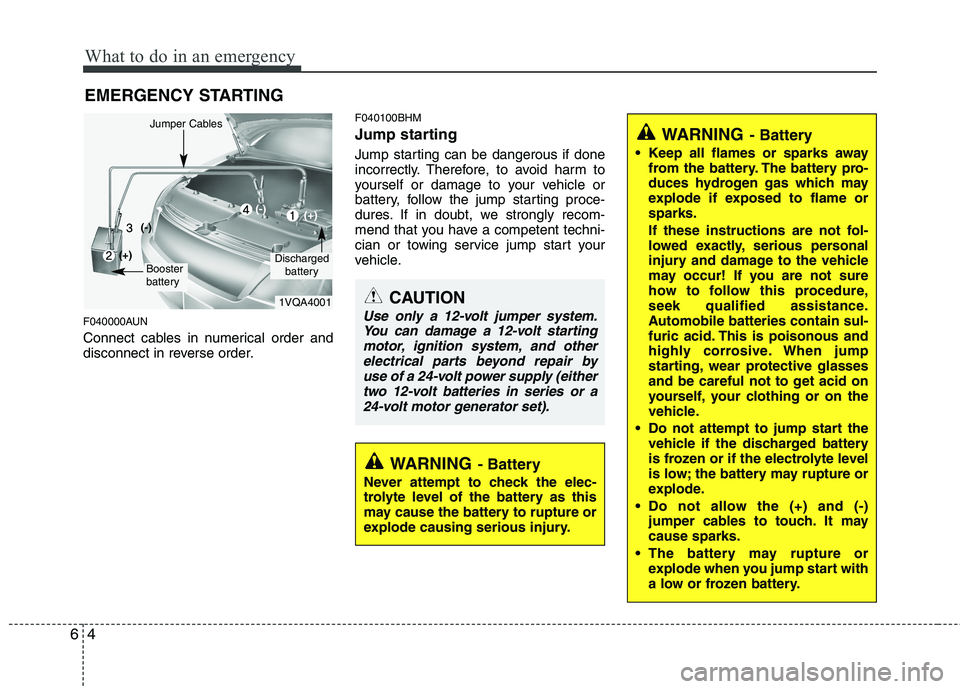
Connect cables in numerical order and
disconnect in reverse order. F040100BHM
Jump starting
Jump starting can be dangerous if done
incorrectly. Therefore, to avoid harm to
yourself or damage to your vehicle or
battery, follow the jump starting proce-
dures. If in doubt, we strongly recom-
mend that you have a competent techni-
cian or towing service jump start your
vehicle.
CAUTION
Use only a 12-volt jumper system.
You can damage a 12-volt starting
motor, ignition system, and otherelectrical parts beyond repair by use of a 24-volt power supply (eithertwo 12-volt batteries in series or a24-volt motor generator set).
WARNING - Battery
• Keep all flames or sparks away from the battery. The battery pro-
duces hydrogen gas which may
explode if exposed to flame orsparks.
If these instructions are not fol-
lowed exactly, serious personal
injury and damage to the vehicle
may occur! If you are not sure
how to follow this procedure,
seek qualified assistance.
Automobile batteries contain sul-
furic acid. This is poisonous and
highly corrosive. When jump
starting, wear protective glasses
and be careful not to get acid on
yourself, your clothing or on the
vehicle.
Do not attempt to jump start the vehicle if the discharged battery
is frozen or if the electrolyte level
is low; the battery may rupture or
explode.
Do not allow the (+) and (-) jumper cables to touch. It maycause sparks.
The battery may rupture or explode when you jump start with
a low or frozen battery.
WARNING - Battery
Never attempt to check the elec-
trolyte level of the battery as this
may cause the battery to rupture or
explode causing serious injury.
1VQA4001
Discharged battery
Jumper Cables
Booster
battery
(-)
(+)
(+)(-)
Page 314 of 417
67
What to do in an emergency
IF YOU HAVE A FLAT TIRE
F070100AEN
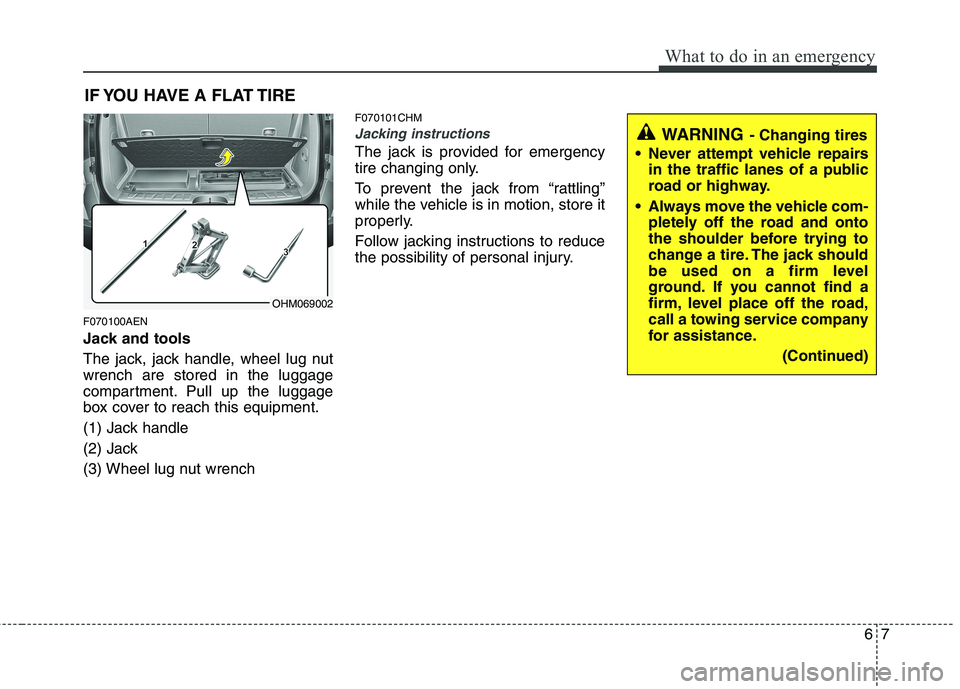
Jack and tools
The jack, jack handle, wheel lug nut wrench are stored in the luggage
compartment. Pull up the luggage
box cover to reach this equipment.
(1) Jack handle
(2) Jack
(3) Wheel lug nut wrench F070101CHM
Jacking instructions
The jack is provided for emergency
tire changing only.
To prevent the jack from “rattling”
while the vehicle is in motion, store it
properly.
Follow jacking instructions to reduce
the possibility of personal injury.
OHM069002
WARNING
- Changing tires
Never attempt vehicle repairs in the traffic lanes of a public
road or highway.
Always move the vehicle com- pletely off the road and onto
the shoulder before trying to
change a tire. The jack should
be used on a firm level
ground. If you cannot find a
firm, level place off the road,
call a towing service company
for assistance.
(Continued)
Page 323 of 417
What to do in an emergency
16
6
TOWING
F080100AHM-EE
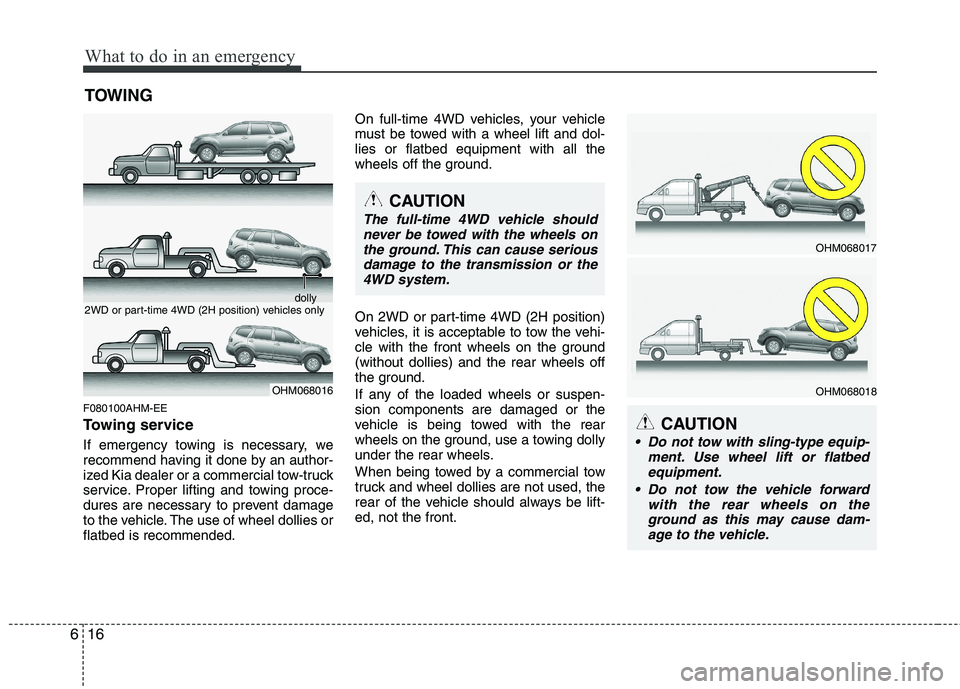
Towing service
If emergency towing is necessary, we
recommend having it done by an author-
ized Kia dealer or a commercial tow-truck
service. Proper lifting and towing proce-
dures are necessary to prevent damage
to the vehicle. The use of wheel dollies orflatbed is recommended. On full-time 4WD vehicles, your vehicle
must be towed with a wheel lift and dol-lies or flatbed equipment with all the
wheels off the ground.
On 2WD or part-time 4WD (2H position)
vehicles, it is acceptable to tow the vehi-
cle with the front wheels on the ground(without dollies) and the rear wheels off
the ground.
If any of the loaded wheels or suspen- sion components are damaged or the
vehicle is being towed with the rear
wheels on the ground, use a towing dolly
under the rear wheels.
When being towed by a commercial tow
truck and wheel dollies are not used, the
rear of the vehicle should always be lift-ed, not the front.
OHM068016
CAUTION
The full-time 4WD vehicle should
never be towed with the wheels onthe ground. This can cause serious
damage to the transmission or the4WD system.
dolly2WD or part-time 4WD (2H position) vehicles only
CAUTION
Do not tow with sling-type equip-
ment. Use wheel lift or flatbedequipment.
Do not tow the vehicle forward with the rear wheels on theground as this may cause dam-
age to the vehicle.
OHM068017
OHM068018
Page 324 of 417
617
What to do in an emergency
When towing your vehicle in an emer- gency without wheel dollies :
1. Set the ignition switch in the ACC posi-tion.
2. Place the transmission shift lever in N (Neutral).
3. For part-time 4WD vehicle, set the transfer shift knob to 2H.
4. Release the parking brake.
F080300AHM
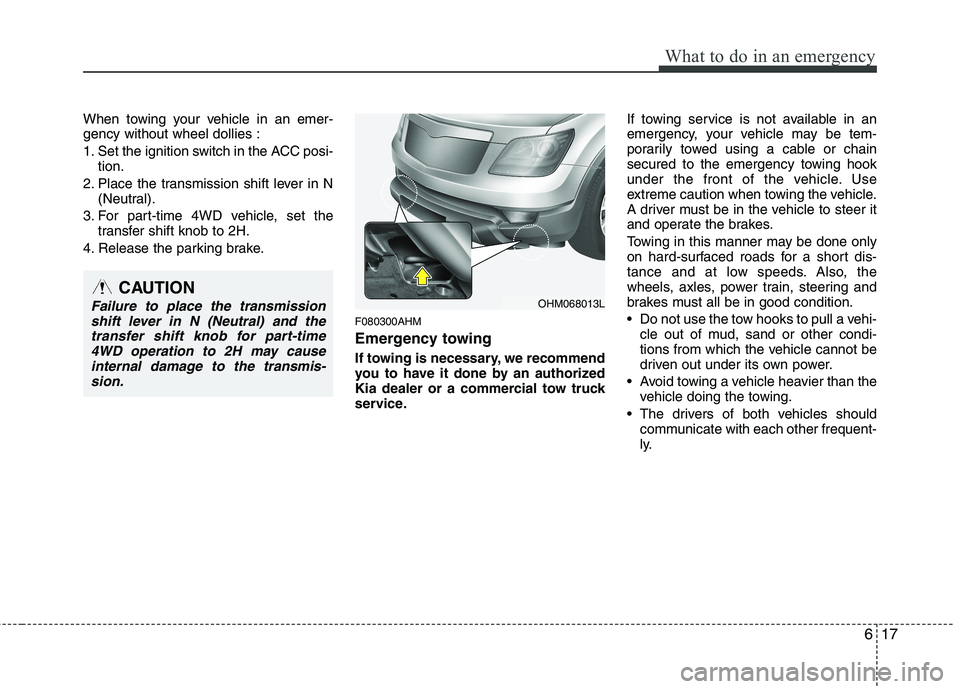
Emergency towing
If towing is necessary, we recommend
you to have it done by an authorized
Kia dealer or a commercial tow truck
service.If towing service is not available in an
emergency, your vehicle may be tem-
porarily towed using a cable or chain
secured to the emergency towing hook
under the front of the vehicle. Use
extreme caution when towing the vehicle.
A driver must be in the vehicle to steer it
and operate the brakes.
Towing in this manner may be done only
on hard-surfaced roads for a short dis-
tance and at low speeds. Also, the
wheels, axles, power train, steering and
brakes must all be in good condition.
Do not use the tow hooks to pull a vehi-
cle out of mud, sand or other condi-
tions from which the vehicle cannot be
driven out under its own power.
Avoid towing a vehicle heavier than the vehicle doing the towing.
The drivers of both vehicles should communicate with each other frequent-
ly.
OHM068013LCAUTION
Failure to place the transmission
shift lever in N (Neutral) and thetransfer shift knob for part-time
4WD operation to 2H may causeinternal damage to the transmis-sion.
Page 325 of 417
What to do in an emergency
18
6
Before emergency towing, check that
the hook is not broken or damaged.
Fasten the towing cable or chain securely to the hook.
Do not jerk the hook. Apply it steadily and with even force.
To avoid damaging the hook, do not pull from the side or at a vertical angle.
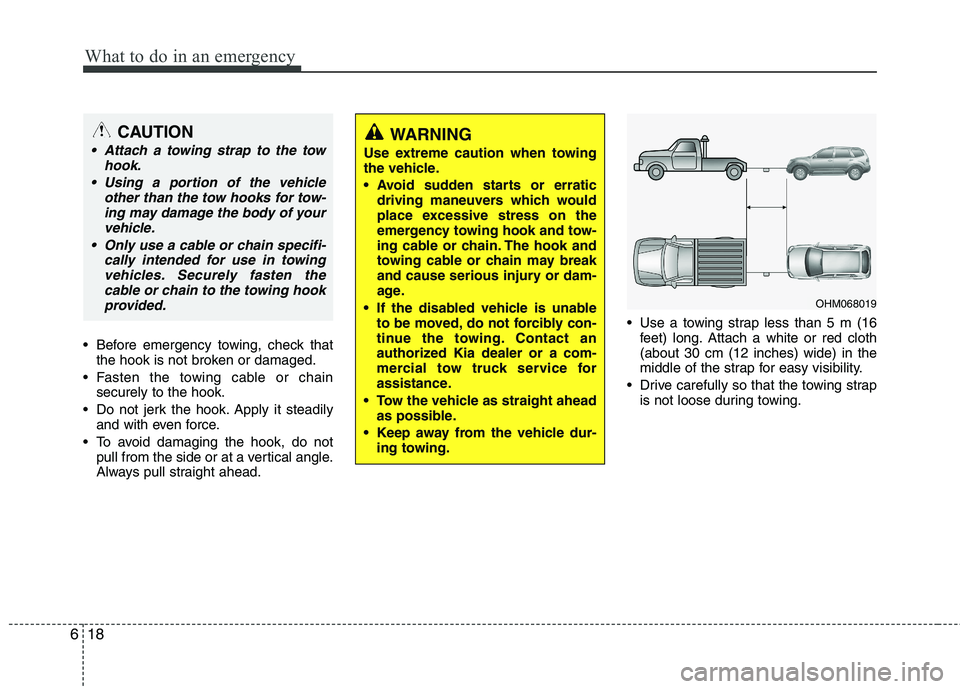
Always pull straight ahead. Use a towing strap less than 5 m (16
feet) long. Attach a white or red cloth(about 30 cm (12 inches) wide) in the
middle of the strap for easy visibility.
Drive carefully so that the towing strap is not loose during towing.
WARNING
Use extreme caution when towing
the vehicle.
driving maneuvers which would
place excessive stress on the
emergency towing hook and tow-
ing cable or chain. The hook and
towing cable or chain may break
and cause serious injury or dam-
age.
If the disabled vehicle is unable to be moved, do not forcibly con-
tinue the towing. Contact an
authorized Kia dealer or a com-
mercial tow truck service for
assistance.
Tow the vehicle as straight ahead as possible.
Keep away from the vehicle dur- ing towing.CAUTION
Attach a towing strap to the tow
hook.
Using a portion of the vehicle other than the tow hooks for tow-ing may damage the body of yourvehicle.
Only use a cable or chain specifi- cally intended for use in towingvehicles. Securely fasten thecable or chain to the towing hook provided.
OHM068019
Page 326 of 417
619
What to do in an emergency
F080301AHM
Emergency towing precautions
Turn the ignition switch to ACC so thesteering wheel isn’t locked.
Place the transmission shift lever in N (Neutral).
Release the parking bake.
Press the brake pedal with more force than usual since you will have reduced
brake performance.
More steering effort will be required because the power steering system
will be disabled.
If you are driving down a long hill, the brakes may overheat and brake per-
formance will be reduced. Stop often
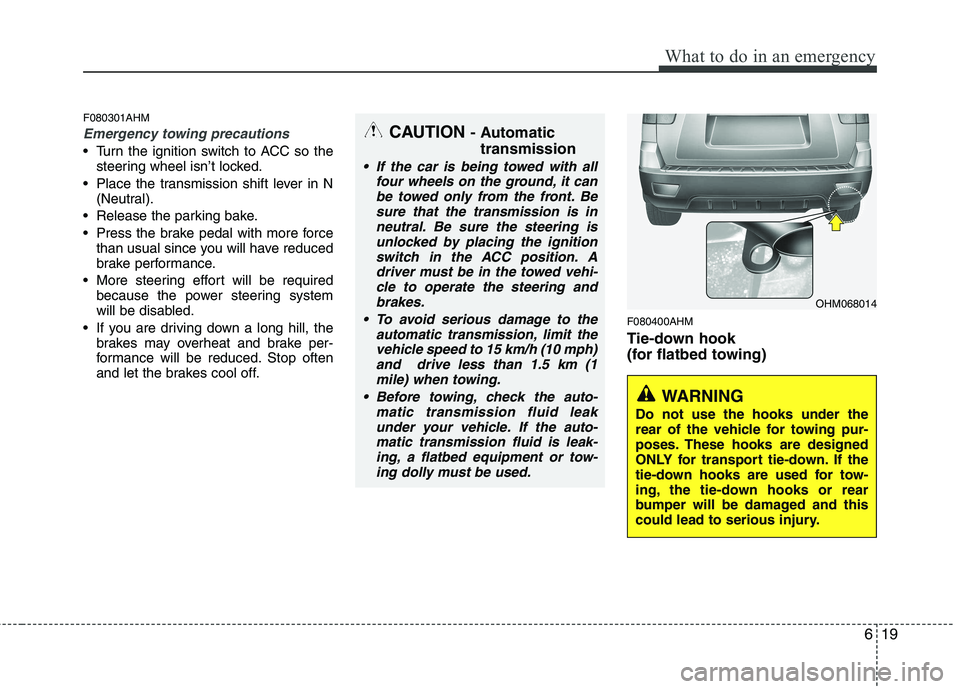
and let the brakes cool off. F080400AHM
Tie-down hook
(for flatbed towing)
OHM068014
WARNING
Do not use the hooks under the
rear of the vehicle for towing pur-
poses. These hooks are designed
ONLY for transport tie-down. If the
tie-down hooks are used for tow-
ing, the tie-down hooks or rear
bumper will be damaged and this
could lead to serious injury.
CAUTION - Automatic
transmission
If the car is being towed with all four wheels on the ground, it can
be towed only from the front. Besure that the transmission is inneutral. Be sure the steering is unlocked by placing the ignition
switch in the ACC position. Adriver must be in the towed vehi-cle to operate the steering and
brakes.
To avoid serious damage to the automatic transmission, limit thevehicle speed to 15 km/h (10 mph)and drive less than 1.5 km (1
mile) when towing.
Before towing, check the auto- matic transmission fluid leakunder your vehicle. If the auto- matic transmission fluid is leak-
ing, a flatbed equipment or tow-ing dolly must be used.
Page 341 of 417
Maintenance
14
7
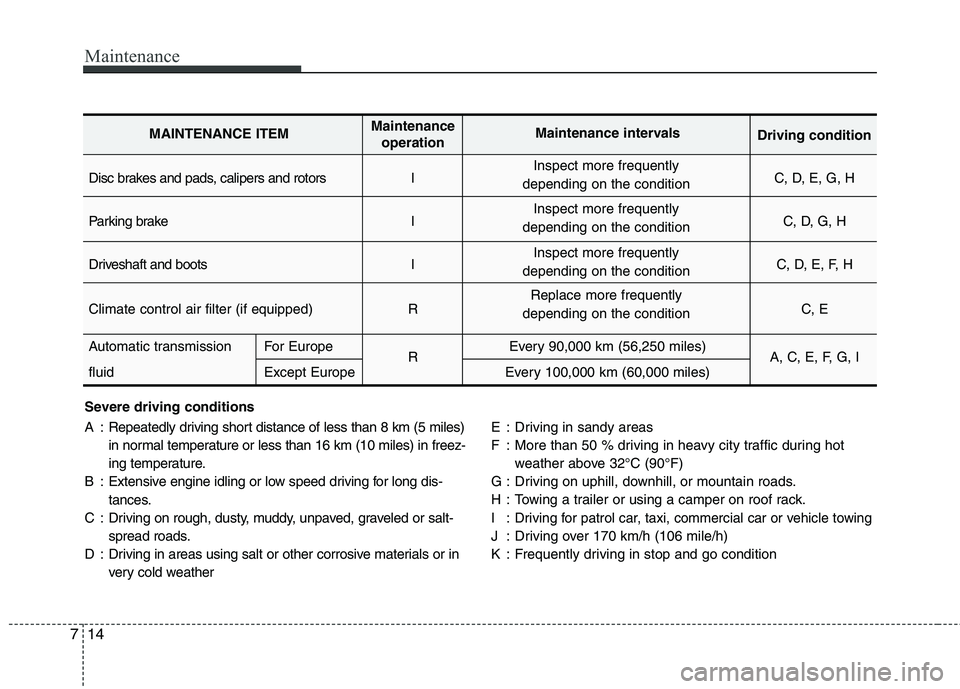
Severe driving conditions
A : Repeatedly driving short distance of less than 8 km (5 miles)
in normal temperature or less than 16 km (10 miles) in freez-
ing temperature.
B : Extensive engine idling or low speed driving for long dis-
tances.
C : Driving on rough, dusty, muddy, unpaved, graveled or salt- spread roads.
D : Driving in areas using salt or other corrosive materials or in very cold weather E : Driving in sandy areas
F : More than 50 % driving in heavy city traffic during hot
weather above 32°C (90°F)
G : Driving on uphill, downhill, or mountain roads.
H : Towing a trailer or using a camper on roof rack.I:
Driving for patrol car, taxi, commercial car or vehicle towing
J : Driving over 170 km/h (106 mile/h)
K : Frequently driving in stop and go condition
Disc brakes and pads, calipers and rotors I C, D, E, G, H
Parking brake I C, D, G, H
Driveshaft and boots I C, D, E, F, H
Climate control air filter (if equipped) R C, E
Automatic transmission For Europe REvery 90,000 km (56,250 miles)
A, C, E, F, G, I
fluid Except Europe Every 100,000 km (60,000 miles)
MAINTENANCE ITEM Maintenance
operation Maintenance intervals
Driving condition
Inspect more frequently
depending on the condition
Inspect more frequently
depending on the condition
Inspect more frequently
depending on the condition
Replace more frequently
depending on the condition
Page 411 of 417
Index
4
I
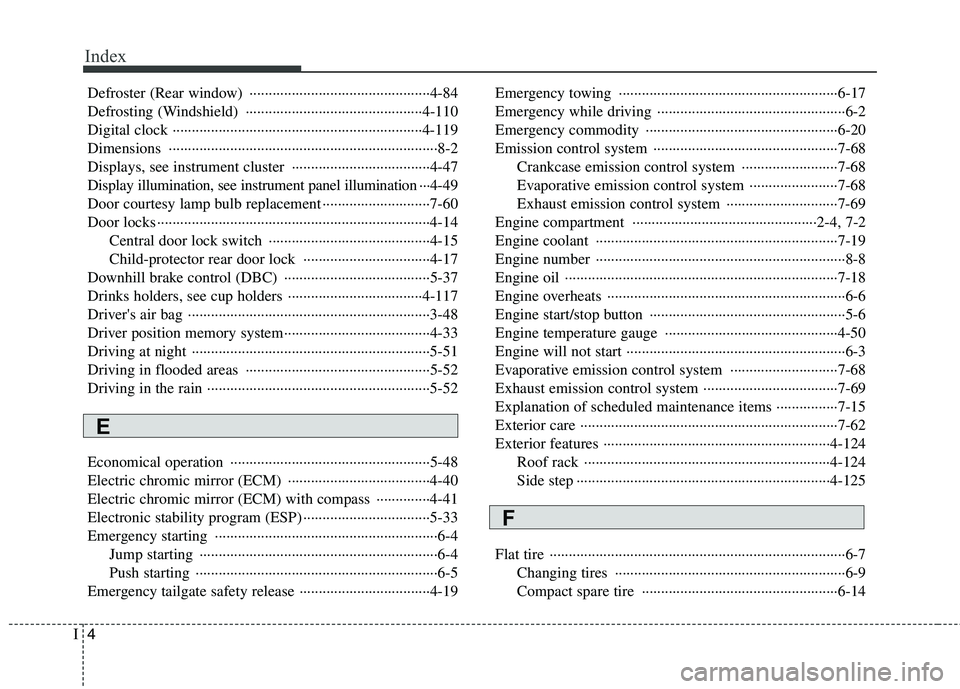
Defroster (Rear window) ···············································4-84
Defrosting (Windshield) ··············································4-110
Digital clock ·································································4-119Dimensions ······································································8-2
Displays, see instrument cluster ····································4-47
Display illumination, see instrument panel illumination ··· 4-49
Door courtesy lamp bulb replacement ····························7-60
Door locks ·······································································4-14 Central door lock switch ··········································4-15
Child-protector rear door lock ·································4-17
Downhill brake control (DBC) ······································5-37
Drinks holders, see cup holders ···································4-117
Driver's air bag ·······························································3-48
Driver position memory system······································4-33
Driving at night ······························································5-51
Driving in flooded areas ················································5-52
Driving in the rain ··························································5-52
Economical operation ····················································5-48
Electric chromic mirror (ECM) ·····································4-40
Electric chromic mirror (ECM) with compass ··············4-41
Electronic stability program (ESP) ·································5-33
Emergency starting ··························································6-4 Jump starting ······························································6-4
Push starting ·······························································6-5
Emergency tailgate safety release ··································4-19 Emergency towing ·························································6-17
Emergency while driving ·················································6-2
Emergency commodity ··················································6-20
Emission control system ················································7-68
Crankcase emission control system ·························7-68
Evaporative emission control system ·······················7-68
Exhaust emission control system ·····························7-69
Engine compartment ················································2-4, 7-2
Engine coolant ·······························································7-19
Engine number ·································································8-8
Engine oil ·······································································7-18
Engine overheats ······························································6-6
Engine start/stop button ···················································5-6
Engine temperature gauge ·············································4-50
Engine will not start ·························································6-3
Evaporative emission control system ····························7-68
Exhaust emission control system ···································7-69Explanation of scheduled maintenance items ················7-15
Exterior care ···································································7-62
Exterior features ···························································4-124 Roof rack ································································4-124
Side step ··································································4-125
Flat tire ·············································································6-7 Changing tires ····························································6-9
Compact spare tire ···················································6-14
E
F