belt KIA MOHAVE 2014 Workshop Manual
[x] Cancel search | Manufacturer: KIA, Model Year: 2014, Model line: MOHAVE, Model: KIA MOHAVE 2014Pages: 417, PDF Size: 38.72 MB
Page 313 of 417
What to do in an emergency
6
6
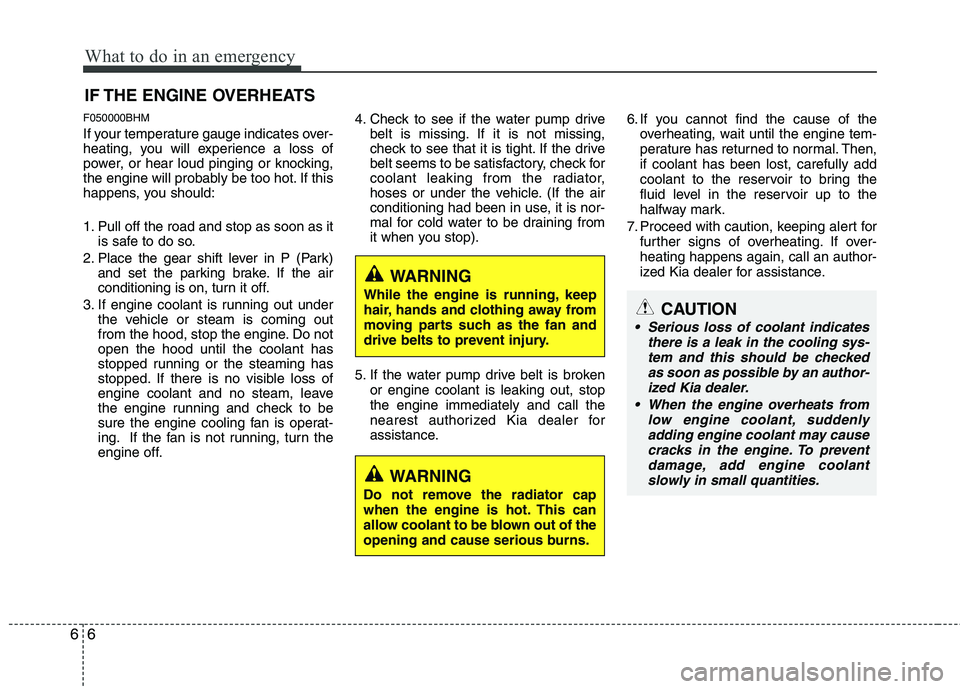
IF THE ENGINE OVERHEATS
F050000BHM
If your temperature gauge indicates over-
heating, you will experience a loss of
power, or hear loud pinging or knocking,
the engine will probably be too hot. If this
happens, you should:
1. Pull off the road and stop as soon as it is safe to do so.
2. Place the gear shift lever in P (Park) and set the parking brake. If the air
conditioning is on, turn it off.
3. If engine coolant is running out under the vehicle or steam is coming out
from the hood, stop the engine. Do notopen the hood until the coolant has
stopped running or the steaming has
stopped. If there is no visible loss of
engine coolant and no steam, leave
the engine running and check to be
sure the engine cooling fan is operat-
ing. If the fan is not running, turn the
engine off. 4. Check to see if the water pump drive
belt is missing. If it is not missing,
check to see that it is tight. If the drive
belt seems to be satisfactory, check for
coolant leaking from the radiator,
hoses or under the vehicle. (If the air
conditioning had been in use, it is nor-
mal for cold water to be draining from
it when you stop).
5. If the water pump drive belt is broken or engine coolant is leaking out, stop the engine immediately and call the
nearest authorized Kia dealer for
assistance. 6. If you cannot find the cause of the
overheating, wait until the engine tem-
perature has returned to normal. Then,if coolant has been lost, carefully add
coolant to the reservoir to bring the
fluid level in the reservoir up to the
halfway mark.
7. Proceed with caution, keeping alert for further signs of overheating. If over-heating happens again, call an author-
ized Kia dealer for assistance.
WARNING
While the engine is running, keep
hair, hands and clothing away from
moving parts such as the fan and
drive belts to prevent injury.
WARNING
Do not remove the radiator cap
when the engine is hot. This can
allow coolant to be blown out of the
opening and cause serious burns.
CAUTION
Serious loss of coolant indicates there is a leak in the cooling sys-
tem and this should be checked as soon as possible by an author-ized Kia dealer.
When the engine overheats from low engine coolant, suddenly
adding engine coolant may causecracks in the engine. To prevent damage, add engine coolantslowly in small quantities.
Page 334 of 417
77
Maintenance
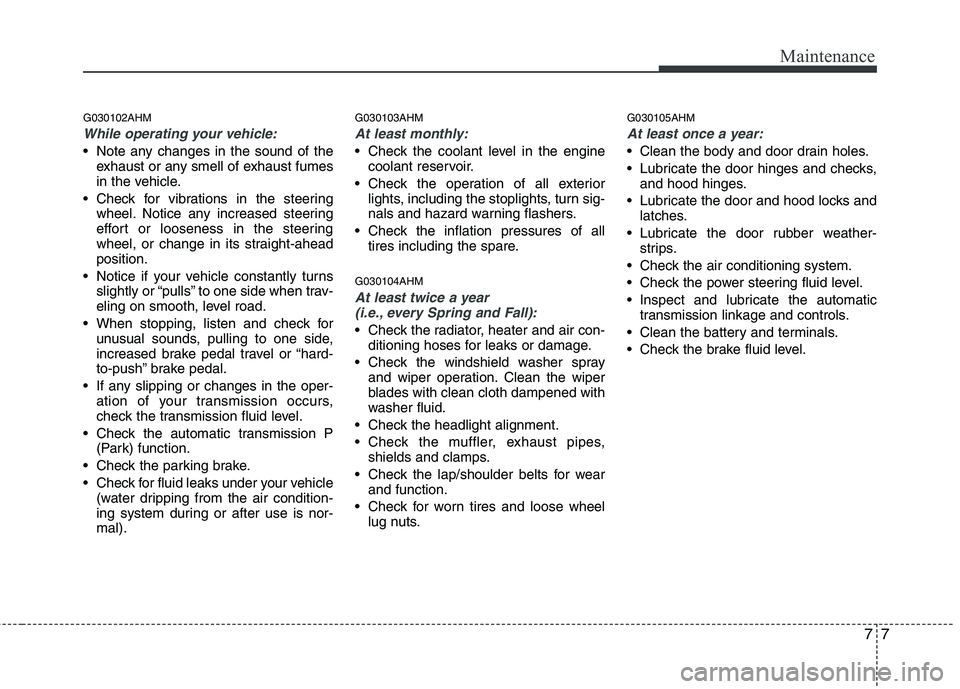
G030102AHM
While operating your vehicle:
Note any changes in the sound of theexhaust or any smell of exhaust fumes
in the vehicle.
Check for vibrations in the steering wheel. Notice any increased steering
effort or looseness in the steering
wheel, or change in its straight-aheadposition.
Notice if your vehicle constantly turns slightly or “pulls” to one side when trav-
eling on smooth, level road.
When stopping, listen and check for unusual sounds, pulling to one side,
increased brake pedal travel or “hard-
to-push” brake pedal.
If any slipping or changes in the oper- ation of your transmission occurs,
check the transmission fluid level.
Check the automatic transmission P (Park) function.
Check the parking brake.
Check for fluid leaks under your vehicle (water dripping from the air condition-
ing system during or after use is nor-mal). G030103AHM
At least monthly:
Check the coolant level in the engine
coolant reservoir.
Check the operation of all exterior lights, including the stoplights, turn sig-
nals and hazard warning flashers.
Check the inflation pressures of all tires including the spare.
G030104AHM
At least twice a year (i.e., every Spring and Fall):
Check the radiator, heater and air con- ditioning hoses for leaks or damage.
Check the windshield washer spray and wiper operation. Clean the wiper
blades with clean cloth dampened with
washer fluid.
Check the headlight alignment.
Check the muffler, exhaust pipes, shields and clamps.
Check the lap/shoulder belts for wear and function.
Check for worn tires and loose wheel lug nuts. G030105AHM
At least once a year:
Clean the body and door drain holes.
Lubricate the door hinges and checks,
and hood hinges.
Lubricate the door and hood locks and latches.
Lubricate the door rubber weather- strips.
Check the air conditioning system.
Check the power steering fluid level.
Inspect and lubricate the automatic transmission linkage and controls.
Clean the battery and terminals.
Check the brake fluid level.
Page 336 of 417
79
Maintenance
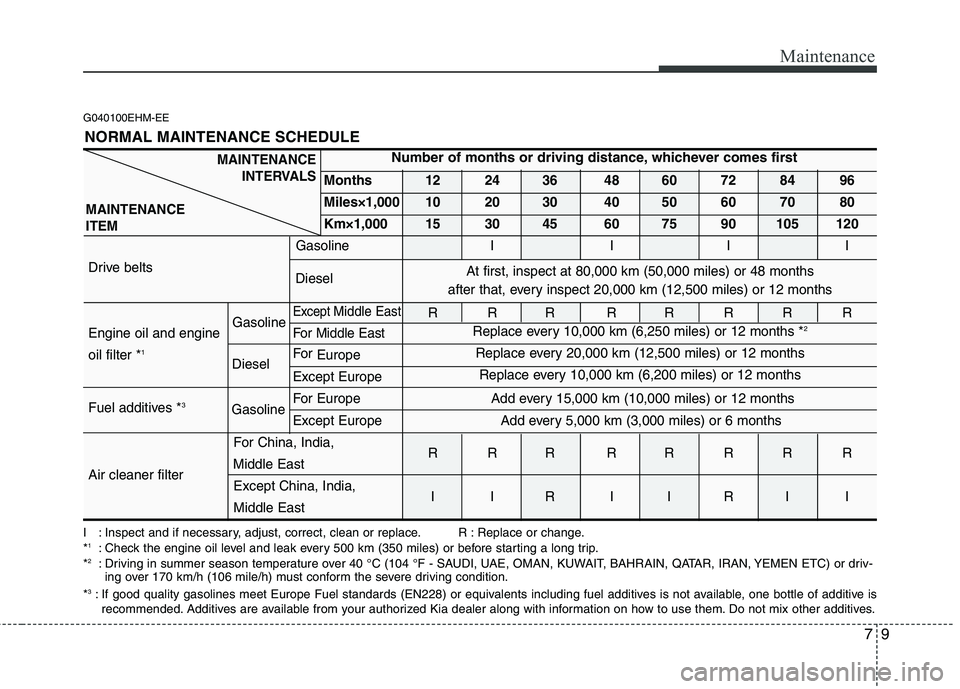
G040100EHM-EE
I : Inspect and if necessary, adjust, correct, clean or replace. R : Replace or change. *1
: Check the engine oil level and leak every 500 km (350 miles) or before starting a long trip.
* 2
: Driving in summer season temperature over 40 °C (104 °F - SAUDI, UAE, OMAN, KUWAIT, BAHRAIN, QATAR, IRAN, YEMEN ETC) or driv-
ing over 170 km/h (106 mile/h) must conform the severe driving condition.
* 3
: If good quality gasolines meet Europe Fuel standards (EN228) or equivalents including fuel additives is not available, one bottle of additive is
recommended. Additives are available from your authorized Kia dealer along with information on how to use them. Do not mix other additives.
MAINTENANCE
INTERVALS
MAINTENANCE ITEMNumber of months or driving distance, whichever comes first
Months 12 24 36 48 60 72 84 96
Miles×1,000 10 20 30 40 50 60 70 80
Km×1,000 15 30 45 60 75 90 105 120
Gasoline I I I I
Drive belts Diesel
Except Middle EastRRR RRRRR
Engine oil and engine Gasoline
For Middle East
oil filter *
1
DieselFor
Europe
Except Europe
Fuel additives * 3
For Europe Add every 15,000 km (10,000 miles) or 12 months
Gasoline Except Europe Add every 5,000 km (3,000 miles) or 6 months
For China, India, RRR RRRRR
Air cleaner filter Middle East
Except China, India, IIRIIRII
Middle East Replace every 20,000 km (12,500 miles) or 12 months
Replace every 10,000 km (6,200 miles) or 12 months
Replace every 10,000 km (6,250 miles) or 12 months *
2
At first, inspect at 80,000 km (50,000 miles) or 48 months
after that, every inspect 20,000 km (12,500 miles) or 12 months
NORMAL MAINTENANCE SCHEDULE
Page 337 of 417
Maintenance
10
7
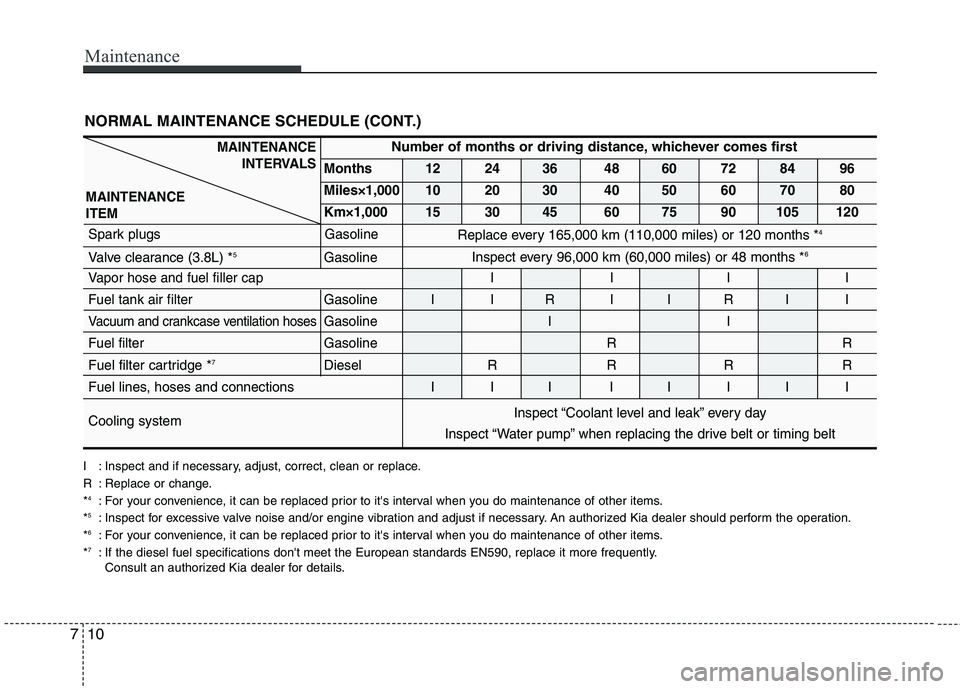
NORMAL MAINTENANCE SCHEDULE (CONT.)
MAINTENANCE
INTERVALS
MAINTENANCE ITEMNumber of months or driving distance, whichever comes first
Months 12 24 36 48 60 72 84 96
Miles×1,000 10 20 30 40 50 60 70 80
Km×1,000 15 30 45 60 75 90 105 120
Spark plugs Gasoline
Valve clearance (3.8L) * 5
Gasoline
Vapor hose and fuel filler cap I I I I
Fuel tank air filter
GasolineIIRIIRII
Vacuum and crankcase ventilation hosesGasolineII
Fuel filter
Gasoline RR
Fuel filter cartridge * 7
Diesel R R R R
Fuel lines, hoses and connections I I I I I I I I Cooling system
Inspect every 96,000 km (60,000 miles) or 48 months * 6
Inspect “Coolant level and leak” every day
Inspect “Water pump” when replacing the drive belt or timing belt
I : Inspect and if necessary, adjust, correct, clean or replace.
R : Replace or change.* 4
: For your convenience, it can be replaced prior to it's interval when you do maintenance of other items.
* 5
: Inspect for excessive valve noise and/or engine vibration and adjust if necessary. An authorized Kia dealer should perform the operation.
* 6
: For your convenience, it can be replaced prior to it's interval when you do maintenance of other items.
* 7
: If the diesel fuel specifications don't meet the European standards EN590, replace it more frequently.
Consult an authorized Kia dealer for details.
Replace every 165,000 km (110,000 miles) or 120 months * 4
Page 342 of 417
715
Maintenance
EXPLANATION OF SCHEDULED MAINTENANCE ITEMS
G050100AHM Engine oil and filter The engine oil and filter should be
changed at the intervals specified in the
maintenance schedule. If the vehicle is
being driven in severe conditions, morefrequent oil and filter changes arerequired.
G050200BUN Drive belts
Inspect all drive belts for evidence of
cuts, cracks, excessive wear or oil satu-
ration and replace if necessary. Drive
belts should be checked periodically forproper tension and adjusted as neces-
sary. G050300AUN
Fuel filter (cartridge) A clogged filter can limit the speed at
which the vehicle may be driven, damage
the emission system and cause multiple
issues such as hard starting. If an exces-
sive amount of foreign matter accumu-
lates in the fuel tank, the filter may
require replacement more frequently.
After installing a new filter, run the engine
for several minutes, and check for leaks
at the connections. Fuel filters should be
installed by an authorized Kia dealer.
G050400AHM
Fuel lines, fuel hoses and con- nections
Check the fuel lines, fuel hoses and con-
nections for leakage and damage. Have
an authorized Kia dealer replace any
damaged or leaking parts immediately.
WARNING -
Diesel only
Never work on the injection system with the engine running or within30 seconds after shutting off the
engine. High pressure pump, rail,
injectors and high pressure pipes
are subject to high pressure even
after the engine stopps. The fuel jet
produced by fuel leaks may cause
serious injury, if it touches the
body. People using pacemakers
should not more move than 30cm
closer to the ECU or wiring harness
within the engine room while the
engine is running, since the highcurrents in the Common Rail sys-
tem produce considerable magnet-ic fields.
CAUTION
When you are inspecting the belt, place the ignition switch in theLOCK/OFF or ACC position.
Page 344 of 417
717
Maintenance
G051500AUN Brake hoses and lines
Visually check for proper installation,
chafing, cracks, deterioration and any
leakage. Replace any deteriorated or
damaged parts immediately. G051600AHM Brake fluid
Check the brake fluid level in the brake
fluid reservoir. The level should be
between “MIN” and “MAX” marks on the
side of the reservoir. Use only hydraulic
brake fluid conforming to DOT 3 or DOT4 specification.
G051700AUN
Parking brake
Inspect the parking brake system includ-
ing the parking brake pedal and cables.G051900BUN
Brake discs, pads, calipers and
rotors
Check the pads for excessive wear, discs
for run out and wear, and calipers for fluid
leakage.
For more information on checking the
pads or lining wear limit, we recommend
to refer to the Kia web site. (
http://brakeman
ual.kia.co.kr)
G052100AUN Suspension mounting bolts
Check the suspension connections for
looseness or damage. Retighten to the
specified torque.
G052200AUN
Steering gear box, linkage &
boots/lower arm ball joint
With the vehicle stopped and engine off,
check for excessive free-play in the
steering wheel.
Check the linkage for bends or damage.
Check the dust boots and ball joints for
deterioration, cracks, or damage.
Replace any damaged parts. G052300AEN
Power steering pump, belt and hoses
Check the power steering pump and
hoses for leakage and damage. Replace
any damaged or leaking parts immedi-
ately. Inspect the power steering belt (or
drive belt) for evidence of cuts, cracks,
excessive wear, oiliness and proper ten-
sion. Replace or adjust it if necessary.
G052400AUN Drive shafts and boots
Check the drive shafts, boots and clamps
for cracks, deterioration, or damage.
Replace any damaged parts and, if nec-
essary, repack the grease.
G052500AUN
Air conditioning refrigerant (if equipped)
Check the air conditioning lines and con-
nections for leakage and damage.
CAUTION
The use of a non-specified fluid
could result in transmission mal-
function and failure.
Use only specified automatic trans-mission fluid. (Refer to“Recommended lubricants and
capacities” in section 8.)
Page 369 of 417
Maintenance
42
7
G201003AHM
3. Checking tire life
(TIN : Tire Identification Number)
Any tires that are over 6 years old,
based on the manufacturing date,(including the spare tire) should be
replaced by new ones. You can find
the manufacturing date on the tire
sidewall (possibly on the inside of the
wheel), displaying the DOT Code.
The DOT Code is a series of num-
bers on a tire consisting of numbers
and English letters. The manufactur-
ing date is designated by the last four
digits (characters) of the DOT code. DOT : XXXX XXXX OOOO
The front part of the DOT means a
plant code number, tire size and
tread pattern and the last four num-
bers indicate week and year manu-
factured.
For example:
DOT XXXX XXXX 1613 represents
that the tire was produced in the 16th
week of 2013.
G1201004AEN
4. Tire ply composition and material
The number of layers or plies of rub-
ber-coated fabric in the tire. Tire
manufacturers also must indicate the
materials in the tire, which include
steel, nylon, polyester, and others.
The letter "R" means radial ply con-
struction; the letter "D" means diago-
nal or bias ply construction; and theletter "B" means belted-bias ply con-
struction.
G201005AUN
5. Maximum permissible inflation
pressure
This number is the greatest amount of air pressure that should be put in
the tire. Do not exceed the maximum
permissible inflation pressure. Refer
to the Tire and Loading Information
label for recommended inflation
pressure.
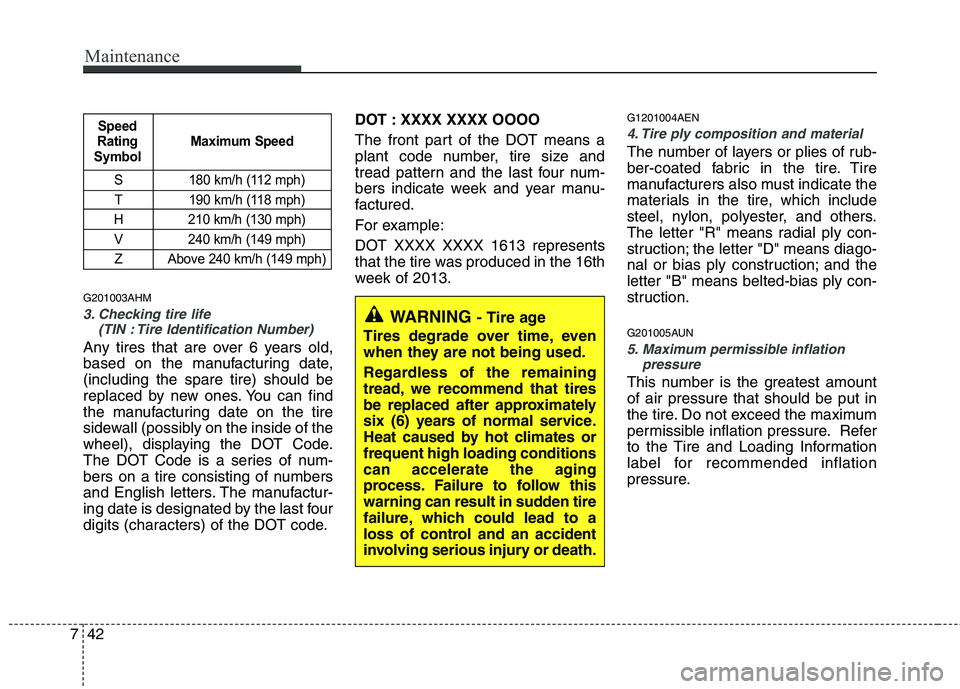
S 180 km/h (112 mph)
T 190 km/h (118 mph)
H 210 km/h (130 mph) V 240 km/h (149 mph)
Z Above 240 km/h (149 mph)
Maximum Speed
Speed
Rating
Symbol
WARNING - Tire age
Tires degrade over time, even
when they are not being used.
Regardless of the remaining
tread, we recommend that tires
be replaced after approximately
six (6) years of normal service.
Heat caused by hot climates orfrequent high loading conditions
can accelerate the aging
process. Failure to follow this
warning can result in sudden tire
failure, which could lead to a
loss of control and an accident
involving serious injury or death.
Page 394 of 417
767
Maintenance
Interior care G230201CHM
Interior general precautions
Prevent chemicals such as perfume, cos- metic oil, sun cream, hand cleaner and
air freshener from contacting the interior
parts because they may cause damage
or discoloration. If they do contact the
interior parts, wipe them off immediately.
See the instructions for the proper way to
clean vinyl.G230202AUN
Cleaning the upholstery and interior
trim
Vinyl
Remove dust and loose dirt from vinyl
with a whisk broom or vacuum cleaner.
Clean vinyl surfaces with a vinyl cleaner.
Fabric
Remove dust and loose dirt from fabric
with a whisk broom or vacuum cleaner.Clean with a mild soap solution recom-
mended for upholstery or carpets.
Remove fresh spots immediately with a
fabric spot cleaner. If fresh spots do not
receive immediate attention, the fabriccan be stained and its color can be
affected. Also, its fire-resistant properties
can be reduced if the material is not
properly maintained. G230203AUN
Cleaning the lap/shoulder belt web-
bing
Clean the belt webbing with any mild
soap solution recommended for cleaning
upholstery or carpet. Follow the instruc-
tions provided with the soap. Do not
bleach or re-dye the webbing because
this may weaken it. G230204AHM
Cleaning the interior window glass
If the interior glass surfaces of the vehi-
cle become fogged (that is, covered with
an oily, greasy or waxy film), they should
be cleaned with a glass cleaner. Followthe directions on the glass cleaner con-
tainer.CAUTION
Never allow water or other liquids to come in contact withelectrical/electronic componentsinside the vehicle as this may dam-age them.
CAUTION
Using anything but recommended
cleaners and procedures may affect the fabric’s appearance and fire-resistant properties.
CAUTION
Do not scrape or scratch the insideof the rear window. This may result in damage of the rear windowdefroster grid.CAUTION
When cleaning leather products(steering wheel, seats etc.), use neutral detergents or low alcohol
content solutions. If you use highalcohol content solutions oracid/alkaline detergents, the colorof the leather may fade or the sur-
face may get stripped off.
Page 415 of 417
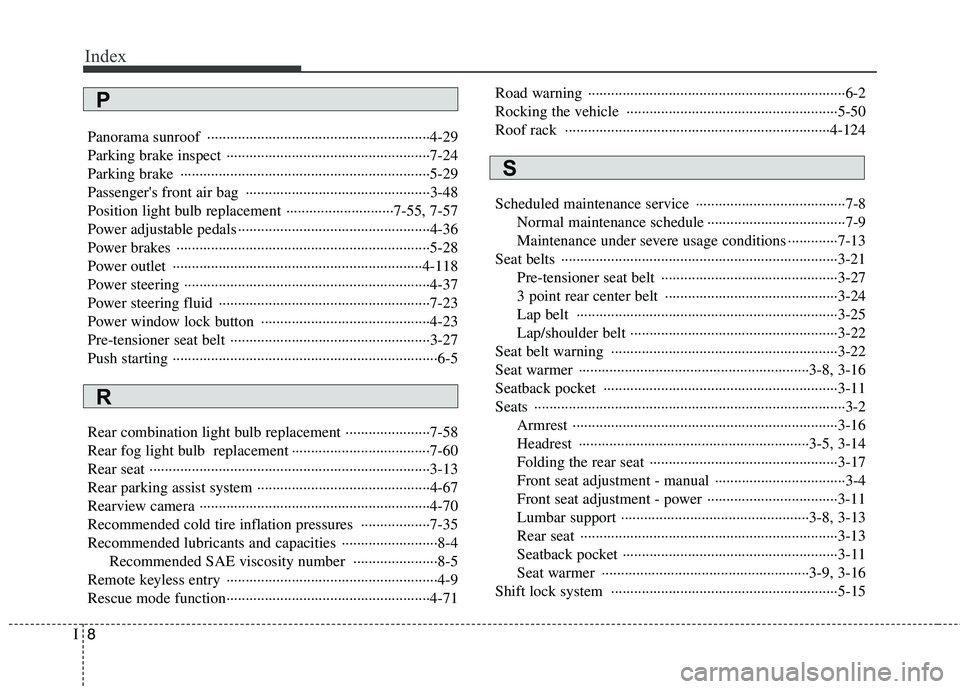
Index
8
I
Panorama sunroof ··························································4-29
Parking brake inspect ·····················································7-24
Parking brake ·································································5-29
Passenger's front air bag ················································3-48
Position light bulb replacement ····························7-55, 7-57
Power adjustable pedals ··················································4-36
Power brakes ··································································5-28
Power outlet ·································································4-118
Power steering ································································4-37
Power steering fluid ·······················································7-23
Power window lock button ············································4-23
Pre-tensioner seat belt ····················································3-27
Push starting ·····································································6-5
Rear combination light bulb replacement ······················7-58
Rear fog light bulb replacement ····································7-60
Rear seat ·········································································3-13
Rear parking assist system ·············································4-67
Rearview camera ····························································4-70
Recommended cold tire inflation pressures ··················7-35
Recommended lubricants and capacities ·························8-4
Recommended SAE viscosity number ······················8-5
Remote keyless entry ·······················································4-9
Rescue mode function·····················································4-71 Road warning ···································································6-2
Rocking the vehicle ·······················································5-50
Roof rack ·····································································4-124
Scheduled maintenance service ·······································7-8
Normal maintenance schedule ····································7-9
Maintenance under severe usage conditions ·············7-13
Seat belts ········································································3-21 Pre-tensioner seat belt ··············································3-27
3 point rear center belt ·············································3-24
Lap belt ····································································3-25
Lap/shoulder belt ······················································3-22
Seat belt warning ···························································3-22
Seat warmer ····························································3-8, 3-16
Seatback pocket ·····························································3-11Seats ·················································································3-2 Armrest ·····································································3-16
Headrest ····························································3-5, 3-14
Folding the rear seat ·················································3-17
Front seat adjustment - manual ··································3-4
Front seat adjustment - power ··································3-11
Lumbar support ·················································3-8, 3-13
Rear seat ···································································3-13
Seatback pocket ························································3-11
Seat warmer ······················································3-9, 3-16
Shift lock system ···························································5-15
R
S
P