starting engine KIA MORNING 2015 Owner's Manual
[x] Cancel search | Manufacturer: KIA, Model Year: 2015, Model line: MORNING, Model: KIA MORNING 2015Pages: 420, PDF Size: 42.6 MB
Page 297 of 420
6
Road warning / 6-2
In case of an emergency whilst driving / 6-3
If the engine will not start / 6-4
Emergency starting / 6-5
If the engine overheats / 6-7
If you have a flat tyre / 6-8
If you have a flat tyre (with tyreMobilityKit) / 6-17
Tyre Pressure Monitoring System (TPMS) / 6-22
Towing / 6-27
Emergency commodity / 6-31
What to do in an emergency
Page 300 of 420
What to do in an emergency
4 6
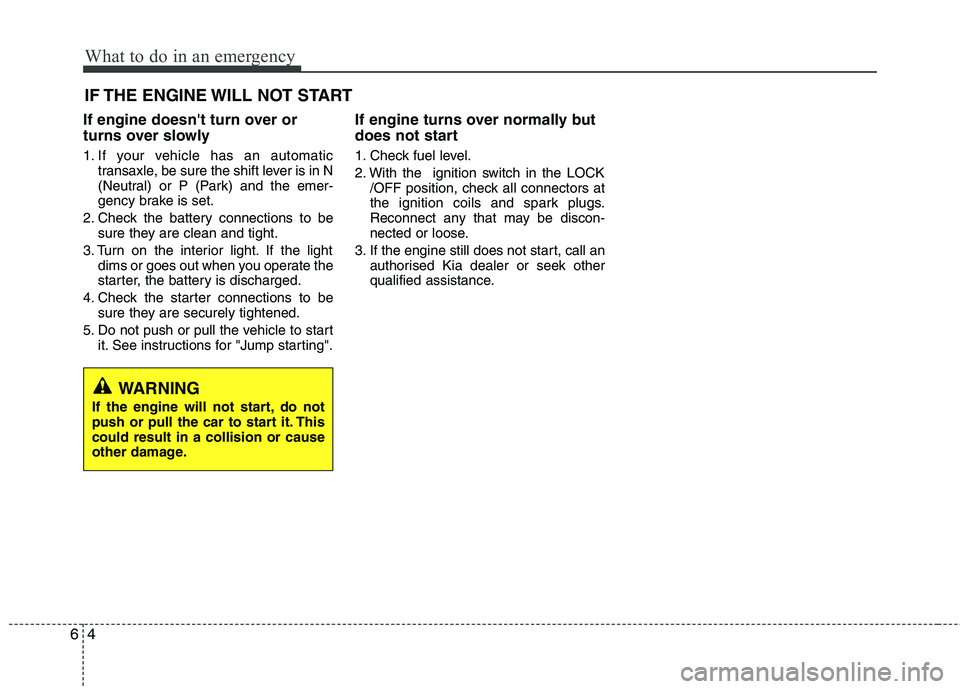
IF THE ENGINE WILL NOT START
If engine doesn't turn over or
turns over slowly
1. If your vehicle has an automatic
transaxle, be sure the shift lever is in N
(Neutral) or P (Park) and the emer-
gency brake is set.
2. Check the battery connections to be
sure they are clean and tight.
3. Turn on the interior light. If the light
dims or goes out when you operate the
starter, the battery is discharged.
4. Check the starter connections to be
sure they are securely tightened.
5. Do not push or pull the vehicle to start
it. See instructions for "Jump starting".
If engine turns over normally but
does not start
1. Check fuel level.
2. With the ignition switch in the LOCK
/OFF position, check all connectors at
the ignition coils and spark plugs.
Reconnect any that may be discon-
nected or loose.
3. If the engine still does not start, call an
authorised Kia dealer or seek other
qualified assistance.
WARNING
If the engine will not start, do not
push or pull the car to start it. This
could result in a collision or cause
other damage.
Page 302 of 420
What to do in an emergency
6 6
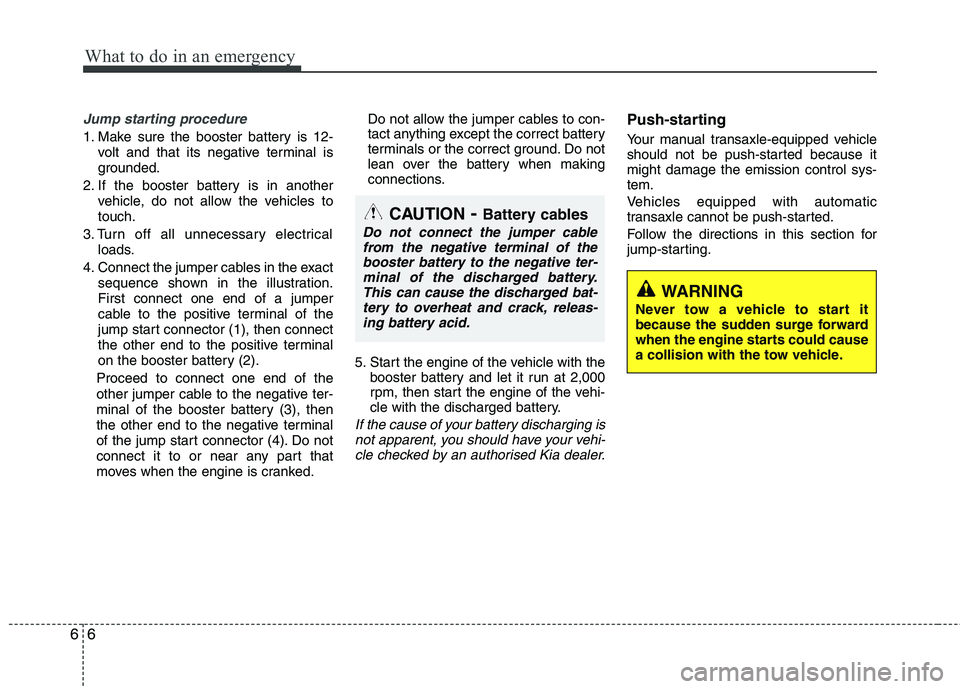
Jump starting procedure
1. Make sure the booster battery is 12-
volt and that its negative terminal is
grounded.
2. If the booster battery is in another
vehicle, do not allow the vehicles to
touch.
3. Turn off all unnecessary electrical
loads.
4. Connect the jumper cables in the exact
sequence shown in the illustration.
First connect one end of a jumper
cable to the positive terminal of the
jump start connector (1), then connect
the other end to the positive terminal
on the booster battery (2).
Proceed to connect one end of the
other jumper cable to the negative ter-
minal of the booster battery (3), then
the other end to the negative terminal
of the jump start connector (4). Do not
connect it to or near any part that
moves when the engine is cranked.Do not allow the jumper cables to con-
tact anything except the correct battery
terminals or the correct ground. Do not
lean over the battery when making
connections.
5. Start the engine of the vehicle with the
booster battery and let it run at 2,000
rpm, then start the engine of the vehi-
cle with the discharged battery.
If the cause of your battery discharging is
not apparent, you should have your vehi-
cle checked by an authorised Kia dealer.
Push-starting
Your manual transaxle-equipped vehicle
should not be push-started because it
might damage the emission control sys-
tem.
Vehicles equipped with automatic
transaxle cannot be push-started.
Follow the directions in this section for
jump-starting.
CAUTION- Battery cables
Do not connect the jumper cable
from the negative terminal of the
booster battery to the negative ter-
minal of the discharged battery.
This can cause the discharged bat-
tery to overheat and crack, releas-
ing battery acid.
WARNING
Never tow a vehicle to start it
because the sudden surge forward
when the engine starts could cause
a collision with the tow vehicle.
Page 319 of 420
623
What to do in an emergency
✽ ✽
NOTICE
If the TPMS indicator does not illu-
minate for 3 seconds when the igni-
tion switch is turned to the ON posi-
tion or engine is running, or if it
comes on after blinking for approxi-
mately one minute, we recommend
that you contact an authorized Kia
dealer.
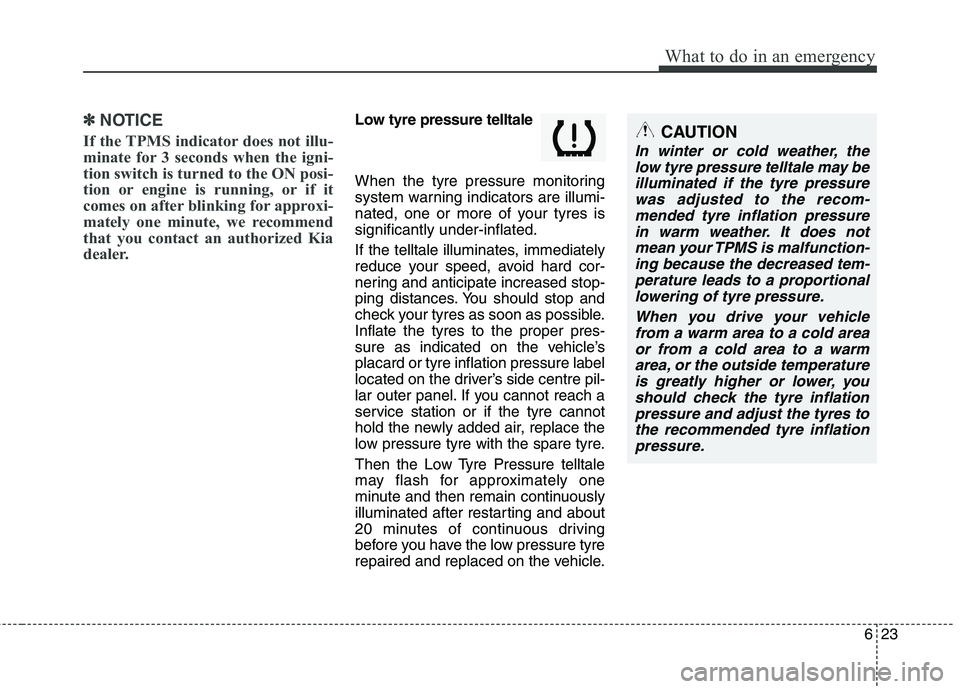
Low tyre pressure telltale
When the tyre pressure monitoring
system warning indicators are illumi-
nated, one or more of your tyres is
significantly under-inflated.
If the telltale illuminates, immediately
reduce your speed, avoid hard cor-
nering and anticipate increased stop-
ping distances. You should stop and
check your tyres as soon as possible.
Inflate the tyres to the proper pres-
sure as indicated on the vehicle’s
placard or tyre inflation pressure label
located on the driver’s side centre pil-
lar outer panel. If you cannot reach a
service station or if the tyre cannot
hold the newly added air, replace the
low pressure tyre with the spare tyre.
Then the Low Tyre Pressure telltale
may flash for approximately one
minute and then remain continuously
illuminated after restarting and about
20 minutes of continuous driving
before you have the low pressure tyre
repaired and replaced on the vehicle.CAUTION
In winter or cold weather, the
low tyre pressure telltale may be
illuminated if the tyre pressure
was adjusted to the recom-
mended tyre inflation pressure
in warm weather. It does not
mean your TPMS is malfunction-
ing because the decreased tem-
perature leads to a proportional
lowering of tyre pressure.
When you drive your vehicle
from a warm area to a cold area
or from a cold area to a warm
area, or the outside temperature
is greatly higher or lower, you
should check the tyre inflation
pressure and adjust the tyres to
the recommended tyre inflation
pressure.
Page 334 of 420
77
Maintenance
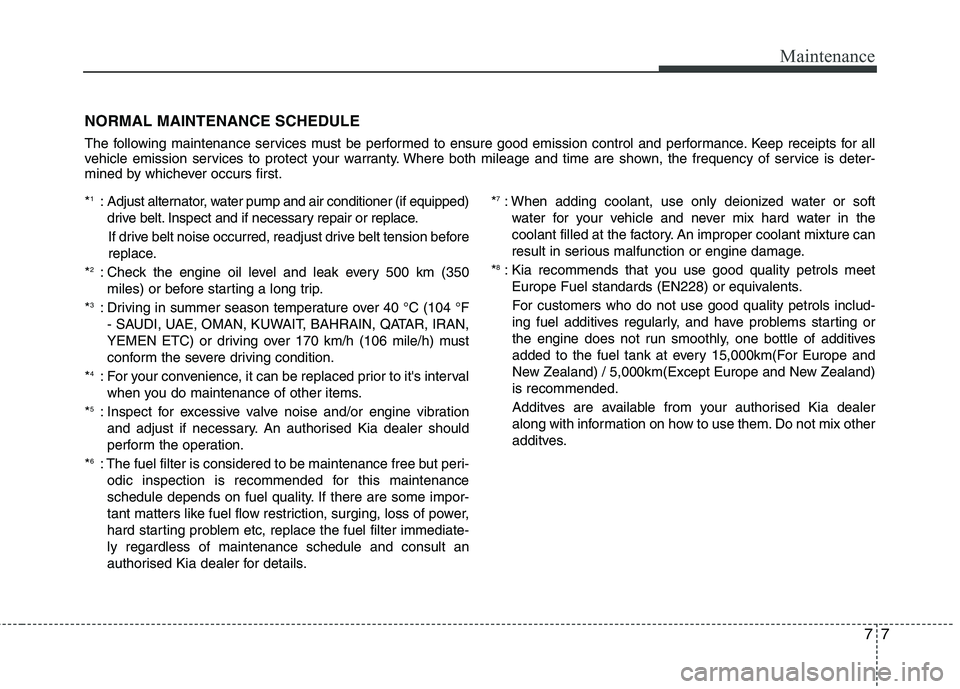
NORMAL MAINTENANCE SCHEDULE
The following maintenance services must be performed to ensure good emission control and performance. Keep receipts for all
vehicle emission services to protect your warranty. Where both mileage and time are shown, the frequency of service is deter-
mined by whichever occurs first.
*
1: Adjust alternator, water pump and air conditioner (if equipped)
drive belt. Inspect and if necessary repair or replace.
If drive belt noise occurred, readjust drive belt tension before
replace.
*
2: Check the engine oil level and leak every 500 km (350
miles) or before starting a long trip.
*
3: Driving in summer season temperature over 40 °C (104 °F
- SAUDI, UAE, OMAN, KUWAIT, BAHRAIN, QATAR, IRAN,
YEMEN ETC) or driving over 170 km/h (106 mile/h) must
conform the severe driving condition.
*
4: For your convenience, it can be replaced prior to it's interval
when you do maintenance of other items.
*
5: Inspect for excessive valve noise and/or engine vibration
and adjust if necessary. An authorised Kia dealer should
perform the operation.
*
6: The fuel filter is considered to be maintenance free but peri-
odic inspection is recommended for this maintenance
schedule depends on fuel quality. If there are some impor-
tant matters like fuel flow restriction, surging, loss of power,
hard starting problem etc, replace the fuel filter immediate-
ly regardless of maintenance schedule and consult an
authorised Kia dealer for details.*
7: When adding coolant, use only deionized water or soft
water for your vehicle and never mix hard water in the
coolant filled at the factory. An improper coolant mixture can
result in serious malfunction or engine damage.
*
8: Kia recommends that you use good quality petrols meet
Europe Fuel standards (EN228) or equivalents.
For customers who do not use good quality petrols includ-
ing fuel additives regularly, and have problems starting or
the engine does not run smoothly, one bottle of additives
added to the fuel tank at every 15,000km(For Europe and
New Zealand) / 5,000km(Except Europe and New Zealand)
is recommended.
Additves are available from your authorised Kia dealer
along with information on how to use them. Do not mix other
additves.
Page 345 of 420
Maintenance
18 7
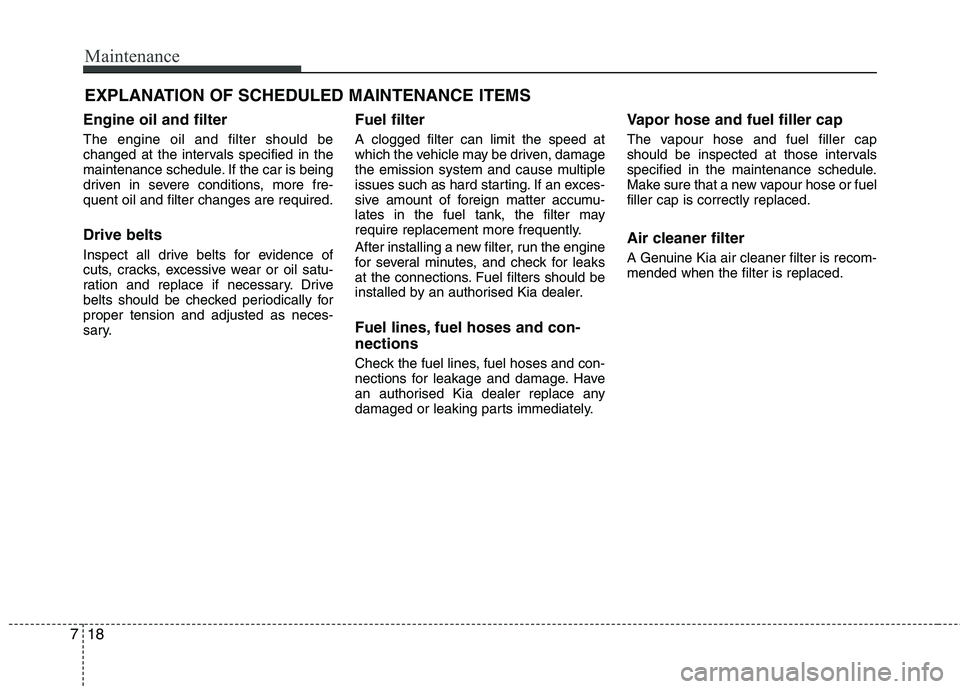
EXPLANATION OF SCHEDULED MAINTENANCE ITEMS
Engine oil and filter
The engine oil and filter should be
changed at the intervals specified in the
maintenance schedule. If the car is being
driven in severe conditions, more fre-
quent oil and filter changes are required.
Drive belts
Inspect all drive belts for evidence of
cuts, cracks, excessive wear or oil satu-
ration and replace if necessary. Drive
belts should be checked periodically for
proper tension and adjusted as neces-
sary.
Fuel filter
A clogged filter can limit the speed at
which the vehicle may be driven, damage
the emission system and cause multiple
issues such as hard starting. If an exces-
sive amount of foreign matter accumu-
lates in the fuel tank, the filter may
require replacement more frequently.
After installing a new filter, run the engine
for several minutes, and check for leaks
at the connections. Fuel filters should be
installed by an authorised Kia dealer.
Fuel lines, fuel hoses and con-
nections
Check the fuel lines, fuel hoses and con-
nections for leakage and damage. Have
an authorised Kia dealer replace any
damaged or leaking parts immediately.
Vapor hose and fuel filler cap
The vapour hose and fuel filler cap
should be inspected at those intervals
specified in the maintenance schedule.
Make sure that a new vapour hose or fuel
filler cap is correctly replaced.
Air cleaner filter
A Genuine Kia air cleaner filter is recom-
mended when the filter is replaced.
Page 415 of 420
Index
4I
Economical operation ....................................................5-37
Electric power steering ..................................................4-34
Electronic stability program (ESP) ................................5-30
Emergency starting ..........................................................6-5
Jump starting ..............................................................6-5
Push starting ................................................................6-6
Emergency stop signal (ESS) ........................................5-35
Emergency towing ..........................................................6-28
Emergency whilst driving ................................................6-3
Emergency commodity ..................................................6-31
Emission control system ................................................7-75
Crankcase emission control system ..........................7-75
Evaporative emission control system ........................7-75
Exhaust emission control system ..............................7-76
Engine compartment..................................................2-4, 7-2
Engine coolant ................................................................7-23
Engine number ..................................................................8-7
Engine oil ........................................................................7-21
Engine overheats ..............................................................6-7
Engine start/stop button ....................................................5-6
Engine will not start..........................................................6-4
Evaporative emission control system..............................7-75
Exhaust emission control system ....................................7-76
Explanation of scheduled maintenance items ................7-18
Exterior care....................................................................7-69Flat tyre ............................................................................6-8
Changing tyres ............................................................6-9
Jack and tools ..............................................................6-8
Removing and storing the spare tyre ..........................6-9
Fluid
Automatic transaxle fluid ..........................................7-27
Washer fluid ..............................................................7-29
Brake fluid ................................................................7-26
Folding the rear seat........................................................3-10
Front seat adjustment - manual ........................................3-4
Fuel filler lid ..................................................................4-27
Fuel gauge ......................................................................4-42
Fuel requirements ............................................................1-2
Fuses ..............................................................................7-50
Fuse/relay panel description......................................7-54
Instrument panel fuse ................................................7-51
Multi fuse ..................................................................7-53
Memory fuse ............................................................7-52
Gauge
Fuel gauge ................................................................4-42
Glassroof, see sunroof ....................................................4-30
Glove box ......................................................................4-100
F
G
E
Page 419 of 420
Index
8I
Special driving conditions ..............................................5-39
Driving at night ........................................................5-40
Driving in flooded areas............................................5-42
Driving in the rain ....................................................5-41
Hazardous driving conditions ..................................5-39
Highway driving ........................................................5-42
Rocking the vehicle ..................................................5-39
Smooth cornering ......................................................5-40
Speedometer....................................................................4-42
Starting difficulties, see engine will not start ..................6-4
Starting the engine ............................................................5-9
Steering wheel ................................................................4-34
Electric power steering..............................................4-34
Heated steering wheel ..............................................4-35
Horn ..........................................................................4-36
Tilt steering ..............................................................4-34
Steering wheel audio control ........................................4-108
Storage compartment ......................................................4-99
Glove box ................................................................4-100
Sunglass holder ......................................................4-100
Sunglass holder ............................................................4-100
Sunroof............................................................................4-30
Sunvisor ........................................................................4-103Tachometer ......................................................................4-42
Tailgate ............................................................................4-18
Tilt steering ....................................................................4-34
Towing ............................................................................6-27
Emergency towing ....................................................6-28
Transaxle
Automatic transaxle ..................................................5-19
Manual transaxle ......................................................5-16
Tripmeter ........................................................................4-44
Trip computer..................................................................4-43
Tyre Pressure Monitoring System (TPMS) ....................6-22
Tyre specification and pressure label................................8-7
Tyres and wheels ....................................................7-40, 8-2
Checking tyre inflation pressure ..............................7-41
Recommended cold tyre inflation pressures ............7-40
Tyre care ....................................................................7-40
Tyre maintenance ......................................................7-45
Tyre replacement ......................................................7-44
Tyre rotation ..............................................................7-42
Tyre sidewall labeling ..............................................7-46
Tyre traction ..............................................................7-45
Wheel alignment and tyre balance ............................7-43
Wheel replacement ....................................................7-45T