steering wheel KIA MORNING 2015 Service Manual
[x] Cancel search | Manufacturer: KIA, Model Year: 2015, Model line: MORNING, Model: KIA MORNING 2015Pages: 420, PDF Size: 42.6 MB
Page 326 of 420
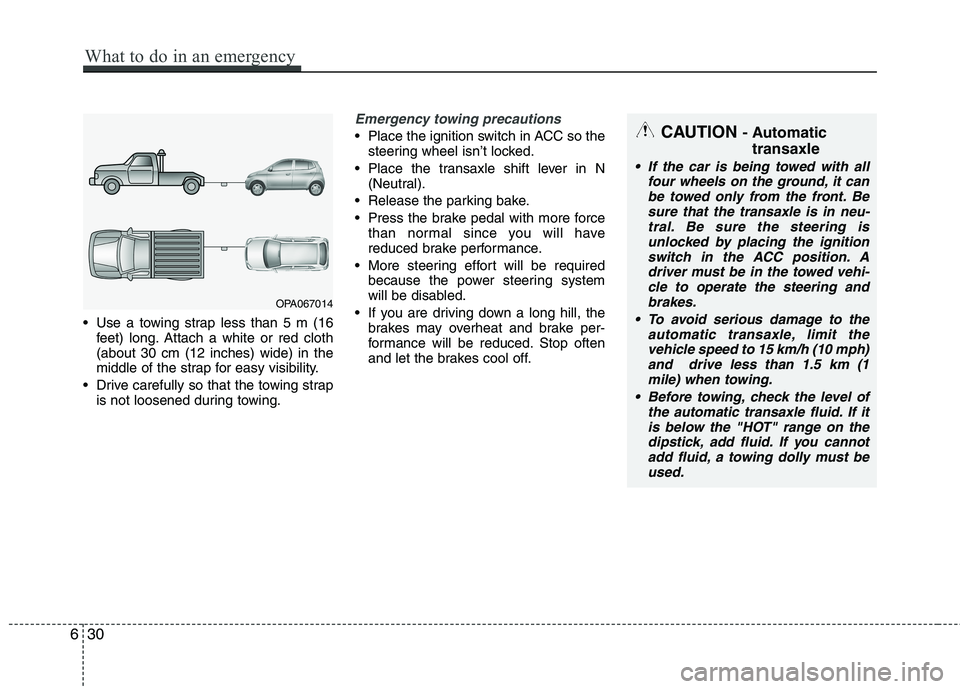
Use a towing strap less than 5 m (16
feet) long. Attach a white or red cloth
(about 30 cm (12 inches) wide) in the
middle of the strap for easy visibility.
Drive carefully so that the towing strap
is not loosened during towing.
Emergency towing precautions
Place the ignition switch in ACC so the
steering wheel isn’t locked.
Place the transaxle shift lever in N
(Neutral).
Release the parking bake.
Press the brake pedal with more force
than normal since you will have
reduced brake performance.
More steering effort will be required
because the power steering system
will be disabled.
If you are driving down a long hill, the
brakes may overheat and brake per-
formance will be reduced. Stop often
and let the brakes cool off.CAUTION - Automatic
transaxle
If the car is being towed with all
four wheels on the ground, it can
be towed only from the front. Be
sure that the transaxle is in neu-
tral. Be sure the steering is
unlocked by placing the ignition
switch in the ACC position. A
driver must be in the towed vehi-
cle to operate the steering and
brakes.
To avoid serious damage to the
automatic transaxle, limit the
vehicle speed to 15 km/h (10 mph)
and drive less than 1.5 km (1
mile) when towing.
Before towing, check the level of
the automatic transaxle fluid. If it
is below the "HOT" range on the
dipstick, add fluid. If you cannot
add fluid, a towing dolly must be
used.
OPA067014
630
What to do in an emergency
Page 332 of 420
75
Maintenance
While operating your vehicle:
Note any changes in the sound of the
exhaust or any smell of exhaust fumes
in the vehicle.
Check for vibrations in the steering
wheel. Notice any increased steering
effort or looseness in the steering
wheel, or change in its straight-ahead
position.
Notice if your vehicle constantly turns
slightly or “pulls” to one side when trav-
elling on smooth, level road.
When stopping, listen and check for
unusual sounds, pulling to one side,
increased brake pedal travel or “hard-
to-push” brake pedal.
If any slipping or changes in the oper-
ation of your transaxle occurs, check
the transaxle fluid level.
Check manual transaxle operation,
including clutch operation.
Check automatic transaxle P (Park)
function.
Check parking brake.
Check for fluid leaks under your vehicle
(water dripping from the air condition-
ing system during or after use is nor-
mal).
At least monthly:
Check coolant level in the engine
coolant reservoir.
Check the operation of all exterior
lights, including the stoplights, turn sig-
nals and hazard warning flashers.
Check the inflation pressures of all
tyres including the spare.
At least twice a year
(i.e., every Spring and Fall):
Check radiator, heater and air condi-
tioning hoses for leaks or damage.
Check windscreen washer spray and
wiper operation. Clean wiper blades
with clean cloth dampened with wash-
er fluid.
Check headlight alignment.
Check muffler, exhaust pipes, shields
and clamps.
Check the lap/shoulder belts for wear
and function.
Check for worn tyres and loose wheel
lug nuts.
At least once a year:
Clean body and door drain holes.
Lubricate door hinges and checks, and
bonnet hinges.
Lubricate door and bonnet locks and
latches.
Lubricate door rubber weatherstrips.
Check the air conditioning system.
Inspect and lubricate automatic
transaxle linkage and controls.
Clean battery and terminals.
Check the brake fluid level.
Page 347 of 420
Maintenance
20 7
Brake hoses and lines
Visually check for proper installation,
chafing, cracks, deterioration and any
leakage. Replace any deteriorated or
damaged parts immediately.
Brake fluid
Check brake fluid level in the brake fluid
reservoir. The level should be between
“MIN” and “MAX” marks on the side of
the reservoir. Use only hydraulic brake
fluid conforming to DOT 3 or DOT 4
specification.
Parking brake
Inspect the parking brake system includ-
ing the parking brake lever and cables.
Rear brake drums and linings
(if equipped)
Check the rear brake drums and linings
for scoring, burning, leaking fluid, broken
parts, and excessive wear.
Brake discs, pads, calipers and
rotors
Check the pads for excessive wear, discs
for run out and wear, and calipers for fluid
leakage.
For more information on checking the
pads or lining wear limit, we recommend
to refer to the Kia web site.
(http://brakeman
ual.kia.co.kr)
Suspension mounting bolts
Check the suspension connections for
looseness or damage. Retighten to the
specified torque.
Steering gear box, linkage &
boots/lower arm ball joint
With the vehicle stopped and engine off,
check for excessive free-play in the
steering wheel.
Check the linkage for bends or damage.
Check the dust boots and ball joints for
deterioration, cracks, or damage.
Replace any damaged parts.
Drive shafts and boots
Check the drive shafts, boots and clamps
for cracks, deterioration, or damage.
Replace any damaged parts and, if nec-
essary, repack the grease.
Air conditioning refrigerant
(if equipped)
Check the air conditioning lines and con-
nections for leakage and damage.
Page 371 of 420
Maintenance
44 7
Tyre replacement
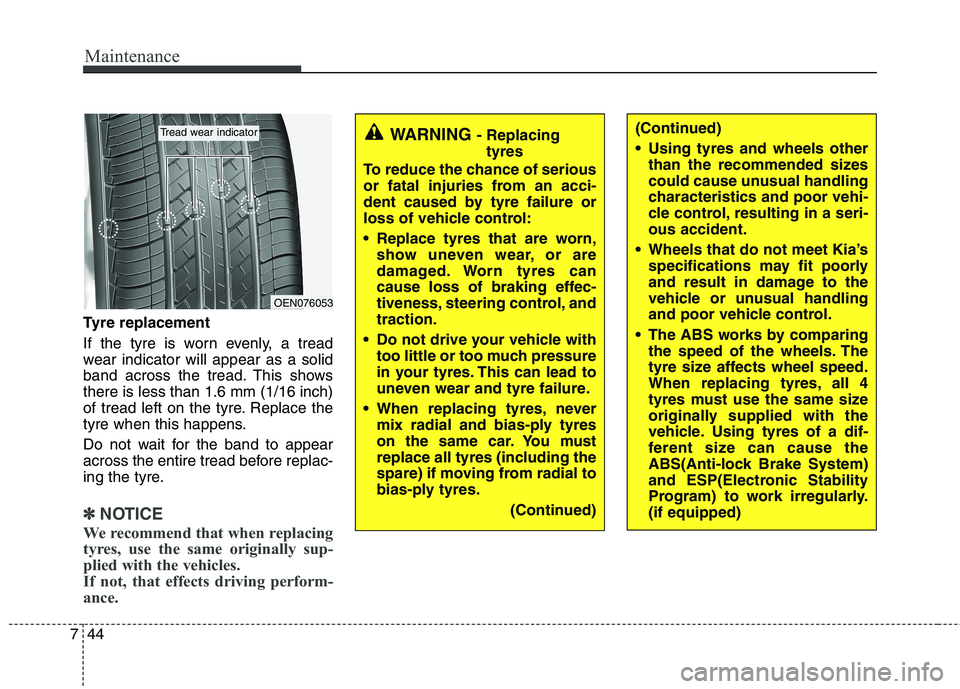
If the tyre is worn evenly, a tread
wear indicator will appear as a solid
band across the tread. This shows
there is less than 1.6 mm (1/16 inch)
of tread left on the tyre. Replace the
tyre when this happens.
Do not wait for the band to appear
across the entire tread before replac-
ing the tyre.
✽ ✽
NOTICE
We recommend that when replacing
tyres, use the same originally sup-
plied with the vehicles.
If not, that effects driving perform-
ance.
OEN076053
Tread wear indicatorWARNING - Replacing
tyres
To reduce the chance of serious
or fatal injuries from an acci-
dent caused by tyre failure or
loss of vehicle control:
Replace tyres that are worn,
show uneven wear, or are
damaged. Worn tyres can
cause loss of braking effec-
tiveness, steering control, and
traction.
Do not drive your vehicle with
too little or too much pressure
in your tyres. This can lead to
uneven wear and tyre failure.
When replacing tyres, never
mix radial and bias-ply tyres
on the same car. You must
replace all tyres (including the
spare) if moving from radial to
bias-ply tyres.
(Continued)(Continued)
Using tyres and wheels other
than the recommended sizes
could cause unusual handling
characteristics and poor vehi-
cle control, resulting in a seri-
ous accident.
Wheels that do not meet Kia’s
specifications may fit poorly
and result in damage to the
vehicle or unusual handling
and poor vehicle control.
The ABS works by comparing
the speed of the wheels. The
tyre size affects wheel speed.
When replacing tyres, all 4
tyres must use the same size
originally supplied with the
vehicle. Using tyres of a dif-
ferent size can cause the
ABS(Anti-lock Brake System)
and ESP(Electronic Stability
Program) to work irregularly.
(if equipped)
Page 384 of 420
757
Maintenance
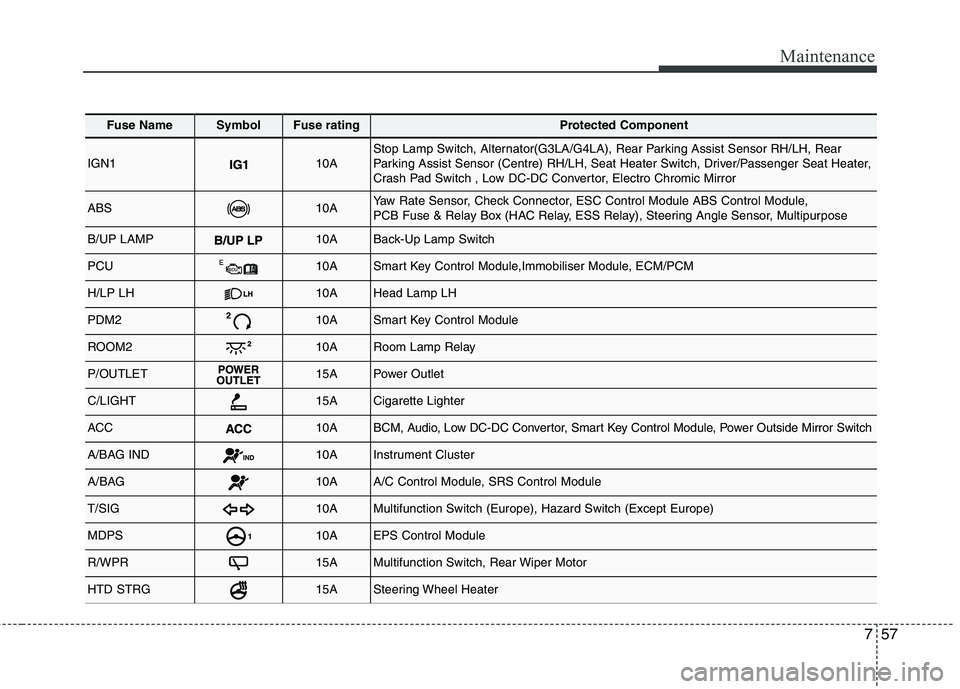
Fuse NameSymbolFuse ratingProtected Component
IGN110AStop Lamp Switch, Alternator(G3LA/G4LA), Rear Parking Assist Sensor RH/LH, Rear
Parking Assist Sensor (Centre) RH/LH, Seat Heater Switch, Driver/Passenger Seat Heater,
Crash Pad Switch , Low DC-DC Convertor, Electro Chromic Mirror
ABS10AYaw Rate Sensor, Check Connector, ESC Control Module ABS Control Module,
PCB Fuse & Relay Box (HAC Relay, ESS Relay), Steering Angle Sensor, Multipurpose
B/UP LAMP10ABack-Up Lamp Switch
PCU10ASmart Key Control Module,Immobiliser Module, ECM/PCM
H/LP LH10AHead Lamp LH
PDM210ASmart Key Control Module
ROOM210ARoom Lamp Relay
P/OUTLET15APower Outlet
C/LIGHT15ACigarette Lighter
ACC10ABCM, Audio, Low DC-DC Convertor, Smart Key Control Module, Power Outside Mirror Switch
A/BAG IND10AInstrument Cluster
A/BAG10AA/C Control Module, SRS Control Module
T/SIG10AMultifunction Switch (Europe), Hazard Switch (Except Europe)
MDPS10AEPS Control Module
R/WPR15AMultifunction Switch, Rear Wiper Motor
HTD STRG15ASteering Wheel Heater
Page 401 of 420
Maintenance
74 7
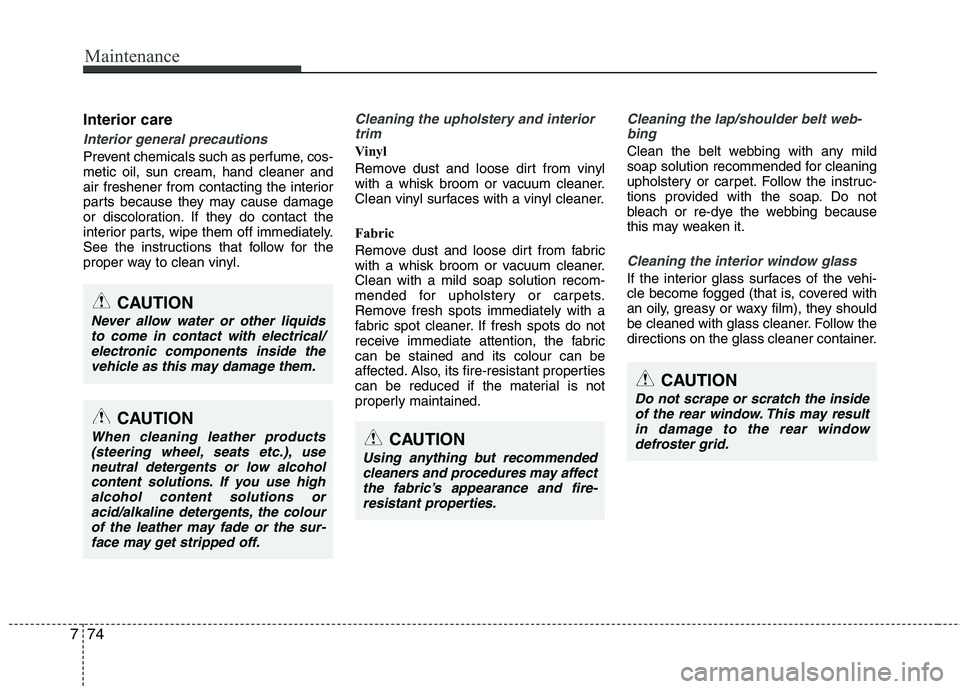
Interior care
Interior general precautions
Prevent chemicals such as perfume, cos-
metic oil, sun cream, hand cleaner and
air freshener from contacting the interior
parts because they may cause damage
or discoloration. If they do contact the
interior parts, wipe them off immediately.
See the instructions that follow for the
proper way to clean vinyl.
Cleaning the upholstery and interior
trim
Vinyl
Remove dust and loose dirt from vinyl
with a whisk broom or vacuum cleaner.
Clean vinyl surfaces with a vinyl cleaner.
Fabric
Remove dust and loose dirt from fabric
with a whisk broom or vacuum cleaner.
Clean with a mild soap solution recom-
mended for upholstery or carpets.
Remove fresh spots immediately with a
fabric spot cleaner. If fresh spots do not
receive immediate attention, the fabric
can be stained and its colour can be
affected. Also, its fire-resistant properties
can be reduced if the material is not
properly maintained.
Cleaning the lap/shoulder belt web-
bing
Clean the belt webbing with any mild
soap solution recommended for cleaning
upholstery or carpet. Follow the instruc-
tions provided with the soap. Do not
bleach or re-dye the webbing because
this may weaken it.
Cleaning the interior window glass
If the interior glass surfaces of the vehi-
cle become fogged (that is, covered with
an oily, greasy or waxy film), they should
be cleaned with glass cleaner. Follow the
directions on the glass cleaner container.
CAUTION
Using anything but recommended
cleaners and procedures may affect
the fabric’s appearance and fire-
resistant properties.
CAUTION
Do not scrape or scratch the inside
of the rear window. This may result
in damage to the rear window
defroster grid.
CAUTION
Never allow water or other liquids
to come in contact with electrical/
electronic components inside the
vehicle as this may damage them.
CAUTION
When cleaning leather products
(steering wheel, seats etc.), use
neutral detergents or low alcohol
content solutions. If you use high
alcohol content solutions or
acid/alkaline detergents, the colour
of the leather may fade or the sur-
face may get stripped off.
Page 413 of 420
Index
2I
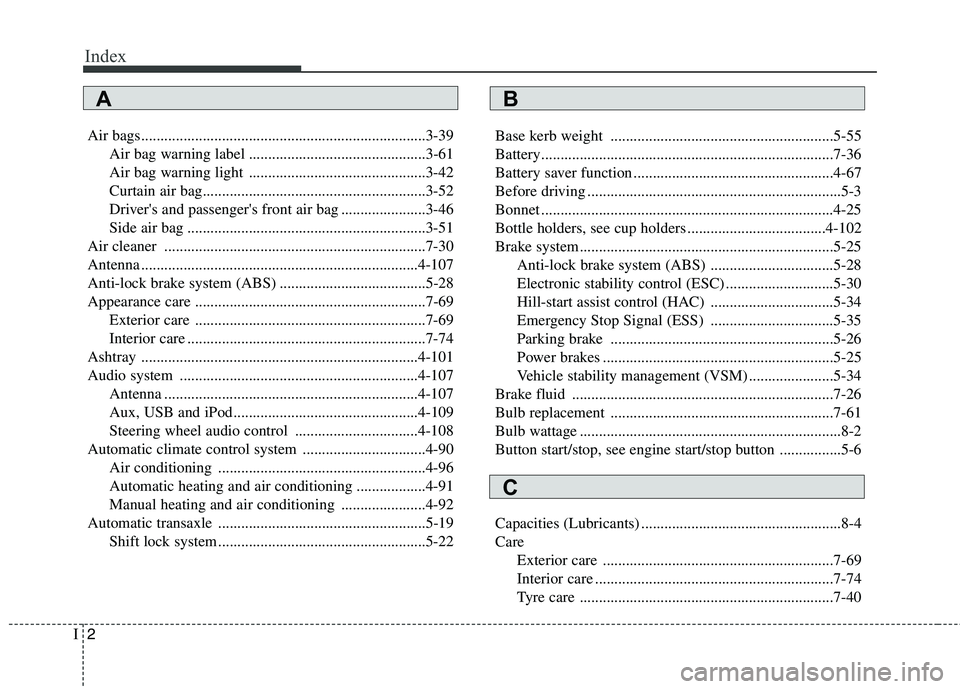
Air bags..........................................................................3-39
Air bag warning label ..............................................3-61
Air bag warning light ..............................................3-42
Curtain air bag..........................................................3-52
Driver's and passenger's front air bag ......................3-46
Side air bag ..............................................................3-51
Air cleaner ....................................................................7-30
Antenna ........................................................................4-107
Anti-lock brake system (ABS) ......................................5-28
Appearance care ............................................................7-69
Exterior care ............................................................7-69
Interior care ..............................................................7-74
Ashtray ........................................................................4-101
Audio system ..............................................................4-107
Antenna ..................................................................4-107
Aux, USB and iPod................................................4-109
Steering wheel audio control ................................4-108
Automatic climate control system ................................4-90
Air conditioning ......................................................4-96
Automatic heating and air conditioning ..................4-91
Manual heating and air conditioning ......................4-92
Automatic transaxle ......................................................5-19
Shift lock system ......................................................5-22Base kerb weight ..........................................................5-55
Battery............................................................................7-36
Battery saver function ....................................................4-67
Before driving ..................................................................5-3
Bonnet ............................................................................4-25
Bottle holders, see cup holders ....................................4-102
Brake system..................................................................5-25
Anti-lock brake system (ABS) ................................5-28
Electronic stability control (ESC) ............................5-30
Hill-start assist control (HAC) ................................5-34
Emergency Stop Signal (ESS) ................................5-35
Parking brake ..........................................................5-26
Power brakes ............................................................5-25
Vehicle stability management (VSM) ......................5-34
Brake fluid ....................................................................7-26
Bulb replacement ..........................................................7-61
Bulb wattage ....................................................................8-2
Button start/stop, see engine start/stop button ................5-6
Capacities (Lubricants) ....................................................8-4
Care
Exterior care ............................................................7-69
Interior care ..............................................................7-74
Tyre care ..................................................................7-40
AB
C
Page 419 of 420
Index
8I
Special driving conditions ..............................................5-39
Driving at night ........................................................5-40
Driving in flooded areas............................................5-42
Driving in the rain ....................................................5-41
Hazardous driving conditions ..................................5-39
Highway driving ........................................................5-42
Rocking the vehicle ..................................................5-39
Smooth cornering ......................................................5-40
Speedometer....................................................................4-42
Starting difficulties, see engine will not start ..................6-4
Starting the engine ............................................................5-9
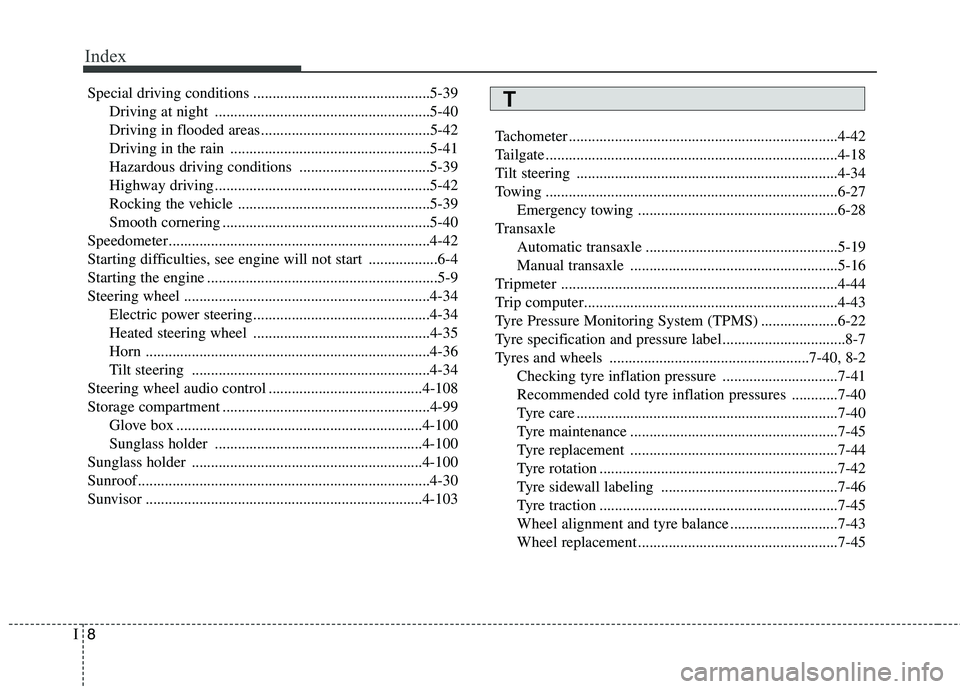
Steering wheel ................................................................4-34
Electric power steering..............................................4-34
Heated steering wheel ..............................................4-35
Horn ..........................................................................4-36
Tilt steering ..............................................................4-34
Steering wheel audio control ........................................4-108
Storage compartment ......................................................4-99
Glove box ................................................................4-100
Sunglass holder ......................................................4-100
Sunglass holder ............................................................4-100
Sunroof............................................................................4-30
Sunvisor ........................................................................4-103Tachometer ......................................................................4-42
Tailgate ............................................................................4-18
Tilt steering ....................................................................4-34
Towing ............................................................................6-27
Emergency towing ....................................................6-28
Transaxle
Automatic transaxle ..................................................5-19
Manual transaxle ......................................................5-16
Tripmeter ........................................................................4-44
Trip computer..................................................................4-43
Tyre Pressure Monitoring System (TPMS) ....................6-22
Tyre specification and pressure label................................8-7
Tyres and wheels ....................................................7-40, 8-2
Checking tyre inflation pressure ..............................7-41
Recommended cold tyre inflation pressures ............7-40
Tyre care ....................................................................7-40
Tyre maintenance ......................................................7-45
Tyre replacement ......................................................7-44
Tyre rotation ..............................................................7-42
Tyre sidewall labeling ..............................................7-46
Tyre traction ..............................................................7-45
Wheel alignment and tyre balance ............................7-43
Wheel replacement ....................................................7-45T