brake fluid KIA NIRO 2017 Owner's Manual
[x] Cancel search | Manufacturer: KIA, Model Year: 2017, Model line: NIRO, Model: KIA NIRO 2017Pages: 552, PDF Size: 14.92 MB
Page 442 of 552
819
Maintenance
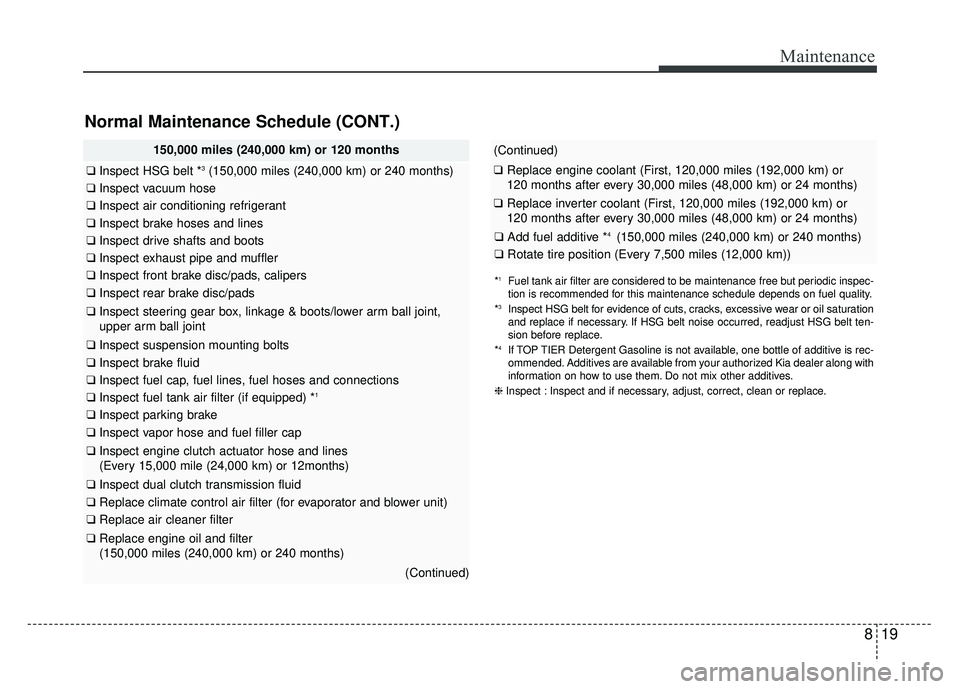
Normal Maintenance Schedule (CONT.)
150,000 miles (240,000 km) or 120 months
❑Inspect HSG belt *3(150,000 miles (240,000 km) or 240 months)
❑Inspect vacuum hose
❑Inspect air conditioning refrigerant
❑Inspect brake hoses and lines
❑Inspect drive shafts and boots
❑Inspect exhaust pipe and muffler
❑Inspect front brake disc/pads, calipers
❑Inspect rear brake disc/pads
❑Inspect steering gear box, linkage & boots/lower arm ball joint,
upper arm ball joint
❑ Inspect suspension mounting bolts
❑Inspect brake fluid
❑Inspect fuel cap, fuel lines, fuel hoses and connections
❑Inspect fuel tank air filter (if equipped) *1
❑Inspect parking brake
❑Inspect vapor hose and fuel filler cap
❑Inspect engine clutch actuator hose and lines
(Every 15,000 mile (24,000 km) or 12months)
❑ Inspect dual clutch transmission fluid
❑Replace climate control air filter (for evaporator and blower unit)
❑Replace air cleaner filter
❑Replace engine oil and filter
(150,000 miles (240,000 km) or 240 months)
(Continued)
(Continued)
❑Replace engine coolant (First, 120,000 miles (192,000 km) or
120 months after every 30,000 miles (48,000 km) or 24 months)
❑Replace inverter coolant (First, 120,000 miles (192,000 km) or
120 months after every 30,000 miles (48,000 km) or 24 months)
❑ Add fuel additive *4 (150,000 miles (240,000 km) or 240 months)
❑Rotate tire position (Every 7,500 miles (12,000 km))
*1Fuel tank air filter are considered to be maintenance free but periodic inspec-
tion is recommended for this maintenance schedule depends on fuel quality.
*
3Inspect HSG belt for evidence of cuts, cracks, excessive wear or oil saturation
and replace if necessary. If HSG belt noise occurred, readjust HSG belt ten-
sion before replace.
*
4If TOP TIER Detergent Gasoline is not available, one bottle of additive is rec-
ommended. Additives are available from your authorized Kia dealer along with
information on how to use them. Do not mix other additives.
❈ Inspect : Inspect and if necessary, adjust, correct, clean or replace.
Page 443 of 552

Maintenance
20
8
Maintenance Under Severe Usage Conditions
Severe Driving Conditions
A - Repeatedly driving short distance of less than 5 miles (8 km) in nor-
mal temperature or less than 10 miles (16 km) in freezing temperature
B - Extensive engine idling or low speed driving for long distances
C - Driving on rough, dusty, muddy, unpaved, graveled or salt- spread roads
D - Driving in areas using salt or other corrosive materials or in very cold weather E - Driving in heavy dust condition.
F - Driving in heavy traffic area.
G - Driving on uphill, downhill, or mountain roads repeatedly.
H - Towing a trailer or using a camper on roof rack.
I - Driving for patrol car, taxi, other commercial use of vehicle towing.
J - Driving over 106 mph (170 km/h).
K - Frequently driving in stop-and-go conditions.
The following items must be serviced more frequently on cars normally used under severe driving conditions. Refer
to the chart below for the appropriate maintenance intervals.
R : Replace I : Inspect and, after inspection, clean, adjust, repair or replace if neces\
sary
MAINTENANCE ITEMMAINTENANCE
OPERATIONMAINTENANCE INTERVALSDRIVING CONDITION
Engine oil and filter REvery 3,750 miles (6,000 km) or 6 monthsA, B, C, D, E, F, G,
H, I, J, K
Air cleaner filterRMore frequentlyC, E
Spark plugsRMore frequentlyB, H
Dual clutch transmission fluid REvery 75,000 miles (12,000 km)A, C, E, F, G, H, I, J
HSG (Hybrid Starter & Generator) beltREvery 30,000 miles (48,000 km) or 24 monthsC, D, E, K
IEvery 3,750 miles (6,000 km) or 6 monthsC, D, E, K
Front brake disc/pads, calipersIMore frequentlyC, D, G, H
Rear brake disc/padsIMore frequentlyC, D, G, F
Parking brakeIMore frequentlyC, D, G, H
Steering gear box, linkage & boots/lower arm ball
joint, upper arm ball jointIMore frequentlyC, D, E, F, G, H, I
Drive shafts and bootsIEvery 7,500 miles (12,000 km) or 6 monthsC, D, E, F, G, H, I, J
Climate control air filter
(for evaporator and blower unit)RMore frequentlyC, E
Suspension mounting boltsIMore frequentlyC, D, E, F, G, H, I
Page 446 of 552
823
Maintenance
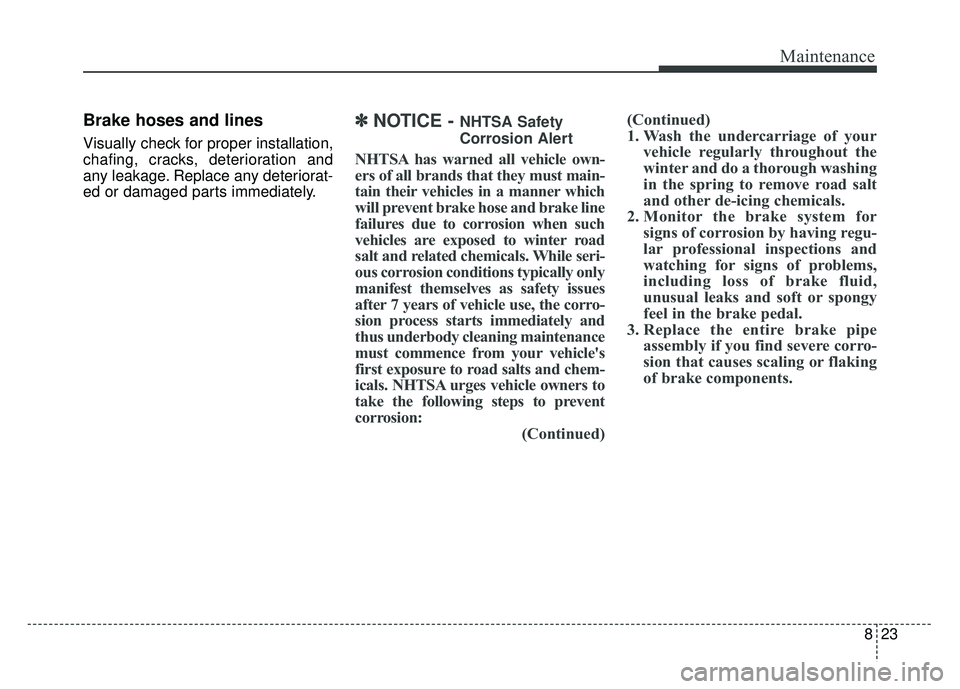
Brake hoses and lines
Visually check for proper installation,
chafing, cracks, deterioration and
any leakage. Replace any deteriorat-
ed or damaged parts immediately.
✽ ✽NOTICE - NHTSA Safety
Corrosion Alert
NHTSA has warned all vehicle own-
ers of all brands that they must main-
tain their vehicles in a manner which
will prevent brake hose and brake line
failures due to corrosion when such
vehicles are exposed to winter road
salt and related chemicals. While seri-
ous corrosion conditions typically only
manifest themselves as safety issues
after 7 years of vehicle use, the corro-
sion process starts immediately and
thus underbody cleaning maintenance
must commence from your vehicle's
first exposure to road salts and chem-
icals. NHTSA urges vehicle owners to
take the following steps to prevent
corrosion:
(Continued)(Continued)
1. Wash the undercarriage of your
vehicle regularly throughout the
winter and do a thorough washing
in the spring to remove road salt
and other de-icing chemicals.
2. Monitor the brake system for signs of corrosion by having regu-
lar professional inspections and
watching for signs of problems,
including loss of brake fluid,
unusual leaks and soft or spongy
feel in the brake pedal.
3. Replace the entire brake pipe assembly if you find severe corro-
sion that causes scaling or flaking
of brake components.
Page 447 of 552
Maintenance
24
8
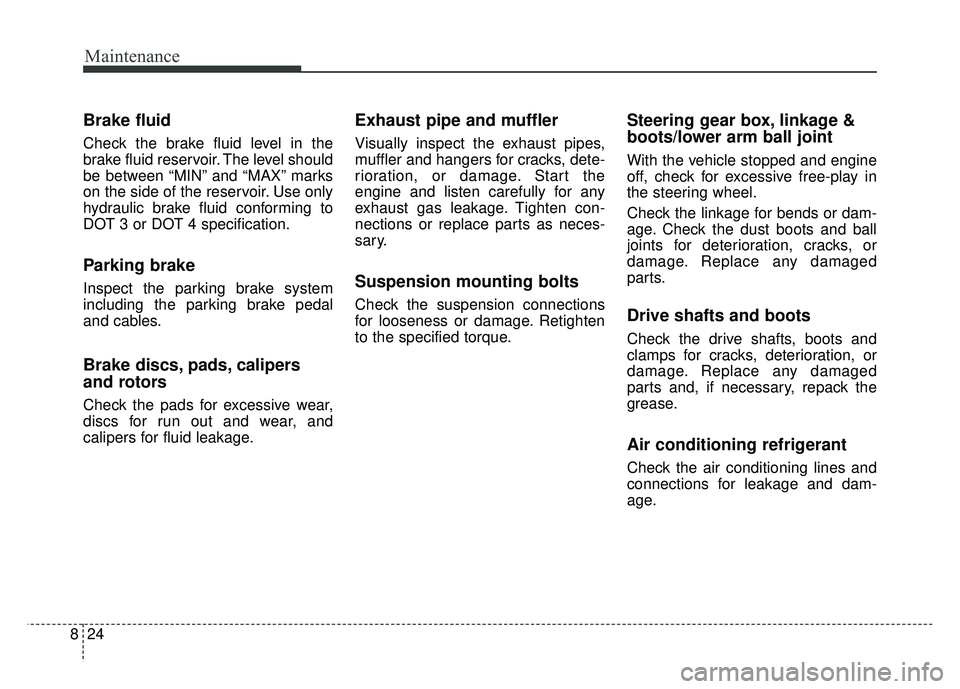
Brake fluid
Check the brake fluid level in the
brake fluid reservoir. The level should
be between “MIN” and “MAX” marks
on the side of the reservoir. Use only
hydraulic brake fluid conforming to
DOT 3 or DOT 4 specification.
Parking brake
Inspect the parking brake system
including the parking brake pedal
and cables.
Brake discs, pads, calipers
and rotors
Check the pads for excessive wear,
discs for run out and wear, and
calipers for fluid leakage.
Exhaust pipe and muffler
Visually inspect the exhaust pipes,
muffler and hangers for cracks, dete-
rioration, or damage. Start the
engine and listen carefully for any
exhaust gas leakage. Tighten con-
nections or replace parts as neces-
sary.
Suspension mounting bolts
Check the suspension connections
for looseness or damage. Retighten
to the specified torque.
Steering gear box, linkage &
boots/lower arm ball joint
With the vehicle stopped and engine
off, check for excessive free-play in
the steering wheel.
Check the linkage for bends or dam-
age. Check the dust boots and ball
joints for deterioration, cracks, or
damage. Replace any damaged
parts.
Drive shafts and boots
Check the drive shafts, boots and
clamps for cracks, deterioration, or
damage. Replace any damaged
parts and, if necessary, repack the
grease.
Air conditioning refrigerant
Check the air conditioning lines and
connections for leakage and dam-
age.
Page 454 of 552
831
Maintenance
BRAKE FLUID
Checking the brake fluid level
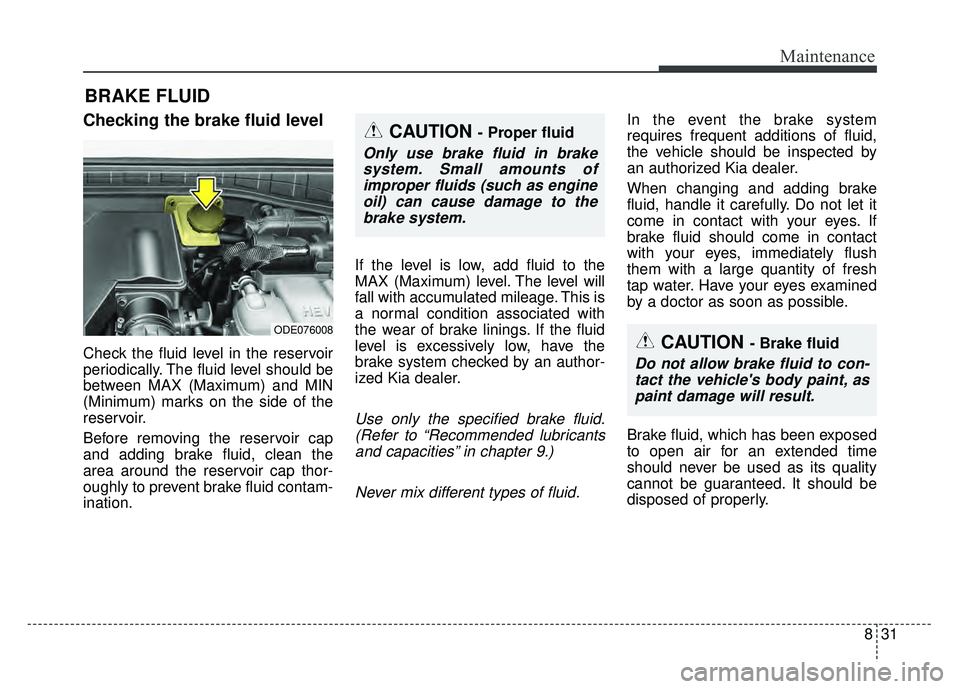
Check the fluid level in the reservoir
periodically. The fluid level should be
between MAX (Maximum) and MIN
(Minimum) marks on the side of the
reservoir.
Before removing the reservoir cap
and adding brake fluid, clean the
area around the reservoir cap thor-
oughly to prevent brake fluid contam-
ination.If the level is low, add fluid to the
MAX (Maximum) level. The level will
fall with accumulated mileage. This is
a normal condition associated with
the wear of brake linings. If the fluid
level is excessively low, have the
brake system checked by an author-
ized Kia dealer.
Use only the specified brake fluid.
(Refer to “Recommended lubricantsand capacities” in chapter 9.)
Never mix different types of fluid.
In the event the brake system
requires frequent additions of fluid,
the vehicle should be inspected by
an authorized Kia dealer.
When changing and adding brake
fluid, handle it carefully. Do not let it
come in contact with your eyes. If
brake fluid should come in contact
with your eyes, immediately flush
them with a large quantity of fresh
tap water. Have your eyes examined
by a doctor as soon as possible.
Brake fluid, which has been exposed
to open air for an extended time
should never be used as its quality
cannot be guaranteed. It should be
disposed of properly.
CAUTION - Brake fluid
Do not allow brake fluid to con-tact the vehicle's body paint, aspaint damage will result.
CAUTION - Proper fluid
Only use brake fluid in brakesystem. Small amounts ofimproper fluids (such as engineoil) can cause damage to thebrake system.
ODE076008
Page 514 of 552
891
Maintenance
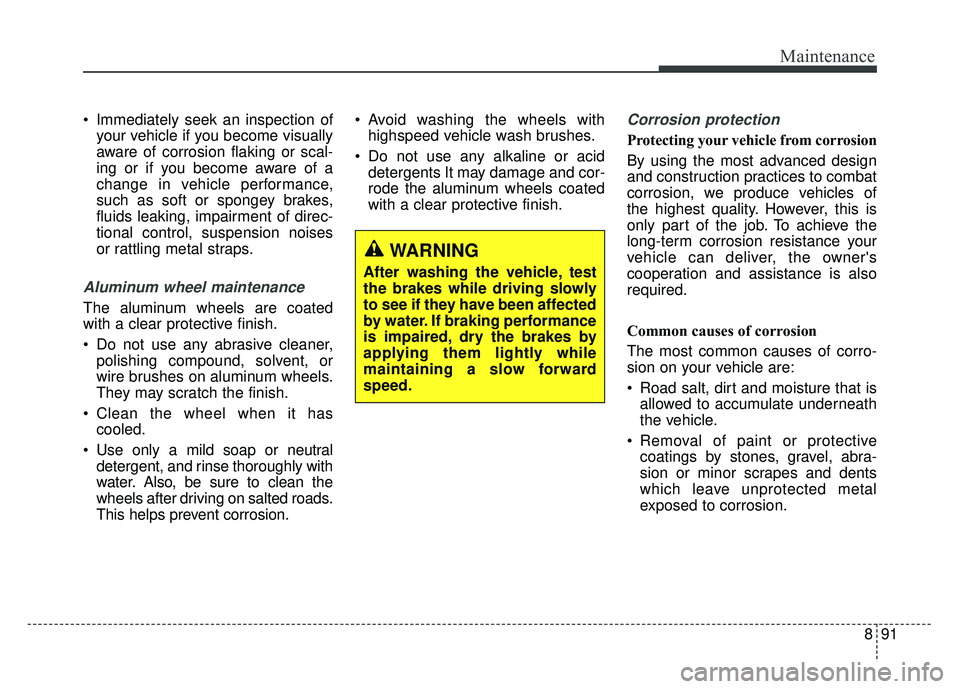
Immediately seek an inspection ofyour vehicle if you become visually
aware of corrosion flaking or scal-
ing or if you become aware of a
change in vehicle performance,
such as soft or spongey brakes,
fluids leaking, impairment of direc-
tional control, suspension noises
or rattling metal straps.
Aluminum wheel maintenance
The aluminum wheels are coated
with a clear protective finish.
Do not use any abrasive cleaner,polishing compound, solvent, or
wire brushes on aluminum wheels.
They may scratch the finish.
Clean the wheel when it has cooled.
Use only a mild soap or neutral detergent, and rinse thoroughly with
water. Also, be sure to clean the
wheels after driving on salted roads.
This helps prevent corrosion. Avoid washing the wheels with
highspeed vehicle wash brushes.
Do not use any alkaline or acid detergents It may damage and cor-
rode the aluminum wheels coated
with a clear protective finish.
Corrosion protection
Protecting your vehicle from corrosion
By using the most advanced design
and construction practices to combat
corrosion, we produce vehicles of
the highest quality. However, this is
only part of the job. To achieve the
long-term corrosion resistance your
vehicle can deliver, the owner's
cooperation and assistance is also
required.
Common causes of corrosion
The most common causes of corro-
sion on your vehicle are:
Road salt, dirt and moisture that isallowed to accumulate underneath
the vehicle.
Removal of paint or protective coatings by stones, gravel, abra-
sion or minor scrapes and dents
which leave unprotected metal
exposed to corrosion.
WARNING
After washing the vehicle, test
the brakes while driving slowly
to see if they have been affected
by water. If braking performance
is impaired, dry the brakes by
applying them lightly while
maintaining a slow forward
speed.
Page 528 of 552
Specifications, Consumer information, Reporting safety defects
69
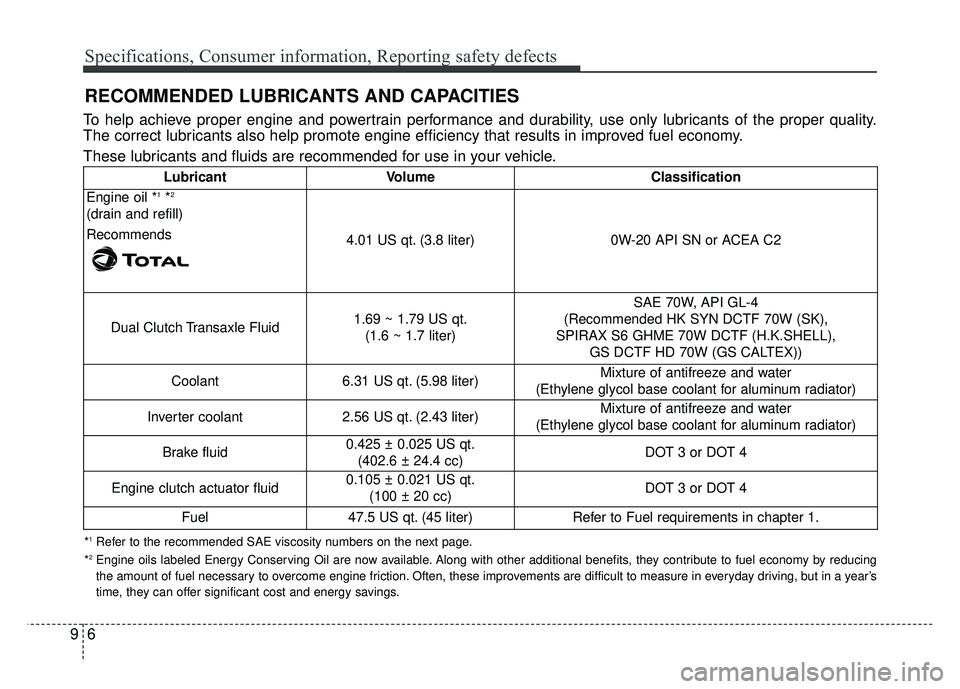
RECOMMENDED LUBRICANTS AND CAPACITIES
To help achieve proper engine and powertrain performance and durability, use only lubricants of the proper quality.
The correct lubricants also help promote engine efficiency that results in improved fuel economy.
These lubricants and fluids are recommended for use in your vehicle.
*1Refer to the recommended SAE viscosity numbers on the next page.
*2Engine oils labeled Energy Conserving Oil are now available. Along with other additional benefits, they contribute to fuel econo my by reducing
the amount of fuel necessary to overcome engine friction. Often, these improvements are difficult to measure in everyday driving, but in a year’s
time, they can offer significant cost and energy savings.
Lubricant VolumeClassification
Engine oil *1*2
(drain and refill)
Recommends
4.01 US qt. (3.8 liter)0W-20 API SN or ACEA C2
Dual Clutch Transaxle Fluid1.69 ~ 1.79 US qt. (1.6 ~ 1.7 liter)
SAE 70W, API GL-4
(Recommended HK SYN DCTF 70W (SK),
SPIRAX S6 GHME 70W DCTF (H.K.SHELL), GS DCTF HD 70W (GS CALTEX))
Coolant6.31 US qt. (5.98 liter)Mixture of antifreeze and water
(Ethylene glycol base coolant for aluminum radiator)
Inverter coolant2.56 US qt. (2.43 liter)Mixture of antifreeze and water
(Ethylene glycol base coolant for aluminum radiator)
Brake fluid0.425 ± 0.025 US qt. (402.6 ± 24.4 cc)DOT 3 or DOT 4
Engine clutch actuator fluid0.105 ± 0.021 US qt. (100 ± 20 cc)DOT 3 or DOT 4
Fuel47.5 US qt. (45 liter)Refer to Fuel requirements in chapter 1.
Page 540 of 552
I3
Index
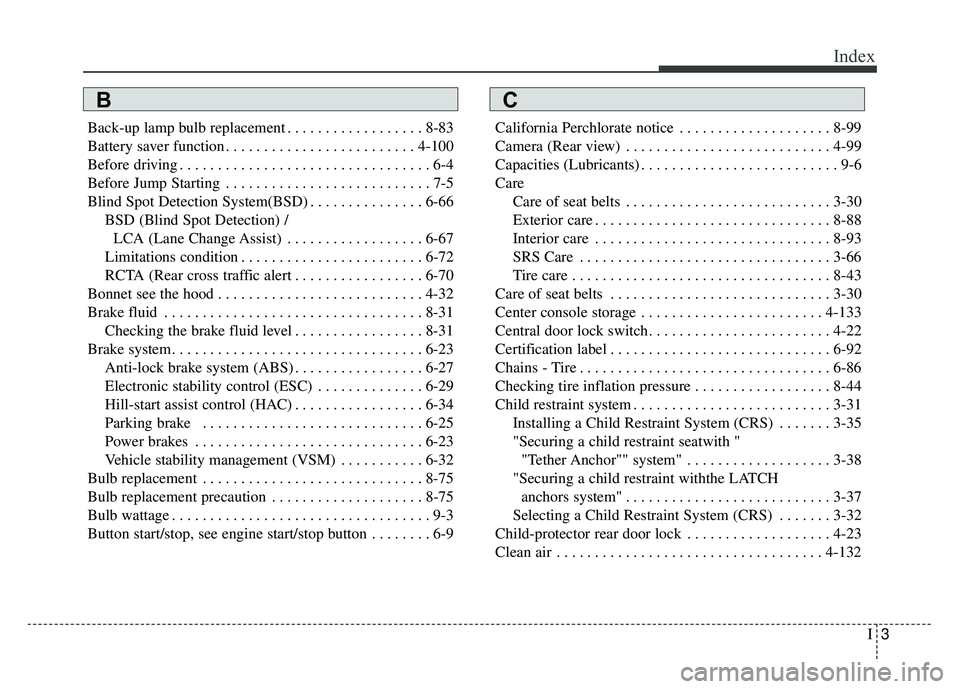
Back-up lamp bulb replacement . . . . . . . . . . . . . . . . . . 8-83
Battery saver function . . . . . . . . . . . . . . . . . . . . . . . . . 4-100
Before driving . . . . . . . . . . . . . . . . . . . . . . . . . . . . . . . . . 6-4
Before Jump Starting . . . . . . . . . . . . . . . . . . . . . . . . . . . 7-5
Blind Spot Detection System(BSD) . . . . . . . . . . . . . . . 6-66BSD (Blind Spot Detection) /LCA (Lane Change Assist) . . . . . . . . . . . . . . . . . . 6-67
Limitations condition . . . . . . . . . . . . . . . . . . . . . . . . 6-72
RCTA (Rear cross traffic alert . . . . . . . . . . . . . . . . . 6-70
Bonnet see the hood . . . . . . . . . . . . . . . . . . . . . . . . . . . 4-32
Brake fluid . . . . . . . . . . . . . . . . . . . . . . . . . . . . . . . . . . 8-31\
Checking the brake fluid level . . . . . . . . . . . . . . . . . 8-31
Brake system. . . . . . . . . . . . . . . . . . . . . . . . . . . . . . . . . 6-23 Anti-lock brake system (ABS) . . . . . . . . . . . . . . . . . 6-27
Electronic stability control (ESC) . . . . . . . . . . . . . . 6-29
Hill-start assist control (HAC) . . . . . . . . . . . . . . . . . 6-34
Parking brake . . . . . . . . . . . . . . . . . . . . . . . . . . . . . 6-25
Power brakes . . . . . . . . . . . . . . . . . . . . . . . . . . . . . . 6-23
Vehicle stability management (VSM) . . . . . . . . . . . 6-32
Bulb replacement . . . . . . . . . . . . . . . . . . . . . . . . . . . . . 8-75
Bulb replacement precaution . . . . . . . . . . . . . . . . . . . . 8-75
Bulb wattage . . . . . . . . . . . . . . . . . . . . . . . . . . . . . . . . . . 9-3
Button start/stop, see engine start/stop button . . . . . . . . 6-9 California Perchlorate notice . . . . . . . . . . . . . . . . . . . . 8-99
Camera (Rear view) . . . . . . . . . . . . . . . . . . . . . . . . . . . 4-99
Capacities (Lubricants) . . . . . . . . . . . . . . . . . . . . . . . . . . 9-6
Care
Care of seat belts . . . . . . . . . . . . . . . . . . . . . . . . . . . 3-30
Exterior care . . . . . . . . . . . . . . . . . . . . . . . . . . . . . . . 8-88
Interior care . . . . . . . . . . . . . . . . . . . . . . . . . . . . . . . 8-93
SRS Care . . . . . . . . . . . . . . . . . . . . . . . . . . . . . . . . . 3-66
Tire care . . . . . . . . . . . . . . . . . . . . . . . . . . . . . . . . . . 8-43\
Care of seat belts . . . . . . . . . . . . . . . . . . . . . . . . . . . . . 3-30
Center console storage . . . . . . . . . . . . . . . . . . . . . . . . 4-133
Central door lock switch. . . . . . . . . . . . . . . . . . . . . . . . 4-22
Certification label . . . . . . . . . . . . . . . . . . . . . . . . . . . . . 6-92
Chains - Tire . . . . . . . . . . . . . . . . . . . . . . . . . . . . . . . . . 6-86
Checking tire inflation pressure . . . . . . . . . . . . . . . . . . 8-44
Child restraint system . . . . . . . . . . . . . . . . . . . . . . . . . . 3-31 Installing a Child Restraint System (CRS) . . . . . . . 3-35
"Securing a child restraint seatwith ""Tether Anchor"" system" . . . . . . . . . . . . . . . . . . . 3-38
"Securing a child restraint withthe LATCH anchors system" . . . . . . . . . . . . . . . . . . . . . . . . . . . 3-37
Selecting a Child Restraint System (CRS) . . . . . . . 3-32
Child-protector rear door lock . . . . . . . . . . . . . . . . . . . 4-23
Clean air . . . . . . . . . . . . . . . . . . . . . . . . . . . . . . . . . . . 4-\
132
BC
Page 542 of 552
I5
Index
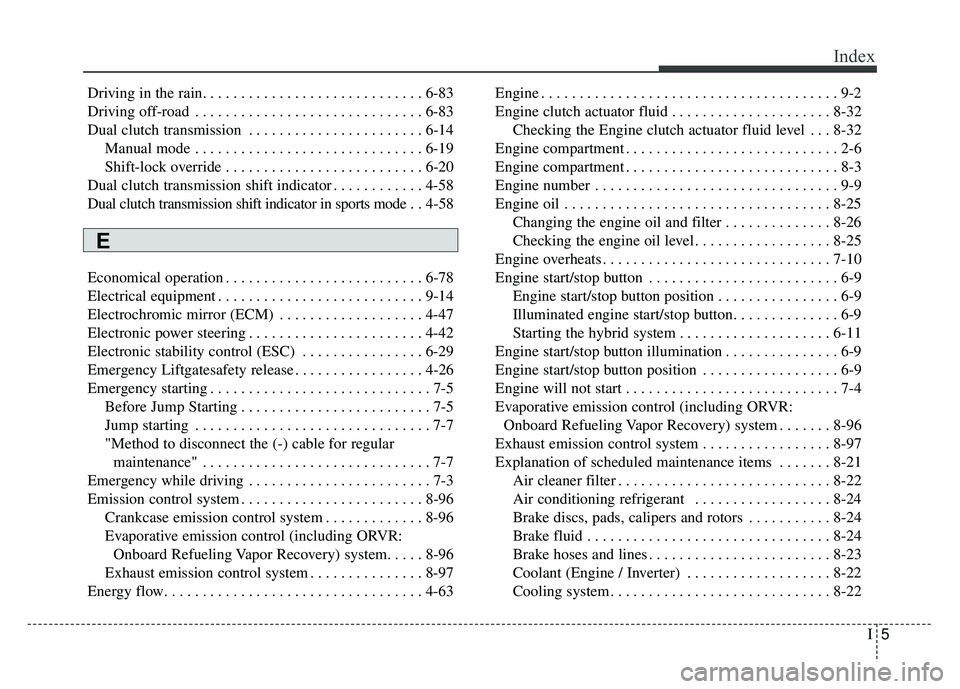
Driving in the rain. . . . . . . . . . . . . . . . . . . . . . . . . . . . . 6-83
Driving off-road . . . . . . . . . . . . . . . . . . . . . . . . . . . . . . 6-83
Dual clutch transmission . . . . . . . . . . . . . . . . . . . . . . . 6-14Manual mode . . . . . . . . . . . . . . . . . . . . . . . . . . . . . . 6-19
Shift-lock override . . . . . . . . . . . . . . . . . . . . . . . . . . 6-20
Dual clutch transmission shift indicator . . . . . . . . . . . . 4-58
Dual clutch transmission shift indicator in sports mode . . 4-58
Economical operation . . . . . . . . . . . . . . . . . . . . . . . . . . 6-78
Electrical equipment . . . . . . . . . . . . . . . . . . . . . . . . . . . 9-14
Electrochromic mirror (ECM) . . . . . . . . . . . . . . . . . . . 4-47
Electronic power steering . . . . . . . . . . . . . . . . . . . . . . . 4-42
Electronic stability control (ESC) . . . . . . . . . . . . . . . . 6-29
Emergency Liftgatesafety release . . . . . . . . . . . . . . . . . 4-26
Emergency starting . . . . . . . . . . . . . . . . . . . . . . . . . . . . . 7-5 Before Jump Starting . . . . . . . . . . . . . . . . . . . . . . . . . 7-5
Jump starting . . . . . . . . . . . . . . . . . . . . . . . . . . . . . . . 7-7
"Method to disconnect the (-) cable for regularmaintenance" . . . . . . . . . . . . . . . . . . . . . . . . . . . . . . 7-7
Emergency while driving . . . . . . . . . . . . . . . . . . . . . . . . 7-3
Emission control system . . . . . . . . . . . . . . . . . . . . . . . . 8-96 Crankcase emission control system . . . . . . . . . . . . . 8-96
Evaporative emission control (including ORVR:Onboard Refueling Vapor Recovery) system. . . . . 8-96
Exhaust emission control system . . . . . . . . . . . . . . . 8-97
Energy flow. . . . . . . . . . . . . . . . . . . . . . . . . . . . . . . . . . 4-63\
Engine . . . . . . . . . . . . . . . . . . . . . . . . . . . . . . . . . . . . \
. . . 9-2
Engine clutch actuator fluid . . . . . . . . . . . . . . . . . . . . . 8-32
Checking the Engine clutch actuator fluid level . . . 8-32
Engine compartment . . . . . . . . . . . . . . . . . . . . . . . . . . . . 2-6
Engine compartment . . . . . . . . . . . . . . . . . . . . . . . . . . . . 8-3
Engine number . . . . . . . . . . . . . . . . . . . . . . . . . . . . . . . . 9-9
Engine oil . . . . . . . . . . . . . . . . . . . . . . . . . . . . . . . . . . . 8-\
25 Changing the engine oil and filter . . . . . . . . . . . . . . 8-26
Checking the engine oil level . . . . . . . . . . . . . . . . . . 8-25
Engine overheats . . . . . . . . . . . . . . . . . . . . . . . . . . . . . . 7-10
Engine start/stop button . . . . . . . . . . . . . . . . . . . . . . . . . 6-9 Engine start/stop button position . . . . . . . . . . . . . . . . 6-9
Illuminated engine start/stop button. . . . . . . . . . . . . . 6-9
Starting the hybrid system . . . . . . . . . . . . . . . . . . . . 6-11
Engine start/stop button illumination . . . . . . . . . . . . . . . 6-9
Engine start/stop button position . . . . . . . . . . . . . . . . . . 6-9
Engine will not start . . . . . . . . . . . . . . . . . . . . . . . . . . . . 7-4
Evaporative emission control (including ORVR: Onboard Refueling Vapor Recovery) system . . . . . . . 8-96
Exhaust emission control system . . . . . . . . . . . . . . . . . 8-97
Explanation of scheduled maintenance items . . . . . . . 8-21 Air cleaner filter . . . . . . . . . . . . . . . . . . . . . . . . . . . . 8-22
Air conditioning refrigerant . . . . . . . . . . . . . . . . . . 8-24
Brake discs, pads, calipers and rotors . . . . . . . . . . . 8-24
Brake fluid . . . . . . . . . . . . . . . . . . . . . . . . . . . . . . . . 8-24
Brake hoses and lines . . . . . . . . . . . . . . . . . . . . . . . . 8-23
Coolant (Engine / Inverter) . . . . . . . . . . . . . . . . . . . 8-22
Cooling system . . . . . . . . . . . . . . . . . . . . . . . . . . . . . 8-22
E
Page 543 of 552
Index
6I
Drive shafts and boots . . . . . . . . . . . . . . . . . . . . . . . 8-24
Dual clutch transmission fluid . . . . . . . . . . . . . . . . . 8-22
Engine oil and filter . . . . . . . . . . . . . . . . . . . . . . . . . 8-21
Exhaust pipe and muffler . . . . . . . . . . . . . . . . . . . . . 8-24
Fuel filter (for gasoline) . . . . . . . . . . . . . . . . . . . . . . 8-21
Fuel lines, fuel hoses and connections . . . . . . . . . . . 8-21
HSG (Hybrid starter & generator) belt . . . . . . . . . . 8-21
Parking brake . . . . . . . . . . . . . . . . . . . . . . . . . . . . . 8-24
Spark plugs . . . . . . . . . . . . . . . . . . . . . . . . . . . . . . . . 8-22
Steering gear box, linkage & boots/lower arm ball joint . . . . . . . . . . . . . . . . . . . . . . . . 8-24
Suspension mounting bolts . . . . . . . . . . . . . . . . . . . 8-24
Vacuum crankcase ventilation hoses . . . . . . . . . . . . 8-22
Vapor hose and fuel filler cap . . . . . . . . . . . . . . . . . 8-21
Exterior care . . . . . . . . . . . . . . . . . . . . . . . . . . . . . . . . . 8-88
Exterior features . . . . . . . . . . . . . . . . . . . . . . . . . . . . . 4-149 Roof rack . . . . . . . . . . . . . . . . . . . . . . . . . . . . . . . . 4-149
Exterior overview (Front) . . . . . . . . . . . . . . . . . . . . . . . . 2-2
Exterior overview (Rear) . . . . . . . . . . . . . . . . . . . . . . . . 2-3
Flat tire . . . . . . . . . . . . . . . . . . . . . . . . . . . . . . . . . . . . \
. 7-18 Changing tires . . . . . . . . . . . . . . . . . . . . . . . . . . . . . 7-20
Compact spare tire . . . . . . . . . . . . . . . . . . . . . . . . . . 7-24
Jack and tools . . . . . . . . . . . . . . . . . . . . . . . . . . . . . . 7-18
Removing and storing the spare tire . . . . . . . . . . . . 7-19
Flat tires, see tire mobility kit. . . . . . . . . . . . . . . . . . . . 7-27 Floor mat anchor(s) . . . . . . . . . . . . . . . . . . . . . . . . . . 4-146
Fluid
Brake fluid . . . . . . . . . . . . . . . . . . . . . . . . . . . . . . . . 8-31
Engine clutch actuator fluid . . . . . . . . . . . . . . . . . . . 8-32
Washer fluid . . . . . . . . . . . . . . . . . . . . . . . . . . . . . . . 8-34
Fog lamp/DRL bulb replacement . . . . . . . . . . . . . . . . . 8-80
Fog light (front) . . . . . . . . . . . . . . . . . . . . . . . . . . . . . 4-104
Folding key . . . . . . . . . . . . . . . . . . . . . . . . . . . . . . . . . . . 4-\
4 Battery replacement . . . . . . . . . . . . . . . . . . . . . . . . . . 4-7
Immobilizer system . . . . . . . . . . . . . . . . . . . . . . . . . . 4-8
Key operations . . . . . . . . . . . . . . . . . . . . . . . . . . . . . . 4-4
Record your key number . . . . . . . . . . . . . . . . . . . . . . 4-4
Transmitter precautions . . . . . . . . . . . . . . . . . . . . . . . 4-6
Folding the outside rearview mirror . . . . . . . . . . . . . . . 4-49
Folding the rear seat . . . . . . . . . . . . . . . . . . . . . . . . . . . 3-16
"Front passenger andrear seat 3-point system withcombination locking retractor" . . . . . . . . . . . . . . 3-23
Front seat adjustment (manual) . . . . . . . . . . . . . . . . . . . 3-7
Front seat adjustment (power) . . . . . . . . . . . . . . . . . . . . 3-8
Front seat belt warning . . . . . . . . . . . . . . . . . . . . . . . . . 3-21
Front turn signal lamp bulb replacement . . . . . . . . . . . 8-80
Fuel filler lid . . . . . . . . . . . . . . . . . . . . . . . . . . . . . . . . . 4-34
Fuel Gauge . . . . . . . . . . . . . . . . . . . . . . . . . . . . . . . . . . 4-55\
Fuel requirements . . . . . . . . . . . . . . . . . . . . . . . . . . . . . . 1-2
Fuses . . . . . . . . . . . . . . . . . . . . . . . . . . . . . . . . . . . . \
. . . 8-58 Engine compartment fuse replacement . . . . . . . . . . 8-61
Fuse/relay panel description. . . . . . . . . . . . . . . . . . . 8-63
Inner panel fuse replacement . . . . . . . . . . . . . . . . . 8-59
F