seats KIA NIRO 2017 Owner's Manual
[x] Cancel search | Manufacturer: KIA, Model Year: 2017, Model line: NIRO, Model: KIA NIRO 2017Pages: 552, PDF Size: 14.92 MB
Page 226 of 552
4123
Features of your vehicle
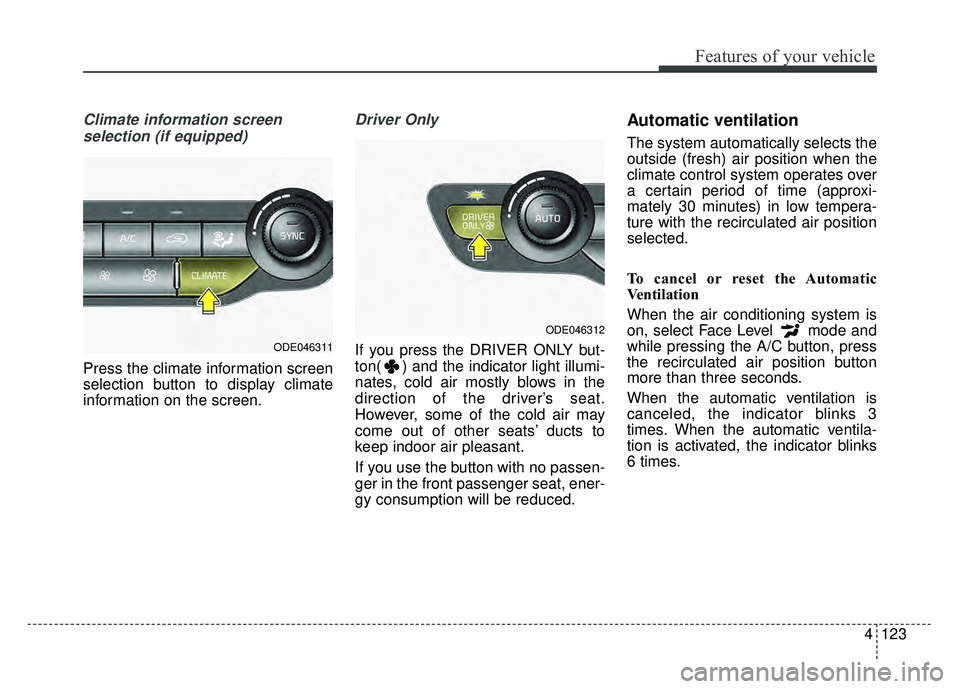
Climate information screen selection (if equipped)
Press the climate information screen
selection button to display climate
information on the screen.
Driver Only
If you press the DRIVER ONLY but-
ton( ) and the indicator light illumi-
nates, cold air mostly blows in the
direction of the driver’s seat.
However, some of the cold air may
come out of other seats’ ducts to
keep indoor air pleasant.
If you use the button with no passen-
ger in the front passenger seat, ener-
gy consumption will be reduced.
Automatic ventilation
The system automatically selects the
outside (fresh) air position when the
climate control system operates over
a certain period of time (approxi-
mately 30 minutes) in low tempera-
ture with the recirculated air position
selected.
To cancel or reset the Automatic
Ventilation
When the air conditioning system is
on, select Face Level mode and
while pressing the A/C button, press
the recirculated air position button
more than three seconds.
When the automatic ventilation is
canceled, the indicator blinks 3
times. When the automatic ventila-
tion is activated, the indicator blinks
6 times.
ODE046312
ODE046311
Page 239 of 552
Features of your vehicle
136
4
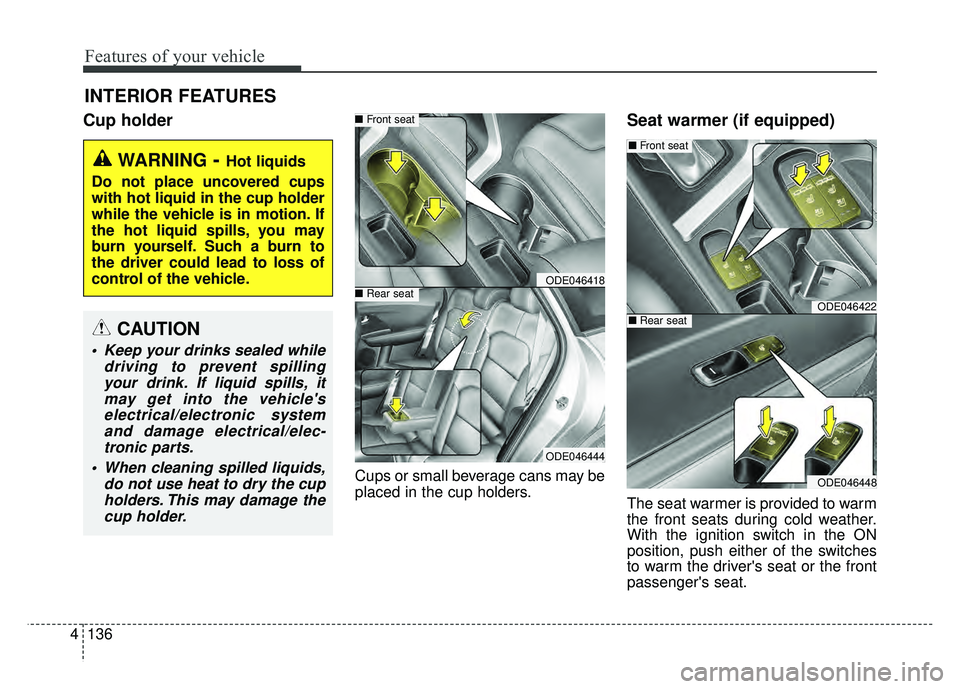
Cup holder
Cups or small beverage cans may be
placed in the cup holders.
Seat warmer (if equipped)
The seat warmer is provided to warm
the front seats during cold weather.
With the ignition switch in the ON
position, push either of the switches
to warm the driver's seat or the front
passenger's seat.
INTERIOR FEATURES
WARNING- Hot liquids
Do not place uncovered cups
with hot liquid in the cup holder
while the vehicle is in motion. If
the hot liquid spills, you may
burn yourself. Such a burn to
the driver could lead to loss of
control of the vehicle.
ODE046418
■ Front seat
■Rear seat
ODE046444
CAUTION
Keep your drinks sealed while
driving to prevent spillingyour drink. If liquid spills, itmay get into the vehicle'selectrical/electronic systemand damage electrical/elec-tronic parts.
When cleaning spilled liquids, do not use heat to dry the cupholders. This may damage thecup holder.
ODE046422
ODE046448
■ Front seat
■Rear seat
Page 241 of 552
Features of your vehicle
138
4
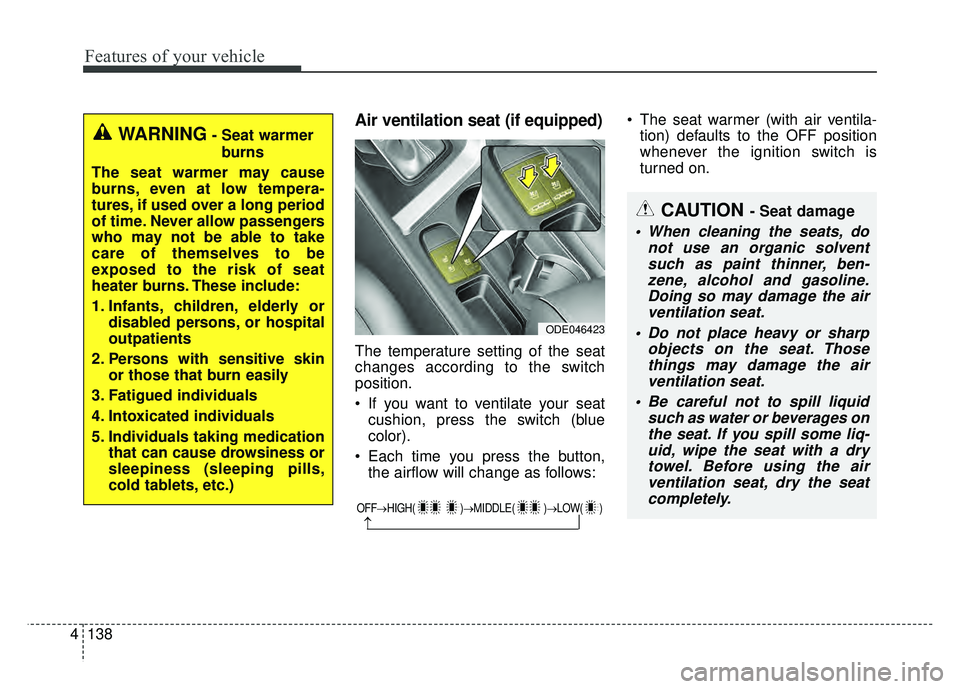
Air ventilation seat (if equipped)
The temperature setting of the seat
changes according to the switch
position.
If you want to ventilate your seat
cushion, press the switch (blue
color).
Each time you press the button, the airflow will change as follows: The seat warmer (with air ventila-
tion) defaults to the OFF position
whenever the ignition switch is
turned on.
OFF→ HIGH( )→ MIDDLE( )→LOW( )
→
CAUTION - Seat damage
When cleaning the seats, do
not use an organic solventsuch as paint thinner, ben-zene, alcohol and gasoline.Doing so may damage the airventilation seat.
Do not place heavy or sharp objects on the seat. Thosethings may damage the airventilation seat.
Be careful not to spill liquid such as water or beverages onthe seat. If you spill some liq-uid, wipe the seat with a drytowel. Before using the airventilation seat, dry the seatcompletely.
ODE046423
WARNING- Seat warmer
burns
The seat warmer may cause
burns, even at low tempera-
tures, if used over a long period
of time. Never allow passengers
who may not be able to take
care of themselves to be
exposed to the risk of seat
heater burns. These include:
1. Infants, children, elderly or disabled persons, or hospital
outpatients
2. Persons with sensitive skin or those that burn easily
3. Fatigued individuals
4. Intoxicated individuals
5. Individuals taking medication that can cause drowsiness or
sleepiness (sleeping pills,
cold tablets, etc.)
Page 378 of 552
Driving your vehicle
90
6
Towing capacity:
We do not recommend using this
vehicle for trailer towing.
Cargo capacity:
The cargo capacity of your vehicle
will increase or decrease depending
on the weight and the number of
occupants.
Steps For Determining Correct
Load Limit -
1. Locate the statement "The com- bined weight of occupants and
cargo should never exceed XXX
kg or XXX lbs.'' on your vehicle's
placard.
2. Determine the combined weight of the driver and passengers that will
be riding in your vehicle.
3. Subtract the combined weight of the driver and passengers from
XXX kg or XXX lbs.
4. The resulting figure equals the available amount of cargo and lug-
gage load capacity. For example, if
the "XXX" amount equals 1400
lbs. and there will be five 150 lbs.
passengers in your vehicle, the
amount of available cargo and lug-
gage load capacity is 650 lbs.
(1400-750 (5 x 150) = 650 lbs.) 5. Determine the combined weight of
luggage and cargo being loaded
on the vehicle. That weight may
not safely exceed the available
cargo and luggage load capacity
calculated in Step 4.
6. If your vehicle will be towing a trail- er, load from your trailer will be
transferred to your vehicle. Consult
this manual to determine how this
reduces the available cargo and
luggage load capacity of your
vehicle.
WARNING - Loose cargo
Do not travel with unsecured
blunt objects in the passenger
compartment of your vehicle
(e.g. suit cases or unsecured
child seats). These items may
strike occupant during a sud-
den stop or crash.
Page 475 of 552
Maintenance
52
8
Temperature -A, B & C
The temperature grades are A (the
highest), B and C representing the
tire’s resistance to the generation of
heat and its ability to dissipate heat
when tested under controlled condi-
tions on a specified indoor laboratory
test wheel.
Sustained high temperature can
cause the material of the tire to
degenerate and reduce tire life, and
excessive temperature can lead to
sudden tire failure. The grade C cor-
responds to a level of performance
which all passenger car tires must
meet under the Federal Motor
Vehicle Safety Standard No. 109.
Grades B and A represent higher
levels of performance on the labora-
tory test wheel than the minimum
required by law. Tire terminology and definitions
Air Pressure:
The amount of air
inside the tire pressing outward on
the tire. Air pressure is expressed in
kilopascal (kPa) or pounds per
square inch (psi).
Accessory Weight: This means the
combined weight of optional acces-
sories. Some examples of optional
accessories are, dual clutch trans-
mission, power seats, and air condi-
tioning.
Aspect Ratio: The relationship of a
tire's height to its width.
Belt: A rubber coated layer of cords
that is located between the plies and
the tread. Cords may be made from
steel or other reinforcing materials.
Bead: The tire bead contains steel
wires wrapped by steel cords that
hold the tire onto the rim.
Bias Ply Tire: A pneumatic tire in
which the plies are laid at alternate
angles less than 90 degrees to the
centerline of the tread. Cold Tire Pressure:
The amount of
air pressure in a tire, measured in
kilopascals (kPa) or pounds per
square inch (psi) before a tire has
built up heat from driving.
Curb Weight: This means the weight
of a motor vehicle with standard and
optional equipment including the
maximum capacity of fuel, oil and
coolant, but without passengers and
cargo.
DOT Markings: A code molded into
the sidewall of a tire signifying that
the tire is in compliance with the U.S.
Department of Transportation motor
vehicle safety standards. The DOT
code includes the Tire Identification
Number (TIN), an alphanumeric des-
ignator which can also identify the
tire manufacturer, production plant,
brand and date of production.
Page 517 of 552
Maintenance
94
8
✽
✽
NOTICE - Natural leather seat
cover (If equipped)
Natural leather has visible pores,
scars or blood vessels, etc. Pressure
marks or wrinkles may be made
when used. Prolonged exposure to
sunlight or heat may cause discol-
oration. These things occur due to
the natural characteristics of
cowhides. If the leather is exposed to
rain or gets wet, remove water with
a dry cloth and dry the leather in the
shade to minimize damage. Make
sure to keep sharp objects away
from the leather as these can create
scratches on the surface. For light-
colored leather, be careful of spots
or color transfer, such as from jeans.
✽ ✽NOTICE - Fabric seat cover
(If equipped)
Please clean the fabric seats regular-
ly with a vacuum cleaner in consid-
eration of fabric material character-
istics. If they are heavily soiled with
beverage stains, etc., use a suitable
interior cleaner. To prevent damage
to seat covers, wipe off the seat cov-
ers down to the seams with a large
wiping motion and moderate pres-
sure using a soft sponge or
microfiber cloth.
Velcro closures on clothing or sharp
objects may cause snagging or
scratches on the surface of the seats.
Make sure not to rub such objects
against the surface.
CAUTION - Electrical
components
Never allow water or other liq-
uids to come in contact withelectrical/electronic compo-nents inside the vehicle as thismay damage them.
CAUTION - Leather
When cleaning leather products(steering wheel, seats etc.), useneutral detergents or low alco-hol content solutions. If you usehigh alcohol content solutionsor acid/alkaline detergents, thecolor of the leather may fade orthe surface may get stripped off.
Page 548 of 552
I11
Index
Self-diagnosis . . . . . . . . . . . . . . . . . . . . . . . . . . . . . . 4-93
Rear seat Folding the rear seat . . . . . . . . . . . . . . . . . . . . . . . . . 3-16
Rear view camera . . . . . . . . . . . . . . . . . . . . . . . . . . . . . 4-99
Recommended lubricants and capacities . . . . . . . . . . . . 9-6 Recommended SAE viscosity number. . . . . . . . . . . . 9-7
Reducing the risk of a rollover . . . . . . . . . . . . . . . . . . . 6-80
Refrigerant label . . . . . . . . . . . . . . . . . . . . . . . . . . . . . . 9-10
Remote control (outside rear view mirror) . . . . . . . . . . 4-48
Reporting safety defects . . . . . . . . . . . . . . . . . . . . . . . . 9-15
Resetting the sunroof . . . . . . . . . . . . . . . . . . . . . . . . . . 4-40
Road warning . . . . . . . . . . . . . . . . . . . . . . . . . . . . . . . . . 7-2
Rocking the vehicle . . . . . . . . . . . . . . . . . . . . . . . . . . . 6-81
Room lamp . . . . . . . . . . . . . . . . . . . . . . . . . . . . . . . . . 4-109
Room lamp bulb replacement . . . . . . . . . . . . . . . . . . . . 8-86
Rotation (Tire) . . . . . . . . . . . . . . . . . . . . . . . . . . . . . . . 8-45
Scheduled maintenance service . . . . . . . . . . . . . . . . . . . 8-8 Maintenance Under Severe Usage Conditions. . . . . 8-20
Normal Maintenance Schedule . . . . . . . . . . . . . . . . . 8-9
Seat belt restraint system . . . . . . . . . . . . . . . . . . . . . . . 3-19
Seat belts . . . . . . . . . . . . . . . . . . . . . . . . . . . . . . . . . . . . \
3-19 Care of seat belts . . . . . . . . . . . . . . . . . . . . . . . . . . . 3-30
"Driver's 3-point systemwith emergencylocking retractor" . . . . . . . . . . . . . . . . . . . . . . . . . . 3-22 "Front passenger andrear seat 3-point system
withcombination locking retractor" . . . . . . . . . . . . 3-23
Front seat belt warning. . . . . . . . . . . . . . . . . . . . . . . 3-21
Precautions . . . . . . . . . . . . . . . . . . . . . . . . . . . . . . . . 3-28
Pre-tensioner seat belt . . . . . . . . . . . . . . . . . . . . . . . 3-25
Seat belt restraint system . . . . . . . . . . . . . . . . . . . . . 3-19
Seat warmer . . . . . . . . . . . . . . . . . . . . . . . . . . . . . . . . 4-136
Seatback pocket (front) . . . . . . . . . . . . . . . . . . . . . . . . . 3-14
Seats . . . . . . . . . . . . . . . . . . . . . . . . . . . . . . . . . . . . \
. . . . 3-4 Front seat adjustment (manual) . . . . . . . . . . . . . . . . . 3-7
Front seat adjustment (power) . . . . . . . . . . . . . . . . . . 3-8
Headrest (rear) . . . . . . . . . . . . . . . . . . . . . . . . . . . . . 3-14
Headrest(front) . . . . . . . . . . . . . . . . . . . . . . . . . . . . . 3-11
Seatback pocket (front) . . . . . . . . . . . . . . . . . . . . . . 3-14
Service Mode . . . . . . . . . . . . . . . . . . . . . . . . . . . . . . . . 4-66
Shift-lock override - Dual clutch transmission. . . . . . . 6-20
Side air bag . . . . . . . . . . . . . . . . . . . . . . . . . . . . . . . . . . 3-60\
Side repeater lamp (LED type) bulb replacement . . . . 8-85
Sliding the sunroof . . . . . . . . . . . . . . . . . . . . . . . . . . . . 4-38
Smart cruise control system . . . . . . . . . . . . . . . . . . . . . 6-51 Limitations of the system . . . . . . . . . . . . . . . . . . . . . 6-61
Speed setting . . . . . . . . . . . . . . . . . . . . . . . . . . . . . . 6-52
To adjust the sensitivity of Smart Cruise Control . . 6-60
To convert to cruise control mode . . . . . . . . . . . . . . 6-60
Vehicle to vehicle distance setting . . . . . . . . . . . . . . 6-57
Smart key . . . . . . . . . . . . . . . . . . . . . . . . . . . . . . . . . . . 4-\
11 Battery replacement . . . . . . . . . . . . . . . . . . . . . . . . . 4-15
Loss of the smart key . . . . . . . . . . . . . . . . . . . . . . . . 4-14
S