tires KIA NIRO 2017 Owner's Manual
[x] Cancel search | Manufacturer: KIA, Model Year: 2017, Model line: NIRO, Model: KIA NIRO 2017Pages: 552, PDF Size: 14.92 MB
Page 399 of 552
What to do in an emergency
18
7
IF YOU HAVE A FLAT TIRE (WITH SPARE TIRE, IF EQUIPPED)
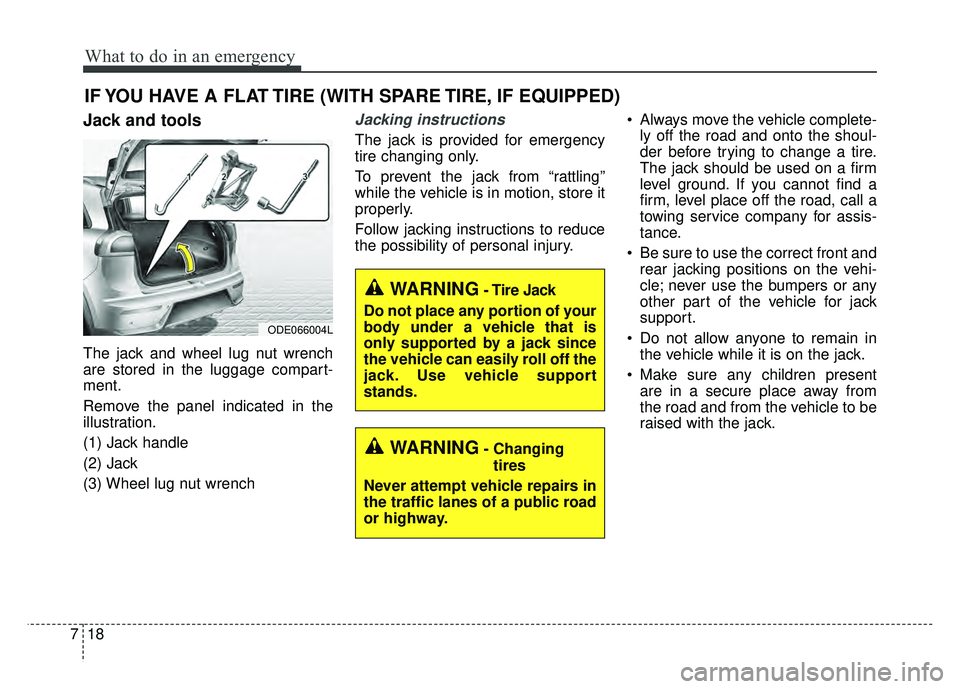
Jack and tools
The jack and wheel lug nut wrench
are stored in the luggage compart-
ment.
Remove the panel indicated in the
illustration.
(1) Jack handle
(2) Jack
(3) Wheel lug nut wrench
Jacking instructions
The jack is provided for emergency
tire changing only.
To prevent the jack from “rattling”
while the vehicle is in motion, store it
properly.
Follow jacking instructions to reduce
the possibility of personal injury. Always move the vehicle complete-
ly off the road and onto the shoul-
der before trying to change a tire.
The jack should be used on a firm
level ground. If you cannot find a
firm, level place off the road, call a
towing service company for assis-
tance.
Be sure to use the correct front and rear jacking positions on the vehi-
cle; never use the bumpers or any
other part of the vehicle for jack
support.
Do not allow anyone to remain in the vehicle while it is on the jack.
Make sure any children present are in a secure place away from
the road and from the vehicle to be
raised with the jack.
WARNING- Changing
tires
Never attempt vehicle repairs in
the traffic lanes of a public road
or highway.
ODE066004L
WARNING- Tire Jack
Do not place any portion of your
body under a vehicle that is
only supported by a jack since
the vehicle can easily roll off the
jack. Use vehicle support
stands.
Page 401 of 552
What to do in an emergency
20
7
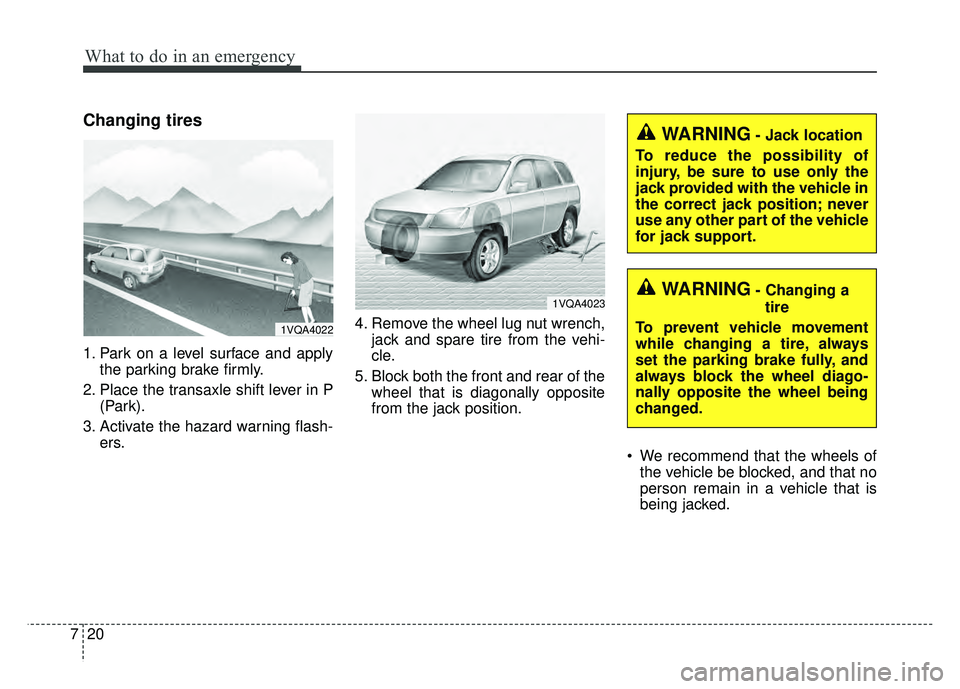
Changing tires
1. Park on a level surface and apply
the parking brake firmly.
2. Place the transaxle shift lever in P (Park).
3. Activate the hazard warning flash- ers. 4. Remove the wheel lug nut wrench,
jack and spare tire from the vehi-
cle.
5. Block both the front and rear of the wheel that is diagonally opposite
from the jack position.
We recommend that the wheels ofthe vehicle be blocked, and that no
person remain in a vehicle that is
being jacked.
WARNING- Jack location
To reduce the possibility of
injury, be sure to use only the
jack provided with the vehicle in
the correct jack position; never
use any other part of the vehicle
for jack support.
WARNING- Changing a tire
To prevent vehicle movement
while changing a tire, always
set the parking brake fully, and
always block the wheel diago-
nally opposite the wheel being
changed.
1VQA4022
1VQA4023
Page 405 of 552
What to do in an emergency
24
7
To prevent the jack, wheel lug nut
wrench and spare tire from rattling
while the vehicle is in motion, store
them properly.
Check the inflation pressures as
soon as possible after installing the
spare tire. Adjust it to the specified
pressure, if necessary. Refer to
“Tires and wheels” in section 8.
Important - use of compact spare
tire
Your vehicle is equipped with a com-
pact spare tire. This compact spare
tire takes up less space than a regu-
lar-size tire. This tire is smaller than a
conventional tire and is designed for
temporary use only.
You should drive carefully when the compact spare is in use. The
compact spare should be replaced
by the proper conventional tire and
rim at the first opportunity.
The operation of this vehicle is not recommended with more than one
compact spare tire in use at the
same time. The compact spare should be inflat-
ed to 60 psi (420 kPa).
✽ ✽
NOTICE
Check the inflation pressure after
installing the spare tire. Adjust it to
the specified pressure, as necessary.
WARNING- Wheel studs
If the studs are damaged, they
may lose their ability to retain
the wheel. This could lead to the
loss of the wheel and a collision
resulting in serious injuries.WARNING- Spare tire
The compact spare tire is for
emergency use only. Do not
operate your vehicle on this
compact spare at speeds over
50 mph (80 km/h). The original
tire should be repaired or
replaced as soon as possible to
avoid failure of the spare possi-
bly leading to personal injury or
death.
Page 406 of 552
725
What to do in an emergency
When using a compact spare tire,
observe the following precautions:
Under no circumstances shouldyou exceed 50 mph (80 km/h); a
higher speed could damage the
tire.
Ensure that you drive slowly enough for the road conditions to
avoid all hazards. Any road hazard,
such as a pothole or debris, could
seriously damage the compact
spare.
Any continuous road use of this tire could result in tire failure, loss of
vehicle control, and possible per-
sonal injury.
Do not exceed the vehicle’s maxi- mum load rating or the load-carry-
ing capacity shown on the sidewall
of the compact spare tire.
Avoid driving over obstacles. The compact spare tire diameter is
smaller than the diameter of a con-
ventional tire and reduces the
ground clearance approximately 1
inch (25 mm), which could result in
damage to the vehicle. Do not take this vehicle through an
automatic vehicle wash while the
compact spare tire is installed.
Do not use tire chains on the com- pact spare tire. Because of the
smaller size, a tire chain will not fit
properly. This could damage the
vehicle and result in loss of the
chain.
Do not use the compact spare tire on any other vehicle because this
tire has been designed especially
for your vehicle.
The compact spare tire’s tread life is shorter than a regular tire.
Inspect your compact spare tire
regularly and replace worn com-
pact spare tires with the same size
and design, mounted on the same
wheel.
The compact spare tire should not be used on any other wheels, nor
should standard tires, snow tires,
wheel covers or trim rings be used
with the compact spare wheel. If
such use is attempted, damage to
these items or other vehicle com-
ponents may occur. Do not use more than one compact
spare tire at a time.
Do not tow a trailer while the com- pact spare tire is installed.
Page 408 of 552
727
What to do in an emergency
IF YOU HAVE A FLAT TIRE (WITH TIRE MOBILITY KIT)
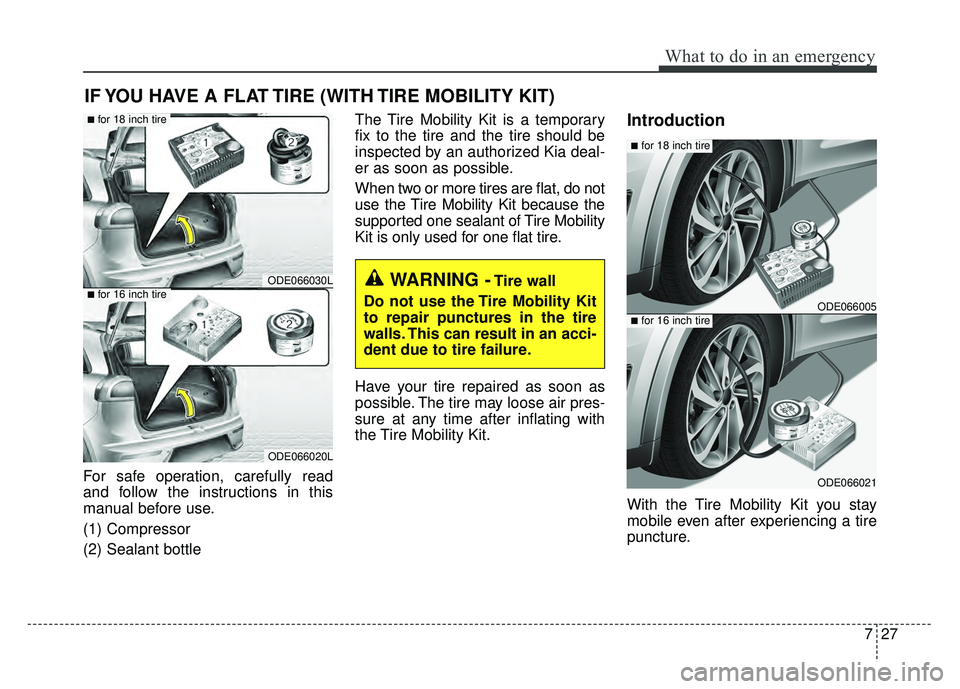
For safe operation, carefully read
and follow the instructions in this
manual before use.
(1) Compressor
(2) Sealant bottleThe Tire Mobility Kit is a temporary
fix to the tire and the tire should be
inspected by an authorized Kia deal-
er as soon as possible.
When two or more tires are flat, do not
use the Tire Mobility Kit because the
supported one sealant of Tire Mobility
Kit is only used for one flat tire.
Have your tire repaired as soon as
possible. The tire may loose air pres-
sure at any time after inflating with
the Tire Mobility Kit.
Introduction
With the Tire Mobility Kit you stay
mobile even after experiencing a tire
puncture.
WARNING -Tire wall
Do not use the Tire Mobility Kit
to repair punctures in the tire
walls. This can result in an acci-
dent due to tire failure.ODE066030L
ODE066020L
■for 18 inch tire
■for 16 inch tireODE066005
ODE066021
■for 18 inch tire
■for 16 inch tire
Page 409 of 552
What to do in an emergency
28
7
The system of compressor and seal-
ing compound effectively and com-
fortably seals most punctures in a
passenger car tire caused by nails or
similar objects and reinflates the tire.
After you ensured that the tire is prop-
erly sealed you can drive cautiously on
the tire (up to 120 miles (200 km)) at a
max. speed of 50 mph (80 km/h) in
order to reach a service station or tire
dealer to have the tire replacement.
It is possible that some tires, especially
with larger punctures or damage to the
sidewall, cannot be sealed completely.
Air pressure loss in the tire may
adversely affect tire performance.
For this reason, you should avoid
abrupt steering or other driving
maneuvers, especially if the vehicle is
heavily loaded or if a trailer is in use.
The Tire Mobility Kit is not designed
or intended as a permanent tire
repair method and is to be used for
one tire only.
This instruction shows you step by
step procedure to temporarily seal
the puncture.
Read the section "Notes on the safe
use of the Tire Mobility Kit".Notes on the safe use of the
Tire Mobility Kit
Park your car at the side of the
road so that you can work with the
Tire Mobility Kit away from moving
traffic.
To be sure your vehicle will not move, even when you're on fairly
level ground, always set your park-
ing brake.
Only use the Tire Mobility Kit for sealing/inflation passenger car
tires. Only punctured areas located
within the tread region of the tire
can be sealed using the Tire
Mobility Kit.
Do not use on motorcycles, bicy- cles or any other type of tires.
When the tire and wheel are dam- aged, do not use Tire Mobility Kit
for your safety. Use of the Tire Mobility Kit may not
be effective for tire damage larger
than approximately 0.24 in (6 mm).
Please contact the nearest Kia
dealership if the tire cannot be
made roadworthy with the Tire
Mobility Kit.
Do not use the Tire Mobility Kit if a tire is severely damaged by driving
run flat or with insufficient air pres-
sure.
Do not remove any foreign objects such as nails or screws that have
penetrated the tire.
Provided the car is outdoors, leave the engine running. Otherwise
operating the compressor may
eventually drain the car battery.
Never leave the Tire Mobility Kit unattended while it is being used.
Do not leave the compressor run- ning for more than 10 min. at a time
or it may overheat.
Do not use the Tire Mobility Kit if the ambient temperature is below -
22°F (-30°C).
Page 424 of 552
Maintenance
Engine compartment . . . . . . . . . . . . . . . . . . . . . . . . 8-3
Maintenance services . . . . . . . . . . . . . . . . . . . . . . . . 8-4
• Owner’s responsibility . . . . . . . . . . . . . . . . . . . . . . . . . 8-4
• Owner maintenance precautions . . . . . . . . . . . . . . . . . 8-5
Owner maintenance . . . . . . . . . . . . . . . . . . . . . . . . . 8-6
• Owner maintenance schedule . . . . . . . . . . . . . . . . . . . 8-6
Scheduled maintenance service . . . . . . . . . . . . . . 8-8
Explanation of scheduled maintenance items . . . 8-21
Engine oil. . . . . . . . . . . . . . . . . . . . . . . . . . . . . . . . . 8-25
• Checking the engine oil level . . . . . . . . . . . . . . . . . . . 8-25
• Changing the engine oil and filter . . . . . . . . . . . . . . . 8-26
Coolant . . . . . . . . . . . . . . . . . . . . . . . . . . . . . . . . . . 8-27\
• Checking the coolant level . . . . . . . . . . . . . . . . . . . . . 8-27
• Engine coolant . . . . . . . . . . . . . . . . . . . . . . . . . . . . . . 8-28
• Inverter coolant . . . . . . . . . . . . . . . . . . . . . . . . . . . . . 8-28
• Recommended coolant . . . . . . . . . . . . . . . . . . . . . . . . 8-29
• Changing the coolant . . . . . . . . . . . . . . . . . . . . . . . . . 8-30
Brake fluid . . . . . . . . . . . . . . . . . . . . . . . . . . . . . . . 8-31
• Checking the brake fluid level . . . . . . . . . . . . . . . . . . 8-31
Engine clutch actuator fluid . . . . . . . . . . . . . . . . . 8-32
• Checking the engine clutch actuator fluid level . . . . 8-32
Washer fluid . . . . . . . . . . . . . . . . . . . . . . . . . . . . . . 8-34
• Checking the washer fluid level . . . . . . . . . . . . . . . . . 8-34
Parking brake . . . . . . . . . . . . . . . . . . . . . . . . . . . . . 8-35
• Checking the parking brake. . . . . . . . . . . . . . . . . . . . 8-35
Air cleaner. . . . . . . . . . . . . . . . . . . . . . . . . . . . . . . . 8-36
• Filter replacement . . . . . . . . . . . . . . . . . . . . . . . . . . . 8-36
Climate control air filter . . . . . . . . . . . . . . . . . . . . 8-38
• Filter inspection . . . . . . . . . . . . . . . . . . . . . . . . . . . . . . 8-38
Wiper blades . . . . . . . . . . . . . . . . . . . . . . . . . . . . . . 8-40
• Blade inspection . . . . . . . . . . . . . . . . . . . . . . . . . . . . . . 8-40
• Blade replacement . . . . . . . . . . . . . . . . . . . . . . . . . . . . 8-40
Tires and wheels . . . . . . . . . . . . . . . . . . . . . . . . . . . 8-43
• Tire care . . . . . . . . . . . . . . . . . . . . . . . . . . . . . . . . . . . . \
8-43
• Recommended cold tire inflation pressures . . . . . . . 8-43
• Tire pressure . . . . . . . . . . . . . . . . . . . . . . . . . . . . . . . . 8-44
• Checking tire inflation pressure. . . . . . . . . . . . . . . . . 8-44
• Tire rotation . . . . . . . . . . . . . . . . . . . . . . . . . . . . . . . . 8-45
• Wheel alignment and tire balance . . . . . . . . . . . . . . . 8-46
• Tire replacement . . . . . . . . . . . . . . . . . . . . . . . . . . . . . 8-47
• Wheel replacement . . . . . . . . . . . . . . . . . . . . . . . . . . . 8-47
• Tire traction . . . . . . . . . . . . . . . . . . . . . . . . . . . . . . . . . 8-48
• Tire maintenance . . . . . . . . . . . . . . . . . . . . . . . . . . . . 8-48
• Tire sidewall labeling . . . . . . . . . . . . . . . . . . . . . . . . . 8-48
• All season tires . . . . . . . . . . . . . . . . . . . . . . . . . . . . . . 8-55
• Summer tires . . . . . . . . . . . . . . . . . . . . . . . . . . . . . . . . 8-55
• Snow tires . . . . . . . . . . . . . . . . . . . . . . . . . . . . . . . . . . . 8-\
55
• Tire chains . . . . . . . . . . . . . . . . . . . . . . . . . . . . . . . . . . 8-55\
8
Page 425 of 552

• Radial-ply tires . . . . . . . . . . . . . . . . . . . . . . . . . . . . . . 8-56
• Low aspect ratio tire . . . . . . . . . . . . . . . . . . . . . . . . . . 8-56
Fuses . . . . . . . . . . . . . . . . . . . . . . . . . . . . . . . . . . . . \
8-58
• Inner panel fuse replacement . . . . . . . . . . . . . . . . . . . 8-59
• Engine compartment fuse replacement. . . . . . . . . . . 8-61
• Fuse/relay panel description. . . . . . . . . . . . . . . . . . . . 8-63
Light bulbs . . . . . . . . . . . . . . . . . . . . . . . . . . . . . . . 8-75
• Bulb replacement precaution . . . . . . . . . . . . . . . . . . 8-75
• Light bulb position (Front). . . . . . . . . . . . . . . . . . . . . 8-76
• Light bulb position (Rear) . . . . . . . . . . . . . . . . . . . . . 8-76
• Light bulb position (Side) . . . . . . . . . . . . . . . . . . . . . . 8-77
• Headlamp (HID type) bulb replacement . . . . . . . . . 8-77
• Headlamp (High/Low beam) bulb replacement . . . . 8-78
• Front turn signal lamp bulb replacement. . . . . . . . . 8-80
• Fog lamp/DRL bulb replacement . . . . . . . . . . . . . . . 8-80
• Stop and tail lamp bulb replacement . . . . . . . . . . . . 8-81
• Tail lamp (inside) bulb replacement . . . . . . . . . . . . . 8-82
• Stop and tail lamp (LED type) bulb replacement . . 8-83
• Back-up lamp bulb replacement . . . . . . . . . . . . . . . . 8-83
• High mounted stop lamp bulb replacement . . . . . . . 8-84
• License plate lamp bulb replacement . . . . . . . . . . . . 8-84
• Side repeater lamp (LED type) bulb replacement . . 8-85
• Map lamp bulb replacement . . . . . . . . . . . . . . . . . . . 8-85
• Vanity mirror lamp bulb replacement . . . . . . . . . . . 8-85
• Room lamp bulb replacement . . . . . . . . . . . . . . . . . . 8-86
• Tailgate room lamp bulb replacement . . . . . . . . . . . 8-87
Appearance care . . . . . . . . . . . . . . . . . . . . . . . . . . . 8-88
• Exterior care . . . . . . . . . . . . . . . . . . . . . . . . . . . . . . . . 8-88
• Interior care . . . . . . . . . . . . . . . . . . . . . . . . . . . . . . . . . 8-93
Emission control system . . . . . . . . . . . . . . . . . . . . 8-96
• Crankcase emission control system . . . . . . . . . . . . . . 8-96
• Evaporative emission control (including ORVR:Onboard Refueling Vapor Recovery) system . . . . . 8-96
• Exhaust emission control system . . . . . . . . . . . . . . . . 8-97
California perchlorate notice . . . . . . . . . . . . . . . . 8-99
8
Page 429 of 552
Maintenance
68
OWNER MAINTENANCE
The following lists are vehicle checks
and inspections that should be per-
formed by the owner or an author-
ized Kia dealer at the frequencies
indicated to help ensure safe,
dependable operation of your vehi-
cle.
Any adverse conditions should be
brought to the attention of your deal-
er as soon as possible.
These Owner Maintenance Checks
are generally not covered by war-
ranties and you may be charged for
labor, parts and lubricants used.Owner maintenance schedule
When you stop for fuel:
Check the engine oil level.
Check the coolant level in coolantreservoir.
Check the windshield washer fluid level.
Look for low or under-inflated tires.
While operating your vehicle:
Note any changes in the sound of the exhaust or any smell of
exhaust fumes in the vehicle.
Check for vibrations in the steering wheel. Notice any increased steer-
ing effort or looseness in the steer-
ing wheel, or change in its straight-
ahead position.
Notice if your vehicle constantly turns slightly or “pulls” to one side
when traveling on smooth, level
road.
When stopping, listen and check for unusual sounds, pulling to one
side, increased brake pedal travel
or “hard-to-push” brake pedal.
If any slipping or changes in the operation of your transaxle occurs,
check the transaxle fluid level.
Check the dual clutch transmission P (Park) function.
Check the parking brake.
Check for fluid leaks under your vehicle (water dripping from the air
conditioning system during or after
use is normal).
WARNING- Hot coolant
Be careful when checking your
engine coolant level when the
engine is hot. Scalding hot
coolant and steam may blow
out under pressure.
WARNING
When you open the engine
hood, turn the Hybrid system
off. If not, it may result in death
or serious injury because of the
high voltage flow.
Page 430 of 552
87
Maintenance
At least monthly:
Check the coolant level in theengine coolant reservoir.
Check the operation of all exterior lights, including the stoplights, turn
signals and hazard warning flash-
ers.
Check the inflation pressures of all tires including the spare.
At least twice a year
(i.e., every Spring and Fall) :
Check the radiator, heater and air conditioning hoses for leaks or
damage.
Check the windshield washer spray and wiper operation. Clean
the wiper blades with clean cloth
dampened with washer fluid.
Check the headlight alignment.
Check the muffler, exhaust pipes, shields and clamps.
Check the lap/shoulder belts for wear and function.
Check for worn tires and loose wheel lug nuts.
At least once a year :
Clean the body and door drainholes.
Lubricate the door hinges and check the hood hinges.
Lubricate the door and hood locks and latches.
Lubricate the door rubber weather- strips.
Check the air conditioning system.
Inspect and lubricate dual clutch transmission linkage and controls.
Clean the battery and terminals.
Check the brake fluid level.