indicator KIA NIRO 2017 Repair Manual
[x] Cancel search | Manufacturer: KIA, Model Year: 2017, Model line: NIRO, Model: KIA NIRO 2017Pages: 552, PDF Size: 14.92 MB
Page 396 of 552

715
What to do in an emergency
When you drive your vehicle from a
warm area to a cold area or from a
cold area to a warm area, or the out-
side temperature is greatly higher or
lower, you should check the tire infla-
tion pressure and adjust the tires to
the recommended tire inflation pres-
sure.TPMS (Tire PressureMonitoring System)malfunction indicator
The low tire pressure telltale will illu-
minate after it blinks for approximate-
ly one minute when there is a prob-
lem with the Tire Pressure
Monitoring System. If the system is
able to correctly detect an underinfla-
tion warning at the same time as sys-
tem failure then it will illuminate both
the TPMS malfunction and low tire
pressure position telltales e.g. if
Front Left sensor fails, the TPMS
malfunction indicator illuminates, but
if the Front Right, Rear Left, or Rear
Right tire is under-inflated, the low
tire pressure position telltales may
illuminate together with the TPMS
malfunction indicator.
Have the system checked by an
authorized Kia dealer as soon as
possible to determine the cause of
the problem. The TPMS malfunction indicator
may be illuminated if the vehicle is
moving around electric power sup-
ply cables or radios transmitters
such as at police stations, govern-
ment and public offices, broadcast-
ing stations, military installations,
airports, or transmitting towers,
etc. This can interfere with normal
operation of the Tire Pressure
Monitoring System (TPMS).
The TPMS malfunction indicator may be illuminated if snow chains
are used or some separate elec-
tronic devices such as notebook
computer, mobile charger, remote
starter or navigation etc., are used
in the vehicle. This can interfere
with normal operation of the Tire
Pressure Monitoring System
(TPMS).
WARNING- Low pressure
damage
Do not drive on low pressure
tires. Significantly low tire pres-
sure can cause the tires to over-
heat and fail making the vehicle
unstable resulting in increased
braking distances and a loss of
vehicle control.
Page 397 of 552

What to do in an emergency
16
7
Changing a tire with TPMS
If you have a flat tire, the Low Tire
Pressure telltale will come on. Have
the flat tire repaired by an authorized
Kia dealer as soon as possible or
replace the flat tire with the spare
tire.
Each wheel is equipped with a tire
pressure sensor mounted inside the
tire behind the valve stem. You must
use TPMS specific wheels. It is rec-
ommended that you always have
your tires serviced by an authorized
Kia dealer. Even if you replace the low pressure
tire with the spare tire, the Low Tire
Pressure telltale will remain on until
the low pressure tire is repaired and
placed on the vehicle.
After you replace the low pressure
tire with the spare tire, the TPMS
malfunction indicator may illuminate
after a few minutes because the
TPMS sensor mounted on the spare
wheel is not initiated.
Once the low pressure tire is inflated
again to the recommended pressure
and installed on the vehicle or the
TPMS sensor mounted on the
replaced spare wheel is initiated by
an authorized Kia dealer, the TPMS
malfunction indicator and the low tire
pressure telltale will turn off within a
few minutes of driving.
If the indicator has not disappeared
after a few minutes of driving, please
visit an authorized Kia dealer.
If an original mounted tire is replaced
with the spare tire, the TPMS sensor
on the replaced spare wheel should
be initiated and the TPMS sensor on
the original mounted wheel should be
deactivated. If the TPMS sensor on
the original mounted wheel located in
the spare tire carrier still activates,
the tire pressure monitoring system
may not operate properly. Have the
tire with TPMS serviced or replaced
by an authorized Kia dealer.
CAUTION- Repair
Agents
Never use a puncture-repairing
agent not approved by Kia torepair and/or inflate a low pres-sure tire. The sealant notapproved by Kia may damagethe tire pressure sensor.
Page 470 of 552
847
Maintenance
Tire replacement
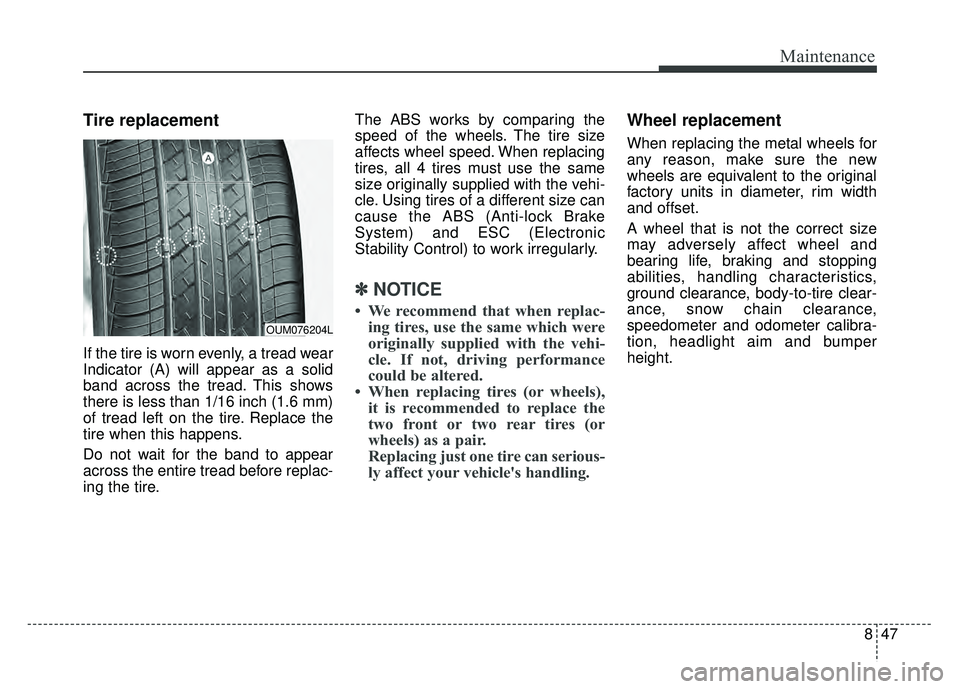
If the tire is worn evenly, a tread wear
Indicator (A) will appear as a solid
band across the tread. This shows
there is less than 1/16 inch (1.6 mm)
of tread left on the tire. Replace the
tire when this happens.
Do not wait for the band to appear
across the entire tread before replac-
ing the tire.The ABS works by comparing the
speed of the wheels. The tire size
affects wheel speed. When replacing
tires, all 4 tires must use the same
size originally supplied with the vehi-
cle. Using tires of a different size can
cause the ABS (Anti-lock Brake
System) and ESC (Electronic
Stability Control) to work irregularly.
✽ ✽
NOTICE
• We recommend that when replac-
ing tires, use the same which were
originally supplied with the vehi-
cle. If not, driving performance
could be altered.
• When replacing tires (or wheels), it is recommended to replace the
two front or two rear tires (or
wheels) as a pair.
Replacing just one tire can serious-
ly affect your vehicle's handling.
Wheel replacement
When replacing the metal wheels for
any reason, make sure the new
wheels are equivalent to the original
factory units in diameter, rim width
and offset.
A wheel that is not the correct size
may adversely affect wheel and
bearing life, braking and stopping
abilities, handling characteristics,
ground clearance, body-to-tire clear-
ance, snow chain clearance,
speedometer and odometer calibra-
tion, headlight aim and bumper
height.
OUM076204L
Page 471 of 552
Maintenance
48
8
Tire traction
Tire traction can be reduced if you
drive on worn tires, tires that are
improperly inflated or on slippery
road surfaces. Tires should be
replaced when tread wear indicators
appear. Slow down whenever there
is rain, snow or ice on the road, to
reduce the possibility of losing con-
trol of the vehicle.
Tire maintenance
In addition to proper inflation, correct
wheel alignment helps to decrease
tire wear. If you find a tire is worn
unevenly, have your dealer check the
wheel alignment.
When you have new tires installed,
make sure they are balanced. This
will increase vehicle ride comfort and
tire life. Additionally, a tire should
always be rebalanced if it is removed
from the wheel.
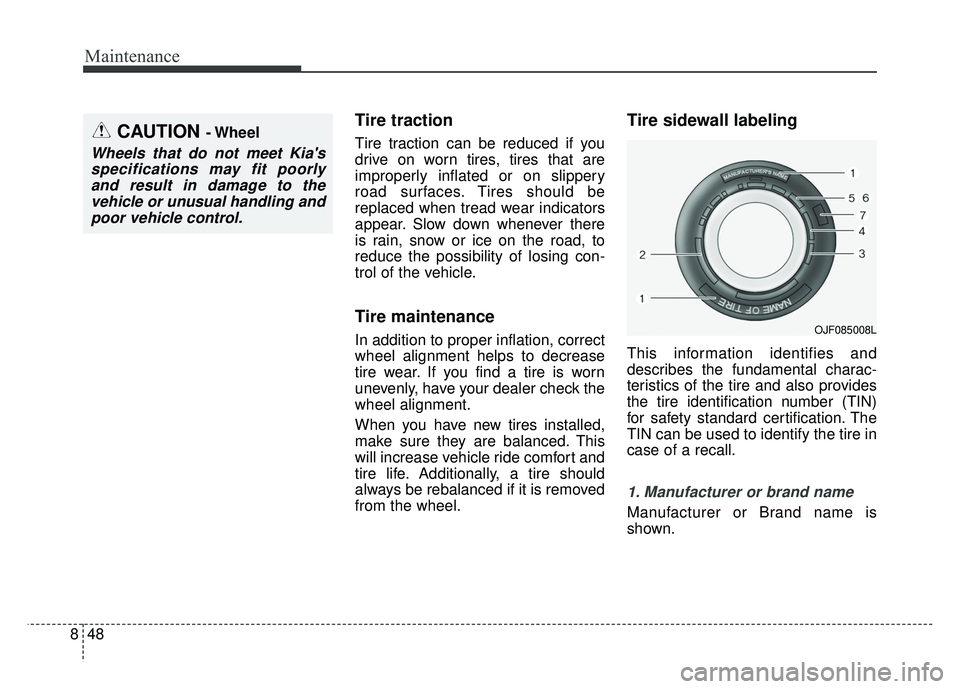
Tire sidewall labeling
This information identifies and
describes the fundamental charac-
teristics of the tire and also provides
the tire identification number (TIN)
for safety standard certification. The
TIN can be used to identify the tire in
case of a recall.
1. Manufacturer or brand name
Manufacturer or Brand name is
shown.
CAUTION - Wheel
Wheels that do not meet Kia's
specifications may fit poorlyand result in damage to thevehicle or unusual handling andpoor vehicle control.
OJF085008L
Page 477 of 552
Maintenance
54
8
Production options weight: The
combined weight of installed regular
production options weighing over 5
lb.(2.3 kg) in excess of the standard
items which they replace, not previ-
ously considered in curb weight or
accessory weight, including heavy
duty brakes, ride levelers, roof rack,
heavy duty battery, and special trim.
Recommended Inflation Pressure:
Vehicle manufacturer's recommend-
ed tire inflation pressure and shown
on the tire placard.
Radial Ply Tire: A pneumatic tire in
which the ply cords that extend to the
beads are laid at 90 degrees to the
centerline of the tread.
Rim: A metal support for a tire and
upon which the tire beads are seat-
ed.
Sidewall: The portion of a tire
between the tread and the bead. Speed Rating:
An alphanumeric
code assigned to a tire indicating the
maximum speed at which a tire can
operate.
Traction: The friction between the
tire and the road surface. The
amount of grip provided.
Tread: The portion of a tire that
comes into contact with the road.
Treadwear Indicators: Narrow
bands, sometimes called "wear
bars," that show across the tread of a
tire when only 1/16 inch of tread
remains.
UTQGS: Uniform Tire Quality
Grading Standards, a tire information
system that provides consumers with
ratings for a tire's traction, tempera-
ture and treadwear. Ratings are
determined by tire manufacturers
using government testing proce-
dures. The ratings are molded into
the sidewall of the tire.
Vehicle Capacity Weight: The num-
ber of designated seating positions
multiplied by 150 lbs. (68kg) plus the
rated cargo and luggage load. Vehicle Maximum Load on the
Tire:
Load on an individual tire due
to curb and accessory weight plus
maximum occupant and cargo
weight.
Vehicle Normal Load on the Tire:
Load on an individual tire that is
determined by distributing to each
axle its share of the curb weight,
accessory weight, and normal occu-
pant weight and driving by 2.
Vehicle Placard: A label permanent-
ly attached to a vehicle showing the
original equipment tire size and rec-
ommended inflation pressure.
Page 482 of 552
859
Maintenance
✽
✽NOTICE
• When replacing fuse, turn the
ignition “OFF” and turn off
switches of all electrical devices
then remove battery (-) terminal.
• The actual fuse/relay panel label may differ from equipped items.
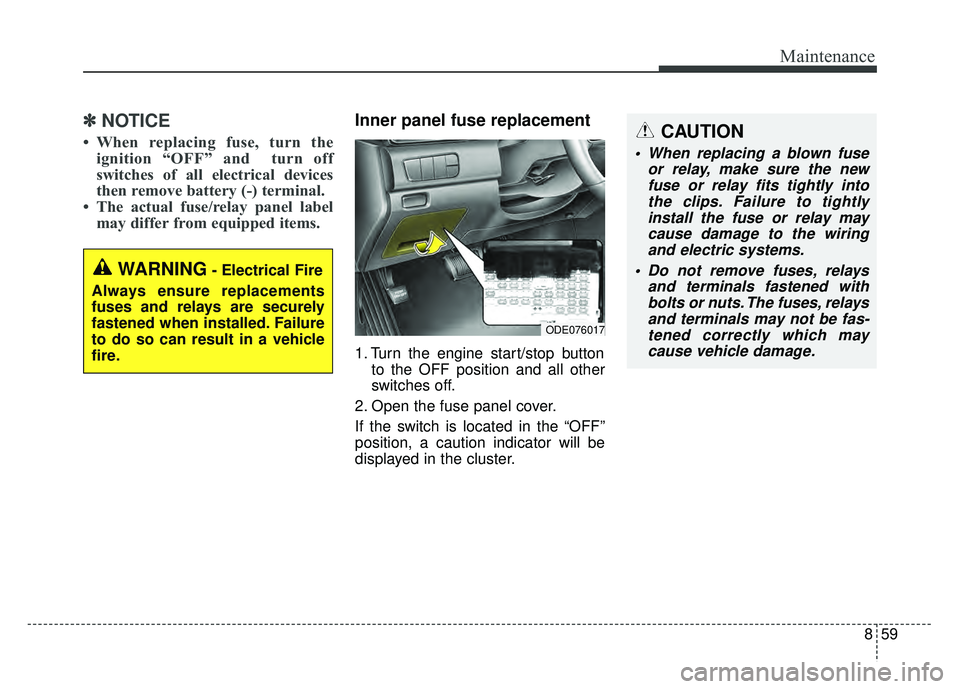
Inner panel fuse replacement
1. Turn the engine start/stop button
to the OFF position and all other
switches off.
2. Open the fuse panel cover.
If the switch is located in the “OFF”
position, a caution indicator will be
displayed in the cluster.
WARNING- Electrical Fire
Always ensure replacements
fuses and relays are securely
fastened when installed. Failure
to do so can result in a vehicle
fire.
CAUTION
When replacing a blown fuse or relay, make sure the newfuse or relay fits tightly intothe clips. Failure to tightlyinstall the fuse or relay maycause damage to the wiringand electric systems.
Do not remove fuses, relays and terminals fastened withbolts or nuts. The fuses, relaysand terminals may not be fas-tened correctly which maycause vehicle damage.
ODE076017
Page 484 of 552
861
Maintenance
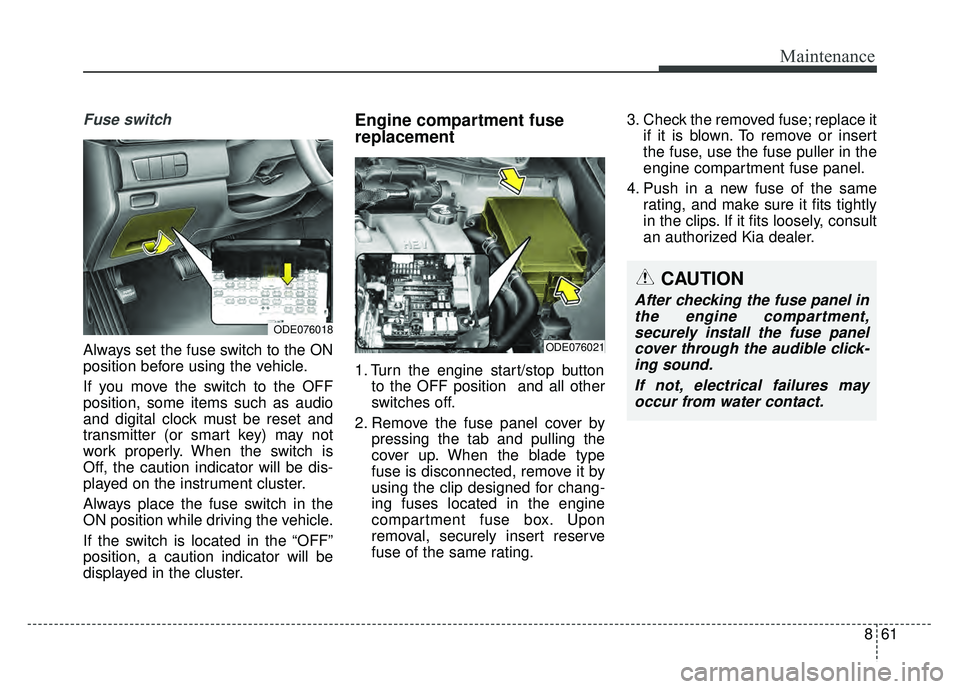
Fuse switch
Always set the fuse switch to the ON
position before using the vehicle.
If you move the switch to the OFF
position, some items such as audio
and digital clock must be reset and
transmitter (or smart key) may not
work properly. When the switch is
Off, the caution indicator will be dis-
played on the instrument cluster.
Always place the fuse switch in the
ON position while driving the vehicle.
If the switch is located in the “OFF”
position, a caution indicator will be
displayed in the cluster.
Engine compartment fuse
replacement
1. Turn the engine start/stop buttonto the OFF position and all other
switches off.
2. Remove the fuse panel cover by pressing the tab and pulling the
cover up. When the blade type
fuse is disconnected, remove it by
using the clip designed for chang-
ing fuses located in the engine
compartment fuse box. Upon
removal, securely insert reserve
fuse of the same rating. 3. Check the removed fuse; replace it
if it is blown. To remove or insert
the fuse, use the fuse puller in the
engine compartment fuse panel.
4. Push in a new fuse of the same rating, and make sure it fits tightly
in the clips. If it fits loosely, consult
an authorized Kia dealer.
CAUTION
After checking the fuse panel inthe engine compartment,securely install the fuse panelcover through the audible click-ing sound.
If not, electrical failures mayoccur from water contact.
ODE076018
ODE076021
Page 487 of 552

Maintenance
64
8
Instrument panel (Driver’s side fuse panel)
Fuse NameFuse ratingCircuit Protected
MODULE 510A
Crash Pad Switch, Electro Chromic Mirror, Audio / Video &Navigation Head Unit, Audio, Shift Lever
Indicator, VESS Unit, Air Conditioner Control Module, Head Lamp Leveling Device Actuator LH/RH, Driver
IMS Module, Front Seat Warmer Control Module, Rear Seat Warmer Control Module, Auto Head Lamp
Leveling Device Module
MODULE 410ALane Departure Warning Control Module, Crash Pad Switch, AEB Module, Blind Spot Detection Radar Left
Handle side/Right Handle side
INTERIOR
LAMP10ALuggage Lamp, Ignition Key ILL. & Door Warning Switch, Front Vanity Lamp LH/RH, Room Lamp, Overhead
Console Lamp
A/BAG15ASRS (Supplemental Restraint System) Control Module
IG 125APrinted Circuit Board Block (Fuse - F35, F36, F37, F38)
CLUSTER10AInstrument Cluster
MODULE 310ABCM (Body Control Module), Dual clutch transmission Shift Lever, Driver/Passenger Door Module, Stop
Lamp Switch
MEMORY 27.5AActive Air Flap Unit
MODULE 810AElectric Water Pump (Engine), Active Air Flap Unit, VPD Sensor,
E/R Junction Block (RLY. 4), BMS Control Module
A/BAG IND7.5AAir Conditioner Control Module, Instrument Cluster
START7.5A[Without Smart Key & Without Immobilizer] Burglaralarm Relay
[With Smart Key / With Immobilizer] Inhibitor Switch
Page 542 of 552
I5
Index
Driving in the rain. . . . . . . . . . . . . . . . . . . . . . . . . . . . . 6-83
Driving off-road . . . . . . . . . . . . . . . . . . . . . . . . . . . . . . 6-83
Dual clutch transmission . . . . . . . . . . . . . . . . . . . . . . . 6-14Manual mode . . . . . . . . . . . . . . . . . . . . . . . . . . . . . . 6-19
Shift-lock override . . . . . . . . . . . . . . . . . . . . . . . . . . 6-20
Dual clutch transmission shift indicator . . . . . . . . . . . . 4-58
Dual clutch transmission shift indicator in sports mode . . 4-58
Economical operation . . . . . . . . . . . . . . . . . . . . . . . . . . 6-78
Electrical equipment . . . . . . . . . . . . . . . . . . . . . . . . . . . 9-14
Electrochromic mirror (ECM) . . . . . . . . . . . . . . . . . . . 4-47
Electronic power steering . . . . . . . . . . . . . . . . . . . . . . . 4-42
Electronic stability control (ESC) . . . . . . . . . . . . . . . . 6-29
Emergency Liftgatesafety release . . . . . . . . . . . . . . . . . 4-26
Emergency starting . . . . . . . . . . . . . . . . . . . . . . . . . . . . . 7-5 Before Jump Starting . . . . . . . . . . . . . . . . . . . . . . . . . 7-5
Jump starting . . . . . . . . . . . . . . . . . . . . . . . . . . . . . . . 7-7
"Method to disconnect the (-) cable for regularmaintenance" . . . . . . . . . . . . . . . . . . . . . . . . . . . . . . 7-7
Emergency while driving . . . . . . . . . . . . . . . . . . . . . . . . 7-3
Emission control system . . . . . . . . . . . . . . . . . . . . . . . . 8-96 Crankcase emission control system . . . . . . . . . . . . . 8-96
Evaporative emission control (including ORVR:Onboard Refueling Vapor Recovery) system. . . . . 8-96
Exhaust emission control system . . . . . . . . . . . . . . . 8-97
Energy flow. . . . . . . . . . . . . . . . . . . . . . . . . . . . . . . . . . 4-63\
Engine . . . . . . . . . . . . . . . . . . . . . . . . . . . . . . . . . . . . \
. . . 9-2
Engine clutch actuator fluid . . . . . . . . . . . . . . . . . . . . . 8-32
Checking the Engine clutch actuator fluid level . . . 8-32
Engine compartment . . . . . . . . . . . . . . . . . . . . . . . . . . . . 2-6
Engine compartment . . . . . . . . . . . . . . . . . . . . . . . . . . . . 8-3
Engine number . . . . . . . . . . . . . . . . . . . . . . . . . . . . . . . . 9-9
Engine oil . . . . . . . . . . . . . . . . . . . . . . . . . . . . . . . . . . . 8-\
25 Changing the engine oil and filter . . . . . . . . . . . . . . 8-26
Checking the engine oil level . . . . . . . . . . . . . . . . . . 8-25
Engine overheats . . . . . . . . . . . . . . . . . . . . . . . . . . . . . . 7-10
Engine start/stop button . . . . . . . . . . . . . . . . . . . . . . . . . 6-9 Engine start/stop button position . . . . . . . . . . . . . . . . 6-9
Illuminated engine start/stop button. . . . . . . . . . . . . . 6-9
Starting the hybrid system . . . . . . . . . . . . . . . . . . . . 6-11
Engine start/stop button illumination . . . . . . . . . . . . . . . 6-9
Engine start/stop button position . . . . . . . . . . . . . . . . . . 6-9
Engine will not start . . . . . . . . . . . . . . . . . . . . . . . . . . . . 7-4
Evaporative emission control (including ORVR: Onboard Refueling Vapor Recovery) system . . . . . . . 8-96
Exhaust emission control system . . . . . . . . . . . . . . . . . 8-97
Explanation of scheduled maintenance items . . . . . . . 8-21 Air cleaner filter . . . . . . . . . . . . . . . . . . . . . . . . . . . . 8-22
Air conditioning refrigerant . . . . . . . . . . . . . . . . . . 8-24
Brake discs, pads, calipers and rotors . . . . . . . . . . . 8-24
Brake fluid . . . . . . . . . . . . . . . . . . . . . . . . . . . . . . . . 8-24
Brake hoses and lines . . . . . . . . . . . . . . . . . . . . . . . . 8-23
Coolant (Engine / Inverter) . . . . . . . . . . . . . . . . . . . 8-22
Cooling system . . . . . . . . . . . . . . . . . . . . . . . . . . . . . 8-22
E
Page 544 of 552

I7
Index
Gauges . . . . . . . . . . . . . . . . . . . . . . . . . . . . . . . . . . . . \
. 4-53Distance to empty. . . . . . . . . . . . . . . . . . . . . . . . . . . 4-56
Fuel Gauge . . . . . . . . . . . . . . . . . . . . . . . . . . . . . . . . 4-55
Hybrid Battery SOC (State of Charge) Gauge . . . . 4-54
Hybrid System Gauge . . . . . . . . . . . . . . . . . . . . . . . 4-53
Odometer . . . . . . . . . . . . . . . . . . . . . . . . . . . . . . . . . 4-57
Outside Temperature Gauge . . . . . . . . . . . . . . . . . . . 4-57
Speedometer . . . . . . . . . . . . . . . . . . . . . . . . . . . . . . . 4-53
Glove box . . . . . . . . . . . . . . . . . . . . . . . . . . . . . . . . . . 4-13\
3
Gross vehicle weight. . . . . . . . . . . . . . . . . . . . . . . . . . . . 9-5
Hazard warning flasher . . . . . . . . . . . . . . . . . . . . . . . . . . 7-2
Hazardous driving conditions . . . . . . . . . . . . . . . . . . . . 6-80
Headlamp (HID type) bulb replacement . . . . . . . . . . . 8-77
Headlamp (High/Low beam) bulb replacement . . . . . . 8-78
Headlight (Headlamp) escort function . . . . . . . . . . . . 4-100
Headlight position. . . . . . . . . . . . . . . . . . . . . . . . . . . . 4-101
Headrest (rear) . . . . . . . . . . . . . . . . . . . . . . . . . . . . . . . 3-14
Headrest(front) . . . . . . . . . . . . . . . . . . . . . . . . . . . . . . . 3-11
Heated steering wheel. . . . . . . . . . . . . . . . . . . . . . . . . . 4-44
HEV power train . . . . . . . . . . . . . . . . . . . . . . . . . . . . . . . 1-5
High - beam operation . . . . . . . . . . . . . . . . . . . . . . . . 4-102
High mounted stop lamp bulb replacement . . . . . . . . . 8-84
Highway driving . . . . . . . . . . . . . . . . . . . . . . . . . . . . . . 6-84 Hill-start assist control (HAC) . . . . . . . . . . . . . . . . . . . 6-34
Hood . . . . . . . . . . . . . . . . . . . . . . . . . . . . . . . . . . . . \
. . . 4-32
Horn . . . . . . . . . . . . . . . . . . . . . . . . . . . . . . . . . . . . \
. . . 4-45
Hybrid Battery SOC (State of Charge) Gauge . . . . . . . 4-54
Hybrid System Gauge. . . . . . . . . . . . . . . . . . . . . . . . . . 4-53
If an accident occurs . . . . . . . . . . . . . . . . . . . . . . . . . . . 7-42
Ignition switch illumination . . . . . . . . . . . . . . . . . . . . . . 6-6
Ignition switch position . . . . . . . . . . . . . . . . . . . . . . . . . 6-6
Indicator Lights. . . . . . . . . . . . . . . . . . . . . . . . . . . . . . . 4-85
Inflation conditions(Air bags) . . . . . . . . . . . . . . . . . . . 3-64
Inside rearview mirror . . . . . . . . . . . . . . . . . . . . . . . . . 4-46
Instrument cluster . . . . . . . . . . . . . . . . . . . . . . . . . . . . . 4-51
Coasting guide . . . . . . . . . . . . . . . . . . . . . . . . . . . . . 4-70
Indicator Lights . . . . . . . . . . . . . . . . . . . . . . . . . . . . 4-85
Instrument Cluster Control. . . . . . . . . . . . . . . . . . . . 4-52
LCD Modes . . . . . . . . . . . . . . . . . . . . . . . . . . . . . . . 4-65
LCD window . . . . . . . . . . . . . . . . . . . . . . . . . . . . . . 4-59
LCD window Control. . . . . . . . . . . . . . . . . . . . . . . . 4-52
Service Mode . . . . . . . . . . . . . . . . . . . . . . . . . . . . . . 4-66
User settings mode . . . . . . . . . . . . . . . . . . . . . . . . . . 4-67
Warning and Indicator lights . . . . . . . . . . . . . . . . . . 4-78
Warning lights . . . . . . . . . . . . . . . . . . . . . . . . . . . . . 4-78
Instrument panel overview . . . . . . . . . . . . . . . . . . . . . . . 2-5
Interior care. . . . . . . . . . . . . . . . . . . . . . . . . . . . . . . . . . 8-93\
Interior features. . . . . . . . . . . . . . . . . . . . . . . . . . . . . . 4-136
H
I
G