oil level KIA NIRO 2018 User Guide
[x] Cancel search | Manufacturer: KIA, Model Year: 2018, Model line: NIRO, Model: KIA NIRO 2018Pages: 616, PDF Size: 18.3 MB
Page 502 of 616
833
Maintenance
BRAKE FLUID
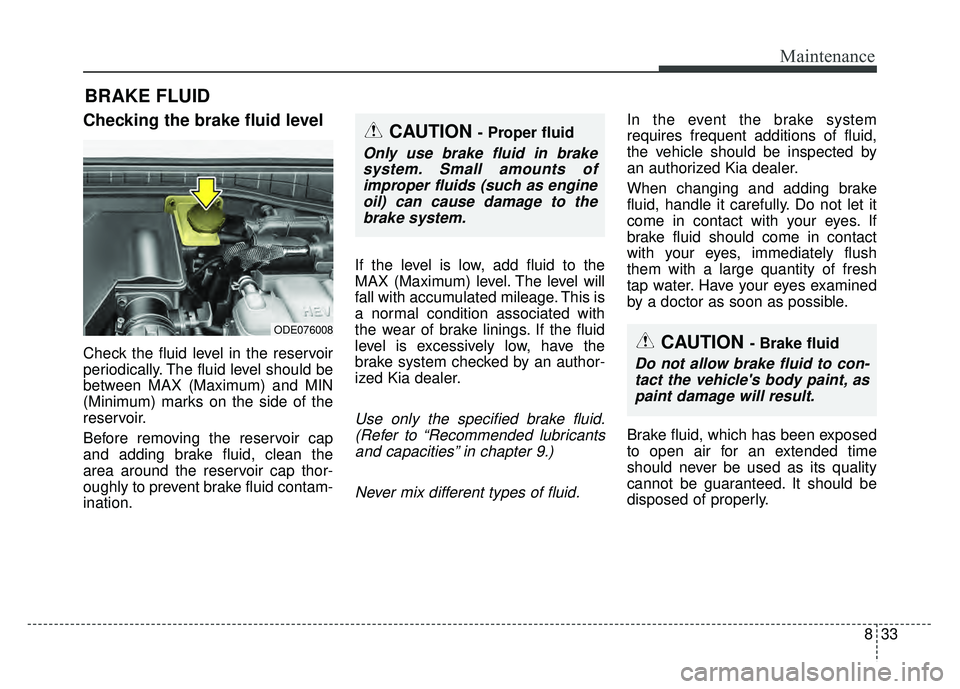
Checking the brake fluid level
Check the fluid level in the reservoir
periodically. The fluid level should be
between MAX (Maximum) and MIN
(Minimum) marks on the side of the
reservoir.
Before removing the reservoir cap
and adding brake fluid, clean the
area around the reservoir cap thor-
oughly to prevent brake fluid contam-
ination.If the level is low, add fluid to the
MAX (Maximum) level. The level will
fall with accumulated mileage. This is
a normal condition associated with
the wear of brake linings. If the fluid
level is excessively low, have the
brake system checked by an author-
ized Kia dealer.
Use only the specified brake fluid.
(Refer to “Recommended lubricantsand capacities” in chapter 9.)
Never mix different types of fluid.
In the event the brake system
requires frequent additions of fluid,
the vehicle should be inspected by
an authorized Kia dealer.
When changing and adding brake
fluid, handle it carefully. Do not let it
come in contact with your eyes. If
brake fluid should come in contact
with your eyes, immediately flush
them with a large quantity of fresh
tap water. Have your eyes examined
by a doctor as soon as possible.
Brake fluid, which has been exposed
to open air for an extended time
should never be used as its quality
cannot be guaranteed. It should be
disposed of properly.
CAUTION - Brake fluid
Do not allow brake fluid to con-tact the vehicle's body paint, aspaint damage will result.
CAUTION - Proper fluid
Only use brake fluid in brakesystem. Small amounts ofimproper fluids (such as engineoil) can cause damage to thebrake system.
ODE076008
Page 503 of 616
Maintenance
34
8
ENGINE CLUTCH ACTUATOR FLUID
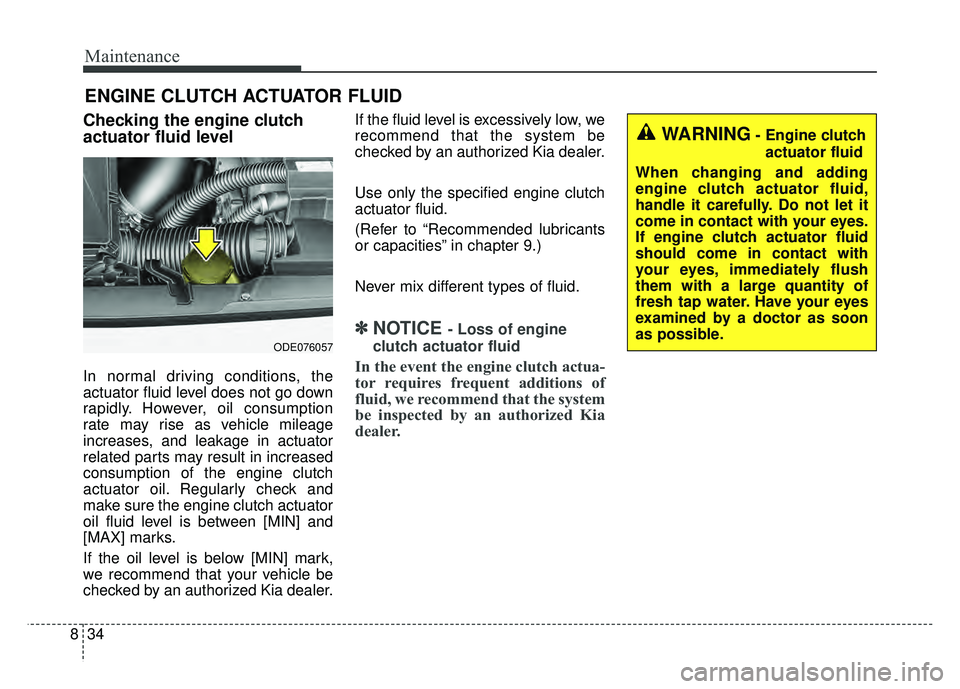
Checking the engine clutch
actuator fluid level
In normal driving conditions, the
actuator fluid level does not go down
rapidly. However, oil consumption
rate may rise as vehicle mileage
increases, and leakage in actuator
related parts may result in increased
consumption of the engine clutch
actuator oil. Regularly check and
make sure the engine clutch actuator
oil fluid level is between [MIN] and
[MAX] marks.
If the oil level is below [MIN] mark,
we recommend that your vehicle be
checked by an authorized Kia dealer. If the fluid level is excessively low, we
recommend that the system be
checked by an authorized Kia dealer.
Use only the specified engine clutch
actuator fluid.
(Refer to “Recommended lubricants
or capacities” in chapter 9.)
Never mix different types of fluid.
✽ ✽
NOTICE - Loss of engine
clutch actuator fluid
In the event the engine clutch actua-
tor requires frequent additions of
fluid, we recommend that the system
be inspected by an authorized Kia
dealer.
WARNING- Engine clutch actuator fluid
When changing and adding
engine clutch actuator fluid,
handle it carefully. Do not let it
come in contact with your eyes.
If engine clutch actuator fluid
should come in contact with
your eyes, immediately flush
them with a large quantity of
fresh tap water. Have your eyes
examined by a doctor as soon
as possible.
ODE076057
Page 526 of 616
857
Maintenance
Temperature -A, B & C
The temperature grades are A (the
highest), B and C representing the
tire’s resistance to the generation of
heat and its ability to dissipate heat
when tested under controlled condi-
tions on a specified indoor laboratory
test wheel.
Sustained high temperature can
cause the material of the tire to
degenerate and reduce tire life, and
excessive temperature can lead to
sudden tire failure. The grade C cor-
responds to a level of performance
which all passenger car tires must
meet under the Federal Motor
Vehicle Safety Standard No. 109.
Grades B and A represent higher
levels of performance on the labora-
tory test wheel than the minimum
required by law.Tire terminology and defini-
tions
Air Pressure:The amount of air
inside the tire pressing outward on
the tire. Air pressure is expressed in
kilopascal (kPa) or pounds per
square inch (psi).
Accessory Weight: This means the
combined weight of optional acces-
sories. Some examples of optional
accessories are, dual clutch trans-
mission, power seats, and air condi-
tioning.
Aspect Ratio: The relationship of a
tire's height to its width.
Belt: A rubber coated layer of cords
that is located between the plies and
the tread. Cords may be made from
steel or other reinforcing materials.
Bead: The tire bead contains steel
wires wrapped by steel cords that
hold the tire onto the rim.
Bias Ply Tire: A pneumatic tire in
which the plies are laid at alternate
angles less than 90 degrees to the
centerline of the tread. Cold Tire Pressure:
The amount of
air pressure in a tire, measured in
kilopascals (kPa) or pounds per
square inch (psi) before a tire has
built up heat from driving.
Curb Weight: This means the weight
of a motor vehicle with standard and
optional equipment including the
maximum capacity of fuel, oil and
coolant, but without passengers and
cargo.
DOT Markings: A code molded into
the sidewall of a tire signifying that
the tire is in compliance with the U.S.
Department of Transportation motor
vehicle safety standards. The DOT
code includes the Tire Identification
Number (TIN), an alphanumeric des-
ignator which can also identify the
tire manufacturer, production plant,
brand and date of production.
Page 606 of 616

I5
Index
"Driver's 3-point systemwith emergency locking retractor" . . . . . . . . . . . . . . . . . . . . . . . . . . . . . . . . . . 3-22\
Driver's and passenger's front air bag . . . . . . . . . . . . . . 3-57
Driving at night . . . . . . . . . . . . . . . . . . . . . . . . . . . . . . . 6-92
Driving in flooded areas . . . . . . . . . . . . . . . . . . . . . . . . 6-93
Driving in the rain. . . . . . . . . . . . . . . . . . . . . . . . . . . . . 6-92
Driving off-road . . . . . . . . . . . . . . . . . . . . . . . . . . . . . . 6-93
Dual clutch transmission . . . . . . . . . . . . . . . . . . . . . . . 6-14 Manual mode . . . . . . . . . . . . . . . . . . . . . . . . . . . . . . 6-19
Shift-lock override . . . . . . . . . . . . . . . . . . . . . . . . . . 6-20
Dual clutch transmission shift indicator . . . . . . . . . . . . 4-63
Economical operation . . . . . . . . . . . . . . . . . . . . . . . . . . 6-87
"Electric chromatic mirror (ECM) with UVO service" . 4-50
Electric power steering . . . . . . . . . . . . . . . . . . . . . . . . . 4-44
Electrical equipment . . . . . . . . . . . . . . . . . . . . . . . . . . . 9-15
Electrochromic mirror (ECM) . . . . . . . . . . . . . . . . . . . 4-49
Electronic stability control (ESC) . . . . . . . . . . . . . . . . 6-29
Emergency starting . . . . . . . . . . . . . . . . . . . . . . . . . . . . . 7-5 Before Jump starting . . . . . . . . . . . . . . . . . . . . . . . . . 7-5
"Method to disconnect the (-) cable for regular maintenance" . . . . . . . . . . . . . . . . . . . . . . . . . . . . . . 7-7
Jump starting . . . . . . . . . . . . . . . . . . . . . . . . . . . . . . . 7-7
Emergency while driving . . . . . . . . . . . . . . . . . . . . . . . . 7-3 Emission control system . . . . . . . . . . . . . . . . . . . . . . . 8-113
Crankcase emission control system . . . . . . . . . . . . 8-113
Evaporative emission control (including ORVR:Onboard Refueling Vapor Recovery) system. . . . 8-113
Exhaust emission control system . . . . . . . . . . . . . . 8-114
Engine . . . . . . . . . . . . . . . . . . . . . . . . . . . . . . . . . . . . \
. . . 9-2
Engine clutch actuator fluid . . . . . . . . . . . . . . . . . . . . . 8-34 Checking the Engine clutch actuator fluid level . . . 8-34
Engine compartment. . . . . . . . . . . . . . . . . . . . . . . . . 2-6,8-3
Engine number . . . . . . . . . . . . . . . . . . . . . . . . . . . . . . . 9-10
Engine oil . . . . . . . . . . . . . . . . . . . . . . . . . . . . . . . . . . . 8-\
26 Checking the engine oil level . . . . . . . . . . . . . . . . . . 8-26
Changing the engine oil and filter . . . . . . . . . . . . . . 8-27
Engine overheats . . . . . . . . . . . . . . . . . . . . . . . . . . . . . . 7-10
Engine start/stop button . . . . . . . . . . . . . . . . . . . . . . . . . 6-9 Starting the hybrid system . . . . . . . . . . . . . . . . . . . . 6-11
Illuminated engine start/stop button. . . . . . . . . . . . . . 6-9
Engine start/stop button position . . . . . . . . . . . . . . . . 6-9
Engine start/stop button illumination . . . . . . . . . . . . . . . 6-9
Engine start/stop button position . . . . . . . . . . . . . . . . . . 6-9
Engine will not start . . . . . . . . . . . . . . . . . . . . . . . . . . . . 7-4
Evaporative emission control (including ORVR: Onboard Refueling Vapor Recovery) system . . . . . . . . . . . . 8-113
Exhaust emission control system . . . . . . . . . . . . . . . . 8-114
Explanation of scheduled maintenance items . . . . . . . 8-22 Engine oil and filter . . . . . . . . . . . . . . . . . . . . . . . . . 8-22
HSG (Hybrid starter & Generator) belt . . . . . . . . . . 8-22
Fuel filter (for Gasoline) . . . . . . . . . . . . . . . . . . . . . 8-22
E