coolant level KIA NIRO 2019 User Guide
[x] Cancel search | Manufacturer: KIA, Model Year: 2019, Model line: NIRO, Model: KIA NIRO 2019Pages: 611, PDF Size: 15.28 MB
Page 495 of 611
821
Maintenance
COOLANT
The high-pressure cooling system
has a reservoir filled with year round
antifreeze coolant. The reservoir is
filled at the factory.
Check the antifreeze protection and
coolant level at least once a year: at
the beginning of the winter season,
and before traveling to a colder cli-
mate.Checking the coolant level Turn the engine off and wait until itcools down. Use extreme care
when removing the radiator cap.
Wrap a thick towel around it, and
turn it counterclockwise slowly to
the first stop. Step back while the
pressure is released from the cool-
ing system.
When you are sure all the pressure
has been released, press down on
the cap, using a thick towel, and
continue turning counterclockwise
to remove it.
Even if the engine is not operating, do not remove the radiator cap or
the drain plug while the engine and
radiator are hot. Hot coolant and
steam may still blow out under
pressure, causing serious injury.
The engine coolant and/or inverter
coolant level is influenced by the
hybrid system temperature. Before
checking or refilling the engine
coolant and/or inverter coolant,
turn the hybrid vehicle off.
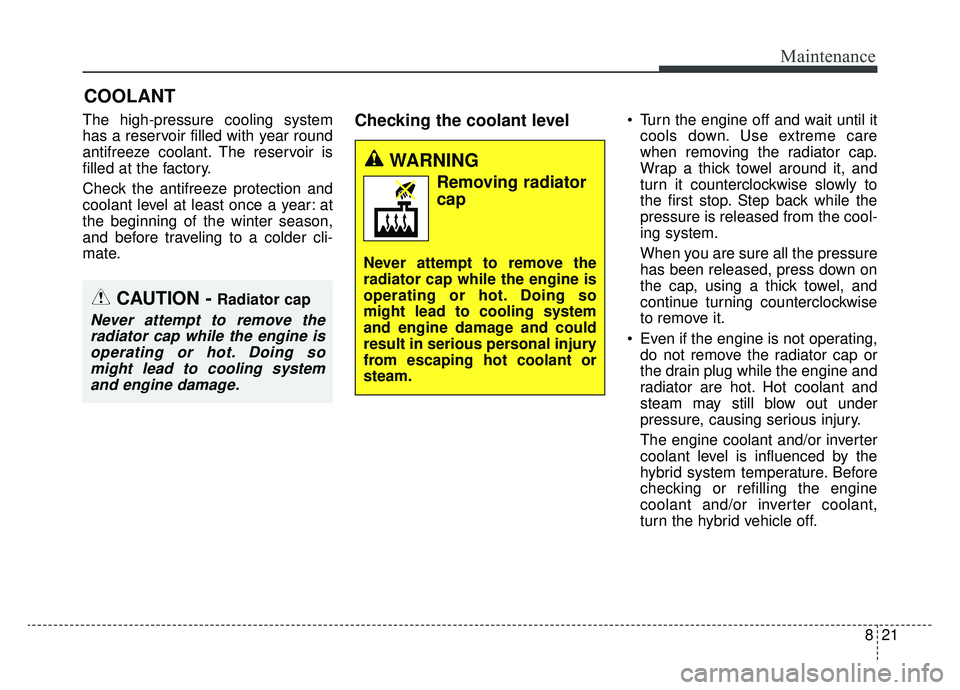
WARNING
Removing radiator
cap
Never attempt to remove the
radiator cap while the engine is
operating or hot. Doing so
might lead to cooling system
and engine damage and could
result in serious personal injury
from escaping hot coolant or
steam.
CAUTION - Radiator cap
Never attempt to remove theradiator cap while the engine isoperating or hot. Doing somight lead to cooling systemand engine damage.
Page 496 of 611
Maintenance
22
8
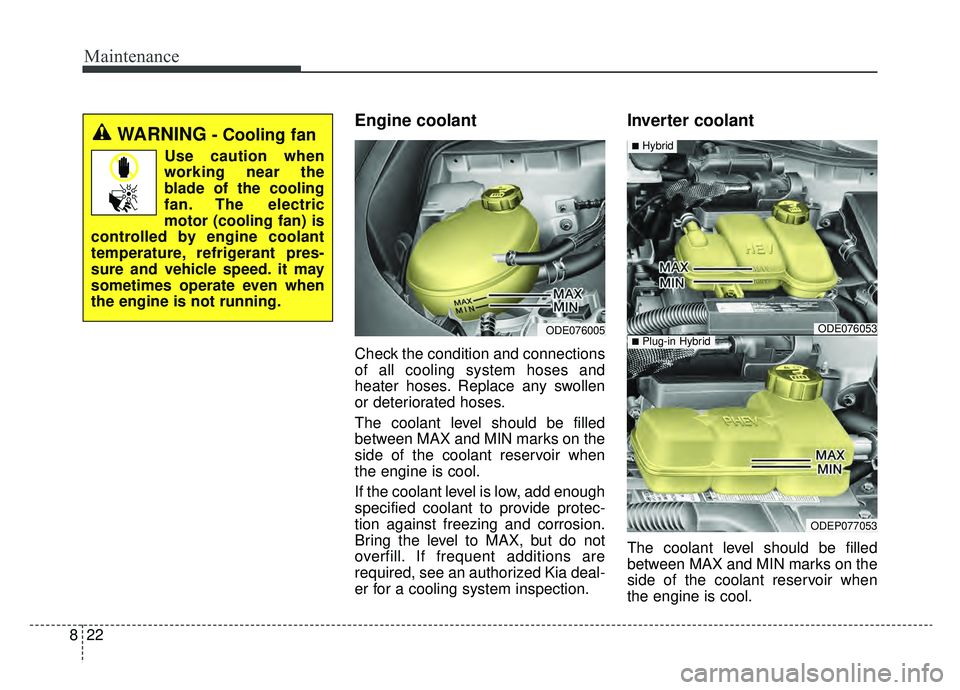
Engine coolant
Check the condition and connections
of all cooling system hoses and
heater hoses. Replace any swollen
or deteriorated hoses.
The coolant level should be filled
between MAX and MIN marks on the
side of the coolant reservoir when
the engine is cool.
If the coolant level is low, add enough
specified coolant to provide protec-
tion against freezing and corrosion.
Bring the level to MAX, but do not
overfill. If frequent additions are
required, see an authorized Kia deal-
er for a cooling system inspection.
Inverter coolant
The coolant level should be filled
between MAX and MIN marks on the
side of the coolant reservoir when
the engine is cool.
WARNING- Cooling fan
Use caution when
working near the
blade of the cooling
fan. The electric
motor (cooling fan) is
controlled by engine coolant
temperature, refrigerant pres-
sure and vehicle speed. it may
sometimes operate even when
the engine is not running.
ODE076005ODE076053
■Hybrid
ODEP077053
■Plug-in Hybrid
Page 497 of 611
823
Maintenance
If the coolant level is low, add enough
specified coolant to provide protec-
tion against freezing and corrosion.
Bring the level to MAX, but do not
overfill. If frequent additions are
required, see an authorized Kia deal-
er for a cooling system inspection.Recommended coolant
When adding coolant, use onlydeionized water or soft water for
your vehicle and never mix hard
water in the coolant filled at the fac-
tory. An improper coolant mixture
can result in serious malfunction or
engine damage.
The engine in your vehicle has alu- minum engine parts and must be
protected by an ethylene-glycol
with phosphate based coolant to
prevent corrosion and freezing.
DO NOT USE alcohol or methanol coolant or mix them with the spec-
ified coolant.
Do not use a solution that contains more than 60% antifreeze or less
than 35% antifreeze. This would
reduce the effectiveness of the
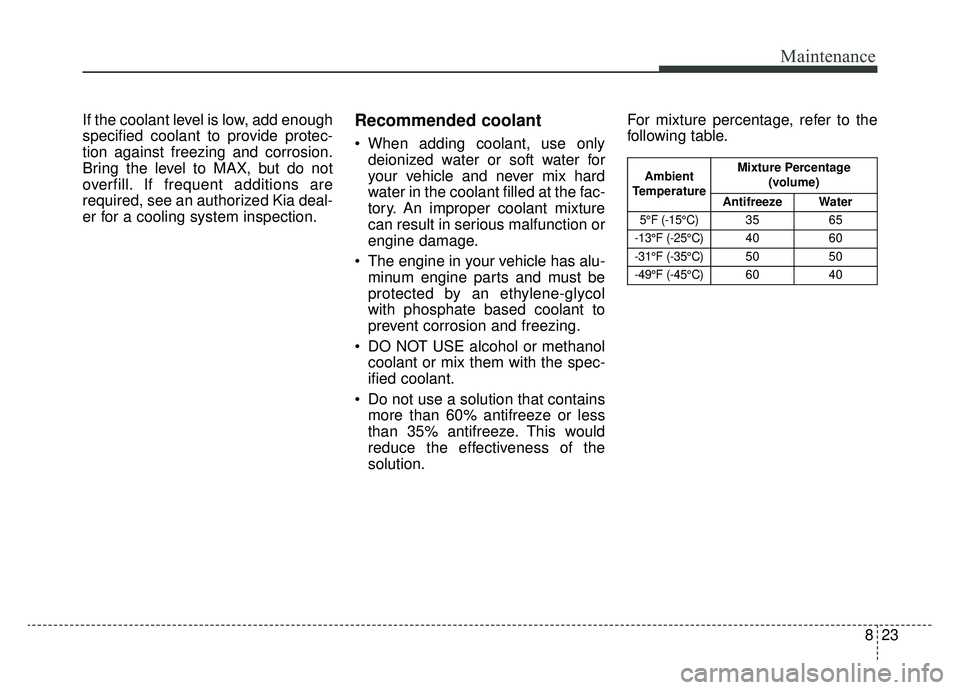
solution. For mixture percentage, refer to the
following table.
Ambient
Temperature Mixture Percentage
(volume)
Antifreeze Water
5°F (-15°C)35 65
-13°F (-25°C)4060
-31°F (-35°C)5050
-49°F (-45°C)6040
Page 503 of 611
829
Maintenance
WASHER FLUID
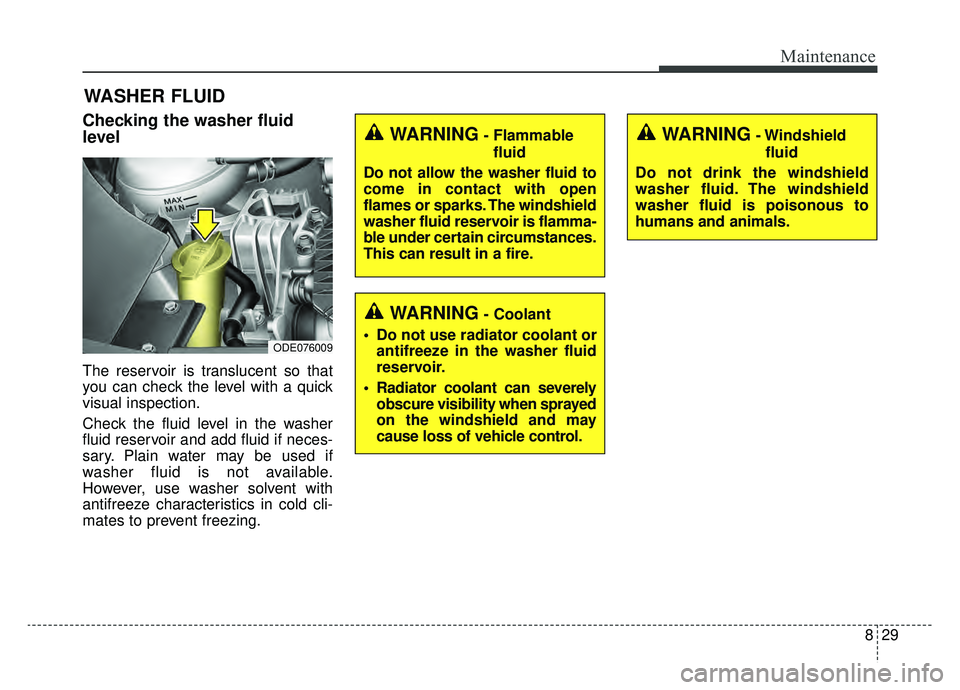
Checking the washer fluid
level
The reservoir is translucent so that
you can check the level with a quick
visual inspection.
Check the fluid level in the washer
fluid reservoir and add fluid if neces-
sary. Plain water may be used if
washer fluid is not available.
However, use washer solvent with
antifreeze characteristics in cold cli-
mates to prevent freezing.
WARNING- Flammablefluid
Do not allow the washer fluid to
come in contact with open
flames or sparks. The windshield
washer fluid reservoir is flamma-
ble under certain circumstances.
This can result in a fire.WARNING- Windshield fluid
Do not drink the windshield
washer fluid. The windshield
washer fluid is poisonous to
humans and animals.
WARNING- Coolant
Do not use radiator coolant or antifreeze in the washer fluid
reservoir.
Radiator coolant can severely obscure visibility when sprayed
on the windshield and may
cause loss of vehicle control.
ODE076009
Page 524 of 611
Maintenance
50
8
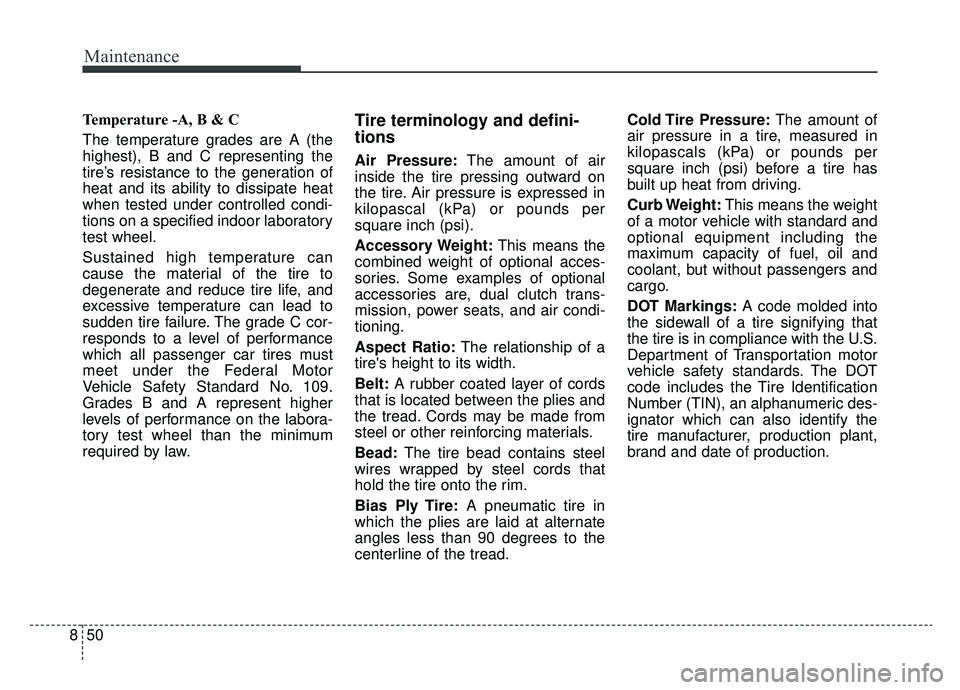
Temperature -A, B & C
The temperature grades are A (the
highest), B and C representing the
tire’s resistance to the generation of
heat and its ability to dissipate heat
when tested under controlled condi-
tions on a specified indoor laboratory
test wheel.
Sustained high temperature can
cause the material of the tire to
degenerate and reduce tire life, and
excessive temperature can lead to
sudden tire failure. The grade C cor-
responds to a level of performance
which all passenger car tires must
meet under the Federal Motor
Vehicle Safety Standard No. 109.
Grades B and A represent higher
levels of performance on the labora-
tory test wheel than the minimum
required by law.Tire terminology and defini-
tions
Air Pressure: The amount of air
inside the tire pressing outward on
the tire. Air pressure is expressed in
kilopascal (kPa) or pounds per
square inch (psi).
Accessory Weight: This means the
combined weight of optional acces-
sories. Some examples of optional
accessories are, dual clutch trans-
mission, power seats, and air condi-
tioning.
Aspect Ratio: The relationship of a
tire's height to its width.
Belt: A rubber coated layer of cords
that is located between the plies and
the tread. Cords may be made from
steel or other reinforcing materials.
Bead: The tire bead contains steel
wires wrapped by steel cords that
hold the tire onto the rim.
Bias Ply Tire: A pneumatic tire in
which the plies are laid at alternate
angles less than 90 degrees to the
centerline of the tread. Cold Tire Pressure:
The amount of
air pressure in a tire, measured in
kilopascals (kPa) or pounds per
square inch (psi) before a tire has
built up heat from driving.
Curb Weight: This means the weight
of a motor vehicle with standard and
optional equipment including the
maximum capacity of fuel, oil and
coolant, but without passengers and
cargo.
DOT Markings: A code molded into
the sidewall of a tire signifying that
the tire is in compliance with the U.S.
Department of Transportation motor
vehicle safety standards. The DOT
code includes the Tire Identification
Number (TIN), an alphanumeric des-
ignator which can also identify the
tire manufacturer, production plant,
brand and date of production.
Page 602 of 611
I3
Index
Before driving . . . . . . . . . . . . . . . . . . . . . . . . . . . . . . . . . 6-4Before entering vehicle . . . . . . . . . . . . . . . . . . . . . . . 6-4
Before starting . . . . . . . . . . . . . . . . . . . . . . . . . . . . . . 6-4
Necessary inspections . . . . . . . . . . . . . . . . . . . . . . . . 6-4
Blind Spot Detection system (BSD). . . . . . . . . . . . . . . 6-68 BSD (Blind Spot Detection) /LCA (Lane Change Assist) . . . . . . . . . . . . . . . . . . 6-69
Limitations condition . . . . . . . . . . . . . . . . . . . . . . . . 6-74
RCTA (Rear Cross Traffic Alert) . . . . . . . . . . . . . . . 6-72
Brake fluid . . . . . . . . . . . . . . . . . . . . . . . . . . . . . . . . . . 8-26\
Checking the brake fluid level . . . . . . . . . . . . . . . . . 8-26
Brake system. . . . . . . . . . . . . . . . . . . . . . . . . . . . . . . . . 6-23 Anti-lock Brake System (ABS) . . . . . . . . . . . . . . . . 6-27
Electronic Stability Control (ESC) . . . . . . . . . . . . . 6-29
Good braking practices . . . . . . . . . . . . . . . . . . . . . . 6-34
Hill-start Assist Control (HAC) . . . . . . . . . . . . . . . . 6-34
Parking brake – Foot type . . . . . . . . . . . . . . . . . . . . 6-25
Power brakes . . . . . . . . . . . . . . . . . . . . . . . . . . . . . . 6-23
Vehicle Stability Management (VSM) . . . . . . . . . . . 6-32
Bulb wattage . . . . . . . . . . . . . . . . . . . . . . . . . . . . . . . . . . 9-3
California perchlorate notice . . . . . . . . . . . . . . . . . . . 8-109
Checking fluid levels . . . . . . . . . . . . . . . . . . . . . . . . . . 8-18
Child Restraint System (CRS) . . . . . . . . . . . . . . . . . . . 3-32 Children always in the rear . . . . . . . . . . . . . . . . . . . 3-32 Installing a Child Restraint System (CRS) . . . . . . . 3-36
Selecting a Child Restraint System (CRS) . . . . . . . 3-33
Climate control air filter . . . . . . . . . . . . . . . . . . . . . . . . 8-33 Filter inspection . . . . . . . . . . . . . . . . . . . . . . . . . . . . 8-33
Consumer Assistance (U.S. only) . . . . . . . . . . . . . . . . . 9-12 Emergency roadside assistance . . . . . . . . . . . . . . . . 9-12
Registering your vehicle in a foreign country . . . . . 9-14
Toll free consumer assistance . . . . . . . . . . . . . . . . . 9-12
Trip interruption . . . . . . . . . . . . . . . . . . . . . . . . . . . . 9-13
Coolant . . . . . . . . . . . . . . . . . . . . . . . . . . . . . . . . . . . . \
. 8-21 Changing the coolant . . . . . . . . . . . . . . . . . . . . . . . . 8-25
Checking the coolant level . . . . . . . . . . . . . . . . . . . . 8-21
Engine coolant . . . . . . . . . . . . . . . . . . . . . . . . . . . . . 8-22
Inverter coolant . . . . . . . . . . . . . . . . . . . . . . . . . . . . 8-22
Recommended coolant . . . . . . . . . . . . . . . . . . . . . . . 8-23
Cruise control system . . . . . . . . . . . . . . . . . . . . . . . . . . 6-48 To cancel cruise control, do one of the following . . 6-50
To decrease the cruising speed . . . . . . . . . . . . . . . . . 6-50
To increase cruise control set speed . . . . . . . . . . . . . 6-49
To resume cruising speed at more thanapproximately 20 mph (30 km/h) . . . . . . . . . . . . . 6-51
To set cruise control speed . . . . . . . . . . . . . . . . . . . . 6-49
To temporarily accelerate with the cruise control on . . . . . . . . . . . . . . . . . . . . . . . . . . . . . . . . 6-50
To turn cruise control off, do one of the following . 6-51
C