towing KIA NIRO 2019 Owners Manual
[x] Cancel search | Manufacturer: KIA, Model Year: 2019, Model line: NIRO, Model: KIA NIRO 2019Pages: 611, PDF Size: 15.28 MB
Page 52 of 611
H45
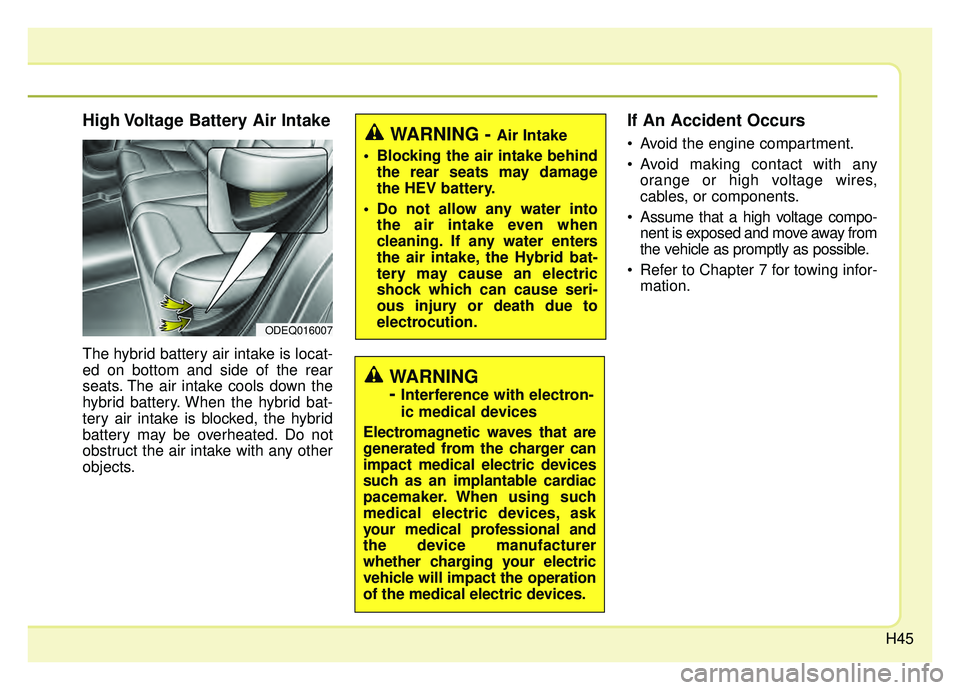
High Voltage Battery Air Intake
The hybrid battery air intake is locat-
ed on bottom and side of the rear
seats. The air intake cools down the
hybrid battery. When the hybrid bat-
tery air intake is blocked, the hybrid
battery may be overheated. Do not
obstruct the air intake with any other
objects.
If An Accident Occurs
Avoid the engine compartment.
Avoid making contact with anyorange or high voltage wires,
cables, or components.
Assume that a high voltage compo- nent is exposed and move away from
the vehicle as promptly as possible.
Refer to Chapter 7 for towing infor- mation.WARNING - Air Intake
Blocking the air intake behind the rear seats may damage
the HEV battery.
Do not allow any water into the air intake even when
cleaning. If any water enters
the air intake, the Hybrid bat-
tery may cause an electric
shock which can cause seri-
ous injury or death due to
electrocution.
ODEQ016007
WARNING
-
Interference with electron-
ic medical devices
Electromagnetic waves that are
generated from the charger can
impact medical electric devices
such as an implantable cardiac
pacemaker. When using such
medical electric devices, ask
your medical professional and
the device manufacturer
whether charging your electric
vehicle will impact the operation
of the medical electric devices.
Page 53 of 611
H46
After parking the vehicle, shift thetransmission into "P" position. Turn
off the hybrid system by pushing
the Engine Start/Stop button.
For your safety, do not touch high voltage cables, connectors and
package modules. High Voltage
components are orange in color.
Exposed cables or wires may be visible inside or outside of the vehi-
cle. Never touch the wires or
cables, because an electrical
shock may occur causing injury or
death.✽ ✽
NOTICE
• If a small scale fire occurs, use a
fire extinguisher (ABC, BC) that is
meant for electrical fires.
If it is impossible to extinguish the
fire in the early stage, remain a
safe distance from the vehicle and
immediately call your local fire
emergency responders. Also,
advise them that a hybrid vehicle
is involved.
If the fire spreads to the high volt-
age battery, large amount of water
is needed to put out the fire.
Using small amount of water or
fire extinguishers not meant for
electrical fires could cause serious
injury or death from electrical
shocks.
• If you need towing, refer to chap- ter 7.
If a vehicle accident occurs:
1.Stop the vehicle and shift the trans-
mission into "P" position and then
depress the parking brake.
2.Turn off the Hybrid system by pushing the Engine Start/Stop
Button.
3.Step away from the vehicle and go to a safe place.
4.Call emergency services for help and let them know the vehicle is a
Hybrid vehicle.
Do not touch high voltage cables,
connectors and package modules.
High voltage components are
orange in color.
Exposed cables or wires may be vis-
ible inside or outside of the vehicle.
Never touch the wires or cables,
because an electrical shock may
occur causing injury or death.
COMPONENTS OF THE HYBRID/PLUG-IN HYBRID VEHICLE (CONT.)
Page 93 of 611
Safety features of your vehicle
26
3
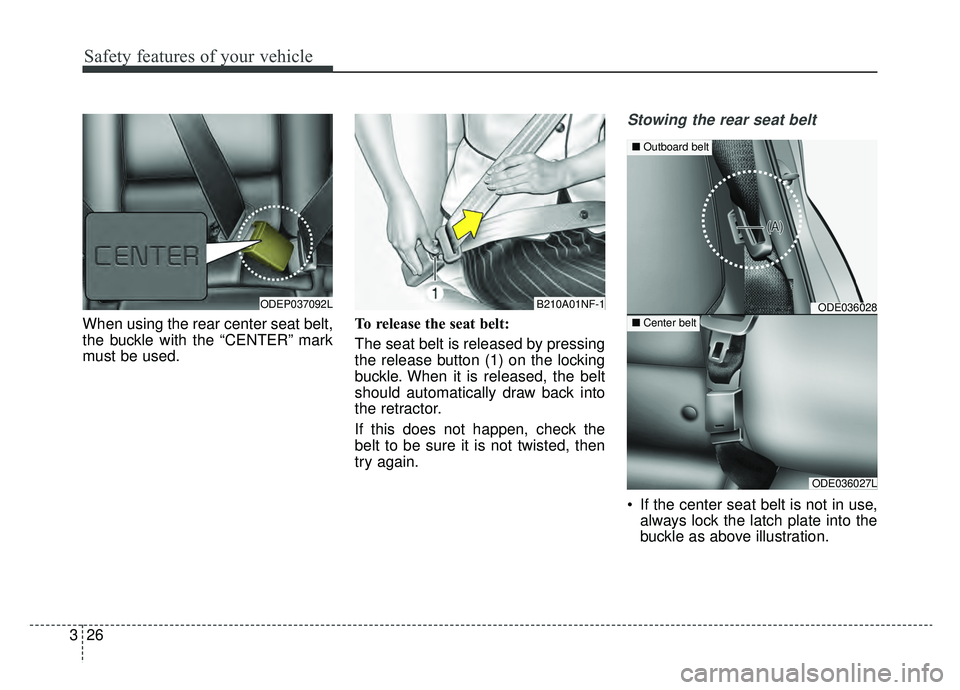
When using the rear center seat belt,
the buckle with the “CENTER” mark
must be used. To release the seat belt:
The seat belt is released by pressing
the release button (1) on the locking
buckle. When it is released, the belt
should automatically draw back into
the retractor.
If this does not happen, check the
belt to be sure it is not twisted, then
try again.
Stowing the rear seat belt
If the center seat belt is not in use,
always lock the latch plate into the
buckle as above illustration.
B210A01NF-1ODE036028
■ Outboard belt
ODE036027L
■Center belt
ODEP037092L
Page 134 of 611
367
Safety features of your vehicle
SRS Care
The SRS is virtually maintenance-
free and so there are no parts you can
safely service by yourself. If the SRS
air bag warning light does not illumi-
nate, or continuously remains on, have
your vehicle immediately inspected by
an authorized Kia dealer.
Any work on the SRS system, such
as removing, installing, repairing, or
any work on the steering wheel, the
front passenger’s panel, front seats
and roof rails must be performed by
an authorized Kia dealer. Improper
handling of the SRS system may
result in serious personal injury.For cleaning the air bag pad covers,
use only a soft, dry cloth or one which
has been moistened with plain water.
Solvents or cleaners could adversely
affect the air bag covers and proper
deployment of the system.
If components of the air bag system
must be discarded, or if the vehicle
must be scrapped, certain safety
precautions must be observed. An
authorized Kia dealer knows these
precautions and can give you the
necessary information. Failure to fol-
low these precautions and proce-
dures could increase the risk of per-
sonal injury.WARNING- Tampering
with SRS
Do not tamper with or discon-
nect SRS wiring, or other com-
ponents of the SRS system.
Doing so could result in the
accidental inflation of the air
bags or render the SRS inoper-
ative.
WARNING- Towing Vehicle
Always have the ignition off
when your vehicle is being
towed. The side air bags may
inflate if the vehicle is tilted
such as when being towed
because of the rollover sensors
in the vehicle.
Page 243 of 611
Features of your vehicle
108
4
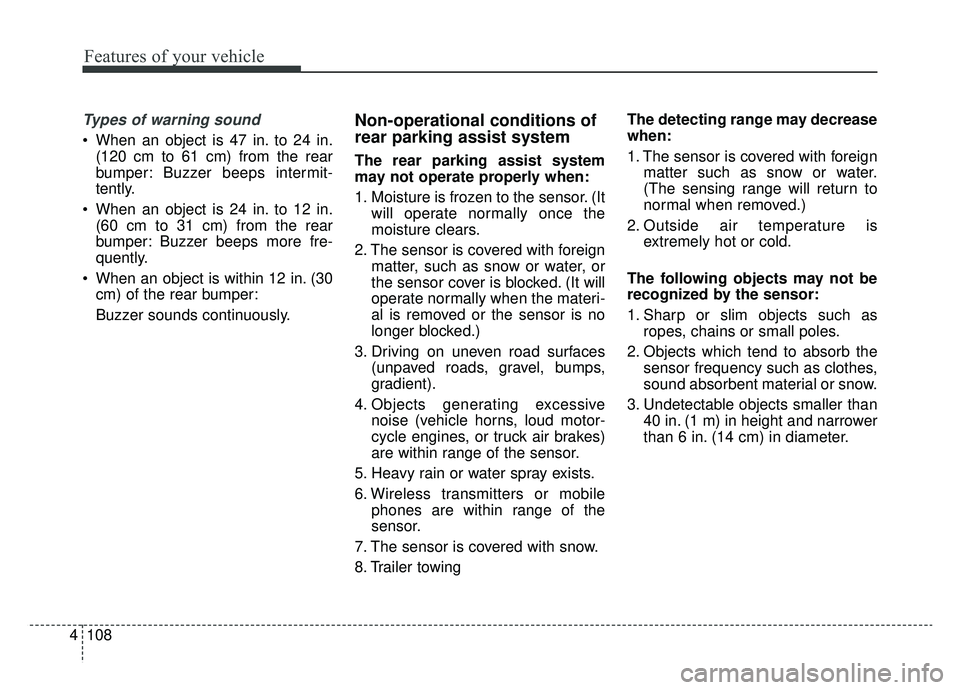
Types of warning sound
When an object is 47 in. to 24 in.
(120 cm to 61 cm) from the rear
bumper: Buzzer beeps intermit-
tently.
When an object is 24 in. to 12 in. (60 cm to 31 cm) from the rear
bumper: Buzzer beeps more fre-
quently.
When an object is within 12 in. (30 cm) of the rear bumper:
Buzzer sounds continuously.
Non-operational conditions of
rear parking assist system
The rear parking assist system
may not operate properly when:
1. Moisture is frozen to the sensor. (It will operate normally once the
moisture clears.
2. The sensor is covered with foreign matter, such as snow or water, or
the sensor cover is blocked. (It will
operate normally when the materi-
al is removed or the sensor is no
longer blocked.)
3. Driving on uneven road surfaces (unpaved roads, gravel, bumps,
gradient).
4. Objects generating excessive noise (vehicle horns, loud motor-
cycle engines, or truck air brakes)
are within range of the sensor.
5. Heavy rain or water spray exists.
6. Wireless transmitters or mobile phones are within range of the
sensor.
7. The sensor is covered with snow.
8. Trailer towing The detecting range may decrease
when:
1. The sensor is covered with foreign
matter such as snow or water.
(The sensing range will return to
normal when removed.)
2. Outside air temperature is extremely hot or cold.
The following objects may not be
recognized by the sensor:
1. Sharp or slim objects such as ropes, chains or small poles.
2. Objects which tend to absorb the sensor frequency such as clothes,
sound absorbent material or snow.
3. Undetectable objects smaller than 40 in. (1 m) in height and narrower
than 6 in. (14 cm) in diameter.
Page 338 of 611
Blind Spot Detection system (BSD) . . . . . . . . . . . 6-68
/ LCA (Lane Change Assist) . . . . . . . . . . . . . . . . . 6-69
. . . . . . . . . . . . . . . . . . . . . . . . . 6-74
Lane Keeping Assist System (LKAS) . . . . . . . . . . 6-76
. . . . . . . . . . . . . . . . . . . . . . . 6-83
Driver Attention Alert system (DAA) . . . . . . . . . . 6-84
. . . . . . . . . . . . . . . . . . . 6-84
. . . . . . . . . . . . . . . . . . . . . . . . . . 6-86
. . . . . . . . . . . . . . . . . . . . . . . . . . . . . . 6-86
. . . . . . . . . . . . . . . . . . . . . . . . . . . 6-86
Economical operation . . . . . . . . . . . . . . . . . . . . . . 6-89
Special driving conditions . . . . . . . . . . . . . . . . . . . 6-91
. . . . . . . . . . . . . . . . . 6-91
. . . . . . . . . . . . . . . . . . . . . . . . . . . 6-93
. . . . . . . . . . . . . . . . . . . . . . . . . . . . 6-93
. . . . . . . . . . . . . . . . . . . . . . . . . . . . . . 6-94
. . . . . . . . . . . . . . . . . . . . . . . . . . . 6-94
. . . . . . . . . . . . . . . . . . . . . . 6-95 . . . . . . . . . . . . . . . . . . . . . . . . . . . . . 6-95
. . . . . . . . . . . . . . . . . . . . . . . . . . . . . 6-95
Winter driving . . . . . . . . . . . . . . . . . . . . . . . . . . . . 6-96
. . . . . . . . . . . . . . . . . . . . . . . 6-96
. . . . . . . . . . 6-98
. . . . . . . . . . . . . . . . . . . . . . 6-98
. . . . . . . 6-98
. . . . . . . . . . . . . . . . . . . . 6-99
6-99
. . . . . . . . . . . . . 6-99
. . . . 6-99
. . . . . . . . . . . . . . . . . . . 6-99
Trailer towing . . . . . . . . . . . . . . . . . . . . . . . . . . . . . 6-99
Vehicle load limit . . . . . . . . . . . . . . . . . . . . . . . . . 6-100
. . . . . . . . . . . . . 6-100
. . . . . . . . . . . . . . . . . . . . . . . . . . . 6-103
Vehicle weight . . . . . . . . . . . . . . . . . . . . . . . . . . . . 6-104
. . . . . . . . . . . . . . . . . . . . . . . . . . . 6-104
. . . . . . . . . . . . . . . . . . . . . . . . . . 6-104
. . . . . . . . . . . . . . . . . . . . . . . . . . . . . . . 6-104
. . . . . . . . . . . . . . . . . . . . 6-104
. . . . . . . . . . . . 6-104
. . . . . . . . . . . . . . . . . . 6-104
. . . . . . . . . . 6-104
6
Page 382 of 611
Driving your vehicle
46
6
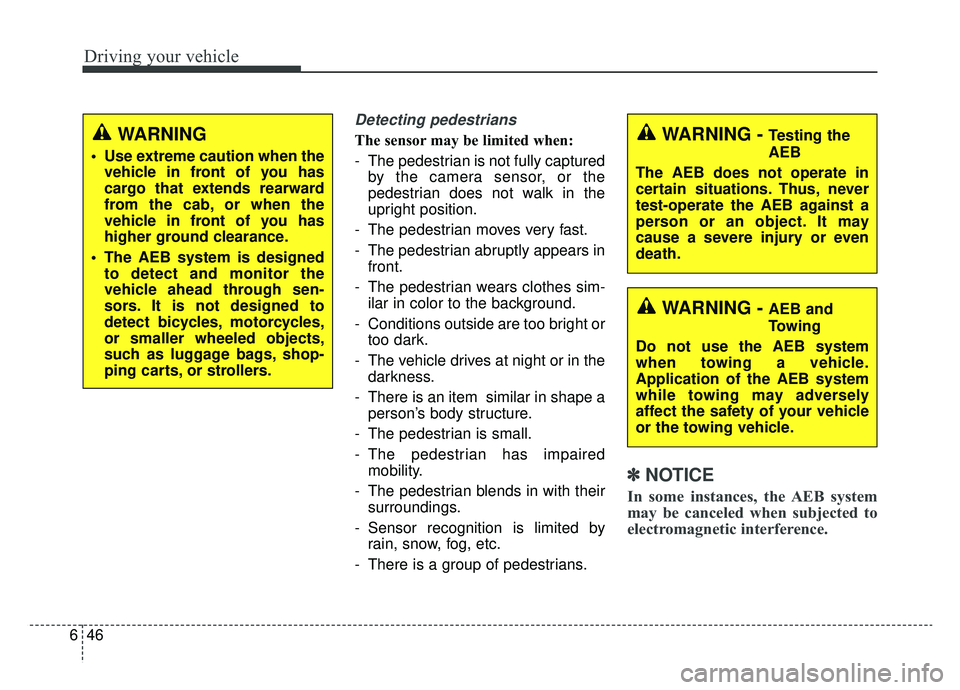
Detecting pedestrians
The sensor may be limited when:
- The pedestrian is not fully captured
by the camera sensor, or the
pedestrian does not walk in the
upright position.
- The pedestrian moves very fast.
- The pedestrian abruptly appears in front.
- The pedestrian wears clothes sim- ilar in color to the background.
- Conditions outside are too bright or too dark.
- The vehicle drives at night or in the darkness.
- There is an item similar in shape a person’s body structure.
- The pedestrian is small.
- The pedestrian has impaired mobility.
- The pedestrian blends in with their surroundings.
- Sensor recognition is limited by rain, snow, fog, etc.
- There is a group of pedestrians.
✽ ✽ NOTICE
In some instances, the AEB system
may be canceled when subjected to
electromagnetic interference.
WARNING - Testing the
AEB
The AEB does not operate in
certain situations. Thus, never
test-operate the AEB against a
person or an object. It may
cause a severe injury or even
death.
WARNING - AEB and
Towing
Do not use the AEB system
when towing a vehicle.
Application of the AEB system
while towing may adversely
affect the safety of your vehicle
or the towing vehicle.
WARNING
Use extreme caution when the vehicle in front of you has
cargo that extends rearward
from the cab, or when the
vehicle in front of you has
higher ground clearance.
The AEB system is designed to detect and monitor the
vehicle ahead through sen-
sors. It is not designed to
detect bicycles, motorcycles,
or smaller wheeled objects,
such as luggage bags, shop-
ping carts, or strollers.
Page 402 of 611
Driving your vehicle
66
6
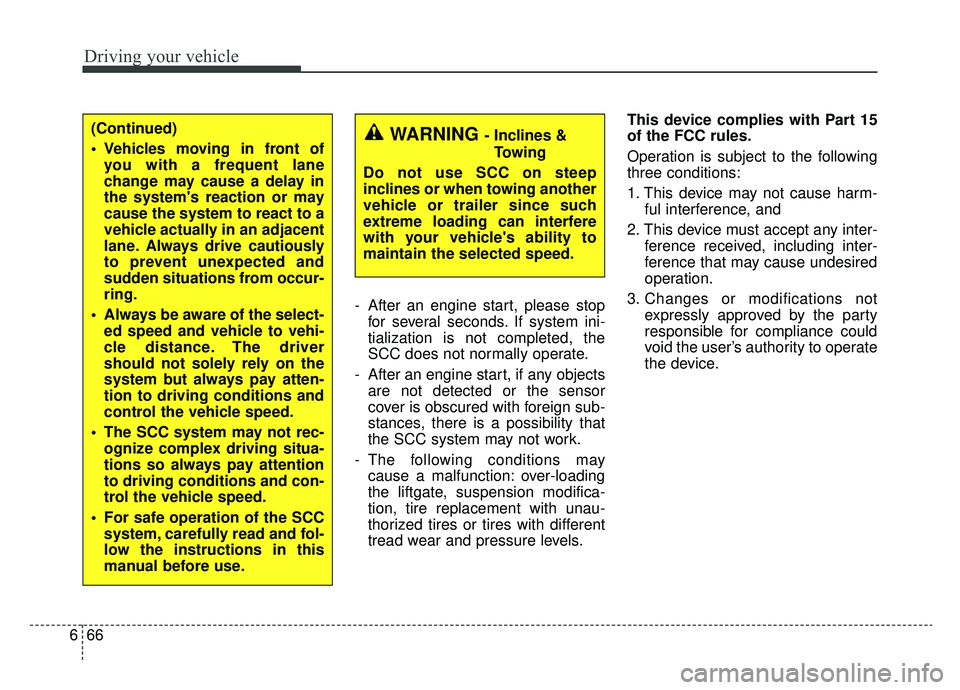
- After an engine start, please stop
for several seconds. If system ini-
tialization is not completed, the
SCC does not normally operate.
- After an engine start, if any objects are not detected or the sensor
cover is obscured with foreign sub-
stances, there is a possibility that
the SCC system may not work.
- The following conditions may cause a malfunction: over-loading
the liftgate, suspension modifica-
tion, tire replacement with unau-
thorized tires or tires with different
tread wear and pressure levels. This device complies with Part 15
of the FCC rules.
Operation is subject to the following
three conditions:
1. This device may not cause harm-
ful interference, and
2. This device must accept any inter- ference received, including inter-
ference that may cause undesired
operation.
3. Changes or modifications not expressly approved by the party
responsible for compliance could
void the user’s authority to operate
the device.
WARNING - Inclines &
Towing
Do not use SCC on steep
inclines or when towing another
vehicle or trailer since such
extreme loading can interfere
with your vehicle's ability to
maintain the selected speed.(Continued)
Vehicles moving in front of you with a frequent lane
change may cause a delay in
the system's reaction or may
cause the system to react to a
vehicle actually in an adjacent
lane. Always drive cautiously
to prevent unexpected and
sudden situations from occur-
ring.
Always be aware of the select- ed speed and vehicle to vehi-
cle distance. The driver
should not solely rely on the
system but always pay atten-
tion to driving conditions and
control the vehicle speed.
The SCC system may not rec- ognize complex driving situa-
tions so always pay attention
to driving conditions and con-
trol the vehicle speed.
For safe operation of the SCC system, carefully read and fol-
low the instructions in this
manual before use.
Page 435 of 611
699
Driving your vehicle
To keep locks from freezing
To keep the locks from freezing,
squirt an approved de-icer fluid or
glycerine into the key opening. If a
lock is covered with ice, squirt it with
an approved de-icing fluid to remove
the ice. If the lock is frozen internally,
you may be able to thaw it out by
using a heated key. Handle the heat-
ed key with care to avoid injury.
Use approved window washer
anti-freeze in system
To keep the water in the window
washer system from freezing, add an
approved window washer anti-freeze
solution in accordance with instruc-
tions on the container. Window wash-
er anti-freeze is available from an
authorized Kia dealer and most auto
parts outlets. Do not use engine
coolant or other types of anti-freeze
as these may damage the paint fin-
ish.
Don’t let your parking brake
freeze
Under some conditions your parking
brake can freeze in the engaged
position. This is most likely to happen
when there is an accumulation of
snow or ice around or near the rear
brakes or if the brakes are wet. If
there is a risk the parking brake may
freeze, apply it only temporarily while
you put the gear shift lever in P (Park,
Dual clutch transmission) and block
the rear wheels so the vehicle cannot
roll. Then release the parking brake.
Don't let ice and snow accu-
mulate underneath
Under some conditions, snow and
ice can build up under the fenders
and interfere with the steering. When
driving in severe winter conditions
where this may happen, you should
periodically check underneath the
vehicle to be sure the movement of
the front wheels and the steering
components are not obstructed.
Carry emergency equipment
Depending on the severity of the
weather, you should carry appropri-
ate emergency equipment. Some of
the items you may want to carry
include tow straps or chains, flash-
light, emergency flares, sand, shov-
el, jumper cables, window scraper,
gloves, ground cloth, coveralls, blan-
ket, etc.
TRAILER TOWING
We do not recommend using this
vehicle for trailer towing.
Page 437 of 611
6101
Driving your vehicle
Towing capacity:
We do not recommend using this
vehicle for trailer towing.
Cargo capacity:
The cargo capacity of your vehicle
will increase or decrease depending
on the weight and the number of
occupants.
Steps For Determining CorrectLoad Limit -
1. Locate the statement "The com- bined weight of occupants and
cargo should never exceed XXX
kg or XXX lbs.'' on your vehicle's
placard.
2. Determine the combined weight of the driver and passengers that will
be riding in your vehicle.
3. Subtract the combined weight of the driver and passengers from
XXX kg or XXX lbs.
4. The resulting figure equals the available amount of cargo and lug-
gage load capacity. For example, if
the "XXX" amount equals 1400
lbs. and there will be five 150 lb
passengers in your vehicle, the
amount of available cargo and lug-
gage load capacity is 650 lbs.
(1400-750 (5 x 150) = 650 lbs.) 5. Determine the combined weight of
luggage and cargo being loaded
on the vehicle. That weight may
not safely exceed the available
cargo and luggage load capacity
calculated in Step 4.
6. If your vehicle will be towing a trail- er, load from your trailer will be
transferred to your vehicle. Consult
this manual to determine how this
reduces the available cargo and
luggage load capacity of your
vehicle.
WARNING - Loose cargo
Do not travel with unsecured
blunt objects in the passenger
compartment of your vehicle
(e.g. suit cases or unsecured
child seats). These items may
strike occupant during a sud-
den stop or crash.