Check brakes KIA NIRO 2021 User Guide
[x] Cancel search | Manufacturer: KIA, Model Year: 2021, Model line: NIRO, Model: KIA NIRO 2021Pages: 710, PDF Size: 14.77 MB
Page 511 of 710
Driving your vehicle
188 5
Driving in flooded areas
Avoid driving through flooded areas
unless you are sure the water is no
higher than the bottom of the wheel
hub. Drive through any water slowly.
Allow adequate stopping distance
because brake performance may be
affected.
After driving through water, dry the
brakes by gently applying them sev-
eral times while the vehicle is moving
slowly.
Driving off-road
Drive carefully off-road because your
vehicle may be damaged by rocks or
roots of trees. Become familiar with
the off-road conditions where you
are going to drive before you begin
driving.
Highway driving
Tires
Adjust the tire inflation pressures to
specification. Low tire inflation pres-
sures will result in overheating and
possible failure of the tires.
Avoid using worn or damaged tires
which may result in reduced traction
or tire failure.
Never exceed the maximum tire
inflation pressure shown on the tires.
Fuel, engine coolant and engine oil
High speed travel consumes more
fuel than urban motoring. Do not for-
get to check both the engine coolant
and engine oil.
Drive belt
A loose or damaged drive belt may
result in overheating of the engine.
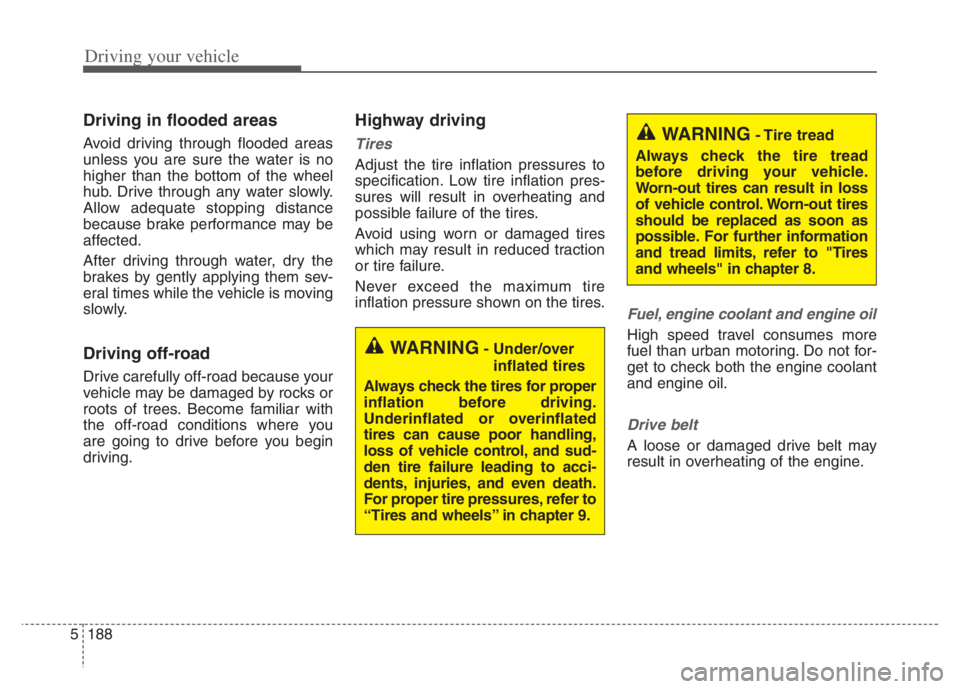
WARNING- Under/over
inflated tires
Always check the tires for proper
inflation before driving.
Underinflated or overinflated
tires can cause poor handling,
loss of vehicle control, and sud-
den tire failure leading to acci-
dents, injuries, and even death.
For proper tire pressures, refer to
“Tires and wheels” in chapter 9.
WARNING- Tire tread
Always check the tire tread
before driving your vehicle.
Worn-out tires can result in loss
of vehicle control. Worn-out tires
should be replaced as soon as
possible. For further information
and tread limits, refer to "Tires
and wheels" in chapter 8.
Page 515 of 710
Driving your vehicle
192 5
To keep locks from freezing
To keep the locks from freezing,
squirt an approved de-icer fluid or
glycerine into the key opening. If a
lock is covered with ice, squirt it with
an approved de-icing fluid to remove
the ice. If the lock is frozen internally,
you may be able to thaw it out by
using a heated key. Handle the heat-
ed key with care to avoid injury.
Use approved window washer
anti-freeze in system
To keep the water in the window
washer system from freezing, add an
approved window washer anti-freeze
solution in accordance with instruc-
tions on the container. Window wash-
er anti-freeze is available from an
authorized Kia dealer and most auto
parts outlets. Do not use engine
coolant or other types of anti-freeze
as these may damage the paint fin-
ish.
Don’t let your parking brake
freeze
Under some conditions your parking
brake can freeze in the engaged
position. This is most likely to happen
when there is an accumulation of
snow or ice around or near the rear
brakes or if the brakes are wet. If
there is a risk the parking brake may
freeze, apply it only temporarily while
you put the gear shift lever in P (Park,
Dual clutch transmission) and block
the rear wheels so the vehicle cannot
roll. Then release the parking brake.
Don't let ice and snow accu-
mulate underneath
Under some conditions, snow and
ice can build up under the fenders
and interfere with the steering. When
driving in severe winter conditions
where this may happen, you should
periodically check underneath the
vehicle to be sure the movement of
the front wheels and the steering
components are not obstructed.
Carry emergency equipment
Depending on the severity of the
weather, you should carry appropri-
ate emergency equipment. Some of
the items you may want to carry
include tow straps or chains, flash-
light, emergency flares, sand, shov-
el, jumper cables, window scraper,
gloves, ground cloth, coveralls, blan-
ket, etc.
TRAILER TOWING
We do not recommend using this
vehicle for trailer towing.
Page 523 of 710

63
What to do in an emergency
If the engine stalls at a cross-
road or crossing
If the engine stalls at a crossroad or
crossing, set the shift lever in the N
(Neutral) position and then push the
vehicle to a safe place.
If you have a flat tire while
driving
If a tire goes flat while you are driv-
ing:
1. Take your foot off the accelerator
pedal and let the vehicle slow
down while driving straight ahead.
Do not apply the brakes immedi-
ately or attempt to pull off the road
as this may cause a loss of con-
trol. When the vehicle has slowed
to such a speed that it is safe to do
so, brake carefully and pull off the
road. Drive off the road as far as
possible and park on firm level
ground. If you are on a divided
highway, do not park in the median
area between the two traffic lanes.2. When the vehicle is stopped, turn
on your emergency hazard flash-
ers, set the parking brake and put
the transmission in P (Park).
3. Have all passengers get out of the
vehicle. Be sure they all get out on
the side of the vehicle that is away
from traffic.
4. When changing a flat tire, follow
the instruction provided later in
this section.
If the engine stalls while driv-
ing
1. Reduce your speed gradually,
keeping a straight line. Move cau-
tiously off the road to a safe place.
2. Turn on your emergency flashers.
3. Try to start the hybrid system
again. If your vehicle will not start,
contact an authorized Kia dealer
or seek other qualified assistance.
✽ ✽
NOTICE
If there was a check engine light and
loss of power or stall and if safe to do
so, wait at least 10 seconds to restart
the vehicle after it stalls. This may
reset the car so it will no longer run
at low power (limp home) condition.
IN CASE OF AN EMERGENCY WHILE DRIVING
Page 563 of 710
Emergency towing precautions
• Turn the ignition switch to ACC sothe steering wheel isn’t locked.
Place the transmission shift lever in N (Neutral).
Release the parking bake.
Press the brake pedal with more force than normal since you will
have reduced brake performance.
More steering effort will be required because the power steer-
ing system will be disabled.
If you are driving down a long hill, the brakes may overheat and brake
performance will be reduced. Stop
often and let the brakes cool off.
To avoid serious damage to the dual clutch transmission, limit the
vehicle speed to 10 mph (15 km/h)
and drive less than 1 mile (1.5 km)
when towing. (for Dual clutch trans-
mission vehicle.) If the car is being towed with all
four wheels on the ground, it can
be towed only from the front. Be
sure that the transmission is in N
(Neutral). Be sure the steering is
unlocked by placing the ignition
switch in the ACC position. A driver
must be in the towed vehicle to
operate the steering and brakes.
CAUTION - Dual clutchtransmission
Before towing, check the dual
clutch transmission for fluidleaks under your vehicle. If thedual clutch transmission fluid isleaking, flatbed equipment or atowing dolly must be used.
What to do in an emergency
43
6
Page 701 of 710
I3
Index
Parking brake – Foot type . . . . . . . . . . . . . . . . . . . . 5-33
Power brakes . . . . . . . . . . . . . . . . . . . . . . . . . . . . . . 5-31
Vehicle Stability Management (VSM) . . . . . . . . . . . 5-51
Warning messages . . . . . . . . . . . . . . . . . . . . . . . . . . 5-43
Bulb wattage . . . . . . . . . . . . . . . . . . . . . . . . . . . . . . . . . . 8-3
California perchlorate notice . . . . . . . . . . . . . . . . . . . 7-117
Checking fluid levels . . . . . . . . . . . . . . . . . . . . . . . . . . 7-18
Child Restraint System (CRS) . . . . . . . . . . . . . . . . . . . 3-35
Children always in the rear . . . . . . . . . . . . . . . . . . . 3-35
Installing a Child Restraint System (CRS) . . . . . . . 3-39
Selecting a Child Restraint System (CRS) . . . . . . . 3-36
Climate control air filter . . . . . . . . . . . . . . . . . . . . . . . . 7-34
Filter inspection . . . . . . . . . . . . . . . . . . . . . . . . . . . . 7-34
Consumer assistance (U.S. only) . . . . . . . . . . . . . . . . . 8-13
Emergency roadside assistance . . . . . . . . . . . . . . . . 8-13
Registering your vehicle in a foreign country . . . . . 8-15
Toll free consumer assistance . . . . . . . . . . . . . . . . . 8-13
Trip interruption . . . . . . . . . . . . . . . . . . . . . . . . . . . . 8-14
Coolant . . . . . . . . . . . . . . . . . . . . . . . . . . . . . . . . . . . . . 7-21
Changing the coolant . . . . . . . . . . . . . . . . . . . . . . . . 7-25
Checking the coolant level . . . . . . . . . . . . . . . . . . . . 7-21
Engine coolant . . . . . . . . . . . . . . . . . . . . . . . . . . . . . 7-22
Inverter coolant. . . . . . . . . . . . . . . . . . . . . . . . . . . . . 7-22
Recommended coolant . . . . . . . . . . . . . . . . . . . . . . . 7-23Cruise Control (CC) . . . . . . . . . . . . . . . . . . . . . . . . . . 5-114
Driving Assist button . . . . . . . . . . . . . . . . . . . . . . . 5-115
To cancel Cruise Control, do one of the following. . 5-117
To decrease the cruising speed . . . . . . . . . . . . . . . . 5-116
To increase Cruise Control set speed . . . . . . . . . . . 5-116
To resume cruising speed at more than approximately
20 mph (30 km/h). . . . . . . . . . . . . . . . . . . . . . . . . 5-118
To set Cruise Control speed . . . . . . . . . . . . . . . . . . 5-115
To temporarily accelerate with Cruise Control on . 5-117
To turn Cruise Control off, do one of the following . 5-118
Declaration of Conformity . . . . . . . . . . . . . . . . . . . . . 4-182
FCC . . . . . . . . . . . . . . . . . . . . . . . . . . . . . . . . . . . . 4-182
Declaration of conformity . . . . . . . . . . . . . . . . . . . . . 5-173
Defroster . . . . . . . . . . . . . . . . . . . . . . . . . . . . . . . . . . . 4-140
Rear window defroster . . . . . . . . . . . . . . . . . . . . . . 4-140
Dimensions . . . . . . . . . . . . . . . . . . . . . . . . . . . . . . . . . . . 8-2
Door locks. . . . . . . . . . . . . . . . . . . . . . . . . . . . . . . . . . . 4-22
Child-protector rear door lock . . . . . . . . . . . . . . . . . 4-26
Operating door locks from inside the vehicle . . . . . 4-23
Operating door locks from outside the vehicle . . . . 4-22
Rear Occupant Alert (ROA) system. . . . . . . . . . . . . 4-26
Driver Attention Warning (DAW). . . . . . . . . . . . . . . . 5-107
Leading Vehicle Departure Alert . . . . . . . . . . . . . . 5-112
Low Activity Warning . . . . . . . . . . . . . . . . . . . . . . 5-107
C
D