park assist KIA NIRO HYBRID EV 2020 User Guide
[x] Cancel search | Manufacturer: KIA, Model Year: 2020, Model line: NIRO HYBRID EV, Model: KIA NIRO HYBRID EV 2020Pages: 687, PDF Size: 11.43 MB
Page 434 of 687
Driving your vehicle
124
5
Smart Cruise Control system will
be temporarily canceled when:
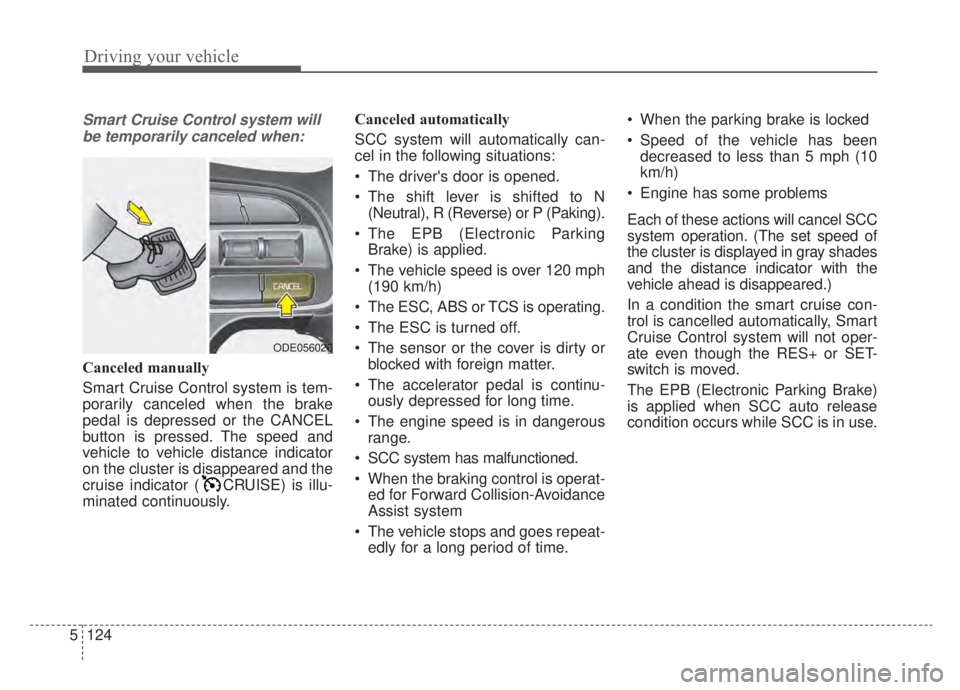
Canceled manually
Smart Cruise Control system is tem-
porarily canceled when the brake
pedal is depressed or the CANCEL
button is pressed. The speed and
vehicle to vehicle distance indicator
on the cluster is disappeared and the
cruise indicator ( CRUISE) is illu-
minated continuously. Canceled automatically
SCC system will automatically can-
cel in the following situations:
The driver's door is opened.
The shift lever is shifted to N
(Neutral), R (Reverse) or P (Paking).
The EPB (Electronic Parking Brake) is applied.
The vehicle speed is over 120 mph (190 km/h)
The ESC, ABS or TCS is operating.
The ESC is turned off.
The sensor or the cover is dirty or blocked with foreign matter.
The accelerator pedal is continu- ously depressed for long time.
The engine speed is in dangerous range.
SCC system has malfunctioned.
When the braking control is operat- ed for Forward Collision-Avoidance
Assist system
The vehicle stops and goes repeat- edly for a long period of time. When the parking brake is locked
Speed of the vehicle has been
decreased to less than 5 mph (10
km/h)
Engine has some problems
Each of these actions will cancel SCC
system operation. (The set speed of
the cluster is displayed in gray shades
and the distance indicator with the
vehicle ahead is disappeared.)
In a condition the smart cruise con-
trol is cancelled automatically, Smart
Cruise Control system will not oper-
ate even though the RES+ or SET-
switch is moved.
The EPB (Electronic Parking Brake)
is applied when SCC auto release
condition occurs while SCC is in use.
ODE056026
Page 467 of 687

5157
Driving your vehicle
System description
Rear Cross-Traffic CollisionWarning system
Rear Cross-Traffic Collision Warning
system uses radar sensors to moni-
tor the approaching cross traffic from
the left and right side of the vehicle
when your vehicle is in reverse.
The blind spot detection range varies
relative to the approaching vehicle
speed.
System setting and activation
System setting
The driver can activate the sys- tems by placing the START/STOP
button to the ON position and by
selecting ‘User Settings →Driver
Assistance →Parking Safety →
Rear Cross-Traffic Safety’. The
RCCW turn on and get activated.
When the vehicle is turned off then on again, the systems always get
ready to be activated.
When the system is initially turned on and when the vehicle is turned
off then on again, the warning light
will illuminate for 3 seconds on the
outside rearview mirror.
REAR CROSS-TRAFFIC COLLISION WARNING (RCCW) (IF EQUIPPED)
OSK3058092L
WARNING
Always be aware of road con-ditions while driving and be
alert for unexpected situations
even though RCCW system is
operating.
RCCW system is supplemen- tal systems to assist you. Do
not entirely rely on the sys-
tems. Always pay attention,
while driving, for your safety.
RCCW system is not substi- tutes for proper and safe driv-
ing. Always drive safely and
use caution when backing up
the vehicle.
Page 495 of 687
63
What to do in an emergency
If the engine stalls at a cross-
road or crossing
If the engine stalls at a crossroad or
crossing, set the shift lever in the N
(Neutral) position and then push the
vehicle to a safe place.
If you have a flat tire while
driving
If a tire goes flat while you are driv-
ing:
1. Take your foot off the acceleratorpedal and let the vehicle slow
down while driving straight ahead.
Do not apply the brakes immedi-
ately or attempt to pull off the road
as this may cause a loss of con-
trol. When the vehicle has slowed
to such a speed that it is safe to do
so, brake carefully and pull off the
road. Drive off the road as far as
possible and park on firm level
ground. If you are on a divided
highway, do not park in the median
area between the two traffic lanes. 2. When the vehicle is stopped, turn
on your emergency hazard flash-
ers, set the parking brake and put
the transmission in P (Park).
3. Have all passengers get out of the vehicle. Be sure they all get out on
the side of the vehicle that is away
from traffic.
4. When changing a flat tire, follow the instruction provided later in
this section.
If the engine stalls while driv-
ing
1. Reduce your speed gradually,keeping a straight line. Move cau-
tiously off the road to a safe place.
2. Turn on your emergency flashers.
3. Try to start the hybrid system again. If your vehicle will not start,
contact an authorized Kia dealer
or seek other qualified assistance.
✽ ✽NOTICE
If there was a check engine light and
loss of power or stall and if safe to do
so, wait at least 10 seconds to restart
the vehicle after it stalls. This may
reset the car so it will no longer run
at low power (limp home) condition.
IN CASE OF AN EMERGENCY WHILE DRIVING
Page 496 of 687
What to do in an emergency
46
IF THE ENGINE WILL NOT START
If engine doesn't turn over or
turns over slowly
1. Be sure the shift lever is in N(Neutral) or P (Park) and the
emergency brake is set.
2. Check the battery connections to be sure they are clean and tight.
3. Turn on the interior light. If the light dims or goes out when you oper-
ate the starter, the battery is dis-
charged.
4. Check the starter connections to be sure they are securely tight-
ened.
5. Do not push or pull the vehicle to start it. See instructions for "Jump
starting".
If engine turns over normally
but does not start
1. Check the fuel level.
2. With the ignition switch in theLOCK position, check all connec-
tors at the ignition coils and spark
plugs. Reconnect any that may be
disconnected or loose.
3. Check the fuel line in the engine compartment.
4. If the engine still does not start, call an authorized Kia dealer or
seek other qualified assistance.
WARNING - Push/
pull start
Do not push or pull the vehicle
to start it. Push or pull starting
may cause the catalytic con-
verter to overload and create a
fire hazard.
Page 503 of 687
611
What to do in an emergency
IF THE ENGINE OVERHEATS
If your temperature gauge indicates
overheating, you will experience a
loss of power, or hear loud pinging or
knocking, the engine is probably too
hot. If this happens, you should:
1. Turn on the emergency warningflasher and stop in a safe place.
Move the shift lever to P (Park)
and engage the parking brake.
2. If hot steam does not come out from the engine room, carefully
open the engine room and check
whether the water pump connec-
tor is properly engaged. If the con-
nector is not properly engaged,
stop the engine immediately and
properly engage the connector.
Then, turn the engine on.
3. Turn on the air conditioner. 4. If the “HEV Warning” light turns on
in the driver instrument cluster, or
engine coolant or hot steam emits
from the engine coolant filler, stop
the engine immediately. Then, call
the nearest authorized Kia dealer
for assistance. If the “Engine
Warning” light remains illuminated
or the engine coolant is not flowing
out, keep the engine running.
Open the engine hood for ventila-
tion to help cool down the engine. 5. Check whether the engine coolant
temperature is low enough by
checking its temperature. If the
engine coolant level is low, please
check the connecting parts
between the radiator hose, heater
hose, and water pump for any signs
of leakage. When there is no sign of
leakage, please refill the engine
coolant. If causes and signs of
engine overheating such as warn-
ing light illumination, engine coolant
leakage, or cooling fan malfunction
are found, stop the vehicle the ear-
liest. Then, call the nearest author-
ized Kia dealer for assistance.
WARNING- Under the
Hood
While the engine is running,
keep hair, hands and clothing
away from moving parts such
as the fan and drive belts to pre-
vent injury.
WARNING- Radiator Cap
Do not remove the
radiator cap when the
engine is hot. This
can allow coolant to
blow out of the open-
ing and cause seri-
ous burns.
Page 505 of 687
613
What to do in an emergency
TIRE PRESSURE MONITORING SYSTEM (TPMS)
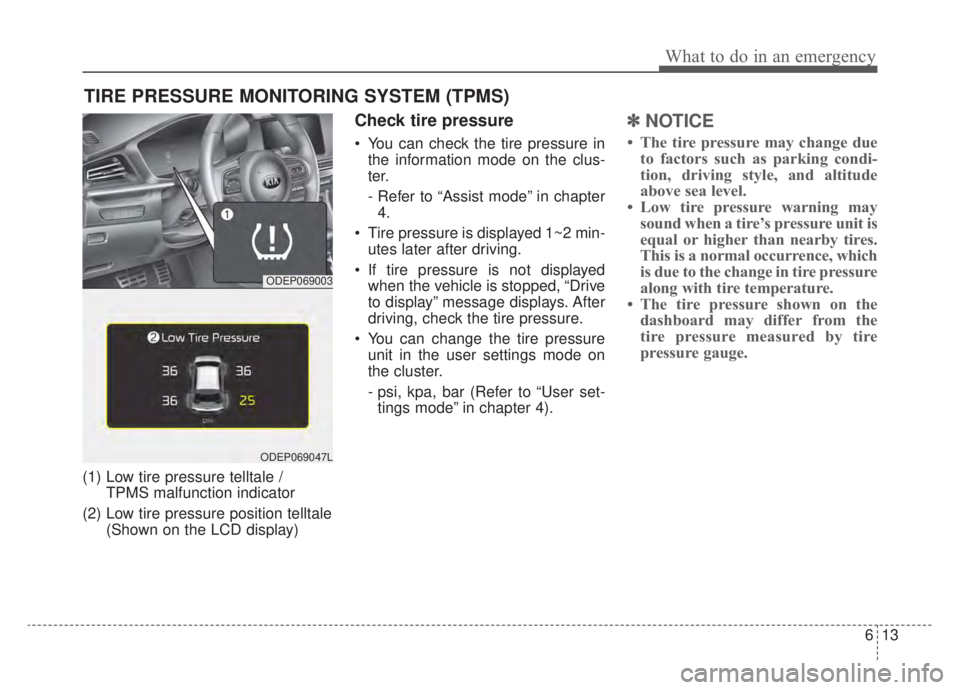
(1) Low tire pressure telltale / TPMS malfunction indicator
(2) Low tire pressure position telltale (Shown on the LCD display)
Check tire pressure
You can check the tire pressure inthe information mode on the clus-
ter.
- Refer to “Assist mode” in chapter4.
Tire pressure is displayed 1~2 min- utes later after driving.
If tire pressure is not displayed when the vehicle is stopped, “Drive
to display” message displays. After
driving, check the tire pressure.
You can change the tire pressure unit in the user settings mode on
the cluster.
- psi, kpa, bar (Refer to “User set-tings mode” in chapter 4).
✽ ✽ NOTICE
• The tire pressure may change due
to factors such as parking condi-
tion, driving style, and altitude
above sea level.
• Low tire pressure warning may sound when a tire’s pressure unit is
equal or higher than nearby tires.
This is a normal occurrence, which
is due to the change in tire pressure
along with tire temperature.
• The tire pressure shown on the dashboard may differ from the
tire pressure measured by tire
pressure gauge.
ODEP069003
ODEP069047L
Page 677 of 687
Index
2I
Air bag - advanced supplemental restraint system . . . . 3-47Adding equipment to or modifying your air bag-equipped vehicle . . . . . . . . . . . . . . . . . . . . 3-73
Air bag warning label. . . . . . . . . . . . . . . . . . . . . . . . 3-73
Air bag warning light . . . . . . . . . . . . . . . . . . . . . . . . 3-50
Curtain air bag . . . . . . . . . . . . . . . . . . . . . . . . . . . . . 3-67
Driver's and passenger's front air bag . . . . . . . . . . . 3-62
How does the air bag system operate? . . . . . . . . . . . 3-48
Occupant Detection System (ODS) . . . . . . . . . . . . . 3-54
Side air bag. . . . . . . . . . . . . . . . . . . . . . . . . . . . . . . . 3-65
SRS Care . . . . . . . . . . . . . . . . . . . . . . . . . . . . . . . . . 3-72
SRS components and functions . . . . . . . . . . . . . . . . 3-51
Air cleaner . . . . . . . . . . . . . . . . . . . . . . . . . . . . . . . . . . 7-32\
Filter replacement. . . . . . . . . . . . . . . . . . . . . . . . . . . 7-32
Air conditioner compressor label . . . . . . . . . . . . . . . . . 8-12
Air conditioning system . . . . . . . . . . . . . . . . . . . . . . . . . 8-7
Appearance care . . . . . . . . . . . . . . . . . . . . . . . . . . . . . 7-104 Exterior care . . . . . . . . . . . . . . . . . . . . . . . . . . . . . . 7-104
Interior care . . . . . . . . . . . . . . . . . . . . . . . . . . . . . . 7-110
Automatic climate control system . . . . . . . . . . . . . . . 4-131 Air Conditioning refrigerant label . . . . . . . . . . . . . 4-144
Automatic heating and air conditioning. . . . . . . . . 4-132
Automatic ventilation . . . . . . . . . . . . . . . . . . . . . . . 4-142
Checking the amount of air conditioner refrigerant and compressor lubricant . . . . . . . . . . 4-145
Climate control air filter. . . . . . . . . . . . . . . . . . . . . 4-144 Manual heating and air conditioning . . . . . . . . . . . 4-134
Recirculated air at washer fluid spray . . . . . . . . . . 4-143
Sunroof inside air recirculation . . . . . . . . . . . . . . . 4-143
System operation . . . . . . . . . . . . . . . . . . . . . . . . . . 4-140
Battery (Plug-in Hybrid). . . . . . . . . . . . . . . . . . . . . . . . 7-39 For best battery service . . . . . . . . . . . . . . . . . . . . . . 7-39
Recharging the battery . . . . . . . . . . . . . . . . . . . . . . . 7-40
Reset items . . . . . . . . . . . . . . . . . . . . . . . . . . . . . . . . 7-41
Before driving . . . . . . . . . . . . . . . . . . . . . . . . . . . . . . . . . 5-5 Before entering vehicle . . . . . . . . . . . . . . . . . . . . . . . 5-5
Before starting . . . . . . . . . . . . . . . . . . . . . . . . . . . . . . 5-5
Necessary inspections . . . . . . . . . . . . . . . . . . . . . . . . 5-5
Blind-Spot Collision Warning (BCW) . . . . . . . . . . . . . 5-96 System description . . . . . . . . . . . . . . . . . . . . . . . . . . 5-96
System setting and activation . . . . . . . . . . . . . . . . . . 5-97
Warning message and system control . . . . . . . . . . . 5-99
Brake fluid . . . . . . . . . . . . . . . . . . . . . . . . . . . . . . . . . . 7-26\
Checking the brake fluid level . . . . . . . . . . . . . . . . . 7-26
Brake system. . . . . . . . . . . . . . . . . . . . . . . . . . . . . . . . . 5-30 Anti-lock Brake System (ABS) . . . . . . . . . . . . . . . . 5-44
Auto hold . . . . . . . . . . . . . . . . . . . . . . . . . . . . . . . . . 5-40
Electronic Parking Brake (EPB) . . . . . . . . . . . . . . . 5-34
Electronic Stability Control (ESC) . . . . . . . . . . . . . 5-46
Good braking practices . . . . . . . . . . . . . . . . . . . . . . 5-52
Hill-start Assist Control (HAC) . . . . . . . . . . . . . . . . 5-51
A
B
Page 678 of 687
I3
Index
Parking brake – Foot type . . . . . . . . . . . . . . . . . . . . 5-32
Power brakes . . . . . . . . . . . . . . . . . . . . . . . . . . . . . . 5-30
Vehicle Stability Management (VSM) . . . . . . . . . . . 5-50
Warning messages . . . . . . . . . . . . . . . . . . . . . . . . . . 5-42
Bulb wattage . . . . . . . . . . . . . . . . . . . . . . . . . . . . . . . . . . 8-3
California perchlorate notice . . . . . . . . . . . . . . . . . . . 7-117
Checking fluid levels . . . . . . . . . . . . . . . . . . . . . . . . . . 7-18
Child Restraint System (CRS) . . . . . . . . . . . . . . . . . . . 3-35 Children always in the rear . . . . . . . . . . . . . . . . . . . 3-35
Installing a Child Restraint System (CRS) . . . . . . . 3-39
Selecting a Child Restraint System (CRS) . . . . . . . 3-36
Climate control air filter . . . . . . . . . . . . . . . . . . . . . . . . 7-34 Filter inspection . . . . . . . . . . . . . . . . . . . . . . . . . . . . 7-34
Consumer assistance (U.S. only) . . . . . . . . . . . . . . . . . 8-13 Emergency roadside assistance . . . . . . . . . . . . . . . . 8-13
Registering your vehicle in a foreign country . . . . . 8-15
Toll free consumer assistance . . . . . . . . . . . . . . . . . 8-13
Trip interruption . . . . . . . . . . . . . . . . . . . . . . . . . . . . 8-14
Coolant . . . . . . . . . . . . . . . . . . . . . . . . . . . . . . . . . . . . \
. 7-21 Changing the coolant . . . . . . . . . . . . . . . . . . . . . . . . 7-25
Checking the coolant level . . . . . . . . . . . . . . . . . . . . 7-21
Engine coolant . . . . . . . . . . . . . . . . . . . . . . . . . . . . . 7-22
Inverter coolant. . . . . . . . . . . . . . . . . . . . . . . . . . . . . 7-22
Recommended coolant . . . . . . . . . . . . . . . . . . . . . . . 7-23 Cruise Control (CC) . . . . . . . . . . . . . . . . . . . . . . . . . . 5-115
Cruise control switch . . . . . . . . . . . . . . . . . . . . . . . 5-116
To cancel cruise control . . . . . . . . . . . . . . . . . . . . . 5-118
To decrease the cruising speed . . . . . . . . . . . . . . . . 5-117
To increase cruise control set speed . . . . . . . . . . . . 5-117
To resume cruising speed at more than approximately 20 mph (30 km/h) . . . . . . . . . . . . . . . . . . . . . . . . 5-119
To set cruise control speed . . . . . . . . . . . . . . . . . . . 5-116
To temporarily accelerate with the cruise control on. 5-118
To turn cruise control off . . . . . . . . . . . . . . . . . . . . 5-119
Declaration of Conformity . . . . . . . . . . . . . . . . . . . . . 4-172 FCC . . . . . . . . . . . . . . . . . . . . . . . . . . . . . . . . . . . . \
4-172
Defroster . . . . . . . . . . . . . . . . . . . . . . . . . . . . . . . . . . . 4-\
130 Rear window defroster . . . . . . . . . . . . . . . . . . . . . . 4-130
Dimensions . . . . . . . . . . . . . . . . . . . . . . . . . . . . . . . . . . . 8-\
2
Door locks. . . . . . . . . . . . . . . . . . . . . . . . . . . . . . . . . . . 4-\
21 Child-protector rear door lock . . . . . . . . . . . . . . . . . 4-25
Operating door locks from inside the vehicle . . . . . 4-22
Operating door locks from outside the vehicle . . . . 4-21
Driver Attention Warning (DAW). . . . . . . . . . . . . . . . 5-107 Leading vehicle departure alert . . . . . . . . . . . . . . . 5-112
Low activity warning . . . . . . . . . . . . . . . . . . . . . . . 5-107
Dual Clutch Transmission (DCT). . . . . . . . . . . . . . . . . 5-16 Dual clutch transmission operation . . . . . . . . . . . . . 5-16
Good driving practices . . . . . . . . . . . . . . . . . . . . . . . 5-25
C
D
Page 683 of 687
Index
8I
High Beam Assist (HBA) . . . . . . . . . . . . . . . . . . . . 4-118
High beam operation . . . . . . . . . . . . . . . . . . . . . . . 4-117
Lighting control . . . . . . . . . . . . . . . . . . . . . . . . . . . 4-116
Turn signals and lane change signals . . . . . . . . . . . 4-120
Luggage volume . . . . . . . . . . . . . . . . . . . . . . . . . . . . . . . 8-7
Maintenance services . . . . . . . . . . . . . . . . . . . . . . . . . . . 7-5 Owner maintenance precautions . . . . . . . . . . . . . . . . 7-6
Owner’s responsibility . . . . . . . . . . . . . . . . . . . . . . . . 7-5
Mirrors . . . . . . . . . . . . . . . . . . . . . . . . . . . . . . . . . . . . \
. 4-51 Inside rearview mirror . . . . . . . . . . . . . . . . . . . . . . . 4-51
Outside rearview mirror . . . . . . . . . . . . . . . . . . . . . . 4-53
Online factory authorized manuals (U.S. only) . . . . . . 8-17 Electrical troubleshooting manual . . . . . . . . . . . . . . 8-17
Owner's manual . . . . . . . . . . . . . . . . . . . . . . . . . . . . 8-17
Service manual . . . . . . . . . . . . . . . . . . . . . . . . . . . . . 8-17
Owner maintenance . . . . . . . . . . . . . . . . . . . . . . . . . . . . 7-7 Owner maintenance schedule. . . . . . . . . . . . . . . . . . . 7-7
Parking brake . . . . . . . . . . . . . . . . . . . . . . . . . . . . . . . . 7-31 Checking the parking brake . . . . . . . . . . . . . . . . . . . 7-31 Rear Cross-Traffic Collision Warning (RCCW). . . . . 5-157
System description . . . . . . . . . . . . . . . . . . . . . . . . . 5-157
System setting and activation . . . . . . . . . . . . . . . . . 5-157
Warning message and system control . . . . . . . . . . 5-159
Rear View Monitor (RVM) . . . . . . . . . . . . . . . . . . . . . 4-111
Recommended lubricants and capacities . . . . . . . . . . . . 8-8 Recommended SAE viscosity number. . . . . . . . . . . . 8-9
Refrigerant label . . . . . . . . . . . . . . . . . . . . . . . . . . . . . . 8-12 Regenerative Braking (Paddle Shifter) . . . . . . . . . . 5-27
Regenerative braking system . . . . . . . . . . . . . . . . . . . . 5-27
Reporting Safety Defects (U.S. only) . . . . . . . . . . . . . . 8-17
Reverse Parking Distance Warning (PDW) . . . . . . . . 4-112 Non-operational conditions of Reverse Parking Distance Warning system . . . . . . . . . . . . . . . . . . . 4-113
Operation of Reverse Parking Distance Warning system . . . . . . . . . . . . . . . . . . . . . . . . . . 4-112
Reverse Parking Distance Warning system precautions . . . . . . . . . . . . . . . . . . . . . . . . . . . . . . 4-114
Self-diagnosis . . . . . . . . . . . . . . . . . . . . . . . . . . . . . 4-114
Road warning . . . . . . . . . . . . . . . . . . . . . . . . . . . . . . . . . 6-2 Hazard warning flasher . . . . . . . . . . . . . . . . . . . . . . . 6-2
M
P
O
R