driver KIA NIRO HYBRID EV 2020 Owners Manual
[x] Cancel search | Manufacturer: KIA, Model Year: 2020, Model line: NIRO HYBRID EV, Model: KIA NIRO HYBRID EV 2020Pages: 687, PDF Size: 11.43 MB
Page 5 of 687
H3
PHEV (PLUG-IN ELECTRIC VEHICLE) SYSTEM
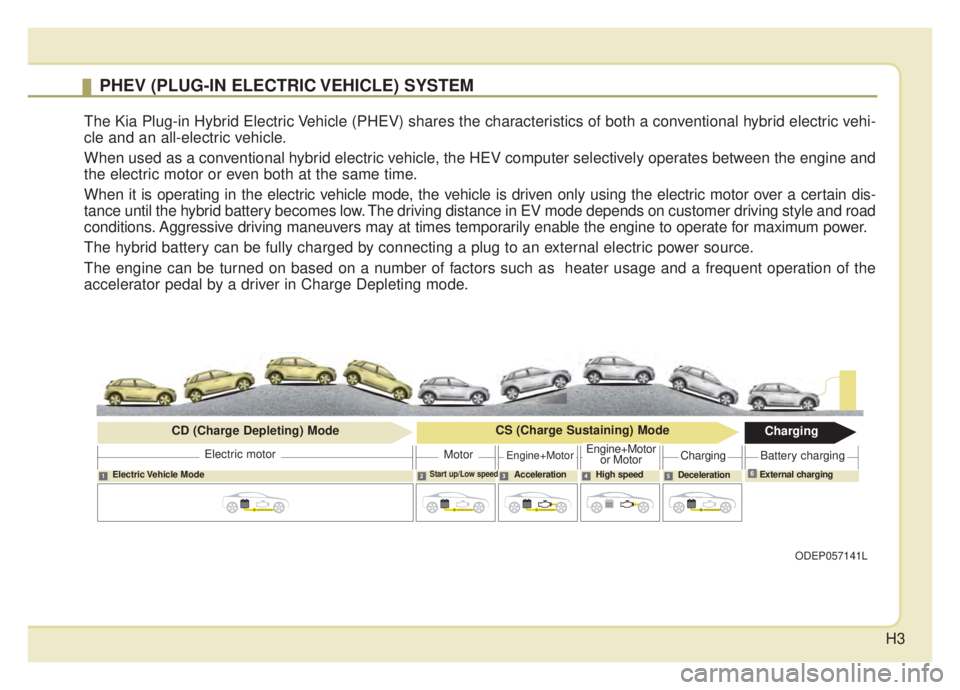
The Kia Plug-in Hybrid Electric Vehicle (PHEV) shares the characteristics of both a conventional hybrid electric vehi-
cle and an all-electric vehicle.
When used as a conventional hybrid electric vehicle, the HEV computer selectively operates between the engine and
the electric motor or even both at the same time.
When it is operating in the electric vehicle mode, the vehicle is driven only using the electric motor over a certain dis-
tance until the hybrid battery becomes low. The driving distance in EV mode depends on customer driving style and road
conditions. Aggressive driving maneuvers may at times temporarily enable the engine to operate for maximum power.
The hybrid battery can be fully charged by connecting a plug to an external electric power source.
The engine can be turned on based on a number of factors such as heater usage and a frequent operation of the
accelerator pedal by a driver in Charge Depleting mode.
ODEP057141L
Electric Vehicle ModeStart up/Low speedAcceleration High speedDecelerationExternal charging
Electric motor
CD (Charge Depleting) Mode
CS (Charge Sustaining) Mode
Charging
MotorEngine+MotorEngine+Motor
or MotorChargingBattery charging
6
Page 8 of 687
H6
When the Charging Connector
is Locked
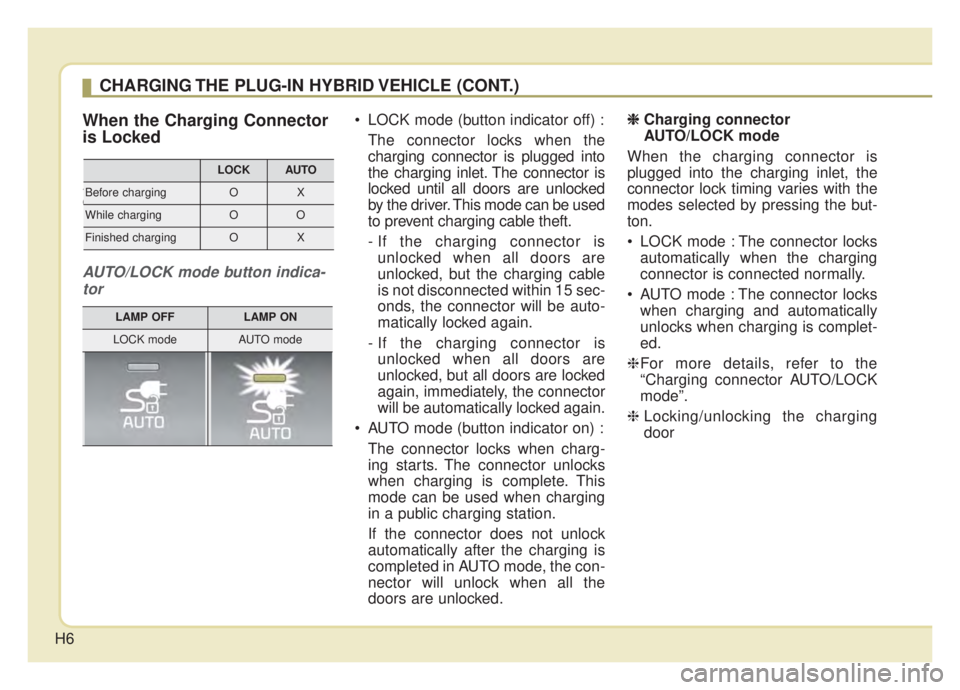
AUTO/LOCK mode button indi-
cator
AUTO/LOCK mode button indica-tor
LOCK mode (button indicator off) :
The connector locks when the
charging connector is plugged into
the charging inlet. The connector is
locked until all doors are unlocked
by the driver. This mode can be used
to prevent charging cable theft.
- If the charging connector isunlocked when all doors are
unlocked, but the charging cable
is not disconnected within 15 sec-
onds, the connector will be auto-
matically locked again.
- If the charging connector is unlocked when all doors are
unlocked, but all doors are locked
again, immediately, the connector
will be automatically locked again.
AUTO mode (button indicator on) : The connector locks when charg-
ing starts. The connector unlocks
when charging is complete. This
mode can be used when charging
in a public charging station.
If the connector does not unlock
automatically after the charging is
completed in AUTO mode, the con-
nector will unlock when all the
doors are unlocked. ❈ ❈
Charging connector
AUTO/LOCK mode
When the charging connector is
plugged into the charging inlet, the
connector lock timing varies with the
modes selected by pressing the but-
ton.
LOCK mode : The connector locks automatically when the charging
connector is connected normally.
AUTO mode : The connector locks when charging and automatically
unlocks when charging is complet-
ed.
❈ For more details, refer to the
“Charging connector AUTO/LOCK
mode”.
❈ Locking/unlocking the charging
door
CHARGING THE PLUG-IN HYBRID VEHICLE (CONT.)
LOCKAUTO
Before chargingOX
While chargingOO
Finished chargingOX
LAMP OFFLAMP ON
LOCK modeAUTO mode
Page 9 of 687
H7
The charging door lock/unlock func-
tion works only when the following
conditions are satisfied with the
charging door closed.
If the unlock function does not work,
use the emergency charging door
unlock method to unlock the charg-
ing door. (For more details, refer to
the “Unlock charging door in emer-
gency”)1. Conditions for lock :
➀: When locking doors from out-
side the vehicle with the
charging door closed.
➁ : When locking the driver’s door
using a mechanical key
➂ : When locking doors using a
smart key
➃ : When pressing the door
lock/unlock button on the front
door outside handle while the
smart key is detected and
doors are unlocked
➄ : When locking all vehicle doors
with the charging door closed.
(When locking doors with
functions such as spare key,
smart key, door lock button on
the outside door handle, cen-
tral door lock switch, auto door
lock.) 2. Conditions for unlock :
➀: When unlocking doors from
outside the vehicle with the
charging door closed.
➁ : When unlocking the driver’s
door using a mechanical key
➂ : When unlocking doors using a
smart key
➃ : When pressing the door
lock/unlock button on the front
door outside handle while the
smart key is detected and
doors are locked
➄ : When unlocking all vehicle
doors with the charging door
closed. (When unlocking doors
with functions such as spare
key, smart key, door lock but-
ton on the outside door han-
dle, central door lock switch,
auto door lock.)
Page 15 of 687
H13
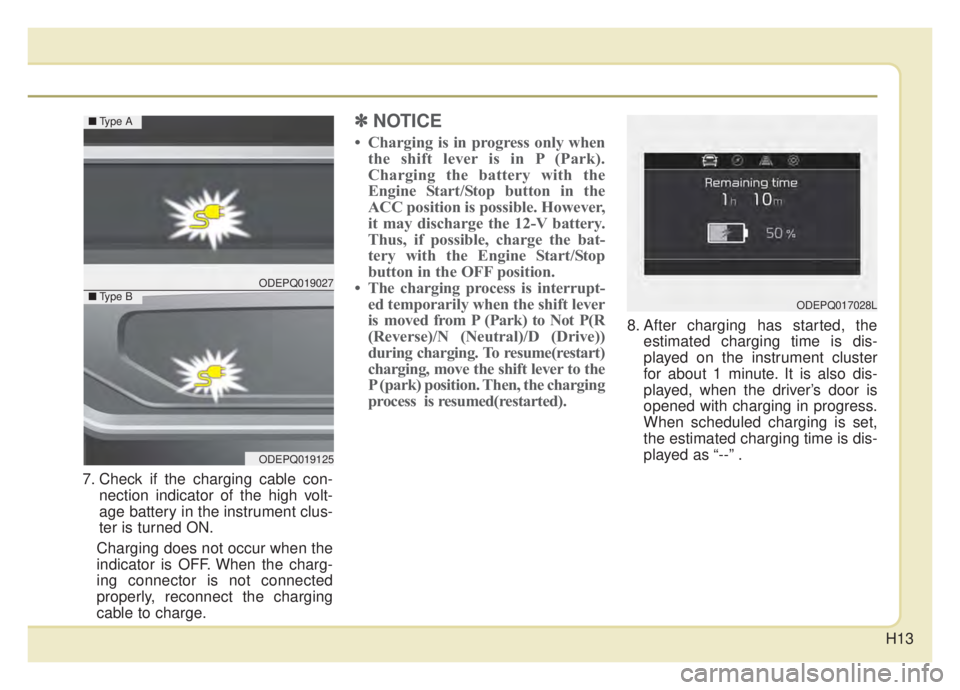
7. Check if the charging cable con-nection indicator of the high volt-
age battery in the instrument clus-
ter is turned ON.
Charging does not occur when the
indicator is OFF. When the charg-
ing connector is not connected
properly, reconnect the charging
cable to charge.
✽ ✽ NOTICE
• Charging is in progress only when
the shift lever is in P (Park).
Charging the battery with the
Engine Start/Stop button in the
ACC position is possible. However,
it may discharge the 12-V battery.
Thus, if possible, charge the bat-
tery with the Engine Start/Stop
button in the OFF position.
• The charging process is interrupt- ed temporarily when the shift lever
is moved from P (Park) to Not P(R
(Reverse)/N (Neutral)/D (Drive))
during charging. To resume(restart)
charging, move the shift lever to the
P (park) position. Then, the charging
process is resumed(restarted).
8. After charging has started, the
estimated charging time is dis-
played on the instrument cluster
for about 1 minute. It is also dis-
played, when the driver’s door is
opened with charging in progress.
When scheduled charging is set,
the estimated charging time is dis-
played as “--” .
ODEPQ017028L
ODEPQ019027
ODEPQ019125
\bType A
\bType B
Page 21 of 687
H19
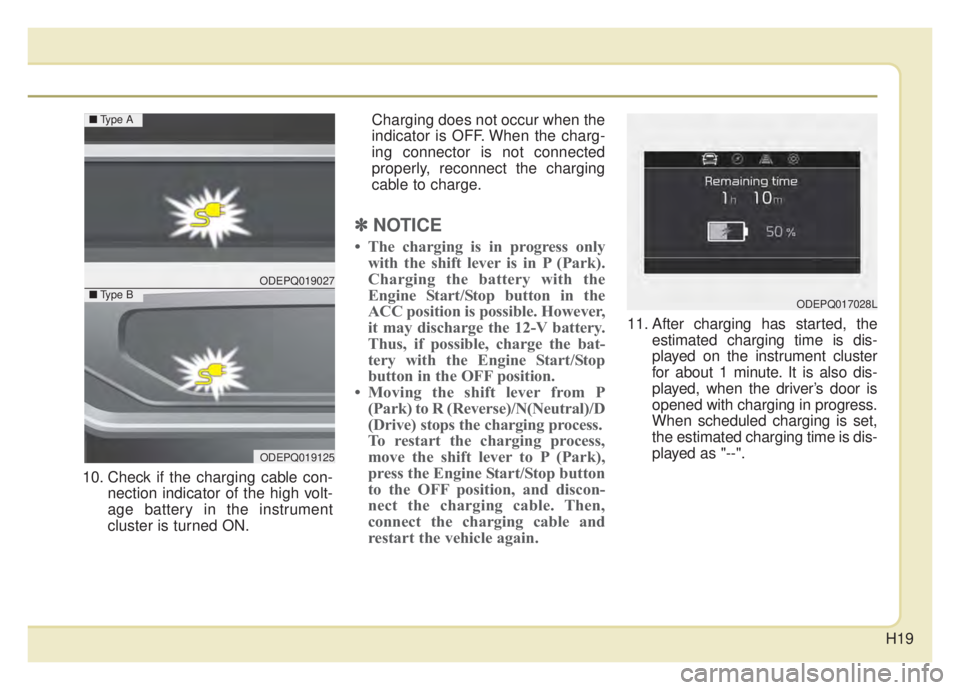
10. Check if the charging cable con-nection indicator of the high volt-
age battery in the instrument
cluster is turned ON. Charging does not occur when the
indicator is OFF. When the charg-
ing connector is not connected
properly, reconnect the charging
cable to charge.
✽ ✽
NOTICE
• The charging is in progress only
with the shift lever is in P (Park).
Charging the battery with the
Engine Start/Stop button in the
ACC position is possible. However,
it may discharge the 12-V battery.
Thus, if possible, charge the bat-
tery with the Engine Start/Stop
button in the OFF position.
• Moving the shift lever from P (Park) to R (Reverse)/N(Neutral)/D
(Drive) stops the charging process.
To restart the charging process,
move the shift lever to P (Park),
press the Engine Start/Stop button
to the OFF position, and discon-
nect the charging cable. Then,
connect the charging cable and
restart the vehicle again.
11. After charging has started, the
estimated charging time is dis-
played on the instrument cluster
for about 1 minute. It is also dis-
played, when the driver’s door is
opened with charging in progress.
When scheduled charging is set,
the estimated charging time is dis-
played as "--".
ODEPQ019027
ODEPQ019125
\bType A
\bType BODEPQ017028L
Page 33 of 687
H31
Coasting guide (if equipped)
A chime will sound and the coasting
guide indicator will blink four times to
inform the driver when to take the foot
off from the accelerator by anticipat-
ing a decelerating event* based on
the analysis of driving routes and
road conditions according to the nav-
igation system. It encourages the
driver to remove foot from accelerator
pedal and allow coasting down the
road with EV motor only. This helps
prevent unnecessary fuel consump-
tion and increases fuel efficiency.
❈Examples of a deceleration events
is going down an extended hill,
slowing down while approaching a
toll booth, and approaching
reduced speed zones.
Press the Engine Start/Stop button
and put the shift lever in P(Park). In
the User Settings Mode, select
Driving Assist, Coasting Guide, and
then On to turn on the system.
Cancel the selection of coasting
guide to turn off the system. For the
explanation of the system, press and
hold the [OK] button.
To activate the system, take the fol-
lowing procedures. Enter your desti-
nation information on the navigation
and select the driving route. Then,
satisfy the following.
- The driving speed should be
between 37 mph (60 km/h) and 99
mph (160 km/h).
❈ The operating speed may vary due
to difference between instrument
cluster and navigation effected by
tire inflation level.
✽ ✽ NOTICE
Coasting guide is only a supplemen-
tal system to assist with fuel-efficient
driving. Thus, the operating condi-
tions may be different in accordance
with traffic/road conditions (i.e.
driving in a traffic jam, driving on a
slope, driving on a curve). Thus,
take the actual driving conditions
into consideration, such as distances
from the vehicles ahead/ behind,
while referring to the coasting guide
system as guidance.
Page 38 of 687
H36
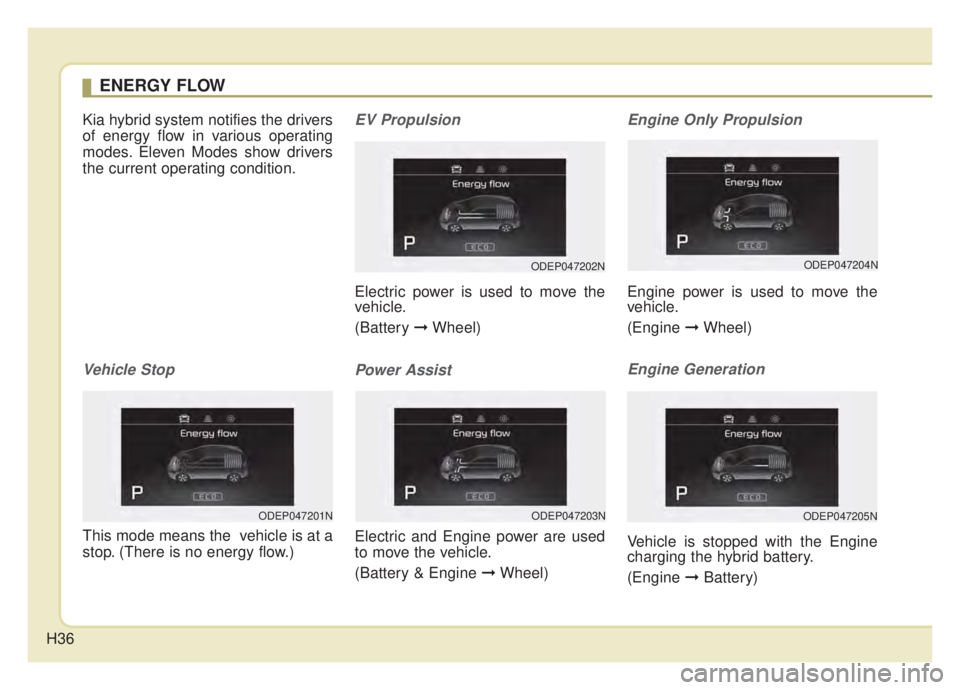
Kia hybrid system notifies the drivers
of energy flow in various operating
modes. Eleven Modes show drivers
the current operating condition.
Vehicle Stop
This mode means the vehicle is at a
stop. (There is no energy flow.)
EV Propulsion
Electric power is used to move the
vehicle.
(Battery ➞Wheel)
Power Assist
Electric and Engine power are used
to move the vehicle.
(Battery & Engine ➞ Wheel)
Engine Only Propulsion
Engine power is used to move the
vehicle.
(Engine ➞Wheel)
Engine Generation
Vehicle is stopped with the Engine
charging the hybrid battery.
(Engine ➞Battery)
ENERGY FLOW
ODEP047202N
ODEP047203N
ODEP047204N
ODEP047205NODEP047201N
Page 41 of 687
H39
System setting
The driver can activate the Aux.
Battery Saver+ function by placing
the engine start/stop button to the
ON position and by selecting:
"User Settings ➞Other Features ➞
Aux. Battery Saver+"WARNING
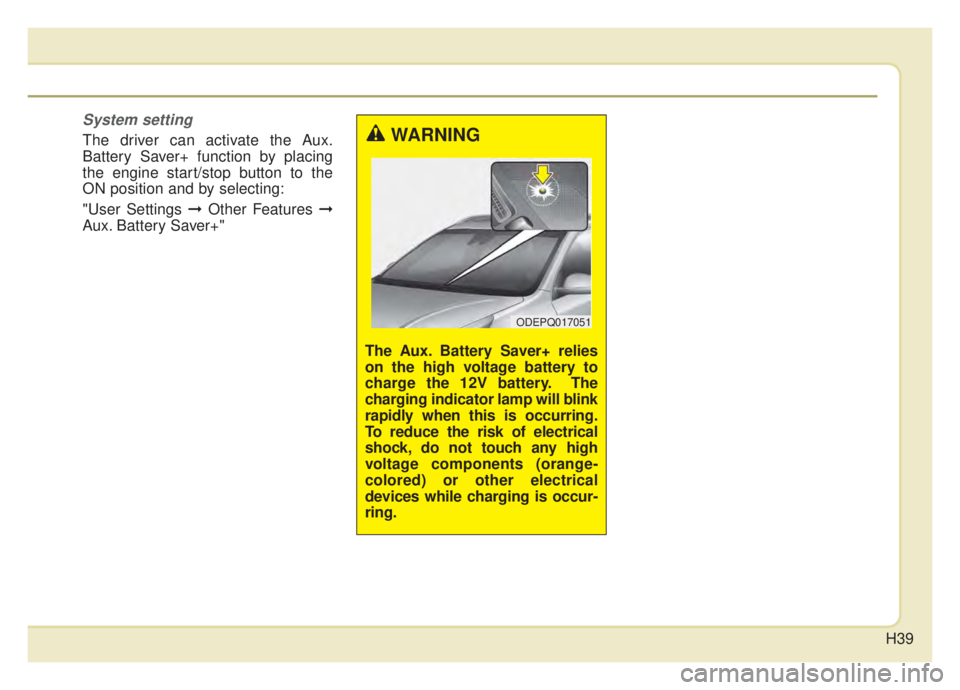
The Aux. Battery Saver+ relies
on the high voltage battery to
charge the 12V battery. The
charging indicator lamp will blink
rapidly when this is occurring.
To reduce the risk of electrical
shock, do not touch any high
voltage components (orange-
colored) or other electrical
devices while charging is occur-
ring.
ODEPQ017051
Page 49 of 687
H47
The HEV system may emit electro-
magnetic waves which can affect the
performance of electronic devices
appliances, such as laptop comput-
ers, which are not part of the vehicle
design.
If you park the vehicle for a long time,
the hybrid system will discharge. You
need to drive the vehicle approximate-
ly once every 2 months, more than 9
miles (15 km) is recommended.
When you start the hybrid system in
the "P" transmission position, the
" " symbol is illuminated in the
cluster. The driver can drive the vehi-
cle even if the engine is stopped.Virtual Engine Sound System
(VESS)
The Virtual Engine Sound System
generates engine sound for pedestri-
ans to hear vehicle sound because
there is limited sound while electric
motor power is used.
If the vehicle is moving at lowspeed, the VESS will operate.
When the gear is shifted to R (Reverse), an additional warning
sound will be heard.
WARNING - Turning off
HEV system
When you leave the vehicle, you
should turn off the hybrid sys-
tem. If you depress the acceler-
ator pedal by mistake and the
vehicle is not in the "P" posi-
tion, the vehicle will accelerate.
This may result in serious injury
or death.
Page 58 of 687
Introduction
61
This vehicle is equipped with an
event data recorder (EDR). The
main purpose of an EDR is to
record, in certain crash or near
crash-like situations, such as an
air bag deployment or hitting a
road obstacle, data that will assist
in understanding how a vehicle's
systems performed. The EDR is
designed to record data related to
vehicle dynamics and safety sys-
tems for a short period of time,
typically 30 seconds or less. The
EDR in this vehicle is designed to
record such data as:
How various systems in yourvehicle were operating;
Whether or not the driver and passenger safety belts were
buckled/ fastened;
How far (if at all) the driver was depressing the accelerator
and/or brake pedal; and,
How fast the vehicle was travel- ing. These data can help provide a bet-
ter understanding of the circum-
stances in which crashes and
injuries occur. NOTE: EDR data
are recorded by your vehicle only
if a non-trivial crash situation
occurs; no data are recorded by
the EDR under normal driving
conditions and no personal data
(e.g., name, gender, age, and
crash location) are recorded.
However, other parties, such as
law enforcement, could combine
the EDR data with the type of per-
sonally identifying data routinely
acquired during a crash investiga-
tion.
To read data recorded by an EDR,
special equipment is required, and
access to the vehicle or the EDR is
needed. In addition to the vehicle
manufacturer, other parties, such
as law enforcement, that have the
special equipment, can read the
information if they have access to
the vehicle or the EDR.
VEHICLE DATA COLLECTION AND EVENT DATA RECORDERS