warning KIA NIRO HYBRID EV 2021 Owner's Manual
[x] Cancel search | Manufacturer: KIA, Model Year: 2021, Model line: NIRO HYBRID EV, Model: KIA NIRO HYBRID EV 2021Pages: 667, PDF Size: 9.17 MB
Page 53 of 667
H48
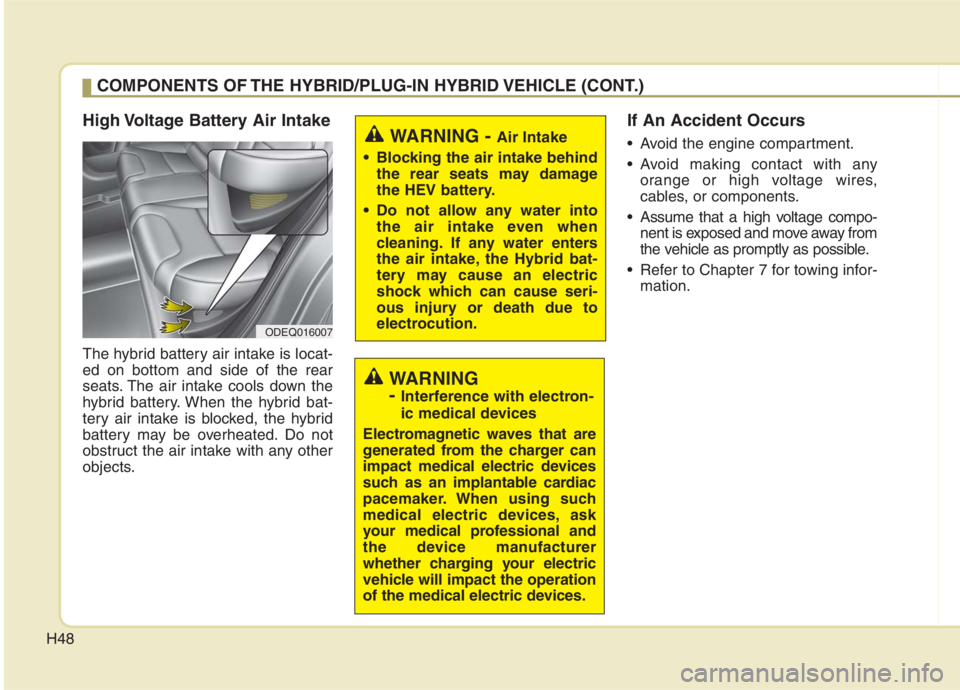
High Voltage Battery Air Intake
The hybrid battery air intake is locat-
ed on bottom and side of the rear
seats. The air intake cools down the
hybrid battery. When the hybrid bat-
tery air intake is blocked, the hybrid
battery may be overheated. Do not
obstruct the air intake with any other
objects.
If An Accident Occurs
Avoid the engine compartment.
Avoid making contact with any
orange or high voltage wires,
cables, or components.
Assume that a high voltage compo-
nent is exposed and move away from
the vehicle as promptly as possible.
Refer to Chapter 7 for towing infor-
mation.WARNING - Air Intake
Blocking the air intake behind
the rear seats may damage
the HEV battery.
Do not allow any water into
the air intake even when
cleaning. If any water enters
the air intake, the Hybrid bat-
tery may cause an electric
shock which can cause seri-
ous injury or death due to
electrocution.
ODEQ016007
WARNING
-
Interference with electron-
ic medical devices
Electromagnetic waves that are
generated from the charger can
impact medical electric devices
such as an implantable cardiac
pacemaker. When using such
medical electric devices, ask
your medical professional and
the device manufacturer
whether charging your electric
vehicle will impact the operation
of the medical electric devices.
COMPONENTS OF THE HYBRID/PLUG-IN HYBRID VEHICLE (CONT.)
Page 54 of 667
H49
After parking the vehicle, shift the
transmission into "P" position. Turn
off the hybrid system by pushing
the Engine Start/Stop button.
For your safety, do not touch high
voltage cables, connectors and
package modules. High Voltage
components are orange in color.
Exposed cables or wires may be
visible inside or outside of the vehi-
cle. Never touch the wires or
cables, because an electrical
shock may occur causing injury or
death.If a vehicle accident occurs:
1.Stop the vehicle and shift the trans-
mission into "P" position and then
depress the parking brake.
2.Turn off the Hybrid system by
pushing the Engine Start/Stop
Button.
3.Step away from the vehicle and go
to a safe place.
4.Call emergency services for help
and let them know the vehicle is a
Hybrid vehicle.
Do not touch high voltage cables,
connectors and package modules.
High voltage components are
orange in color.
Exposed cables or wires may be vis-
ible inside or outside of the vehicle.
Never touch the wires or cables,
because an electrical shock may
occur causing injury or death.
WARNING
If a small scale fire occurs,
use a fire extinguisher (ABC,
BC) that is meant for electrical
fires.
If it is impossible to extin-
guish the fire in the early
stage, remain a safe distance
from the vehicle and immedi-
ately call your local fire emer-
gency responders. Also,
advise them that a hybrid
vehicle is involved.
If the fire spreads to the high
voltage battery, large amount
of water is needed to put out
the fire.
Using small amount of water
or fire extinguishers not
meant for electrical fires
could cause serious injury or
death from electrical shocks.
If you need towing, refer to
chapter 6.
Page 55 of 667
H50
When the hybrid vehicle shuts
off
When the high voltage battery or 12-
volt battery discharges, or fuel tank is
empty, the hybrid system may not
operate.
If the Hybrid system stops operating
while the vehicle is moving, reduce
the vehicle speed gradually, pull your
vehicle off the road to a safe area,
and shift the transmission in to Park
(P) position and;
1. Turn on the hazard warning flashers.
2. Set the start button at OFF, and try
to start the Hybrid system by
applying the brake pedal and
pushing the start button.
3. If the Hybrid system will not oper-
ate, refer to "EMERGENCY
STARTING" in chapter 6.
Before you try to jump start the vehi-
cle, confirm the fuel level. If the fuel
level is low add more fuel before
attempting as emergency start.
WARNING
If submersion in water occurs:
If your vehicle was flooded and
has soaked carpeting or water
on the flooring, you should not
try to start the Hybrid system.
Never touch the high voltage
cables, connectors or package
modules, because an electrical
shock may occur causing injury
or death. High Voltage cables
are orange in color.
If this occurs. have the vehicle
towed to and inspected by an
authorized Kia dealer.
WARNING - Vehicle
Accident
Never touch electric wires or
cable. If exposed electric wires
or cables are visible inside or
outside of your vehicle, an elec-
tric shock may occur.
WARNING - Putting out
fire
Never use a small quantity of
water to put out a fire in your
vehicle. If a fire occurs, evacu-
ate the car immediately and
contact the fire department.
COMPONENTS OF THE HYBRID/PLUG-IN HYBRID VEHICLE (CONT.)
Page 57 of 667
Introduction
2 1
Your new vehicle is designed to use
only unleaded fuel having a pump
octane number ((R+M)/2) of 87
(Research Octane Number 91) or
higher. (Do not use methanol blend-
ed fuels.)
Your new vehicle is designed to
obtain maximum performance with
UNLEADED FUEL, as well as mini-
mize exhaust emissions and spark
plug fouling.
Never add any fuel system cleaning
agents to the fuel tank other than
what has been specified. (Consult an
authorized Kia dealer for details.)
• Tighten the cap until it clicks one
time, otherwise the Check Engine
light will illuminate.
Gasoline containing alcohol and
methanol
Gasohol, a mixture of gasoline and
ethanol (also known as grain alco-
hol), and gasoline or gasohol con-
taining methanol (also known as
wood alcohol) are being marketed
along with or instead of leaded or
unleaded gasoline.Pursuant to EPA regulations, ethanol
may be used in your vehicle.
Do not use gasohol containing more
than 15% ethanol, and do not use
gasoline or gasohol containing any
methanol. Ethanol provides less
energy than gasoline and it attracts
water, and it is thus likely to reduce
your fuel efficiency and could lower
your MPG results.
Methanol may cause drivability prob-
lems and damage to the fuel system,
engine control system and emission
control system.
Discontinue using gasohol of any
kind if drivability problems occur.
Vehicle damage or drivability prob-
lems may not be covered by the
manufacturer’s warranty if they result
from the use of:
1. Gasoline or gasohol containing
methanol.
2. Leaded fuel or leaded gasohol.
3. Gasohol containing more than
15% ethanol.
WARNING - Refueling
• Do not “top off” after the noz-
zle automatically shuts off.
Attempts to force more fuel
into the tank can cause fuel
overflow onto you and the
ground, causing a risk of fire.
Always check that the fuel cap
is installed securely to pre-
vent fuel spillage, especially
in the event of an accident.
FUEL REQUIREMENTS
Page 65 of 667
Your vehicle at a glance
4 2
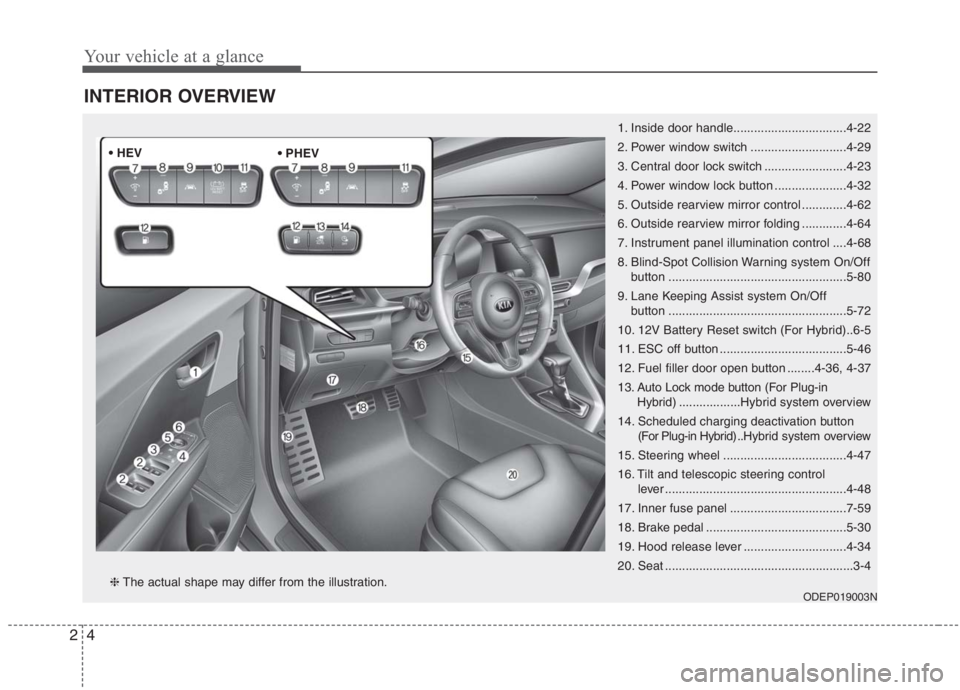
INTERIOR OVERVIEW
1. Inside door handle.................................4-22
2. Power window switch ............................4-29
3. Central door lock switch ........................4-23
4. Power window lock button .....................4-32
5. Outside rearview mirror control .............4-62
6. Outside rearview mirror folding .............4-64
7. Instrument panel illumination control ....4-68
8. Blind-Spot Collision Warning system On/Off
button ....................................................5-80
9. Lane Keeping Assist system On/Off
button ....................................................5-72
10. 12V Battery Reset switch (For Hybrid)..6-5
11. ESC off button .....................................5-46
12. Fuel filler door open button ........4-36, 4-37
13. Auto Lock mode button (For Plug-in
Hybrid)..................Hybrid system overview
14. Scheduled charging deactivation button
(For Plug-in Hybrid) ..Hybrid system overview
15. Steering wheel ....................................4-47
16. Tilt and telescopic steering control
lever .....................................................4-48
17. Inner fuse panel ..................................7-59
18. Brake pedal .........................................5-30
19. Hood release lever ..............................4-34
20. Seat .......................................................3-4
ODEP019003N❈The actual shape may differ from the illustration. • HEV
Page 66 of 667
25
Your vehicle at a glance
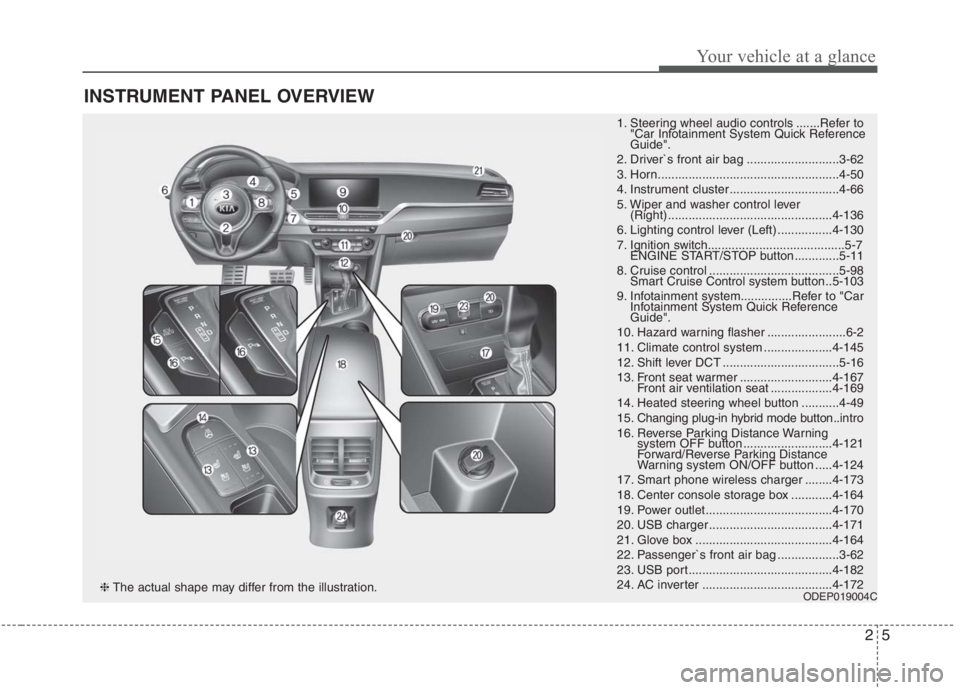
INSTRUMENT PANEL OVERVIEW
1. Steering wheel audio controls .......Refer to
"Car Infotainment System Quick Reference
Guide".
2. Driver`s front air bag ...........................3-62
3. Horn.....................................................4-50
4. Instrument cluster ................................4-66
5. Wiper and washer control lever
(Right) ................................................4-136
6. Lighting control lever (Left) ................4-130
7. Ignition switch........................................5-7
ENGINE START/STOP button .............5-11
8. Cruise control ......................................5-98
Smart Cruise Control system button ..5-103
9. Infotainment system...............Refer to "Car
Infotainment System Quick Reference
Guide".
10. Hazard warning flasher .......................6-2
11. Climate control system ....................4-145
12. Shift lever DCT ..................................5-16
13. Front seat warmer ...........................4-167
Front air ventilation seat ..................4-169
14. Heated steering wheel button ...........4-49
15. Changing plug-in hybrid mode button..intro
16. Reverse Parking Distance Warning
system OFF button ..........................4-121
Forward/Reverse Parking Distance
Warning system ON/OFF button .....4-124
17. Smart phone wireless charger ........4-173
18. Center console storage box ............4-164
19. Power outlet.....................................4-170
20. USB charger ....................................4-171
21. Glove box ........................................4-164
22. Passenger`s front air bag ..................3-62
23. USB port..........................................4-182
24. AC inverter ......................................4-172
ODEP019004C❈The actual shape may differ from the illustration.
Page 69 of 667
Safety features of your vehicle
2 3
You will find many safety precautions
and recommendations throughout
this section, and throughout this man-
ual. The safety precautions in this sec-
tion are among the most important.
Always wear your seat belt
A seat belt is your best protection in
all types of accidents. Air bags are
designed to supplement seat belts,
not replace them. So even though
your vehicle is equipped with air
bags, ALWAYS make sure you and
your passengers wear your seat
belts, and wear them properly.
Restrain all children
All children under age 13 should ride
in your vehicle properly restrained in
a rear seat, not the front seat. Infants
and small children should be
restrained in an appropriate child
restraint. Larger children should use
a booster seat with the lap/shoulder
belt until they can use the seat belt
properly without a booster seat.
Air bag hazards
While air bags can save lives, they
can also cause serious or fatal
injuries to occupants who sit too
close to them, or who are not prop-
erly restrained. Infants, young chil-
dren, and shorter adults are at the
greatest risk of being injured by an
inflating air bag. Follow all instruc-
tions and warnings in this manual.
Driver distraction
Driver distraction presents a serious
and potentially deadly danger, espe-
cially for inexperienced drivers.
Safety should be the first concern
when behind the wheel and drivers
need to be aware of the wide array of
potential distractions, such as drowsi-
ness, reaching for objects, eating,
personal grooming, other passen-
gers, and using cellular phones.
Drivers can become distracted when
they take their eyes and attention off
the road or their hands off the wheel
to focus on activities other than driv-
ing. To reduce your risk of distraction
or getting into an accident:
• ALWAYS set up your mobile
devices (i.e., MP3 players, phones,
navigation units, etc.) when your
vehicle is parked or safely stopped.
IMPORTANT SAFETY PRECAUTIONS
Page 72 of 667
35
Safety features of your vehicle
WARNING- Uprighting
seat
Do not press the release lever on
a manual seatback without hold-
ing and controlling the seatback.
The seatback will spring upright,
possibly impacting you or other
passengers.
WARNING- Loose
objects
Do not place anything in the dri-
ver's foot well or under the front
seats. Loose objects in the dri-
ver's foot area could interfere
with the operation of the foot
pedals.WARNING- Driver respon-
sibility for passengers
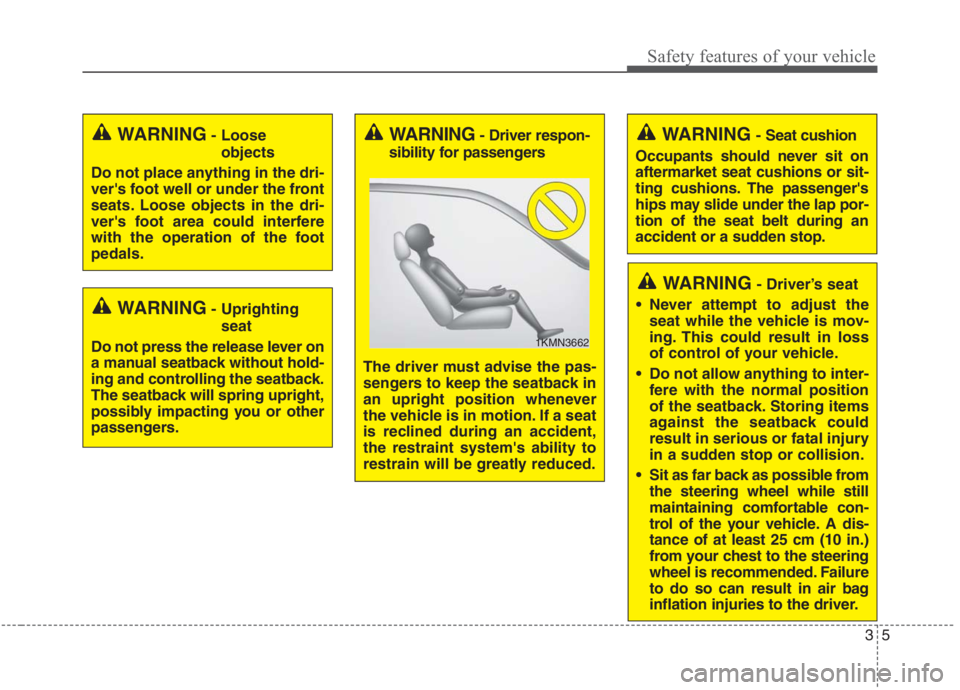
The driver must advise the pas-
sengers to keep the seatback in
an upright position whenever
the vehicle is in motion. If a seat
is reclined during an accident,
the restraint system's ability to
restrain will be greatly reduced.
1KMN3662
WARNING- Seat cushion
Occupants should never sit on
aftermarket seat cushions or sit-
ting cushions. The passenger's
hips may slide under the lap por-
tion of the seat belt during an
accident or a sudden stop.
WARNING- Driver’s seat
Never attempt to adjust the
seat while the vehicle is mov-
ing. This could result in loss
of control of your vehicle.
Do not allow anything to inter-
fere with the normal position
of the seatback. Storing items
against the seatback could
result in serious or fatal injury
in a sudden stop or collision.
Sit as far back as possible from
the steering wheel while still
maintaining comfortable con-
trol of the your vehicle. A dis-
tance of at least 25 cm (10 in.)
from your chest to the steering
wheel is recommended. Failure
to do so can result in air bag
inflation injuries to the driver.
Page 73 of 667
Safety features of your vehicle
6 3
Feature of Seat Leather
Leather is made from the outer
skin of an animal, which goes
through a special process to be
available for use. Since it is a nat-
ural substance, each part differs in
thickness or density.
Wrinkles may appear as a natural
result of stretching and shrinking
depending on the temperature and
humidity.
The seat cover is made of stretch-
able material to improve comfort of
passengers.
The parts contacting the body are
curved and the side supporting
area is high which provides driving
comfort and stability.
Wrinkles may appear naturally
from usage. It is not a fault of the
product.
WARNING- Unexpected
Seat Movement
After adjusting a manual seat,
always check that it is locked by
shifting your weight to the front
and back. Sudden or unexpect-
ed movement of the driver's
seat could cause you to lose
control of the vehicle.
WARNING - Rear seatbacks
Always lock the rear seatback
before driving. Failure to do so
could result in passengers or
objects being thrown forward,
injuring vehicle occupants.WARNING- Seat
adjustment
Do not adjust the seat while
wearing seat belts. Moving the
seat forward will cause strong
pressure on the abdomen.
Do not place your hand near
the seat bottom or seat track
while adjusting the seat. Your
hand could get caught in the
seat mechanism.
WARNING- Small
Objects
Use extreme caution when pick-
ing up small objects trapped
under the seats or between the
seat and the center console.
Your hands might be cut or
injured by the sharp edges of
the seats mechanism.
Page 76 of 667
39
Safety features of your vehicle
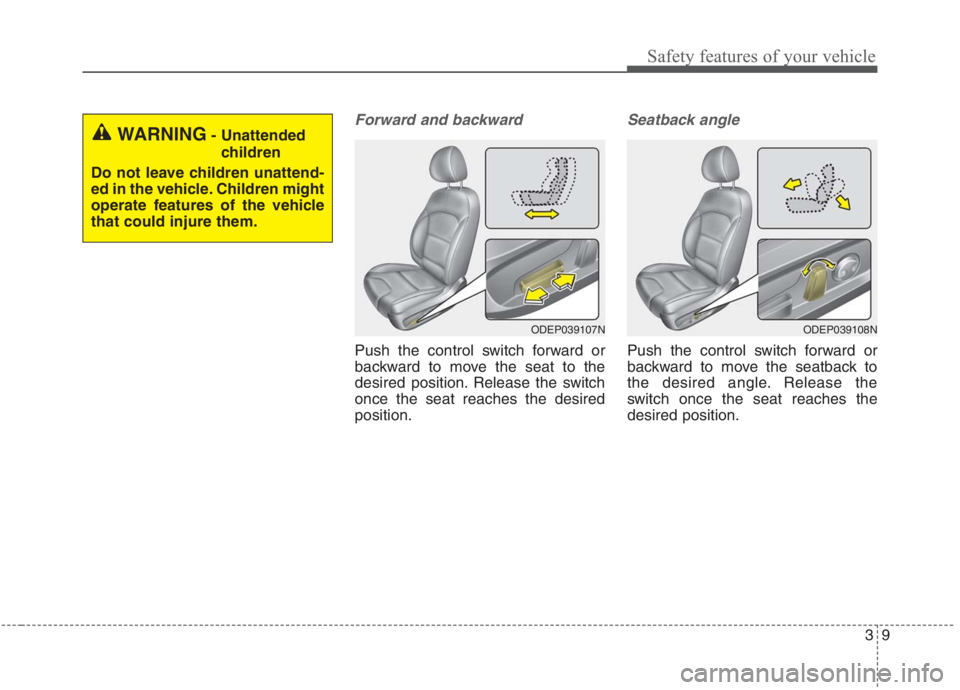
Forward and backward
Push the control switch forward or
backward to move the seat to the
desired position. Release the switch
once the seat reaches the desired
position.
Seatback angle
Push the control switch forward or
backward to move the seatback to
the desired angle. Release the
switch once the seat reaches the
desired position.
WARNING- Unattended
children
Do not leave children unattend-
ed in the vehicle. Children might
operate features of the vehicle
that could injure them.
ODEP039107NODEP039108N