ac charge KIA NIRO PHEV 2019 Owner's Manual
[x] Cancel search | Manufacturer: KIA, Model Year: 2019, Model line: NIRO PHEV, Model: KIA NIRO PHEV 2019Pages: 611, PDF Size: 15.28 MB
Page 39 of 611
H32
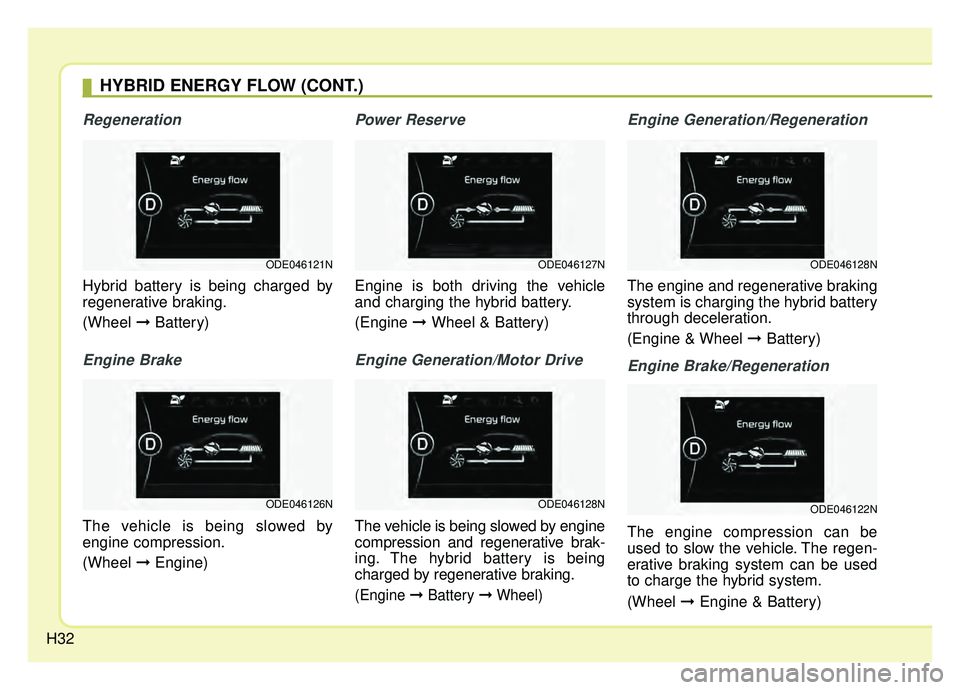
Regeneration
Hybrid battery is being charged by
regenerative braking.
(Wheel ➞Battery)
Engine Brake
The vehicle is being slowed by
engine compression.
(Wheel ➞Engine)
Power Reserve
Engine is both driving the vehicle
and charging the hybrid battery.
(Engine ➞ Wheel & Battery)
Engine Generation/Motor Drive
The vehicle is being slowed by engine
compression and regenerative brak-
ing. The hybrid battery is being
charged by regenerative braking.
(Engine ➞Battery ➞Wheel)
Engine Generation/Regeneration
The engine and regenerative braking
system is charging the hybrid battery
through deceleration.
(Engine & Wheel ➞ Battery)
Engine Brake/Regeneration
The engine compression can be
used to slow the vehicle. The regen-
erative braking system can be used
to charge the hybrid system.
(Wheel ➞Engine & Battery)
HYBRID ENERGY FLOW (CONT.)
ODE046128N
ODE046122N
ODE046127N
ODE046128N
ODE046121N
ODE046126N
Page 41 of 611
H34
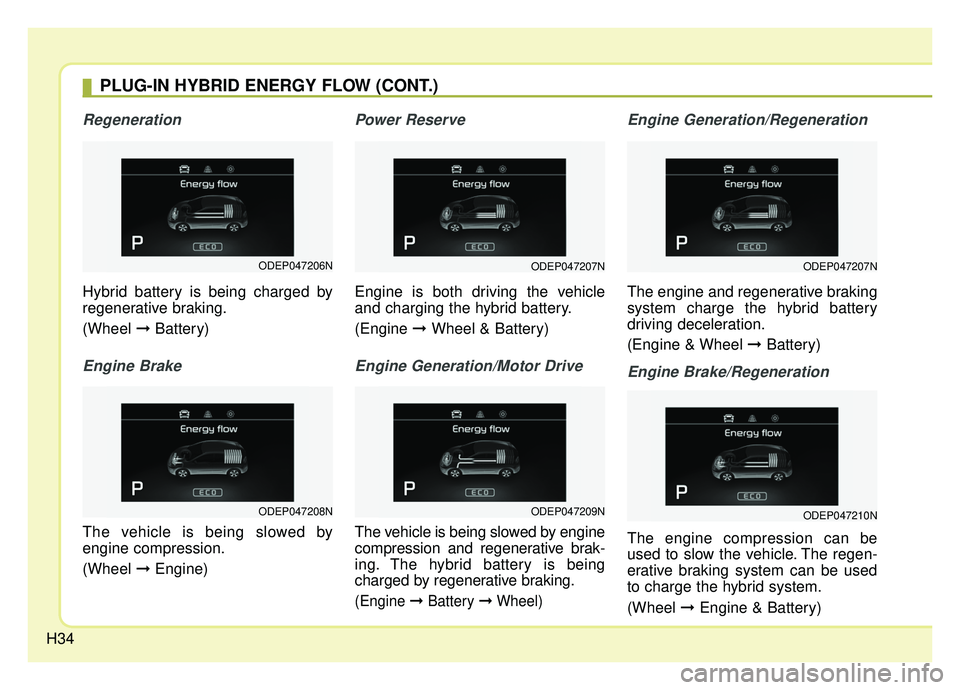
Regeneration
Hybrid battery is being charged by
regenerative braking.
(Wheel ➞Battery)
Engine Brake
The vehicle is being slowed by
engine compression.
(Wheel ➞Engine)
Power Reserve
Engine is both driving the vehicle
and charging the hybrid battery.
(Engine ➞ Wheel & Battery)
Engine Generation/Motor Drive
The vehicle is being slowed by engine
compression and regenerative brak-
ing. The hybrid battery is being
charged by regenerative braking.
(Engine ➞Battery ➞Wheel)
Engine Generation/Regeneration
The engine and regenerative braking
system charge the hybrid battery
driving deceleration.
(Engine & Wheel ➞ Battery)
Engine Brake/Regeneration
The engine compression can be
used to slow the vehicle. The regen-
erative braking system can be used
to charge the hybrid system.
(Wheel ➞Engine & Battery)
PLUG-IN HYBRID ENERGY FLOW (CONT.)
ODEP047207N
ODEP047209N
ODEP047207N
ODEP047210N
ODEP047206N
ODEP047208N
Page 42 of 611
H35
AUX. BATTERY SAVER+ (For
Plug-in Hybrid, if equipped)
The Aux. Battery Saver+ is a function
that monitors the charging status of
the 12V auxiliary battery.
If the auxiliary battery level is low, the
main high voltage battery charges
the auxiliary battery.
✽ ✽NOTICE
The Aux. Battery Saver+ function will
be ON when the vehicle is delivered. If
the function is not needed, you may
turn it off in the Users Settings mode
on the LCD display. For more infor-
mation, refer to the "System setting"
on the following page.
Mode
When the vehicle is OFF with all
doors, hood and liftgate closed, the
Aux. Battery Saver+ periodically acti-
vates according to the auxiliary bat-
tery status.
When the engine start/stop button is
in the ON position with the charging
connector plugged in, this function
activates according to the auxiliary
battery status to prevent over-dis-
charge of the auxiliary battery.
✽ ✽NOTICE
The Aux. Battery Saver+ activates
for a maximum of 20 minutes. If the
Aux. Battery Saver+ function acti-
vates more than 10 times consecu-
tively, in the Automatic Mode, this
function will stop activating, judg-
ing that there is a problem with the
auxiliary battery. In this case, drive
the vehicle for some period of time.
The function will start activating if
the auxiliary battery returns to nor-
mal.
✽ ✽NOTICE
If the Aux. Battery Saver+ function
was activated, a message will be dis-
played on the instrument cluster
and the high voltage battery level
may have decreased.
CAUTION
The Aux. Battery Saver+ func-
tion cannot prevent battery dis-charge if the auxiliary battery isdamaged, worn out, used as apower supply or unauthorizedelectronic devices are used.
Page 43 of 611
H36
System setting
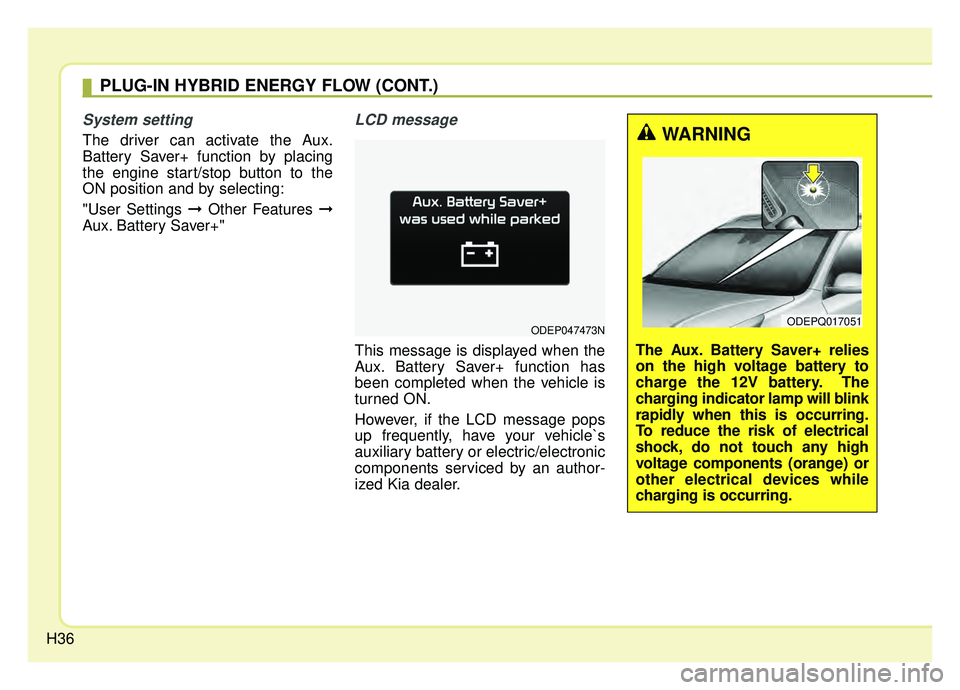
The driver can activate the Aux.
Battery Saver+ function by placing
the engine start/stop button to the
ON position and by selecting:
"User Settings ➞Other Features ➞
Aux. Battery Saver+"
LCD message
This message is displayed when the
Aux. Battery Saver+ function has
been completed when the vehicle is
turned ON.
However, if the LCD message pops
up frequently, have your vehicle`s
auxiliary battery or electric/electronic
components serviced by an author-
ized Kia dealer.
ODEP047473N
WARNING
The Aux. Battery Saver+ relies
on the high voltage battery to
charge the 12V battery. The
charging indicator lamp will blink
rapidly when this is occurring.
To reduce the risk of electrical
shock, do not touch any high
voltage components (orange) or
other electrical devices while
charging is occurring.
ODEPQ017051
PLUG-IN HYBRID ENERGY FLOW (CONT.)
Page 45 of 611
H38
ECONOMICAL and SAFE
OPERATION of Hybrid system
Drive smoothly. Accelerate at amoderate rate and maintain a
steady cruising speed. Don't make
"jack-rabbit" starts. Don't race
between stoplights.
Avoid heavy traffic whenever pos-
sible. Always maintain a safe dis-
tance from other vehicles so you
can avoid unnecessary braking.
This also reduces brake wear.
The regenerative brake generates energy when the vehicle deceler-
ates.
When the hybrid battery power is low, the hybrid system automatical-
ly recharges the hybrid battery.
When the engine runs in "N" posi- tion, the hybrid system cannot gen-
erate electricity. The hybrid battery
cannot recharge in "N" position.
Please refer to chapter 6.
✽ ✽ NOTICE
When the hybrid system is in ready
mode, the engine will automatically
start and stop as needed.
The " " symbol will illuminate in
the cluster when the system is oper-
ational.
CAUTION - Extended
cranking
Do not crank the engine for aprolonged period of time with-out the engine starting. Thiscould result in damage to theHEV battery and becomingtotally discharged.
STARTING THE HYBRID/PLUG-IN HYBRID VEHICLE (SMART KEY) (CONT.)
Page 48 of 611
H41
WARNING - Battery elec-trolyte
As with all batteries, avoid fluid
contact with the Hybrid battery.
If the battery is damaged and if
electrolyte comes in contact
with your body, clothes or eyes,
immediately flush with a large
quantity of fresh water.
WARNING - After market
battery charger
Do not use an after-market bat-
tery charger to charge the
Hybrid battery. Doing so may
result in death or serious injury.
WARNING - High Waters
Avoid high waters as this may result in your vehicle becom-
ing saturated with water and
could compromise the high
voltage components.
Do not touch any of the high voltage components within
your vehicle if your vehicle
has been submerged in water
equal to half of the vehicle
height. Touching high voltage
components once submerged
in water could result in severe
burns or electric shock that
could result in death or seri-
ous injury.
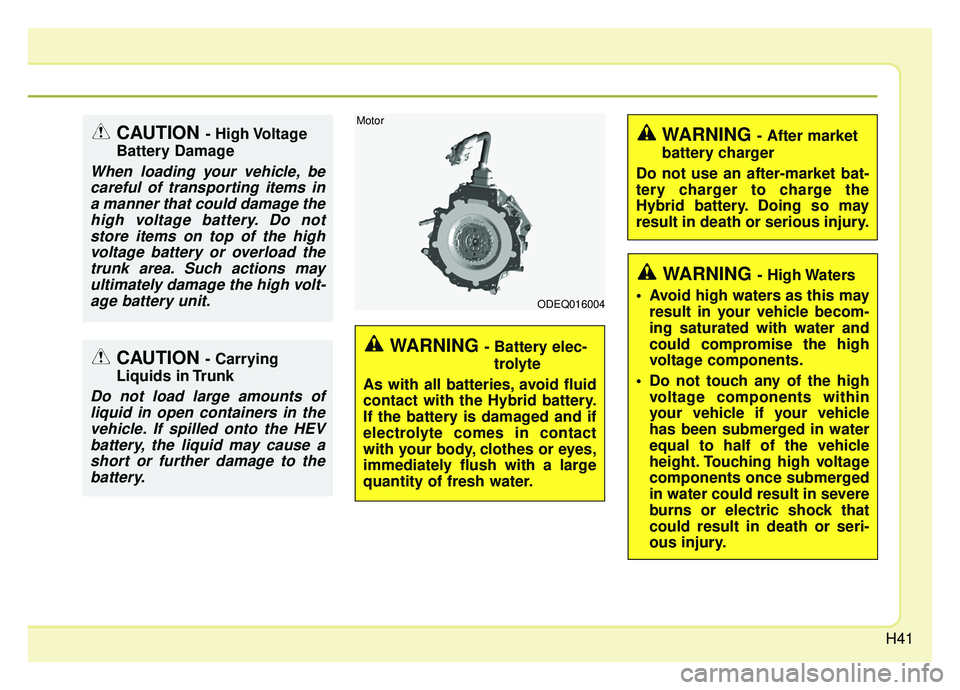
ODEQ016004
MotorCAUTION - High Voltage
Battery Damage
When loading your vehicle, be careful of transporting items ina manner that could damage thehigh voltage battery. Do notstore items on top of the highvoltage battery or overload thetrunk area. Such actions mayultimately damage the high volt-age battery unit.
CAUTION - Carrying
Liquids in Trunk
Do not load large amounts of liquid in open containers in thevehicle. If spilled onto the HEVbattery, the liquid may cause ashort or further damage to thebattery.
Page 49 of 611
H42
✽ ✽NOTICE - Prolonged parking
Prolonged parking might cause bat-
tery discharge and operation failure
due to natural discharge. Driving
the vehicle approximately once
every 2 months, more than 9 miles
(15 km) is recommended. The bat-
tery will be charged automatically
when driving the vehicle.
WARNING - Exposure to
High Voltage
High voltage in the hybrid bat- tery system is very dangerous
and can cause severe burns
and electric shock. This may
result in serious injury or death.
For your safety, never touch, replace, dismantle or remove
any portion of the hybrid bat-
tery system including compo-
nents, cables and connectors.
WARNING - Use of Water
or Liquids
If water or liquids come into
contact with the hybrid system
components, and you are also
in contact with the water, severe
injury or death due to electrocu-
tion may occur.
WARNING - Hot
Components
When the hybrid battery system
operates, the HEV battery system
can be hot. Heat burns may result
from touching even insulated
components of the HEV system.
CAUTION - Cleaning
Engine
When you clean the engine com- partment, do not wash usingwater. Water may cause electricarcing to occur and damage elec-tronic parts and components.
COMPONENTS OF THE HYBRID/PLUG-IN HYBRID VEHICLE (CONT.)
Page 51 of 611
H44
The HEV system may emit electro-
magnetic waves which can affect the
performance of electronic devices
appliances, such as laptop comput-
ers, which are not part of the vehicle
design.
If you park the vehicle for a long time,
the hybrid system will discharge. You
need to drive the vehicle approximate-
ly once every 2 months, more than 9
miles (15 km) is recommended.
When you start the hybrid system in
the "P" transmission position, the
" " symbol is illuminated in the
cluster. The driver can drive the vehi-
cle even if the engine is stopped.Virtual Engine Sound System
(VESS)
The Virtual Engine Sound System
generates engine sound for pedestri-
ans to hear vehicle sound because
there is limited sound while electric
motor power is used.
If the vehicle is moving at lowspeed, the VESS will operate.
When the gear is shifted to R (Reverse), an additional warning
sound will be heard.
WARNING - Turning off
HEV system
When you leave the vehicle, you
should turn off the hybrid sys-
tem. If you depress the acceler-
ator pedal by mistake and the
vehicle is not in the "P" posi-
tion, the vehicle will accelerate.
This may result in serious injury
or death.
COMPONENTS OF THE HYBRID/PLUG-IN HYBRID VEHICLE (CONT.)
Page 52 of 611
H45
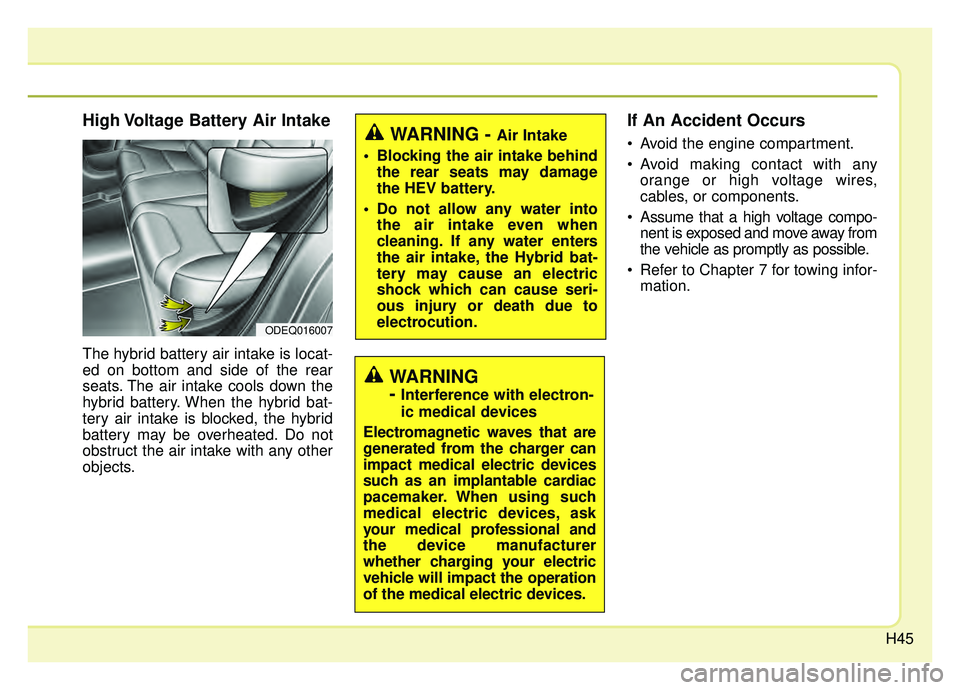
High Voltage Battery Air Intake
The hybrid battery air intake is locat-
ed on bottom and side of the rear
seats. The air intake cools down the
hybrid battery. When the hybrid bat-
tery air intake is blocked, the hybrid
battery may be overheated. Do not
obstruct the air intake with any other
objects.
If An Accident Occurs
Avoid the engine compartment.
Avoid making contact with anyorange or high voltage wires,
cables, or components.
Assume that a high voltage compo- nent is exposed and move away from
the vehicle as promptly as possible.
Refer to Chapter 7 for towing infor- mation.WARNING - Air Intake
Blocking the air intake behind the rear seats may damage
the HEV battery.
Do not allow any water into the air intake even when
cleaning. If any water enters
the air intake, the Hybrid bat-
tery may cause an electric
shock which can cause seri-
ous injury or death due to
electrocution.
ODEQ016007
WARNING
-
Interference with electron-
ic medical devices
Electromagnetic waves that are
generated from the charger can
impact medical electric devices
such as an implantable cardiac
pacemaker. When using such
medical electric devices, ask
your medical professional and
the device manufacturer
whether charging your electric
vehicle will impact the operation
of the medical electric devices.
Page 54 of 611
H47
When the hybrid vehicle shuts
off
When the high voltage battery or 12-
volt battery discharges, or fuel tank is
empty, the hybrid system may not
operate.
If the Hybrid system stops operating
while the vehicle is moving, reduce
the vehicle speed gradually, pull your
vehicle off the road to a safe area,
and shift the transmission in to Park
(P) position and;
1. Turn on the hazard warning flashers.
2. Set the start button at OFF, and tryto start the Hybrid system by
applying the brake pedal and
pushing the start button.
3. If the Hybrid system will not oper- ate, refer to "EMERGENCY
STARTING" in chapter 7.
Before you try to jump start the vehi-
cle, confirm the fuel level. If the fuel
level is low add more fuel before
attempting as emergency start.
WARNING
If a submersion in water occurs:
If your vehicle was flooded and
has soaked carpeting or water
on the flooring, you should not
try to start the Hybrid system.
Never touch the high voltage
cables, connectors and pack-
age modules, because an elec-
trical shock may occur causing
injury or death. High Voltage
cables are orange in color.
In this case, have the vehicle
towed to and inspected by an
authorized Kia dealer.
WARNING - Vehicle
Accident
Never touch electric wires or
cable. If exposed electric wires
or cables are visible inside or
outside of your vehicle, an elec-
tric shock may occur.
WARNING - Putting out
fire
Never use a small quantity of
water to put out a fire in your
vehicle. If a fire occurs, evacu-
ate the car immediately and
contact the fire department.