child restraint system KIA NIRO PHEV 2019 Owner's Manual
[x] Cancel search | Manufacturer: KIA, Model Year: 2019, Model line: NIRO PHEV, Model: KIA NIRO PHEV 2019Pages: 611, PDF Size: 15.28 MB
Page 126 of 611
359
Safety features of your vehicle
Your vehicle is equipped with an
Advanced Supplemental Restraint
(Air Bag) System and lap/shoulder
belts at both the driver and passen-
ger seating position.
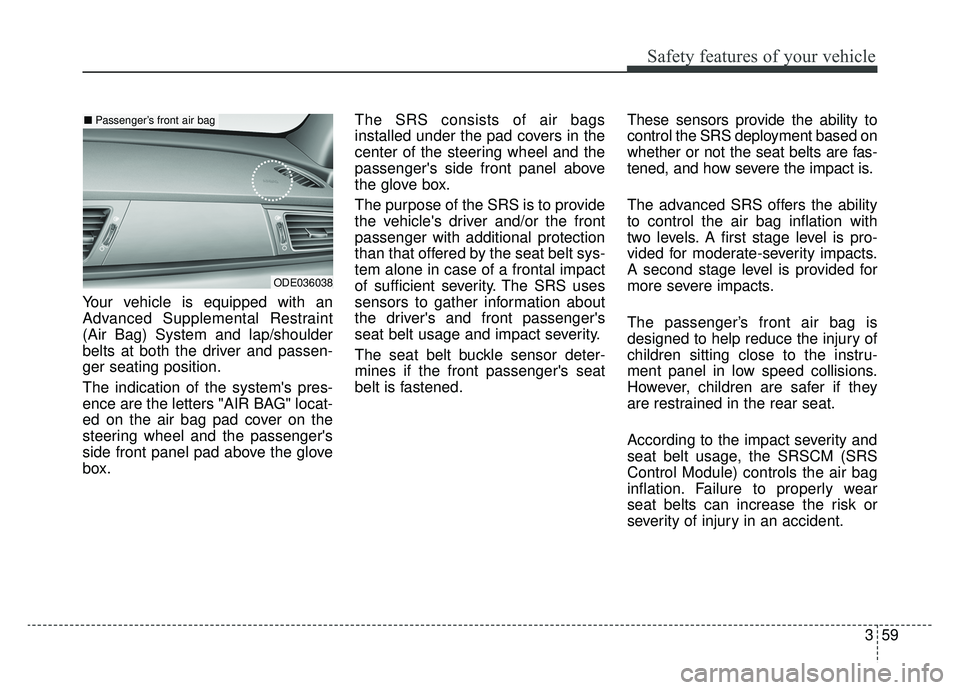
The indication of the system's pres-
ence are the letters "AIR BAG" locat-
ed on the air bag pad cover on the
steering wheel and the passenger's
side front panel pad above the glove
box.The SRS consists of air bags
installed under the pad covers in the
center of the steering wheel and the
passenger's side front panel above
the glove box.
The purpose of the SRS is to provide
the vehicle's driver and/or the front
passenger with additional protection
than that offered by the seat belt sys-
tem alone in case of a frontal impact
of sufficient severity. The SRS uses
sensors to gather information about
the driver's and front passenger's
seat belt usage and impact severity.
The seat belt buckle sensor deter-
mines if the front passenger's seat
belt is fastened.
These sensors provide the ability to
control the SRS deployment based on
whether or not the seat belts are fas-
tened, and how severe the impact is.
The advanced SRS offers the ability
to control the air bag inflation with
two levels. A first stage level is pro-
vided for moderate-severity impacts.
A second stage level is provided for
more severe impacts.
The passenger’s front air bag is
designed to help reduce the injury of
children sitting close to the instru-
ment panel in low speed collisions.
However, children are safer if they
are restrained in the rear seat.
According to the impact severity and
seat belt usage, the SRSCM (SRS
Control Module) controls the air bag
inflation. Failure to properly wear
seat belts can increase the risk or
severity of injury in an accident.
ODE036038
■
Passenger’s front air bag
Page 602 of 611
I3
Index
Before driving . . . . . . . . . . . . . . . . . . . . . . . . . . . . . . . . . 6-4Before entering vehicle . . . . . . . . . . . . . . . . . . . . . . . 6-4
Before starting . . . . . . . . . . . . . . . . . . . . . . . . . . . . . . 6-4
Necessary inspections . . . . . . . . . . . . . . . . . . . . . . . . 6-4
Blind Spot Detection system (BSD). . . . . . . . . . . . . . . 6-68 BSD (Blind Spot Detection) /LCA (Lane Change Assist) . . . . . . . . . . . . . . . . . . 6-69
Limitations condition . . . . . . . . . . . . . . . . . . . . . . . . 6-74
RCTA (Rear Cross Traffic Alert) . . . . . . . . . . . . . . . 6-72
Brake fluid . . . . . . . . . . . . . . . . . . . . . . . . . . . . . . . . . . 8-26\
Checking the brake fluid level . . . . . . . . . . . . . . . . . 8-26
Brake system. . . . . . . . . . . . . . . . . . . . . . . . . . . . . . . . . 6-23 Anti-lock Brake System (ABS) . . . . . . . . . . . . . . . . 6-27
Electronic Stability Control (ESC) . . . . . . . . . . . . . 6-29
Good braking practices . . . . . . . . . . . . . . . . . . . . . . 6-34
Hill-start Assist Control (HAC) . . . . . . . . . . . . . . . . 6-34
Parking brake – Foot type . . . . . . . . . . . . . . . . . . . . 6-25
Power brakes . . . . . . . . . . . . . . . . . . . . . . . . . . . . . . 6-23
Vehicle Stability Management (VSM) . . . . . . . . . . . 6-32
Bulb wattage . . . . . . . . . . . . . . . . . . . . . . . . . . . . . . . . . . 9-3
California perchlorate notice . . . . . . . . . . . . . . . . . . . 8-109
Checking fluid levels . . . . . . . . . . . . . . . . . . . . . . . . . . 8-18
Child Restraint System (CRS) . . . . . . . . . . . . . . . . . . . 3-32 Children always in the rear . . . . . . . . . . . . . . . . . . . 3-32 Installing a Child Restraint System (CRS) . . . . . . . 3-36
Selecting a Child Restraint System (CRS) . . . . . . . 3-33
Climate control air filter . . . . . . . . . . . . . . . . . . . . . . . . 8-33 Filter inspection . . . . . . . . . . . . . . . . . . . . . . . . . . . . 8-33
Consumer Assistance (U.S. only) . . . . . . . . . . . . . . . . . 9-12 Emergency roadside assistance . . . . . . . . . . . . . . . . 9-12
Registering your vehicle in a foreign country . . . . . 9-14
Toll free consumer assistance . . . . . . . . . . . . . . . . . 9-12
Trip interruption . . . . . . . . . . . . . . . . . . . . . . . . . . . . 9-13
Coolant . . . . . . . . . . . . . . . . . . . . . . . . . . . . . . . . . . . . \
. 8-21 Changing the coolant . . . . . . . . . . . . . . . . . . . . . . . . 8-25
Checking the coolant level . . . . . . . . . . . . . . . . . . . . 8-21
Engine coolant . . . . . . . . . . . . . . . . . . . . . . . . . . . . . 8-22
Inverter coolant . . . . . . . . . . . . . . . . . . . . . . . . . . . . 8-22
Recommended coolant . . . . . . . . . . . . . . . . . . . . . . . 8-23
Cruise control system . . . . . . . . . . . . . . . . . . . . . . . . . . 6-48 To cancel cruise control, do one of the following . . 6-50
To decrease the cruising speed . . . . . . . . . . . . . . . . . 6-50
To increase cruise control set speed . . . . . . . . . . . . . 6-49
To resume cruising speed at more thanapproximately 20 mph (30 km/h) . . . . . . . . . . . . . 6-51
To set cruise control speed . . . . . . . . . . . . . . . . . . . . 6-49
To temporarily accelerate with the cruise control on . . . . . . . . . . . . . . . . . . . . . . . . . . . . . . . . 6-50
To turn cruise control off, do one of the following . 6-51
C