warning KIA NIRO PHEV 2020 Owners Manual
[x] Cancel search | Manufacturer: KIA, Model Year: 2020, Model line: NIRO PHEV, Model: KIA NIRO PHEV 2020Pages: 687, PDF Size: 11.43 MB
Page 640 of 687
Maintenance
104
7
APPEARANCE CARE
Exterior care
Exterior general caution
It is very important to follow the label
directions when using any chemical
cleaner or polish. Read all warning
and caution statements that appear
on the label.
Finish maintenance
Washing
To help protect your vehicle’s finish
from rust and deterioration, wash it
thoroughly and frequently at least
once a month with lukewarm or cold
water.
If you use your vehicle for off-road
driving, you should wash it after each
off-road trip. Pay special attention to
the removal of any accumulation of
salt, dirt, mud, and other foreign mate-
rials. Make sure the drain holes in the
lower edges of the doors and rocker
panels are kept clear and clean.
Insects, tar, tree sap, bird droppings,
industrial pollution and similar
deposits can damage your vehicle’s
finish if not removed immediately.
Even prompt washing with plain water
may not completely remove all these
deposits. A mild soap, safe for use on
painted surfaces, may be used.
After washing, rinse the vehicle thor-
oughly with lukewarm or cold water.
Do not allow soap to dry on the finish. After washing the vehicle, test the
brakes while driving slowly to see if
they have been affected by water. If
braking performance is impaired, dry
the brakes by applying them lightly
while maintaining a slow forward
speed.
Page 644 of 687
Maintenance
108
7
Aluminum wheel maintenance
The aluminum wheels are coated with
a clear protective finish.
Do not use any abrasive cleaner,
polishing compound, solvent, or wire
brushes on aluminum wheels. They
may scratch the finish.
Clean the wheel when it has cooled.
Use only a mild soap or neutral detergent, and rinse thoroughly with
water. Also, be sure to clean the
wheels after driving on salted roads.
This helps prevent corrosion.
Avoid washing the wheels with high- speed vehicle wash brushes.
Do not use any alkaline or acid detergents It may damage and cor-
rode the aluminum wheels coated
with a clear protective finish.
Corrosion protection
Protecting your vehicle from corrosion
By using the most advanced design
and construction practices to combat
corrosion, we produce vehicles of
the highest quality. However, this is
only part of the job. To achieve the
long-term corrosion resistance your
vehicle can deliver, the owner's
cooperation and assistance is also
required.
Common causes of corrosion
The most common causes of corro-
sion on your vehicle are:
Road salt, dirt and moisture that isallowed to accumulate underneath
the vehicle.
Removal of paint or protective coatings by stones, gravel, abra-
sion or minor scrapes and dents
which leave unprotected metal
exposed to corrosion.WARNING
After washing the vehicle, test
the brakes while driving slowly
to see if they have been affected
by water. If braking performance
is impaired, dry the brakes by
applying them lightly while
maintaining a slow forward
speed.
Page 651 of 687
7115
Maintenance
Canister
Fuel vapors generated inside the fuel
tank are absorbed and stored in the
onboard canister. When the engine is
running, the fuel vapors absorbed in
the canister are drawn into the surge
tank through the purge control sole-
noid valve.
Purge Control Solenoid Valve(PCSV)
The purge control solenoid valve is
controlled by the Engine Control
Module (ECM); when the engine
coolant temperature is low during
idling, the PCSV closes so that evap-
orated fuel is not taken into the
engine. After the engine warms up
during ordinary driving, the PCSV
opens to introduce evaporated fuel to
the engine.
3. Exhaust emission control system
The Exhaust Emission Control
System is a highly effective system
which controls exhaust emissions
while maintaining good vehicle per-
formance.
Engine exhaust gas precautions
(carbon monoxide)
Carbon monoxide can be present with other exhaust fumes.
Therefore, if you smell exhaust
fumes of any kind inside your vehi-
cle, have it inspected and repaired
immediately. If you ever suspect
exhaust fumes are coming into
your vehicle, drive it only with all
the windows fully open. Have your
vehicle checked and repaired
immediately.
WARNING - Exhaust
Engine exhaust gases contain
carbon monoxide (CO). Though
colorless and odorless, it is
dangerous and could be lethal if
inhaled. Follow the instructions
on this page to avoid CO poi-
soning.
Page 652 of 687

Maintenance
116
7
Do not operate the engine in con-
fined or closed areas (such as
garages) any more than what is
necessary to move the vehicle in or
out of the area.
When the vehicle is stopped in an open area for more than a short
time with the engine running,
adjust the ventilation system (as
needed) to draw outside air into the
vehicle.
Never sit in a parked or stopped vehicle for any extended time with
the engine running.
When the engine stalls or fails to start, excessive attempts to restart
the engine may cause damage to
the emission control system.Operating precautions for catalyt-
ic converters (if equipped)
WARNING- Catalytic converter
Keep away from the catalytic
converter and exhaust system
while the vehicle is running or
immediately thereafter. The
exhaust and catalytic systems
are very hot and may burn you.
WARNING- Fire
Do not park, idle or drive the vehicle over or near flamma-
ble objects, such as grass,
vegetation, paper, leaves, etc.
A hot exhaust system can
ignite flammable items under
your vehicle.
Also, do not remove the heat sink around the exhaust sys-
tem, do not seal the bottom of
the vehicle and do not coat
the vehicle for corrosion con-
trol. It may present a fire risk
under certain conditions.
Page 669 of 687
Specifications, Consumer information, Reporting safety defects
16
8
The electrical system of your vehicle is designed to per-
form under all reasonably expected operating conditions.
However, before any additional electrical equipment is
installed in your vehicle, consult an Authorized Kia
Dealer, in order to ensure that you do not void your war-
ranty.
Certain electrical equipment, or the way in which it is
installed, may adversely affect the operation of your vehi-
cle, including such systems as the engine control system,
the audio system and the electrical charging system and
thus potentially void all or part of your warranty.
We assume no responsibility for any expense you may
incur or for any malfunction of your vehicle or any of its
components or systems that may result from the installa-
tion of additional electrical equipment that is not supplied,
or recommended for installation by, Kia.Installation of a mobile two-way radio system
If a mobile two-way radio system is installed improperly,
or if an excessively powerful type of system is used, other
electronic systems may be adversely affected. To avoid
damage to your vehicle, consult an Authorized Kia Dealer
concerning the proper equipment and installation.
Kia motor vehicles are designed and manufactured to
meet or exceed all applicable safety standards.
For your safety, however, we strongly urge you to read
and follow all directions in this Owner's Manual, particu-
larly the information under the headings "NOTICE",
"CAUTION" and "WARNING".
If, after reading this manual, you have any questions
regarding the operation of your vehicle, safety issues and
defects please contact your Kia's toll-free Consumer
Assistance hot line as below:
National Consumer Affairs Manager
Kia Motors America, Inc.
P.O. Box 52410
Irvine, CA 92619-2410
1-800-333-4Kia (4542)
ELECTRICAL EQUIPMENT (U.S. ONLY)
Page 673 of 687
ii
Foreword
We want to help you get the greatest
possible driving pleasure from your
vehicle. Your Owner’s Manual can
assist you in many ways. We strong-
ly recommend that you read the
entire manual. In order to minimize
the chance of death or injury, you
must read the WARNING and CAU-
TION sections in the manual.
Illustrations complement the words
in this manual to best explain how to
enjoy your vehicle. By reading your
manual, you will learn about fea-
tures, important safety information,
and driving tips under various road
conditions.
The general layout of the manual is
provided in the Table of Contents.
Use the index when looking for a
specific area or subject; it has an
alphabetical listing of all information
in your manual.
Sections: This manual has nine sec-
tions plus an index. Each section
begins with a brief list of contents so
you can tell at a glance if that section
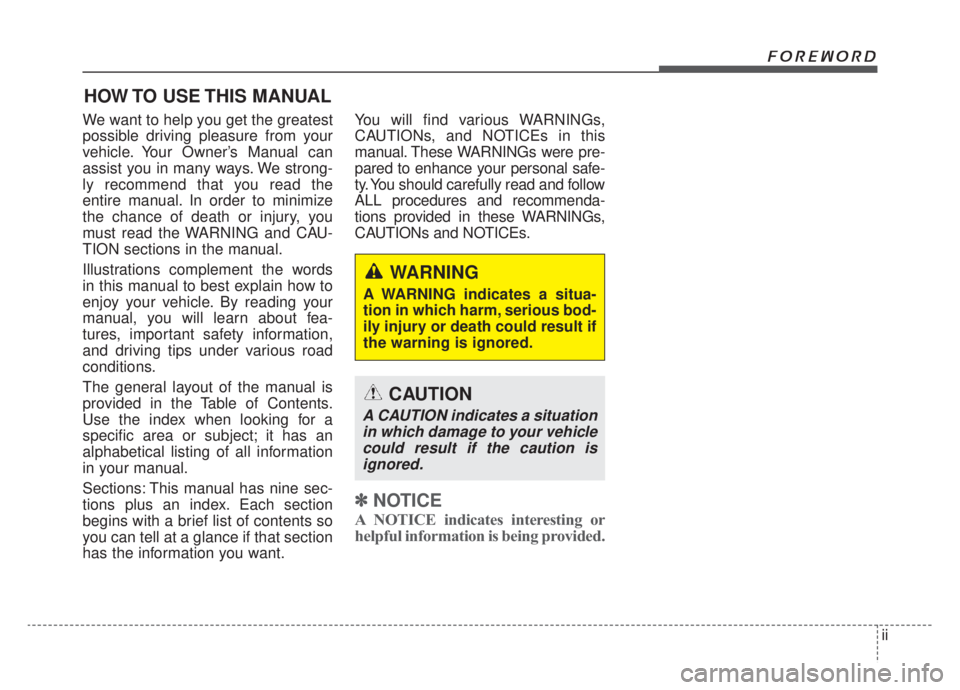
has the information you want.You will find various WARNINGs,
CAUTIONs, and NOTICEs in this
manual. These WARNINGs were pre-
pared to enhance your personal safe-
ty. You should carefully read and follow
ALL procedures and recommenda-
tions provided in these WARNINGs,
CAUTIONs and NOTICEs.
✽ ✽
NOTICE
A NOTICE indicates interesting or
helpful information is being provided.
HOW TO USE THIS MANUAL
WARNING
A WARNING indicates a situa-
tion in which harm, serious bod-
ily injury or death could result if
the warning is ignored.
CAUTION
A CAUTION indicates a situation
in which damage to your vehiclecould result if the caution isignored.
Page 677 of 687
Index
2I
Air bag - advanced supplemental restraint system . . . . 3-47Adding equipment to or modifying your air bag-equipped vehicle . . . . . . . . . . . . . . . . . . . . 3-73
Air bag warning label. . . . . . . . . . . . . . . . . . . . . . . . 3-73
Air bag warning light . . . . . . . . . . . . . . . . . . . . . . . . 3-50
Curtain air bag . . . . . . . . . . . . . . . . . . . . . . . . . . . . . 3-67
Driver's and passenger's front air bag . . . . . . . . . . . 3-62
How does the air bag system operate? . . . . . . . . . . . 3-48
Occupant Detection System (ODS) . . . . . . . . . . . . . 3-54
Side air bag. . . . . . . . . . . . . . . . . . . . . . . . . . . . . . . . 3-65
SRS Care . . . . . . . . . . . . . . . . . . . . . . . . . . . . . . . . . 3-72
SRS components and functions . . . . . . . . . . . . . . . . 3-51
Air cleaner . . . . . . . . . . . . . . . . . . . . . . . . . . . . . . . . . . 7-32\
Filter replacement. . . . . . . . . . . . . . . . . . . . . . . . . . . 7-32
Air conditioner compressor label . . . . . . . . . . . . . . . . . 8-12
Air conditioning system . . . . . . . . . . . . . . . . . . . . . . . . . 8-7
Appearance care . . . . . . . . . . . . . . . . . . . . . . . . . . . . . 7-104 Exterior care . . . . . . . . . . . . . . . . . . . . . . . . . . . . . . 7-104
Interior care . . . . . . . . . . . . . . . . . . . . . . . . . . . . . . 7-110
Automatic climate control system . . . . . . . . . . . . . . . 4-131 Air Conditioning refrigerant label . . . . . . . . . . . . . 4-144
Automatic heating and air conditioning. . . . . . . . . 4-132
Automatic ventilation . . . . . . . . . . . . . . . . . . . . . . . 4-142
Checking the amount of air conditioner refrigerant and compressor lubricant . . . . . . . . . . 4-145
Climate control air filter. . . . . . . . . . . . . . . . . . . . . 4-144 Manual heating and air conditioning . . . . . . . . . . . 4-134
Recirculated air at washer fluid spray . . . . . . . . . . 4-143
Sunroof inside air recirculation . . . . . . . . . . . . . . . 4-143
System operation . . . . . . . . . . . . . . . . . . . . . . . . . . 4-140
Battery (Plug-in Hybrid). . . . . . . . . . . . . . . . . . . . . . . . 7-39 For best battery service . . . . . . . . . . . . . . . . . . . . . . 7-39
Recharging the battery . . . . . . . . . . . . . . . . . . . . . . . 7-40
Reset items . . . . . . . . . . . . . . . . . . . . . . . . . . . . . . . . 7-41
Before driving . . . . . . . . . . . . . . . . . . . . . . . . . . . . . . . . . 5-5 Before entering vehicle . . . . . . . . . . . . . . . . . . . . . . . 5-5
Before starting . . . . . . . . . . . . . . . . . . . . . . . . . . . . . . 5-5
Necessary inspections . . . . . . . . . . . . . . . . . . . . . . . . 5-5
Blind-Spot Collision Warning (BCW) . . . . . . . . . . . . . 5-96 System description . . . . . . . . . . . . . . . . . . . . . . . . . . 5-96
System setting and activation . . . . . . . . . . . . . . . . . . 5-97
Warning message and system control . . . . . . . . . . . 5-99
Brake fluid . . . . . . . . . . . . . . . . . . . . . . . . . . . . . . . . . . 7-26\
Checking the brake fluid level . . . . . . . . . . . . . . . . . 7-26
Brake system. . . . . . . . . . . . . . . . . . . . . . . . . . . . . . . . . 5-30 Anti-lock Brake System (ABS) . . . . . . . . . . . . . . . . 5-44
Auto hold . . . . . . . . . . . . . . . . . . . . . . . . . . . . . . . . . 5-40
Electronic Parking Brake (EPB) . . . . . . . . . . . . . . . 5-34
Electronic Stability Control (ESC) . . . . . . . . . . . . . 5-46
Good braking practices . . . . . . . . . . . . . . . . . . . . . . 5-52
Hill-start Assist Control (HAC) . . . . . . . . . . . . . . . . 5-51
A
B
Page 678 of 687
I3
Index
Parking brake – Foot type . . . . . . . . . . . . . . . . . . . . 5-32
Power brakes . . . . . . . . . . . . . . . . . . . . . . . . . . . . . . 5-30
Vehicle Stability Management (VSM) . . . . . . . . . . . 5-50
Warning messages . . . . . . . . . . . . . . . . . . . . . . . . . . 5-42
Bulb wattage . . . . . . . . . . . . . . . . . . . . . . . . . . . . . . . . . . 8-3
California perchlorate notice . . . . . . . . . . . . . . . . . . . 7-117
Checking fluid levels . . . . . . . . . . . . . . . . . . . . . . . . . . 7-18
Child Restraint System (CRS) . . . . . . . . . . . . . . . . . . . 3-35 Children always in the rear . . . . . . . . . . . . . . . . . . . 3-35
Installing a Child Restraint System (CRS) . . . . . . . 3-39
Selecting a Child Restraint System (CRS) . . . . . . . 3-36
Climate control air filter . . . . . . . . . . . . . . . . . . . . . . . . 7-34 Filter inspection . . . . . . . . . . . . . . . . . . . . . . . . . . . . 7-34
Consumer assistance (U.S. only) . . . . . . . . . . . . . . . . . 8-13 Emergency roadside assistance . . . . . . . . . . . . . . . . 8-13
Registering your vehicle in a foreign country . . . . . 8-15
Toll free consumer assistance . . . . . . . . . . . . . . . . . 8-13
Trip interruption . . . . . . . . . . . . . . . . . . . . . . . . . . . . 8-14
Coolant . . . . . . . . . . . . . . . . . . . . . . . . . . . . . . . . . . . . \
. 7-21 Changing the coolant . . . . . . . . . . . . . . . . . . . . . . . . 7-25
Checking the coolant level . . . . . . . . . . . . . . . . . . . . 7-21
Engine coolant . . . . . . . . . . . . . . . . . . . . . . . . . . . . . 7-22
Inverter coolant. . . . . . . . . . . . . . . . . . . . . . . . . . . . . 7-22
Recommended coolant . . . . . . . . . . . . . . . . . . . . . . . 7-23 Cruise Control (CC) . . . . . . . . . . . . . . . . . . . . . . . . . . 5-115
Cruise control switch . . . . . . . . . . . . . . . . . . . . . . . 5-116
To cancel cruise control . . . . . . . . . . . . . . . . . . . . . 5-118
To decrease the cruising speed . . . . . . . . . . . . . . . . 5-117
To increase cruise control set speed . . . . . . . . . . . . 5-117
To resume cruising speed at more than approximately 20 mph (30 km/h) . . . . . . . . . . . . . . . . . . . . . . . . 5-119
To set cruise control speed . . . . . . . . . . . . . . . . . . . 5-116
To temporarily accelerate with the cruise control on. 5-118
To turn cruise control off . . . . . . . . . . . . . . . . . . . . 5-119
Declaration of Conformity . . . . . . . . . . . . . . . . . . . . . 4-172 FCC . . . . . . . . . . . . . . . . . . . . . . . . . . . . . . . . . . . . \
4-172
Defroster . . . . . . . . . . . . . . . . . . . . . . . . . . . . . . . . . . . 4-\
130 Rear window defroster . . . . . . . . . . . . . . . . . . . . . . 4-130
Dimensions . . . . . . . . . . . . . . . . . . . . . . . . . . . . . . . . . . . 8-\
2
Door locks. . . . . . . . . . . . . . . . . . . . . . . . . . . . . . . . . . . 4-\
21 Child-protector rear door lock . . . . . . . . . . . . . . . . . 4-25
Operating door locks from inside the vehicle . . . . . 4-22
Operating door locks from outside the vehicle . . . . 4-21
Driver Attention Warning (DAW). . . . . . . . . . . . . . . . 5-107 Leading vehicle departure alert . . . . . . . . . . . . . . . 5-112
Low activity warning . . . . . . . . . . . . . . . . . . . . . . . 5-107
Dual Clutch Transmission (DCT). . . . . . . . . . . . . . . . . 5-16 Dual clutch transmission operation . . . . . . . . . . . . . 5-16
Good driving practices . . . . . . . . . . . . . . . . . . . . . . . 5-25
C
D
Page 679 of 687

Index
4I
Economical operation . . . . . . . . . . . . . . . . . . . . . . . . . 5-167
Electrical Equipment (U.S. only) . . . . . . . . . . . . . . . . . 8-16Installation of a mobile two-way radio system . . . . 8-16
Emergency starting . . . . . . . . . . . . . . . . . . . . . . . . . . . . . 6-5 Before Jump Starting (For Hybrid) . . . . . . . . . . . . . . 6-5
Jump starting . . . . . . . . . . . . . . . . . . . . . . . . . . . . . . . 6-8
Method to disconnect the (-) cable for regular maintenance (For Hybrid) . . . . . . . . . . . . . . . . . . . . 6-7
Push-starting . . . . . . . . . . . . . . . . . . . . . . . . . . . . . . . 6-10
Emission control system . . . . . . . . . . . . . . . . . . . . . . . 7-114 Crankcase emission control system . . . . . . . . . . . . 7-114
Evaporative emission control (including ORVR:Onboard Refueling Vapor Recovery) system. . . . 7-114
Exhaust emission control system . . . . . . . . . . . . . . 7-115
Engine . . . . . . . . . . . . . . . . . . . . . . . . . . . . . . . . . . . . \
. . 8-2
Engine clutch actuator fluid . . . . . . . . . . . . . . . . . . . . . 7-28 Checking the engine clutch actuator fluid level. . . . 7-28
Engine compartment . . . . . . . . . . . . . . . . . . . . . . . . 2-6, 7-4
Engine number . . . . . . . . . . . . . . . . . . . . . . . . . . . . . . . 8-11
Engine oil . . . . . . . . . . . . . . . . . . . . . . . . . . . . . . . . . . . 7-\
19 Changing the engine oil and filter . . . . . . . . . . . . . . 7-20
Checking the engine oil level . . . . . . . . . . . . . . . . . . 7-19
ENGINE START/STOP button . . . . . . . . . . . . . . . . . . 5-11 ENGINE START/STOP button position . . . . . . . . . 5-11
Illuminated ENGINE START/STOP button . . . . . . 5-11
Starting the hybrid system . . . . . . . . . . . . . . . . . . . . 5-13 Explanation of scheduled maintenance items . . . . . . . 7-15
Exterior features . . . . . . . . . . . . . . . . . . . . . . . . . . . . . 4-166
Roof rack . . . . . . . . . . . . . . . . . . . . . . . . . . . . . . . . 4-166
Exterior overview . . . . . . . . . . . . . . . . . . . . . . . . . . . . . . 2-2
Folding key . . . . . . . . . . . . . . . . . . . . . . . . . . . . . . . . . . . 4-\
4 Battery replacement . . . . . . . . . . . . . . . . . . . . . . . . . . 4-7
Immobilizer system . . . . . . . . . . . . . . . . . . . . . . . . . . 4-8
Key operations . . . . . . . . . . . . . . . . . . . . . . . . . . . . . . 4-4
Record your key number . . . . . . . . . . . . . . . . . . . . . . 4-4
Transmitter precautions . . . . . . . . . . . . . . . . . . . . . . . 4-6
Forward Collision-Avoidance Assist (FCA) (front view camera only) . . . . . . . . . . . . . . . . . . . . . 5-53
Brake operation . . . . . . . . . . . . . . . . . . . . . . . . . . . . 5-57
Detecting sensor (front view camera) . . . . . . . . . . . 5-58
FCA warning message and system control . . . . . . . 5-56
Limitation of the system . . . . . . . . . . . . . . . . . . . . . 5-62
System malfunction . . . . . . . . . . . . . . . . . . . . . . . . . 5-60
System setting and activation . . . . . . . . . . . . . . . . . . 5-53
Forward Collision-Avoidance Assist (FCA) (sensor fusion) . . . . . . . . . . . . . . . . . . . . . . . . . . . . . 5-69
Brake operation . . . . . . . . . . . . . . . . . . . . . . . . . . . . 5-74
Detecting sensors (front view camera/front radar) . 5-74
FCA warning message and system control . . . . . . . 5-72
Limitation of the system . . . . . . . . . . . . . . . . . . . . . 5-78
E
F
Page 680 of 687
I5
Index
System malfunction . . . . . . . . . . . . . . . . . . . . . . . . . 5-76
System setting and activation . . . . . . . . . . . . . . . . . . 5-69
Fuel filler door (Hybrid) . . . . . . . . . . . . . . . . . . . . . . . . 4-36 Closing the fuel filler door . . . . . . . . . . . . . . . . . . . . 4-36
Opening the fuel filler door . . . . . . . . . . . . . . . . . . . 4-36
Fuel filler door (Plug-in hybrid) . . . . . . . . . . . . . . . . . . 4-37 Closing the fuel filler door . . . . . . . . . . . . . . . . . . . . 4-38
Opening the fuel filler door . . . . . . . . . . . . . . . . . . . 4-37
Fuel requirements . . . . . . . . . . . . . . . . . . . . . . . . . . . . . . 1-2 Do not use methanol . . . . . . . . . . . . . . . . . . . . . . . . . 1-3
Fuel additives . . . . . . . . . . . . . . . . . . . . . . . . . . . . . . . 1-4
Gasoline containing alcohol and methanol . . . . . . . . 1-2
Operation in foreign countries . . . . . . . . . . . . . . . . . . 1-4
Fuses . . . . . . . . . . . . . . . . . . . . . . . . . . . . . . . . . . . . \
. . . 7-58 Engine compartment fuse replacement . . . . . . . . . . 7-61
Fuse/relay panel description. . . . . . . . . . . . . . . . . . . 7-64
Inner panel fuse replacement . . . . . . . . . . . . . . . . . . 7-59
Gross vehicle weight. . . . . . . . . . . . . . . . . . . . . . . . . . . . 8-6
HEV/PHEV powertrain . . . . . . . . . . . . . . . . . . . . . . . . . 1-5
Highway Driving Assist (HDA) . . . . . . . . . . . . . . . . . 5-149 HDA malfunction . . . . . . . . . . . . . . . . . . . . . . . . . . 5-154
HDA system operation . . . . . . . . . . . . . . . . . . . . . . 5-150 Operating conditions . . . . . . . . . . . . . . . . . . . . . . . 5-150
Setting and activating HDA system . . . . . . . . . . . . 5-150
Warning related to steering wheel . . . . . . . . . . . . . 5-151
When the hands-off warning lasts for
a certain period of time . . . . . . . . . . . . . . . . . . . . 5-152
Hood . . . . . . . . . . . . . . . . . . . . . . . . . . . . . . . . . . . . \
. . . 4-34 Closing the hood . . . . . . . . . . . . . . . . . . . . . . . . . . . 4-35
Opening the hood . . . . . . . . . . . . . . . . . . . . . . . . . . . 4-34
If An Accident Occurs . . . . . . . . . . . . . . . . . . . . . . . . . 6-44
If the engine overheats . . . . . . . . . . . . . . . . . . . . . . . . . 6-11
If the engine will not start . . . . . . . . . . . . . . . . . . . . . . . 6-4 If engine doesn't turn over or turns over slowly . . . . 6-4
If engine turns over normally but does not start . . . . 6-4
If you have a flat tire (with spare tire) . . . . . . . . . . . . . 6-19 Changing tires . . . . . . . . . . . . . . . . . . . . . . . . . . . . . 6-20
Jack and tools . . . . . . . . . . . . . . . . . . . . . . . . . . . . . . 6-19
Removing and storing the spare tire . . . . . . . . . . . . 6-20
If you have a flat tire (with Tire Mobility Kit). . . . . . . 6-28 Checking the tire inflation pressure . . . . . . . . . . . . . 6-36
Components of the Tire Mobility Kit . . . . . . . . . . . 6-32
Distributing the sealant . . . . . . . . . . . . . . . . . . . . . . 6-35
Introduction . . . . . . . . . . . . . . . . . . . . . . . . . . . . . . . 6-29
Notes on the safe use of the Tire Mobility Kit . . . . 6-30
Technical Data . . . . . . . . . . . . . . . . . . . . . . . . . . . . . 6-38
Using the Tire Mobility Kit . . . . . . . . . . . . . . . . . . . 6-33
H
I
G