warning KIA NIRO PHEV 2021 Owners Manual
[x] Cancel search | Manufacturer: KIA, Model Year: 2021, Model line: NIRO PHEV, Model: KIA NIRO PHEV 2021Pages: 710, PDF Size: 14.77 MB
Page 341 of 710
Driving your vehicle
18 5
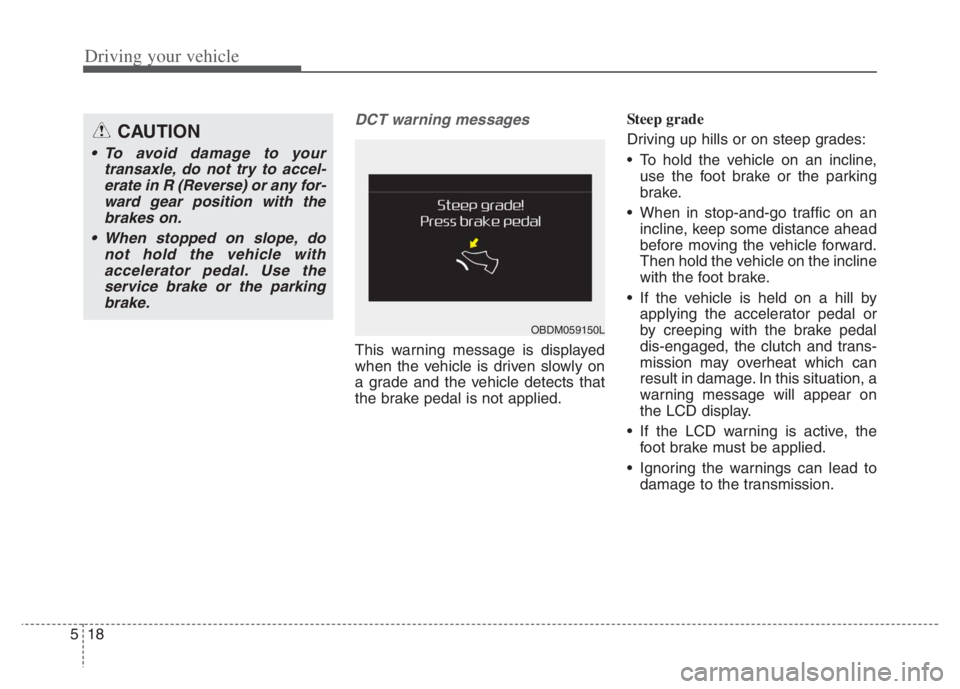
DCT warning messages
This warning message is displayed
when the vehicle is driven slowly on
a grade and the vehicle detects that
the brake pedal is not applied.Steep grade
Driving up hills or on steep grades:
To hold the vehicle on an incline,
use the foot brake or the parking
brake.
When in stop-and-go traffic on an
incline, keep some distance ahead
before moving the vehicle forward.
Then hold the vehicle on the incline
with the foot brake.
If the vehicle is held on a hill by
applying the accelerator pedal or
by creeping with the brake pedal
dis-engaged, the clutch and trans-
mission may overheat which can
result in damage. In this situation, a
warning message will appear on
the LCD display.
If the LCD warning is active, the
foot brake must be applied.
Ignoring the warnings can lead to
damage to the transmission.
CAUTION
To avoid damage to your
transaxle, do not try to accel-
erate in R (Reverse) or any for-
ward gear position with the
brakes on.
When stopped on slope, do
not hold the vehicle with
accelerator pedal. Use the
service brake or the parking
brake.
OBDM059150L
Page 342 of 710
519
Driving your vehicle
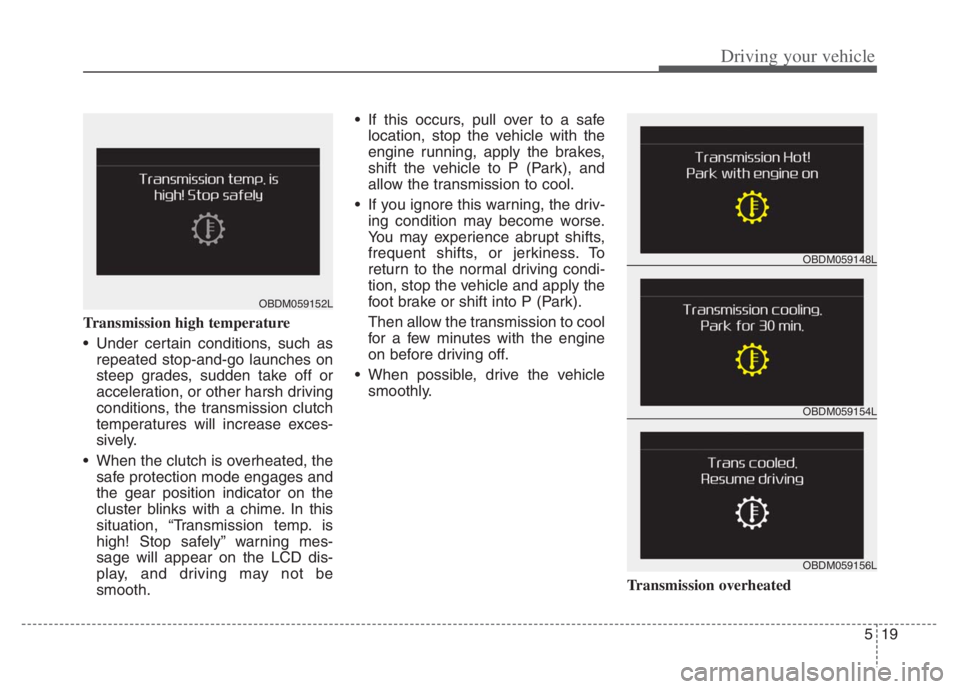
Transmission high temperature
Under certain conditions, such as
repeated stop-and-go launches on
steep grades, sudden take off or
acceleration, or other harsh driving
conditions, the transmission clutch
temperatures will increase exces-
sively.
When the clutch is overheated, the
safe protection mode engages and
the gear position indicator on the
cluster blinks with a chime. In this
situation, “Transmission temp. is
high! Stop safely” warning mes-
sage will appear on the LCD dis-
play, and driving may not be
smooth. If this occurs, pull over to a safe
location, stop the vehicle with the
engine running, apply the brakes,
shift the vehicle to P (Park), and
allow the transmission to cool.
If you ignore this warning, the driv-
ing condition may become worse.
You may experience abrupt shifts,
frequent shifts, or jerkiness. To
return to the normal driving condi-
tion, stop the vehicle and apply the
foot brake or shift into P (Park).
Then allow the transmission to cool
for a few minutes with the engine
on before driving off.
When possible, drive the vehicle
smoothly.
Transmission overheated
OBDM059152L
OBDM059154L OBDM059148L
OBDM059156L
Page 343 of 710
Driving your vehicle
20 5
If the vehicle continues to be driv-
en and the clutch temperatures
reach the maximum temperature
limit, the " Transmission Hot! Park
with engine on" warning will be dis-
played. When this occurs, the
clutch is disabled until the clutch
cools to normal temperatures.
The warning will display a time to
wait for the transmission to cool.
If this occurs, pull over to a safe
location, stop the vehicle with the
engine running, apply the brakes,
shift the vehicle to P (Park), and
allow the transmission to cool.
When the message "Trans cooled.
Resume driving.“ appears, you can
continue to drive your vehicle.
When possible, drive the vehicle
smoothly.
If any of the warning messages in
the LCD display continue to blink, for
your safety, we recommend having
the system checked by an authorized
Kia dealer.Transmission ranges
The indicator in the instrument clus-
ter displays the shift lever position
when the ignition switch or ENGINE
START/STOP button is in the ON
position.P (Park)
Always come to a complete stop
before shifting into P (Park).
To shift from P (Park), you must
depress firmly on the brake pedal
and make sure your foot is off the
accelerator pedal.
The shift lever must be in P (Park)
before turning the engine off.
WARNING
Shifting into P (Park) while the
vehicle is in motion may
cause you to lose control of
the vehicle.
After the vehicle has stopped,
always make sure the shift
lever is in P (Park), apply the
parking brake, and turn the
engine off.
Do not use the P (Park) position
in place of the parking brake.
Page 344 of 710
521
Driving your vehicle
R (Reverse)
Use this position to drive the vehicle
backward.N (Neutral)
The wheels and transmission are not
engaged.- Parking in N (Neutral) gear
Follow below steps when parking
and you want the vehicle to move
when pushed.
1.After parking your vehicle, step on
the brake pedal and move the shift
lever to [P] with the ignition switch or
ENGINE START/STOP button in
[ON] or while the engine is running.
2.If the parking brake is applied
unlock the parking brake.
- For EPB (Electronic Parking
Brake) equipped vehicles, push
the brake pedal with the ignition
switch or ENGINE START/STOP
button in [ON] or while the engine
is running to disengage the park-
ing brake. If [AUTO HOLD] func-
tion is used while driving (If
[AUTO HOLD] indicator is on in
the cluster), press [AUTO HOLD]
switch and [AUTO HOLD] func-
tion should be turn off.
CAUTION
Always come to a complete stop
before shifting into or out of R
(Reverse); you may damage the
transmission if you shift into R
(Reverse) while the vehicle is in
motion.
WARNING
Do not shift into gear unless
your foot is firmly on the brake
pedal. Shifting into gear when
the engine is running at high
speed can cause the vehicle to
move very rapidly. You could
lose control of the vehicle and
hit people or objects.
WARNING
Do not drive with the shift lever
in N (Neutral).
The engine brake may not work
and lead to an accident.
Page 345 of 710
![KIA NIRO PHEV 2021 Owners Manual Driving your vehicle
22 5
3.While pressing the brake pedal,
turn the ignition switch or ENGINE
START/STOP button [OFF].
- For smart key equipped vehicles,
the ignition switch or ENGINE
START/STOP bu](/img/2/54749/w960_54749-344.png "KIA NIRO PHEV 2021 Owners Manual Driving your vehicle
22 5
3.While pressing the brake pedal,
turn the ignition switch or ENGINE
START/STOP button [OFF].
- For smart key equipped vehicles,
the ignition switch or ENGINE
START/STOP bu")
Driving your vehicle
22 5
3.While pressing the brake pedal,
turn the ignition switch or ENGINE
START/STOP button [OFF].
- For smart key equipped vehicles,
the ignition switch or ENGINE
START/STOP button can be
moved to [OFF] only when the
shift lever is in [P].
4.Change the gear shift lever to [N]
(Neutral) while pressing the brake
pedal and pushing [SHIFT LOCK
RELEASE] button or inserting,
pressing down a tool (e.g. flathead
screw-driver) into the [SHIFT LOCK
RELEASE] access hole at the same
time. Then, the vehicle will move
when external force is applied.
WARNING - Parking In
Neutral
With the exception of parking
in neutral gear, always park the
vehicle in [P] (Park) for safety
and apply the parking brake.
Before parking in [N] (Neutral)
gear, make sure the parking
ground is level and flat. Do not
park in [N] gear on any slopes
or gradients. If parked and left
in [N], the vehicle may move
and cause serious damage or
injury.
After the ignition switch or
ENGINE START/STOP button
has been turned off, the
Electronic Parking Brake can-
not be disengaged.
(Continued)(Continued)
For EPB (Electronic Parking
Brake) equipped vehicles with
[AUTO HOLD] function used
while driving, if the ignition
switch or ENGINE
START/STOP button has been
turned [OFF], the Electronic
Parking Brake will be engaged
automatically. Therefore,
[AUTO HOLD] function should
be turned off before the igni-
tion button is turned off.
Page 348 of 710
525
Driving your vehicle
Shift lock system
For your safety, the dual clutch trans-
mission has a shift lock system which
prevents shifting the transaxle from P
(Park) into R (Reverse) unless the
brake pedal is depressed.
To shift the transaxle from P (Park)
into R (Reverse):
1. Depress and hold the brake pedal.
2. Start the engine or turn the ignition
switch or ENGINE START/STOP
button to the ON position.
3. Move the shift lever.
If the brake pedal is repeatedly
depressed and released with the shift
lever in the P (Park) position, a chat-
tering noise & vibration near the shift
lever may be heard. This is a normal
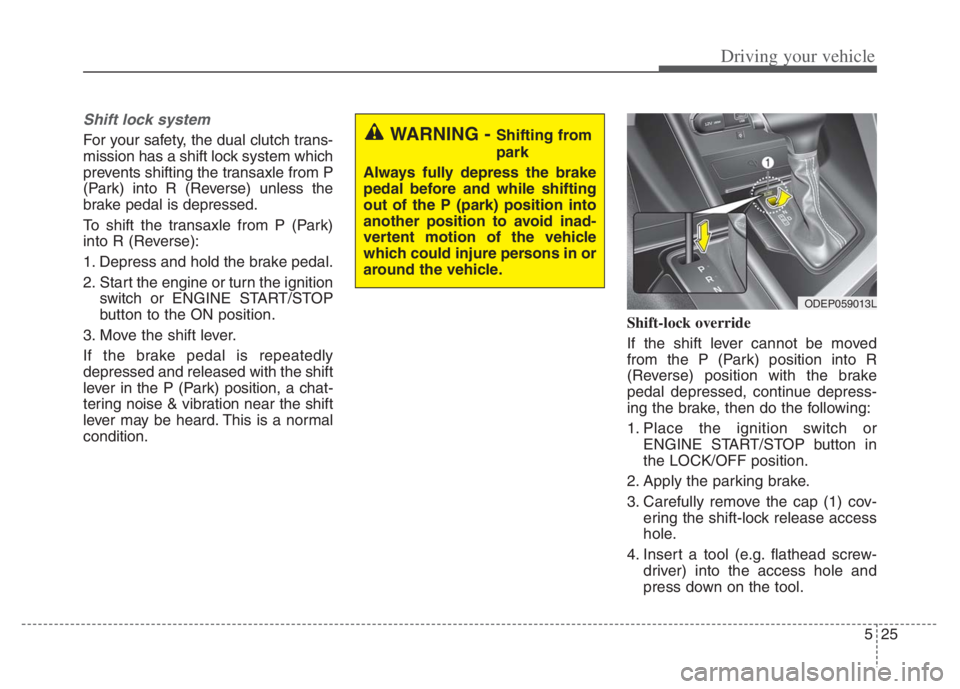
condition.Shift-lock override
If the shift lever cannot be moved
from the P (Park) position into R
(Reverse) position with the brake
pedal depressed, continue depress-
ing the brake, then do the following:
1. Place the ignition switch or
ENGINE START/STOP button in
the LOCK/OFF position.
2. Apply the parking brake.
3. Carefully remove the cap (1) cov-
ering the shift-lock release access
hole.
4. Insert a tool (e.g. flathead screw-
driver) into the access hole and
press down on the tool.WARNING - Shifting from
park
Always fully depress the brake
pedal before and while shifting
out of the P (park) position into
another position to avoid inad-
vertent motion of the vehicle
which could injure persons in or
around the vehicle.
ODEP059013L
Page 350 of 710
527
Driving your vehicle
Always use the parking brake. Do
not depend on placing the
transaxle in P (Park) to keep the
car from moving.
Exercise extreme caution when
driving on a slippery surface. Be
especially careful when braking,
accelerating or shifting gears. On a
slippery surface, an abrupt change
in vehicle speed can cause the
drive wheels to lose traction and
the vehicle to go out of control.
Optimum vehicle performance and
economy is obtained by smoothly
depressing and releasing the
accelerator pedal.
CAUTION
- Holding the Vehicle Using
Accelerator Pedal
Do not attempt to hold your
vehicle on a hill by applying the
accelerator pedal. This can
cause your clutch and transmis-
sion to be damaged as a result
of overheating.
WARNING
If your vehicle becomes stuck in
snow, mud, sand, etc., then you
may attempt to rock the vehicle
free by moving it forward and
backward. Do not attempt this
procedure if people or objects
are anywhere near the vehicle.
During the rocking operation the
vehicle may suddenly move for-
ward of backward as it becomes
unstuck, causing injury or dam-
age to nearby people or objects.
WARNING
When driving uphill or downhill,
always shift to D (Drive) for driv-
ing forward or shift to R
(Reverse) for driving backwards,
and check the gear position
indicated on the cluster before
driving.
Driving in the opposite direction
of the selected gear can lead to
a dangerous situation by shut-
ting off the engine and affecting
the braking performance.
Page 351 of 710
![KIA NIRO PHEV 2021 Owners Manual Driving your vehicle
28 5
Regenerative Braking
(Paddle Shifter)
The paddle shifter is used to adjust
the regenerative braking level from 0
to 3 during decelerating or braking.
Left side [-] : Increa](/img/2/54749/w960_54749-350.png "KIA NIRO PHEV 2021 Owners Manual Driving your vehicle
28 5
Regenerative Braking
(Paddle Shifter)
The paddle shifter is used to adjust
the regenerative braking level from 0
to 3 during decelerating or braking.
Left side [-] : Increa")
Driving your vehicle
28 5
Regenerative Braking
(Paddle Shifter)
The paddle shifter is used to adjust
the regenerative braking level from 0
to 3 during decelerating or braking.
Left side [-] : Increases regenera-
tive braking and deceleration.
Right side [+] : Decreases regener-
ative braking and deceleration.
✽ ✽
NOTICE
• The control level will be started at
0 when the engine start. It will
activate only in D (Drive) range.
• If you operate the shift lever (to P,
R, N/Sport), Regen B mode will be
cancelled and if you return to D
(Drive) range, the Regen B mode
will be returned to 0 level.
• Regen B mode will be cancelled
when ABS, ESC operate.
• The speed decrement may differ-
ent depends on the vehicle speed
even in the same Regen B level.
(The speed decrement in each level
is bigger in the city driving than
that of highway driving.)
✽ ✽
NOTICE
The vehicle does not completely stop
by using paddle shifter lever. When
the Regen B power reduced, the
vehicle slowly moves about 10 km/h.
In order to stop the vehicle, depress
the brake pedal.
✽ ✽
NOTICE
The paddle shifter does not operate
when:
• The [-] and [+] paddle shifters are
pulled at the same time.
• The vehicle is decelerating by
depressing the brake pedal.
• Cruise Control or Smart Cruise
Control is activated.
REGENERATIVE BRAKING SYSTEM
ODEP059294
WARNING
Usage of the regenerative brak-
ing function may be limited
according to the battery and
motor’s condition. (over charge,
high and low temperature)
Check traffic and driving condi-
tions. If necessary, control the
vehicle speed by using the
brake pedal.
Page 353 of 710
Driving your vehicle
30 5
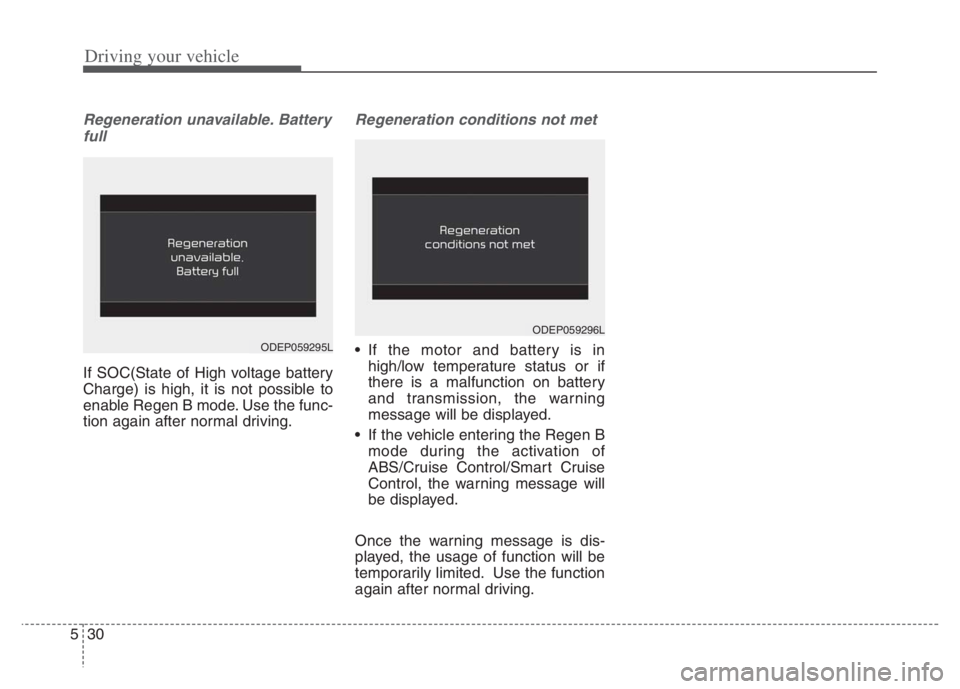
Regeneration unavailable. Battery
full
If SOC(State of High voltage battery
Charge) is high, it is not possible to
enable Regen B mode. Use the func-
tion again after normal driving.
Regeneration conditions not met
If the motor and battery is in
high/low temperature status or if
there is a malfunction on battery
and transmission, the warning
message will be displayed.
If the vehicle entering the Regen B
mode during the activation of
ABS/Cruise Control/Smart Cruise
Control, the warning message will
be displayed.
Once the warning message is dis-
played, the usage of function will be
temporarily limited. Use the function
again after normal driving.
ODEP059296L
ODEP059295L
Page 354 of 710
531
Driving your vehicle
Power brakes
Your vehicle has power-assisted
brakes that adjust automatically
through normal usage.
If the hybrid system is not on or is
turned off while driving, the power
assist for the brakes will not work.
You can still stop your vehicle by
applying greater force to the brake
pedal than typical. The stopping dis-
tance, however, will be longer than
with power brakes.
When the hybrid system is not on,
the reserve brake power is partially
depleted each time the brake pedal
is applied. Do not pump the brake
pedal when the power assist has
been interrupted.
Pump the brake pedal only when
necessary to maintain steering con-
trol on slippery surfaces.
BRAKE SYSTEM
WARNING- Steep hill
braking
Avoid continuous application of
the brakes when descending a
long or steep hill by shifting to a
lower gear. Continuous brake
application may cause the
brakes to overheat and could
result in a temporary loss of
braking performance.
WARNING- HEV driving
down hill
Do not turn off the Hybrid sys-
tem while going down a hill. The
brake booster may not work
sufficiently and the braking dis-
tance may be longer.CAUTION- Brake Pedal
Do not drive with your foot rest-
ing on the brake pedal. This will
create abnormally high brake
temperatures which can cause
excessive brake lining and pad
wear.