engine oil KIA NIRO PHEV 2021 Owner's Manual
[x] Cancel search | Manufacturer: KIA, Model Year: 2021, Model line: NIRO PHEV, Model: KIA NIRO PHEV 2021Pages: 710, PDF Size: 14.77 MB
Page 590 of 710
Maintenance
26 7
BRAKE FLUID
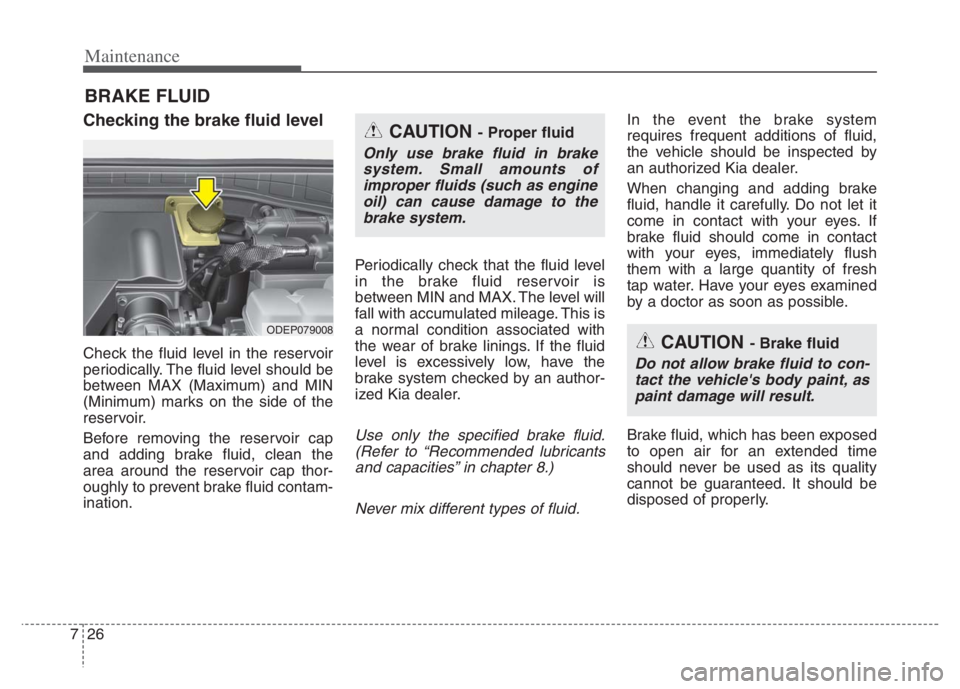
Checking the brake fluid level
Check the fluid level in the reservoir
periodically. The fluid level should be
between MAX (Maximum) and MIN
(Minimum) marks on the side of the
reservoir.
Before removing the reservoir cap
and adding brake fluid, clean the
area around the reservoir cap thor-
oughly to prevent brake fluid contam-
ination.Periodically check that the fluid level
in the brake fluid reservoir is
between MIN and MAX. The level will
fall with accumulated mileage. This is
a normal condition associated with
the wear of brake linings. If the fluid
level is excessively low, have the
brake system checked by an author-
ized Kia dealer.
Use only the specified brake fluid.
(Refer to “Recommended lubricants
and capacities” in chapter 8.)
Never mix different types of fluid.
In the event the brake system
requires frequent additions of fluid,
the vehicle should be inspected by
an authorized Kia dealer.
When changing and adding brake
fluid, handle it carefully. Do not let it
come in contact with your eyes. If
brake fluid should come in contact
with your eyes, immediately flush
them with a large quantity of fresh
tap water. Have your eyes examined
by a doctor as soon as possible.
Brake fluid, which has been exposed
to open air for an extended time
should never be used as its quality
cannot be guaranteed. It should be
disposed of properly.
CAUTION - Brake fluid
Do not allow brake fluid to con-
tact the vehicle's body paint, as
paint damage will result.
CAUTION - Proper fluid
Only use brake fluid in brake
system. Small amounts of
improper fluids (such as engine
oil) can cause damage to the
brake system.
ODEP079008
Page 592 of 710
Maintenance
28 7
ENGINE CLUTCH ACTUATOR FLUID
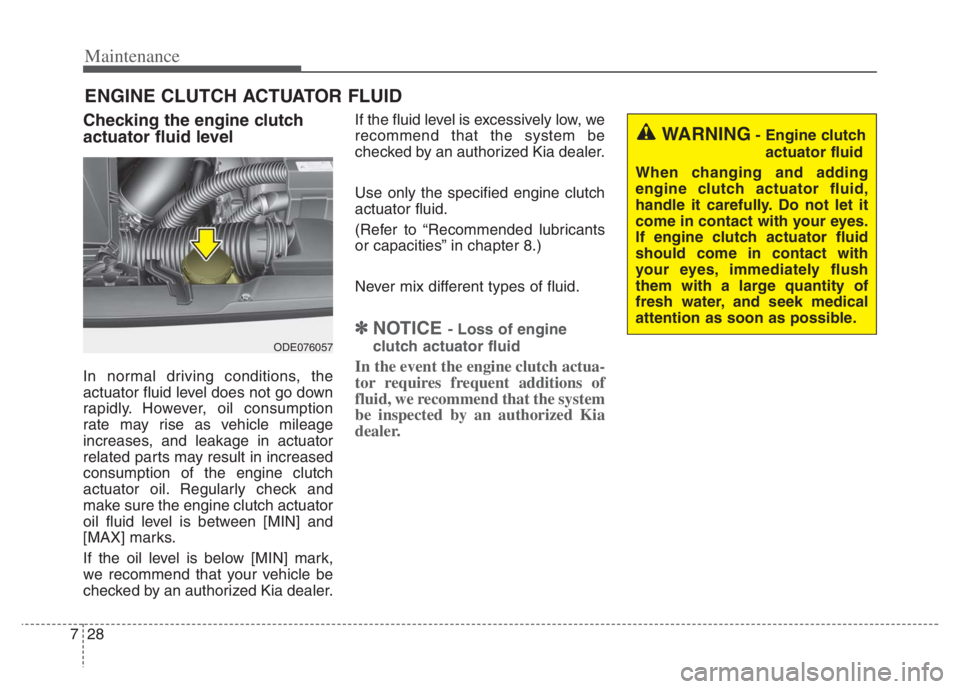
Checking the engine clutch
actuator fluid level
In normal driving conditions, the
actuator fluid level does not go down
rapidly. However, oil consumption
rate may rise as vehicle mileage
increases, and leakage in actuator
related parts may result in increased
consumption of the engine clutch
actuator oil. Regularly check and
make sure the engine clutch actuator
oil fluid level is between [MIN] and
[MAX] marks.
If the oil level is below [MIN] mark,
we recommend that your vehicle be
checked by an authorized Kia dealer.If the fluid level is excessively low, we
recommend that the system be
checked by an authorized Kia dealer.
Use only the specified engine clutch
actuator fluid.
(Refer to “Recommended lubricants
or capacities” in chapter 8.)
Never mix different types of fluid.
✽ ✽
NOTICE - Loss of engine
clutch actuator fluid
In the event the engine clutch actua-
tor requires frequent additions of
fluid, we recommend that the system
be inspected by an authorized Kia
dealer.
WARNING- Engine clutch
actuator fluid
When changing and adding
engine clutch actuator fluid,
handle it carefully. Do not let it
come in contact with your eyes.
If engine clutch actuator fluid
should come in contact with
your eyes, immediately flush
them with a large quantity of
fresh water, and seek medical
attention as soon as possible.
ODE076057
Page 593 of 710
729
Maintenance
CAUTION
Do not allow engine clutch actu-
ator fluid to contact the vehi-
cle's body paint, as paint dam-
age will result. The engine
clutch actuator fluid that has
been exposed to open air for an
extended time should never be
used as its quality cannot be
guaranteed. It should be proper-
ly disposed. Do not put in the
wrong kind of fluid. A few drops
of mineral-based oil, such as
engine oil, in your engine clutch
actuator system can damage
engine clutch actuator system
parts.
Page 605 of 710
741
Maintenance
When recharging the battery,
observe the following precautions:
The battery must be removed from
the vehicle and placed in an area
with good ventilation.
Do not allow cigarettes, sparks, or
flame near the battery.
Watch the battery during charging,
and stop or reduce the charging
rate if the battery cells begin
gassing (boiling) violently or if the
temperature of the electrolyte of
any cell exceeds 120°F (49°C).
Wear eye protection when check-
ing the battery during charging.
Disconnect the battery charger in
the following order.
1. Turn off the battery charger main
switch.
2. Unhook the negative clamp from
the negative battery terminal.
3. Unhook the positive clamp from
the positive battery terminal. Before performing maintenance or
recharging the battery, turn off all
accessories and stop the engine.
The negative battery cable must be
removed first and installed last
when the battery is disconnected.Reset items
The following items should be reset
after the battery has been dis-
charged or the battery has been dis-
connected.
Auto up/down window
Sunroof
Trip computer
Climate control system
Driver position memory system
Audio
Page 622 of 710
Maintenance
58 7
FUSES
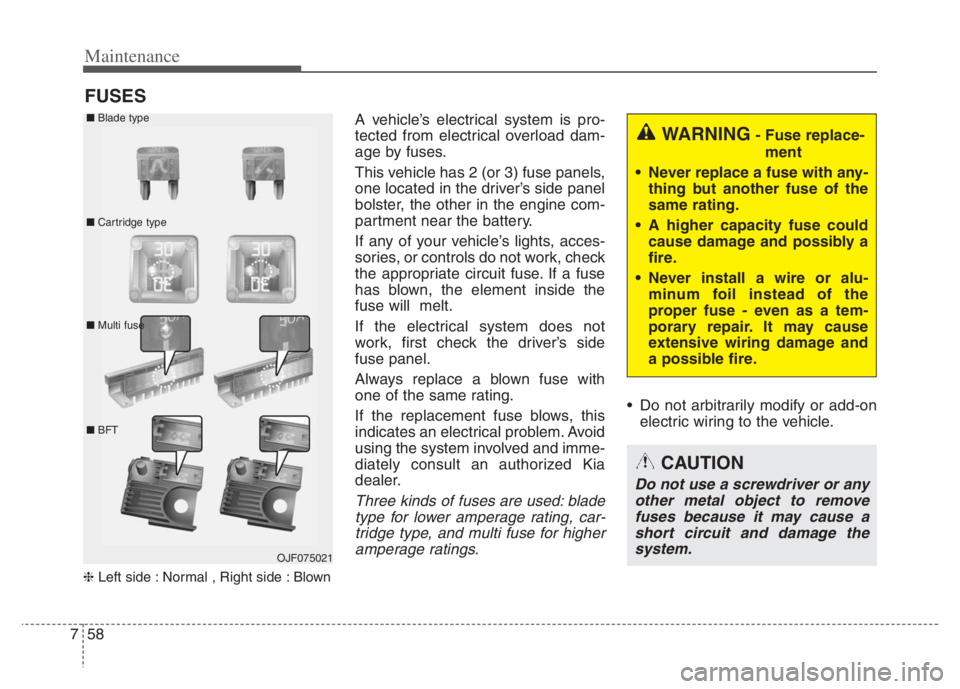
❈Left side : Normal , Right side : Blown
A vehicle’s electrical system is pro-
tected from electrical overload dam-
age by fuses.
This vehicle has 2 (or 3) fuse panels,
one located in the driver’s side panel
bolster, the other in the engine com-
partment near the battery.
If any of your vehicle’s lights, acces-
sories, or controls do not work, check
the appropriate circuit fuse. If a fuse
has blown, the element inside the
fuse will melt.
If the electrical system does not
work, first check the driver’s side
fuse panel.
Always replace a blown fuse with
one of the same rating.
If the replacement fuse blows, this
indicates an electrical problem. Avoid
using the system involved and imme-
diately consult an authorized Kia
dealer.
Three kinds of fuses are used: blade
type for lower amperage rating, car-
tridge type, and multi fuse for higher
amperage ratings.
Do not arbitrarily modify or add-on
electric wiring to the vehicle.
WARNING- Fuse replace-
ment
Never replace a fuse with any-
thing but another fuse of the
same rating.
A higher capacity fuse could
cause damage and possibly a
fire.
Never install a wire or alu-
minum foil instead of the
proper fuse - even as a tem-
porary repair. It may cause
extensive wiring damage and
a possible fire.
CAUTION
Do not use a screwdriver or any
other metal object to remove
fuses because it may cause a
short circuit and damage the
system.
OJF075021 ■Blade type
■Cartridge type
■Multi fuse
■BFT
Page 641 of 710
777
Maintenance
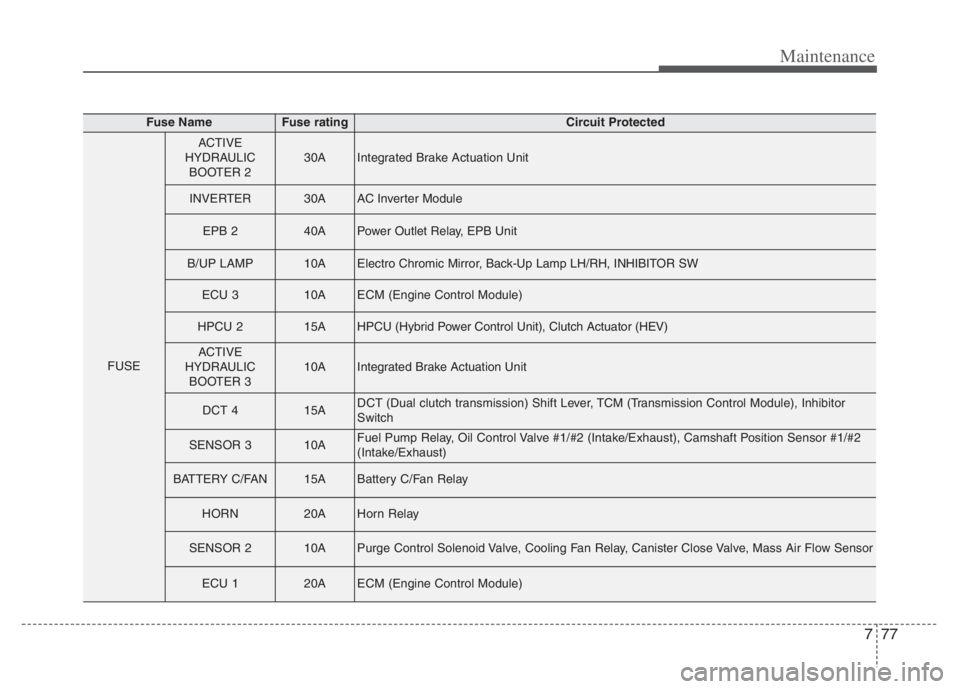
Fuse NameFuse ratingCircuit Protected
FUSE
ACTIVE
HYDRAULIC
BOOTER 230AIntegrated Brake Actuation Unit
INVERTER30AAC Inverter Module
EPB 240APower Outlet Relay, EPB Unit
B/UP LAMP10AElectro Chromic Mirror, Back-Up Lamp LH/RH, INHIBITOR SW
ECU 310AECM (Engine Control Module)
HPCU 215AHPCU (Hybrid Power Control Unit), Clutch Actuator (HEV)
ACTIVE
HYDRAULIC
BOOTER 310AIntegrated Brake Actuation Unit
DCT 415ADCT (Dual clutch transmission) Shift Lever, TCM (Transmission Control Module), Inhibitor
Switch
SENSOR 310AFuel Pump Relay, Oil Control Valve #1/#2 (Intake/Exhaust), Camshaft Position Sensor #1/#2
(Intake/Exhaust)
BATTERY C/FAN15ABattery C/Fan Relay
HORN20AHorn Relay
SENSOR 210APurge Control Solenoid Valve, Cooling Fan Relay, Canister Close Valve, Mass Air Flow Sensor
ECU 120AECM (Engine Control Module)
Page 642 of 710
Maintenance
78 7
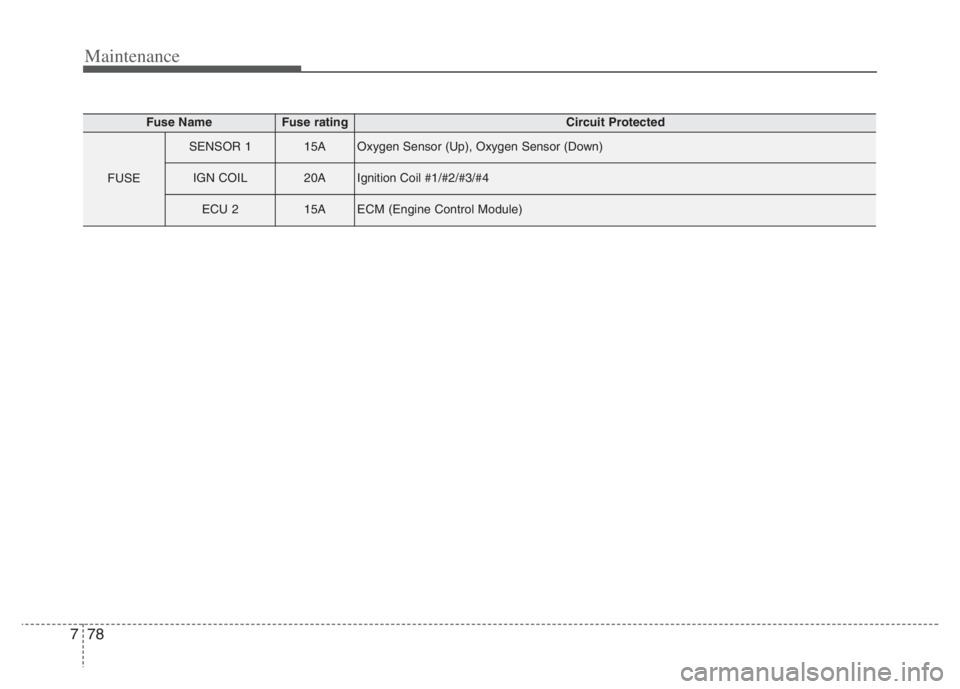
Fuse NameFuse ratingCircuit Protected
FUSE
SENSOR 115AOxygen Sensor (Up), Oxygen Sensor (Down)
IGN COIL20AIgnition Coil #1/#2/#3/#4
ECU 215AECM (Engine Control Module)
Page 645 of 710
781
Maintenance
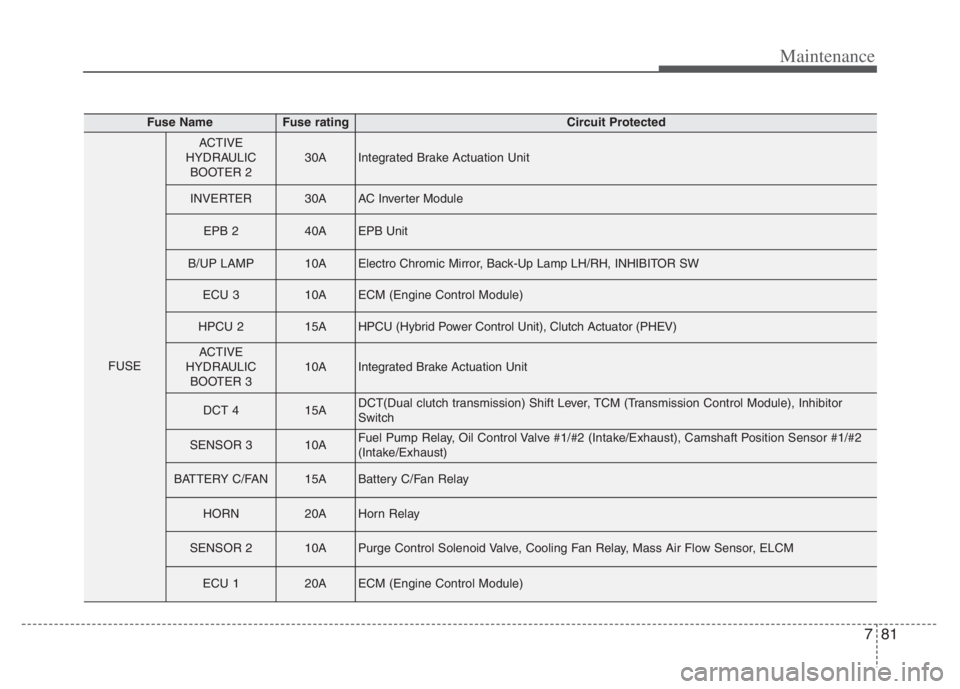
Fuse NameFuse ratingCircuit Protected
FUSE
ACTIVE
HYDRAULIC
BOOTER 230AIntegrated Brake Actuation Unit
INVERTER30AAC Inverter Module
EPB 240AEPB Unit
B/UP LAMP10AElectro Chromic Mirror, Back-Up Lamp LH/RH, INHIBITOR SW
ECU 310AECM (Engine Control Module)
HPCU 215AHPCU (Hybrid Power Control Unit), Clutch Actuator (PHEV)
ACTIVE
HYDRAULIC
BOOTER 310AIntegrated Brake Actuation Unit
DCT 415ADCT(Dual clutch transmission) Shift Lever, TCM (Transmission Control Module), Inhibitor
Switch
SENSOR 310AFuel Pump Relay, Oil Control Valve #1/#2 (Intake/Exhaust), Camshaft Position Sensor #1/#2
(Intake/Exhaust)
BATTERY C/FAN15ABattery C/Fan Relay
HORN20AHorn Relay
SENSOR 210APurge Control Solenoid Valve, Cooling Fan Relay, Mass Air Flow Sensor, ELCM
ECU 120AECM (Engine Control Module)
Page 646 of 710
Maintenance
82 7
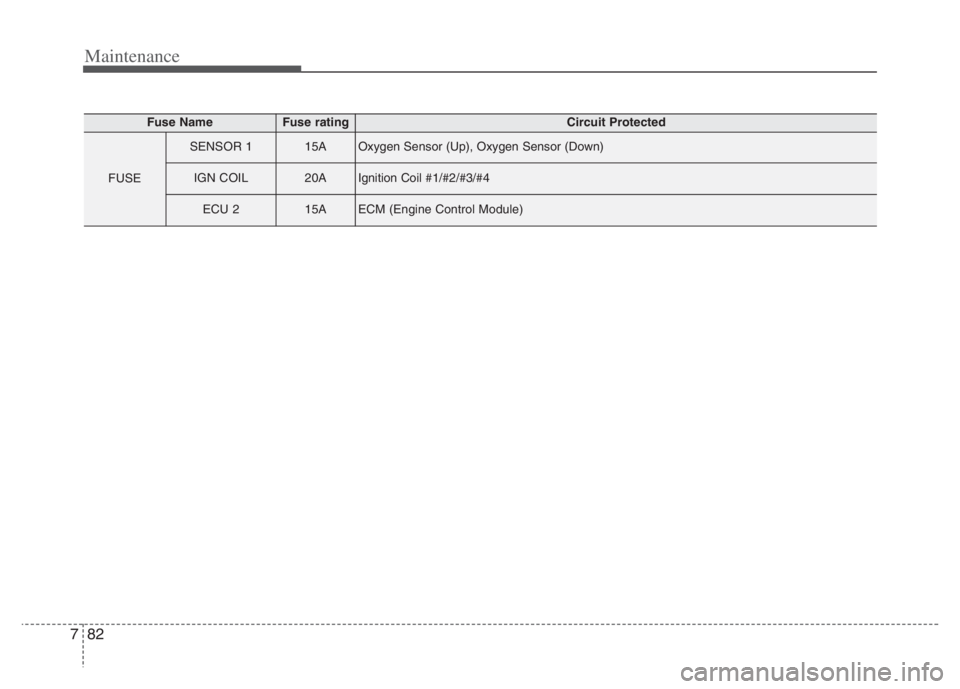
Fuse NameFuse ratingCircuit Protected
FUSE
SENSOR 115AOxygen Sensor (Up), Oxygen Sensor (Down)
IGN COIL20AIgnition Coil #1/#2/#3/#4
ECU 215AECM (Engine Control Module)
Page 689 of 710
Specifications, Consumer information, Reporting safety defects
8 8
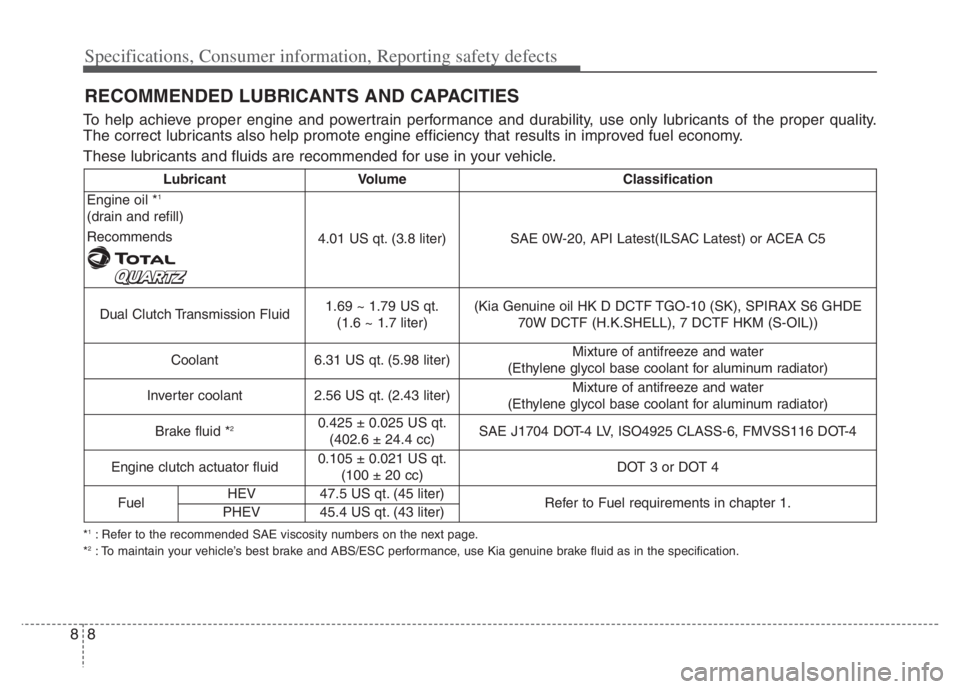
RECOMMENDED LUBRICANTS AND CAPACITIES
To help achieve proper engine and powertrain performance and durability, use only lubricants of the proper quality.
The correct lubricants also help promote engine efficiency that results in improved fuel economy.
These lubricants and fluids are recommended for use in your vehicle.
*1: Refer to the recommended SAE viscosity numbers on the next page.
*2: To maintain your vehicle’s best brake and ABS/ESC performance, use Kia genuine brake fluid as in the specification.
Lubricant VolumeClassification
Engine oil *1
(drain and refill)
Recommends
4.01 US qt. (3.8 liter)SAE 0W-20, API Latest(ILSAC Latest) or ACEA C5
Dual Clutch Transmission Fluid1.69 ~ 1.79 US qt.
(1.6 ~ 1.7 liter)(Kia Genuine oil HK D DCTF TGO-10 (SK), SPIRAX S6 GHDE
70W DCTF (H.K.SHELL), 7 DCTF HKM (S-OIL))
Coolant6.31 US qt. (5.98 liter)Mixture of antifreeze and water
(Ethylene glycol base coolant for aluminum radiator)
Inverter coolant2.56 US qt. (2.43 liter)Mixture of antifreeze and water
(Ethylene glycol base coolant for aluminum radiator)
Brake fluid *20.425 ± 0.025 US qt.
(402.6 ± 24.4 cc)SAE J1704 DOT-4 LV, ISO4925 CLASS-6, FMVSS116 DOT-4
Engine clutch actuator fluid0.105 ± 0.021 US qt.
(100 ± 20 cc)DOT 3 or DOT 4
FuelHEV47.5 US qt. (45 liter)Refer to Fuel requirements in chapter 1.PHEV45.4 US qt. (43 liter)