towing KIA Opirus 2004 1.G User Guide
[x] Cancel search | Manufacturer: KIA, Model Year: 2004, Model line: Opirus, Model: KIA Opirus 2004 1.GPages: 296, PDF Size: 29.34 MB
Page 229 of 296
In case of an emergency16
6
1
2
3
4
5
6
7
8
9
When towing your vehicle in an
emergency without wheel dollies :
1. Set the ignition switch in the ACC
position.
2. Place the transaxle shift lever in N (Neutral).
3. Release the parking brake.✽ ✽ NOTICEFailure to place the transaxle shift
lever in N (Neutral) may cause
internal damage to the transaxle.
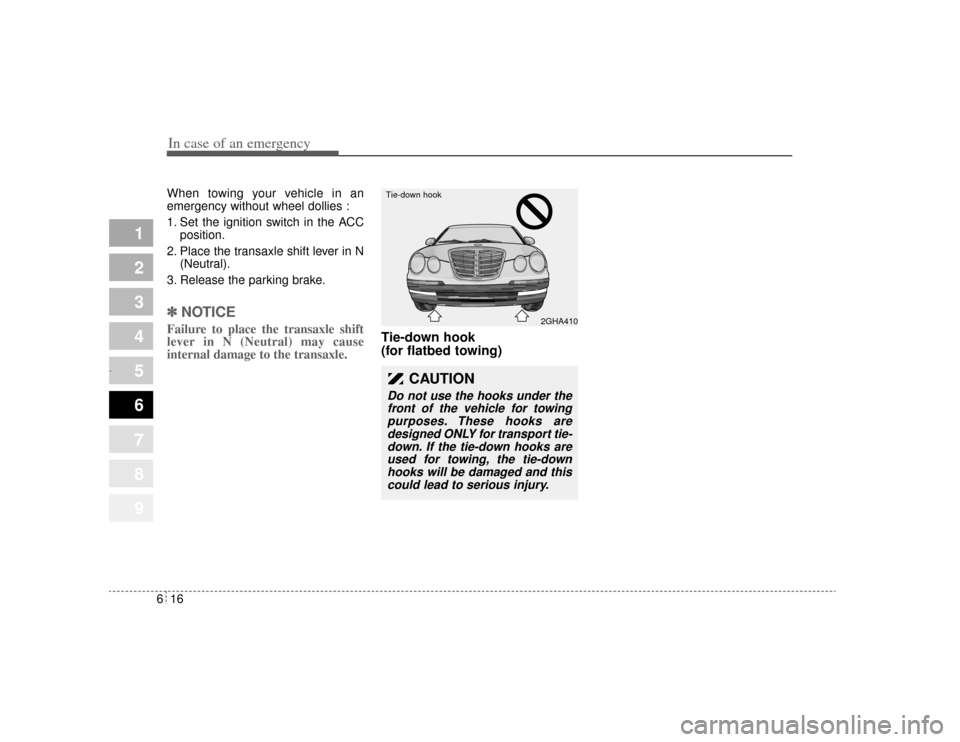
Tie-down hook
(for flatbed towing)
2GHA410
Tie-down hook
CAUTION
Do not use the hooks under the
front of the vehicle for towingpurposes. These hooks aredesigned ONLY for transport tie-down. If the tie-down hooks areused for towing, the tie-downhooks will be damaged and thiscould lead to serious injury.
Opirus CAN 6-1.qxd 7/8/03 2:22 PM Page 16
Page 230 of 296
617
In case of an emergency
1
2
3
4
5
6
7
8
9
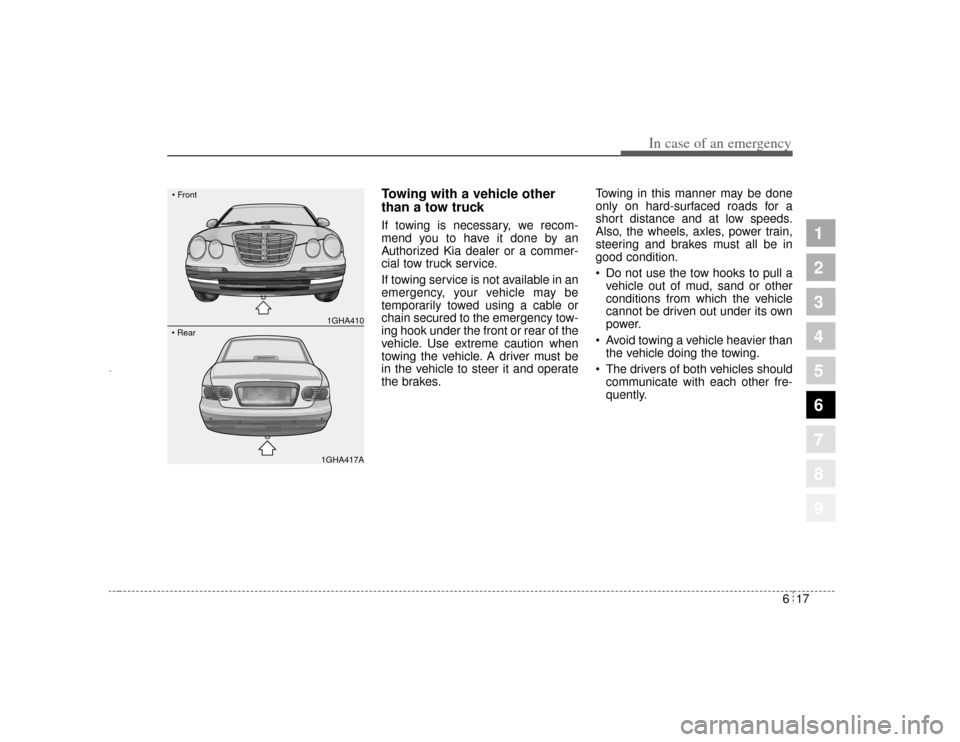
Towing with a vehicle other
than a tow truck If towing is necessary, we recom-
mend you to have it done by an
Authorized Kia dealer or a commer-
cial tow truck service.
If towing service is not available in an
emergency, your vehicle may be
temporarily towed using a cable or
chain secured to the emergency tow-
ing hook under the front or rear of the
vehicle. Use extreme caution when
towing the vehicle. A driver must be
in the vehicle to steer it and operate
the brakes.Towing in this manner may be done
only on hard-surfaced roads for a
short distance and at low speeds.
Also, the wheels, axles, power train,
steering and brakes must all be in
good condition.
Do not use the tow hooks to pull a
vehicle out of mud, sand or other
conditions from which the vehicle
cannot be driven out under its own
power.
Avoid towing a vehicle heavier than
the vehicle doing the towing.
The drivers of both vehicles should
communicate with each other fre-
quently.
1GHA410
Front1GHA417A
Rear
Opirus CAN 6-1.qxd 7/8/03 2:22 PM Page 17
Page 231 of 296
In case of an emergency18
6
1
2
3
4
5
6
7
8
9
✽ ✽
NOTICE• Attach a towing strap to the tow
hook.
• Using a portion of the vehicle other than the tow hooks for tow-
ing may damage the body of your
vehicle.
• Use only a cable or chain specifi- cally intended for use in towing
vehicles. Securely fasten the cable
or chain to the towing hook pro-
vided. Before emergency towing, check
that the hook is not broken or dam-
aged.
Fasten the towing cable or chain
securely to the hook.
Do not jerk the hook. Apply steady
and even force.
To avoid damaging the hook, do
not pull from the side or at a verti-
cal angle. Always pull straight
ahead.
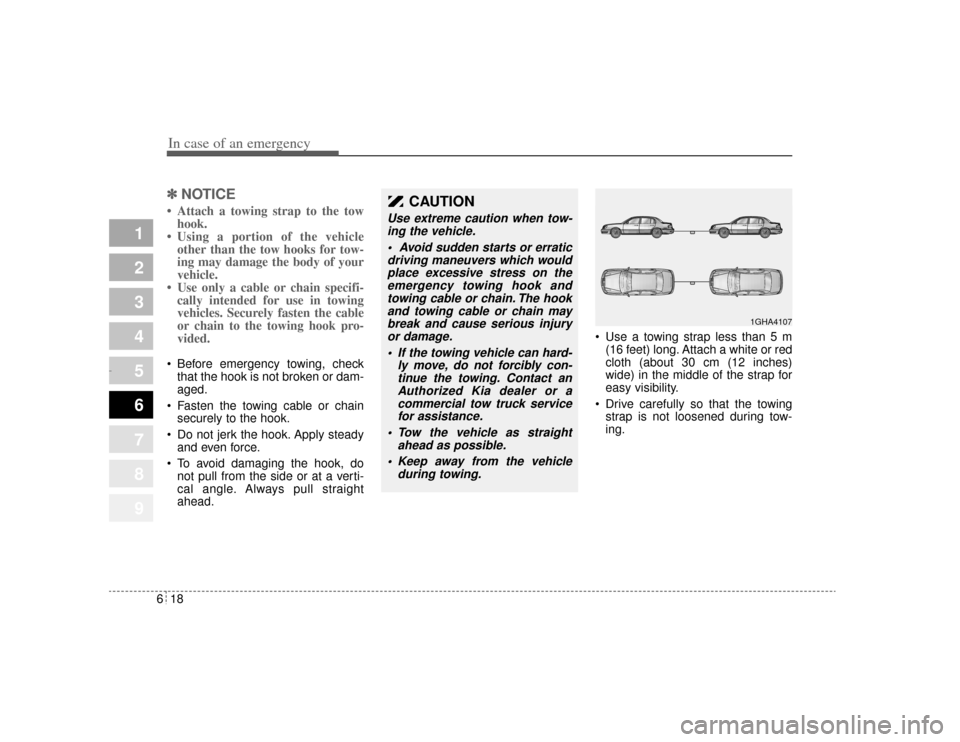
Use a towing strap less than 5 m
(16 feet) long. Attach a white or red
cloth (about 30 cm (12 inches)
wide) in the middle of the strap for
easy visibility.
Drive carefully so that the towing
strap is not loosened during tow-
ing.
CAUTION
Use extreme caution when tow-
ing the vehicle.
Avoid sudden starts or erraticdriving maneuvers which wouldplace excessive stress on theemergency towing hook andtowing cable or chain. The hookand towing cable or chain maybreak and cause serious injuryor damage.
If the towing vehicle can hard- ly move, do not forcibly con-tinue the towing. Contact anAuthorized Kia dealer or acommercial tow truck servicefor assistance.
Tow the vehicle as straight ahead as possible.
Keep away from the vehicle during towing.
1GHA4107
Opirus CAN 6-1.qxd 7/8/03 2:22 PM Page 18
Page 232 of 296
619
In case of an emergency
1
2
3
4
5
6
7
8
9
When your vehicle is being
towed by another vehicle
other than a tow truck (In case
of an emergency) Turn the ignition switch to ACC so
the steering wheel isn’t locked.
Place the transaxle shift lever in N
(Neutral).
Release the parking bake.
Vehicle equipped with automatic
transaxles should not exceed 45
km/h (28 mph) and should not be
towed more than 80 km (50 miles).
Press the brake pedal with more
force than normal since you will
have reduced brake performance.
More steering effort will be
required because the power steer-
ing system will be disabled.
If you are driving down a long hill,
the brakes may overheat and brake
performance will be reduced. Stop
often and let the brakes cool off.
✽ ✽
NOTICETo prevent internal damage to the
transaxle, never tow your vehicle
from the rear (backwards) with all
four tires in contact with the sur-
face.
Tips for towing a stuck vehicleThe following methods are effective
when your vehicle is stuck in mud,
sand or similar substances that pre-
vent the vehicle from being driven
out under its own power.
Remove the soil and sand, etc.
from the front and the back of the
tires.
Place a stone or wood under the
tires.
Opirus CAN 6-1.qxd 7/8/03 2:22 PM Page 19
Page 234 of 296
621
In case of an emergency
1
2
3
4
5
6
7
8
9
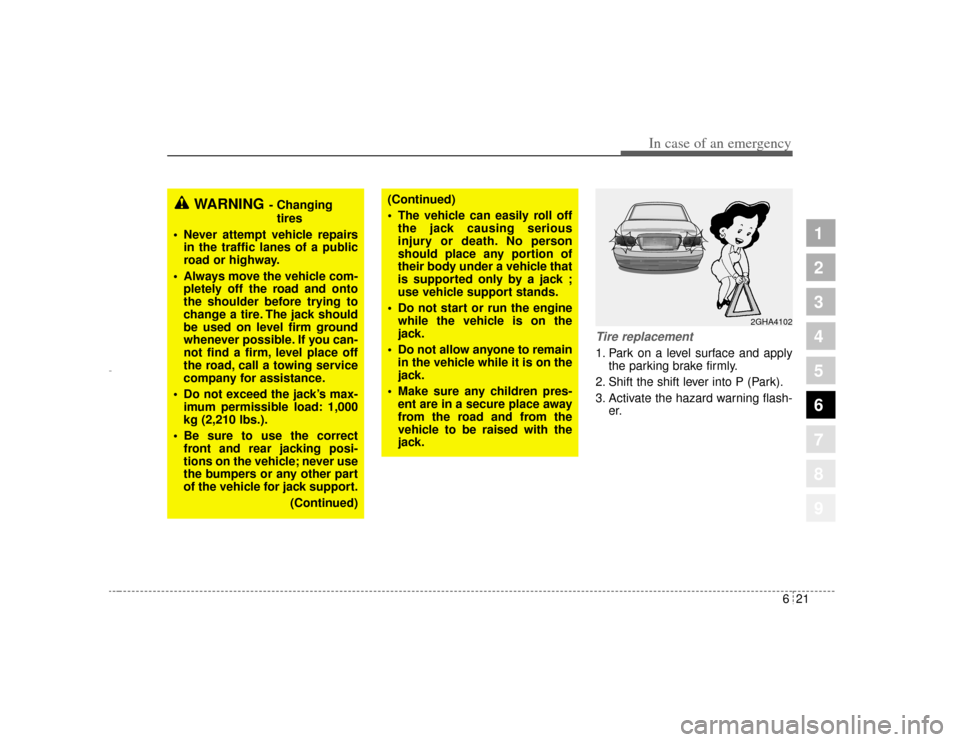
Tire replacement 1. Park on a level surface and applythe parking brake firmly.
2. Shift the shift lever into P (Park).
3. Activate the hazard warning flash- er.
WARNING
- Changing
tires
Never attempt vehicle repairs in the traffic lanes of a public
road or highway.
Always move the vehicle com- pletely off the road and onto
the shoulder before trying to
change a tire. The jack should
be used on level firm ground
whenever possible. If you can-
not find a firm, level place off
the road, call a towing service
company for assistance.
Do not exceed the jack’s max- imum permissible load: 1,000
kg (2,210 lbs.).
Be sure to use the correct front and rear jacking posi-
tions on the vehicle; never use
the bumpers or any other part
of the vehicle for jack support.
(Continued)
(Continued)
The vehicle can easily roll offthe jack causing serious
injury or death. No person
should place any portion of
their body under a vehicle that
is supported only by a jack ;
use vehicle support stands.
Do not start or run the engine while the vehicle is on the
jack.
Do not allow anyone to remain in the vehicle while it is on the
jack.
Make sure any children pres- ent are in a secure place away
from the road and from the
vehicle to be raised with the
jack.
2GHA4102
Opirus CAN 6-1.qxd 7/8/03 2:22 PM Page 21