engine overheat KIA Optima 2007 2.G User Guide
[x] Cancel search | Manufacturer: KIA, Model Year: 2007, Model line: Optima, Model: KIA Optima 2007 2.GPages: 294, PDF Size: 3.37 MB
Page 225 of 294
65
In case of an emergency
Do not allow the jumper cables to con-
tact anything except the correct bat-
tery terminals or the correct ground.
Do not lean over the battery when
making connections.
7. Start the engine of the vehicle with the booster battery and let it run at 2,000
rpm, then start the engine of the vehi-
cle with the discharged battery.If the cause of your battery discharging isnot apparent, you should have your vehi- cle checked by an authorized Kia dealer.
Push-starting Your manual transaxle-equipped vehicle
should not be push-started because it
might damage the emission control sys-
tem.
Vehicles equipped with automatic
transaxle cannot be push-started.
Follow the directions in this section for
jump-starting.
CAUTION
Never tow a vehicle to start itbecause the sudden surge forwardwhen the engine starts could causea collision with the tow vehicle.
CAUTION -
Battery cables
Do not connect the jumper cable from the negative terminal of thebooster battery to the negative ter-minal of the discharged battery. This can cause the discharged bat-tery to overheat and crack, releas-ing battery acid.
Page 226 of 294
In case of an emergency66ELECTRICAL CIRCUIT PROTECTIONFuses A vehicle’s electrical system is protected
from electrical overload damage by
fuses.This vehicle has two fuse panels, one
located in the driver's side panel bolster,
the other in the engine compartment
near the battery.
If any of your vehicle’s lights, acces-
sories, or controls do not work, check the
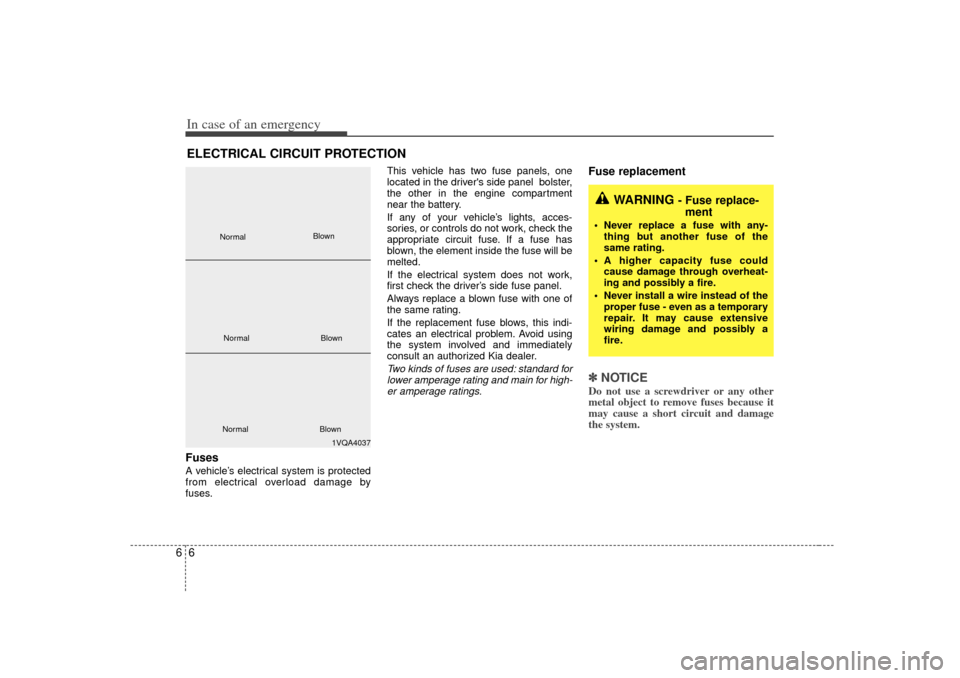
appropriate circuit fuse. If a fuse has
blown, the element inside the fuse will be
melted.
If the electrical system does not work,
first check the driver’s side fuse panel.
Always replace a blown fuse with one of
the same rating.
If the replacement fuse blows, this indi-
cates an electrical problem. Avoid using
the system involved and immediately
consult an authorized Kia dealer.
Two kinds of fuses are used: standard for
lower amperage rating and main for high-er amperage ratings.
Fuse replacement ✽ ✽ NOTICEDo not use a screwdriver or any other
metal object to remove fuses because it
may cause a short circuit and damage
the system.
WARNING
- Fuse replace-
ment
Never replace a fuse with any-
thing but another fuse of the
same rating.
A higher capacity fuse could cause damage through overheat-
ing and possibly a fire.
Never install a wire instead of the proper fuse - even as a temporary
repair. It may cause extensive
wiring damage and possibly a
fire.
1VQA4037
Normal
Normal
Blown
Blown
Normal Blown
Page 293 of 294

93
Index
If you have a flat tire ··················\
··················\
···············6-22
Ignition switch ··················\
··················\
··················\
··········4-2
Immobilizer system ··················\
··················\
··················\
··3-8
Instrument cluster ··················\
··················\
··················\
·4-24
Instrument panel overview ··················\
··················\
·······2-3
Interior care··················\
··················\
··················\
············7-38
Interior features ··················\
··················\
··················\
·····3-86
Interior lights ··················\
··················\
··················\
·········3-83
Interior overview················\
··················\
··················\
········2-2
Keys ··················\
··················\
··················\
··················\
·········3-2
Label information ··················\
··················\
··················\
··5-15
Lighting ··················\
··················\
··················\
··················\
·4-40
Lubricant specifications ··················\
··················\
··········7-35
Lubricants and fluids ··················\
··················\
··············7-17
Luggage net ··················\
··················\
··················\
············3-92
Maintenance schedule ··················\
··················\
···············7-3
Maintenance services ··················\
··················\
·················7-2
Manual climate control system··················\
·················4-48\
Manual transaxle ··················\
··················\
··················\
·····4-4
Mirrors ··················\
··················\
··················\
··················\
··3-75Overheating ··················\
··················\
··················\
··············6-2
Overloading ··················\
··················\
··················\
············5-14
Owner maintenance ··················\
··················\
··················\
·7-7
Power steering ··················\
··················\
··················\
········7-15
Remote keyless entry ··················\
··················\
·················3-4
Road warning ··················\
··················\
··················\
···········6-2
Safety belts··················\
··················\
··················\
··············3-28
Seat ··················\
··················\
··················\
··················\
········3-18
Special driving conditions ··················\
··················\
·········5-6
Specifications ··················\
··················\
··················\
············8-2
Starting the engine ··················\
··················\
··················\
···4-3
Steering wheel···············\
··················\
··················\
············4-16
Storage compartment ··················\
··················\
··············3-84
Suggestions for economical operation··················\
········5-5
Sunroof ··················\
··················\
··················\
··················\
··3-90KILM
OSPR