warning lights KIA Optima 2007 2.G User Guide
[x] Cancel search | Manufacturer: KIA, Model Year: 2007, Model line: Optima, Model: KIA Optima 2007 2.GPages: 294, PDF Size: 3.37 MB
Page 222 of 294
In case of an emergency26ROAD WARNING Hazard warning flasher The hazard warning flasher serves as a
warning to other drivers to exercise
extreme caution when approaching,
overtaking, or passing your vehicle. It
should be used whenever emergency
repairs are being made or when the vehi-
cle is stopped near the edge of a road-
way.
Depress the flasher switch with the igni-
tion switch in any position. The flasher
switch is located in the center console
switch panel. All turn signal lights will
flash simultaneously.• The hazard warning flasher operates
whether your vehicle is running or not.
The turn signals do not work when the hazard flasher is on.
Care must be taken when using the hazard warning flasher while the vehi-
cle is being towed. If your temperature gauge indicates over-
heating, if you experience a loss of
power, or if you hear a loud knocking or
pinging noise, the engine has probably
overheated. Should any of these symp-
toms occur, use the following procedure:
1. Turn on the hazard warning flasher,
then drive to the nearest safe location
and stop your vehicle; set the automat-
ic transaxle in P (Park), or shift the
manual transaxle to N (Neutral) and
apply the parking brake.
2. Make sure the air conditioner is off.
3. If coolant or steam is boiling out of the radiator, stop the engine and call an
authorized Kia dealer for assistance.
If coolant is not boiling out, allow the
engine to idle and open the hood to
permit the engine to cool gradually.
If the temperature does not go down
with the engine idling, stop the engine
and allow sufficient time for it to cool.
OVERHEATING
OMG065001
Page 226 of 294
In case of an emergency66ELECTRICAL CIRCUIT PROTECTIONFuses A vehicle’s electrical system is protected
from electrical overload damage by
fuses.This vehicle has two fuse panels, one
located in the driver's side panel bolster,
the other in the engine compartment
near the battery.
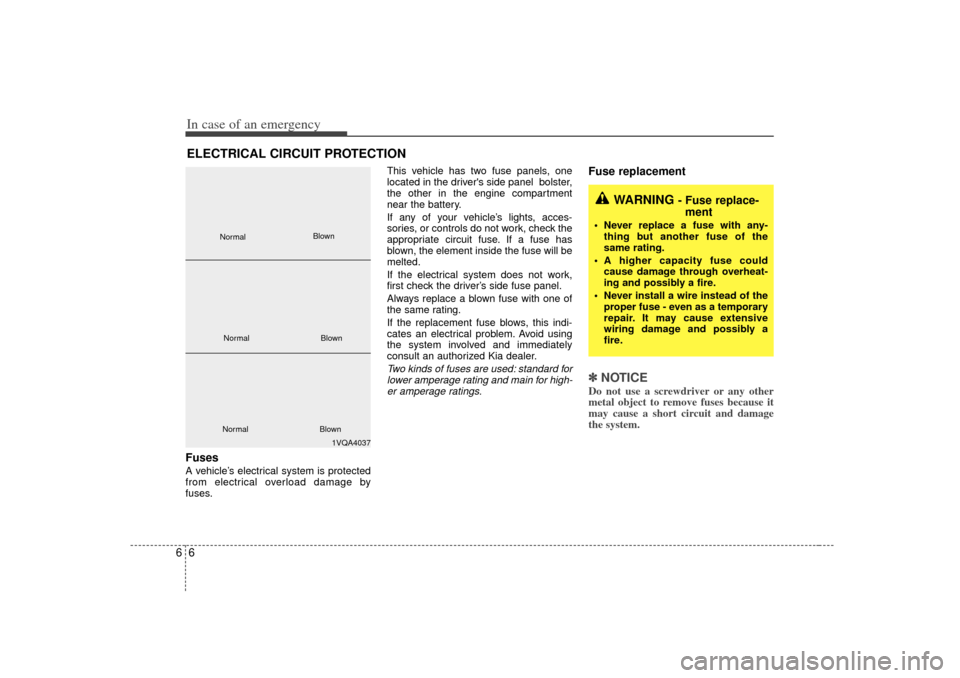
If any of your vehicle’s lights, acces-
sories, or controls do not work, check the
appropriate circuit fuse. If a fuse has
blown, the element inside the fuse will be
melted.
If the electrical system does not work,
first check the driver’s side fuse panel.
Always replace a blown fuse with one of
the same rating.
If the replacement fuse blows, this indi-
cates an electrical problem. Avoid using
the system involved and immediately
consult an authorized Kia dealer.
Two kinds of fuses are used: standard for
lower amperage rating and main for high-er amperage ratings.
Fuse replacement ✽ ✽ NOTICEDo not use a screwdriver or any other
metal object to remove fuses because it
may cause a short circuit and damage
the system.
WARNING
- Fuse replace-
ment
Never replace a fuse with any-
thing but another fuse of the
same rating.
A higher capacity fuse could cause damage through overheat-
ing and possibly a fire.
Never install a wire instead of the proper fuse - even as a temporary
repair. It may cause extensive
wiring damage and possibly a
fire.
1VQA4037
Normal
Normal
Blown
Blown
Normal Blown
Page 232 of 294
In case of an emergency12
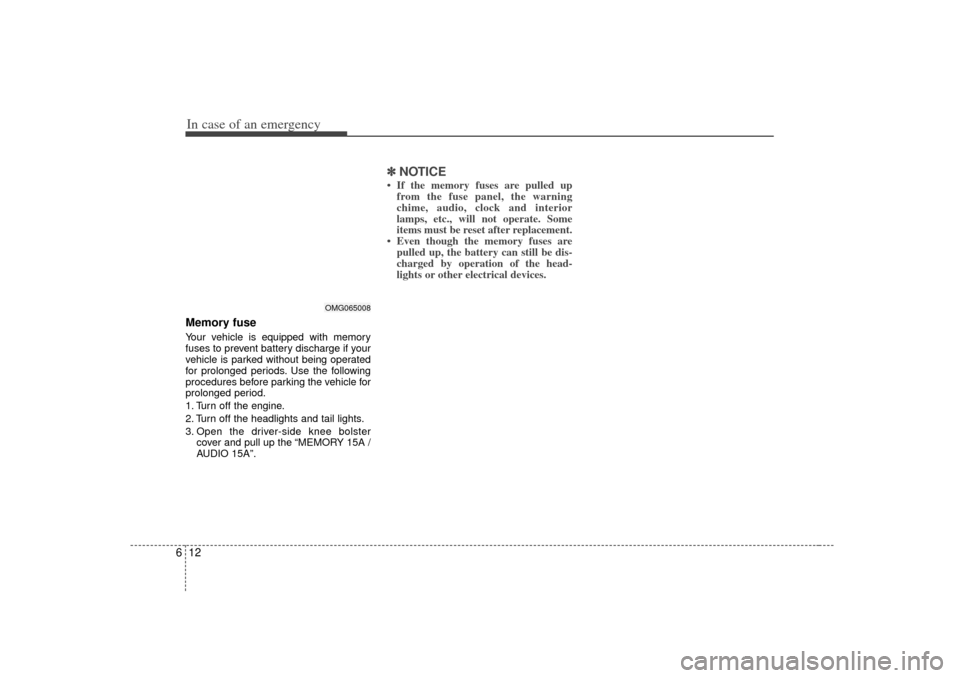
6Memory fuseYour vehicle is equipped with memory
fuses to prevent battery discharge if your
vehicle is parked without being operated
for prolonged periods. Use the following
procedures before parking the vehicle for
prolonged period.
1. Turn off the engine.
2. Turn off the headlights and tail lights.
3. Open the driver-side knee bolster
cover and pull up the “MEMORY 15A /
AUDIO 15A”.
✽ ✽NOTICE• If the memory fuses are pulled up
from the fuse panel, the warning
chime, audio, clock and interior
lamps, etc., will not operate. Some
items must be reset after replacement.
• Even though the memory fuses are pulled up, the battery can still be dis-
charged by operation of the head-
lights or other electrical devices.
OMG065008
Page 254 of 294
77
Maintenance
OWNER MAINTENANCE Owner maintenance schedule The following lists are vehicle checks and
inspections that should be performed by
the owner or an authorized Kia dealer at
the frequencies indicated to help ensure
safe, dependable operation of your vehi-
cle.
Any adverse conditions should be
brought to the attention of your dealer as
soon as possible.
These Owner Maintenance Checks are
generally not covered by warranties and
you may be charged for labor, parts and
lubricants used.When you stop for fuel: Check the engine oil level.
Check coolant level in coolant reser-voir.
Check the windshield washer fluid level.
Look for low or under-inflated tires.
While operating your vehicle: Note any changes in the sound of the exhaust or any smell of exhaust fumes
in the vehicle.
Check for vibrations in the steering wheel. Notice any increased steering
effort or looseness in the steering
wheel, or change in its straight-ahead
position.
Notice if your vehicle constantly turns slightly or “pulls” to one side when trav-
eling on smooth, level road.
When stopping, listen and check for strange sounds, pulling to one side,
increased brake pedal travel or “hard-
to-push” brake pedal.
If any slipping or changes in the oper- ation of your transaxle occurs, check
the transaxle fluid level.
Check automatic transaxle P (Park) function.
Check parking brake.
Check for fluid leaks under your vehicle (water dripping from the air condition-
ing system during or after use is nor-
mal).
At least monthly: Check coolant level in the coolantrecovery reservoir.
Check the operation of all exterior lights, including the stoplights, turn sig-
nals and hazard warning flashers.
Check the inflation pressures of all tires including the spare.At least twice a year (i.e., every Spring and Fall) : Check radiator, heater and air condi- tioning hoses for leaks or damage.
Check windshield washer spray and wiper operation. Clean wiper blades
with clean cloth dampened with wash-
er fluid.
Check headlight alignment.
Check muffler, exhaust pipes, shields and clamps.
Check the lap/shoulder belts for wear and function.
Check for worn tires and loose wheel lug nuts.
WARNING
- Radiationcoolant
Be careful when checking your
engine coolant level when the
engine is hot. Scalding hot coolant
and steam may blow out under
pressure. This could cause burns or
other serious injury.
Page 293 of 294

93
Index
If you have a flat tire ··················\
··················\
···············6-22
Ignition switch ··················\
··················\
··················\
··········4-2
Immobilizer system ··················\
··················\
··················\
··3-8
Instrument cluster ··················\
··················\
··················\
·4-24
Instrument panel overview ··················\
··················\
·······2-3
Interior care··················\
··················\
··················\
············7-38
Interior features ··················\
··················\
··················\
·····3-86
Interior lights ··················\
··················\
··················\
·········3-83
Interior overview················\
··················\
··················\
········2-2
Keys ··················\
··················\
··················\
··················\
·········3-2
Label information ··················\
··················\
··················\
··5-15
Lighting ··················\
··················\
··················\
··················\
·4-40
Lubricant specifications ··················\
··················\
··········7-35
Lubricants and fluids ··················\
··················\
··············7-17
Luggage net ··················\
··················\
··················\
············3-92
Maintenance schedule ··················\
··················\
···············7-3
Maintenance services ··················\
··················\
·················7-2
Manual climate control system··················\
·················4-48\
Manual transaxle ··················\
··················\
··················\
·····4-4
Mirrors ··················\
··················\
··················\
··················\
··3-75Overheating ··················\
··················\
··················\
··············6-2
Overloading ··················\
··················\
··················\
············5-14
Owner maintenance ··················\
··················\
··················\
·7-7
Power steering ··················\
··················\
··················\
········7-15
Remote keyless entry ··················\
··················\
·················3-4
Road warning ··················\
··················\
··················\
···········6-2
Safety belts··················\
··················\
··················\
··············3-28
Seat ··················\
··················\
··················\
··················\
········3-18
Special driving conditions ··················\
··················\
·········5-6
Specifications ··················\
··················\
··················\
············8-2
Starting the engine ··················\
··················\
··················\
···4-3
Steering wheel···············\
··················\
··················\
············4-16
Storage compartment ··················\
··················\
··············3-84
Suggestions for economical operation··················\
········5-5
Sunroof ··················\
··················\
··················\
··················\
··3-90KILM
OSPR