fuel KIA Optima 2007 2.G Owner's Guide
[x] Cancel search | Manufacturer: KIA, Model Year: 2007, Model line: Optima, Model: KIA Optima 2007 2.GPages: 294, PDF Size: 3.37 MB
Page 238 of 294
In case of an emergency18
6TIRES PRESSURE MONITORING SYSTEM (TPMS) (IF EQUIPPED)
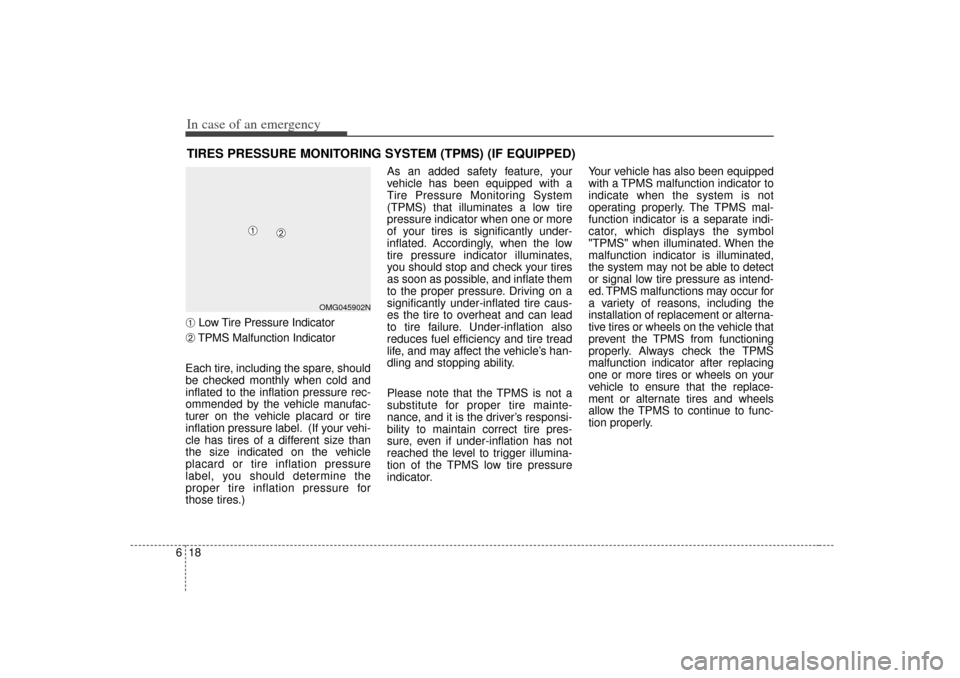
➀
Low Tire Pressure Indicator
➁
TPMS Malfunction Indicator
Each tire, including the spare, should
be checked monthly when cold and
inflated to the inflation pressure rec-
ommended by the vehicle manufac-
turer on the vehicle placard or tire
inflation pressure label. (If your vehi-
cle has tires of a different size than
the size indicated on the vehicle
placard or tire inflation pressure
label, you should determine the
proper tire inflation pressure for
those tires.) As an added safety feature, your
vehicle has been equipped with a
Tire Pressure Monitoring System
(TPMS) that illuminates a low tire
pressure indicator when one or more
of your tires is significantly under-
inflated. Accordingly, when the low
tire pressure indicator illuminates,
you should stop and check your tires
as soon as possible, and inflate them
to the proper pressure. Driving on a
significantly under-inflated tire caus-
es the tire to overheat and can lead
to tire failure. Under-inflation also
reduces fuel efficiency and tire tread
life, and may affect the vehicle’s han-
dling and stopping ability.
Please note that the TPMS is not a
substitute for proper tire mainte-
nance, and it is the driver’s responsi-
bility to maintain correct tire pres-
sure, even if under-inflation has not
reached the level to trigger illumina-
tion of the TPMS low tire pressure
indicator.
Your vehicle has also been equipped
with a TPMS malfunction indicator to
indicate when the system is not
operating properly. The TPMS mal-
function indicator is a separate indi-
cator, which displays the symbol
"TPMS" when illuminated. When the
malfunction indicator is illuminated,
the system may not be able to detect
or signal low tire pressure as intend-
ed. TPMS malfunctions may occur for
a variety of reasons, including the
installation of replacement or alterna-
tive tires or wheels on the vehicle that
prevent the TPMS from functioning
properly. Always check the TPMS
malfunction indicator after replacing
one or more tires or wheels on your
vehicle to ensure that the replace-
ment or alternate tires and wheels
allow the TPMS to continue to func-
tion properly.
OMG045902N
➀
➁
Page 250 of 294
73
Maintenance
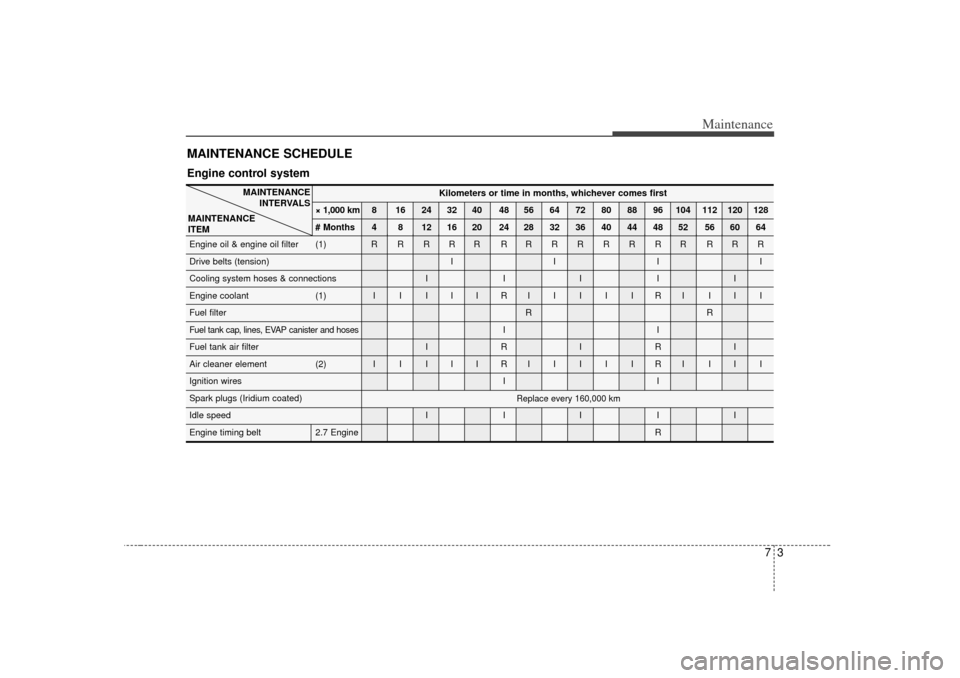
MAINTENANCE SCHEDULE Engine control system
MAINTENANCEINTERVALS
MAINTENANCE
ITEM
Kilometers or time in months, whichever comes first
× 1,000 km 8 16 24 32 40 48 56 64 72 80 88 96 104 112 120 128
# Months 4 8 12 16 20 24 28 32 36 40 44 48 52 56 60 64
Engine oil & engine oil filter (1) R R R R R R RRRRRRR RRR
Drive belts (tension) I I I I
Cooling system hoses & connections I I I I I
Engine coolant (1) I I I I I R IIIIIRI III
Fuel filter RR
Fuel tank cap, lines, EVAP canister and hoses
II
Fuel tank air filter I R I R I
Air cleaner element (2) I I I I I R IIIIIRI III
Ignition wires I I
Spark plugs (Iridium coated)
Idle speed I I I I I
Engine timing belt 2.7 Engine R
Replace every 160,000 km
Page 254 of 294
77
Maintenance
OWNER MAINTENANCE Owner maintenance schedule The following lists are vehicle checks and
inspections that should be performed by
the owner or an authorized Kia dealer at
the frequencies indicated to help ensure
safe, dependable operation of your vehi-
cle.
Any adverse conditions should be
brought to the attention of your dealer as
soon as possible.
These Owner Maintenance Checks are
generally not covered by warranties and
you may be charged for labor, parts and
lubricants used.When you stop for fuel: Check the engine oil level.
Check coolant level in coolant reser-voir.
Check the windshield washer fluid level.
Look for low or under-inflated tires.
While operating your vehicle: Note any changes in the sound of the exhaust or any smell of exhaust fumes
in the vehicle.
Check for vibrations in the steering wheel. Notice any increased steering
effort or looseness in the steering
wheel, or change in its straight-ahead
position.
Notice if your vehicle constantly turns slightly or “pulls” to one side when trav-
eling on smooth, level road.
When stopping, listen and check for strange sounds, pulling to one side,
increased brake pedal travel or “hard-
to-push” brake pedal.
If any slipping or changes in the oper- ation of your transaxle occurs, check
the transaxle fluid level.
Check automatic transaxle P (Park) function.
Check parking brake.
Check for fluid leaks under your vehicle (water dripping from the air condition-
ing system during or after use is nor-
mal).
At least monthly: Check coolant level in the coolantrecovery reservoir.
Check the operation of all exterior lights, including the stoplights, turn sig-
nals and hazard warning flashers.
Check the inflation pressures of all tires including the spare.At least twice a year (i.e., every Spring and Fall) : Check radiator, heater and air condi- tioning hoses for leaks or damage.
Check windshield washer spray and wiper operation. Clean wiper blades
with clean cloth dampened with wash-
er fluid.
Check headlight alignment.
Check muffler, exhaust pipes, shields and clamps.
Check the lap/shoulder belts for wear and function.
Check for worn tires and loose wheel lug nuts.
WARNING
- Radiationcoolant
Be careful when checking your
engine coolant level when the
engine is hot. Scalding hot coolant
and steam may blow out under
pressure. This could cause burns or
other serious injury.
Page 271 of 294
Maintenance24
7TIRES AND WHEELS
Tire care For proper maintenance, safety, and
maximum fuel economy, you must
always maintain recommended tire
inflation pressures and stay within
the load limits and weight distribution
recommended for your vehicle.Recommended cold tire infla-
tion pressures All tire pressures (including the
spare) should be checked every day
when the tires are cold. “Cold Tires”
means the vehicle has not been driv-
en for at least three hours or driven
less than 1.6 km (1 mile).
Recommended pressures must be
maintained for the best ride, top vehi-
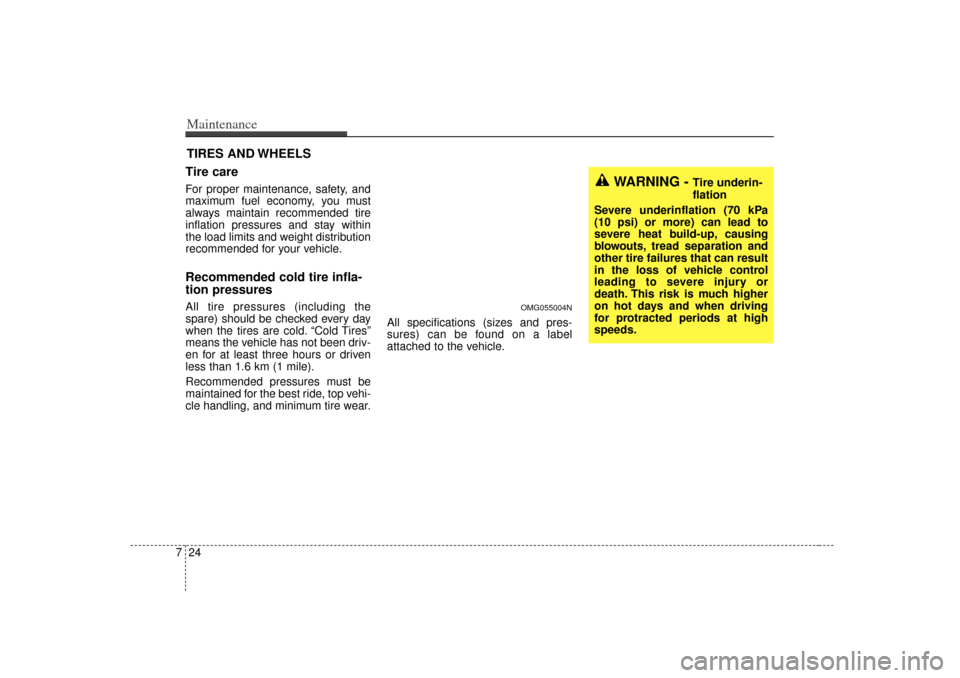
cle handling, and minimum tire wear. All specifications (sizes and pres-
sures) can be found on a label
attached to the vehicle.
WARNING -
Tire underin-
flation
Severe underinflation (70 kPa
(10 psi) or more) can lead to
severe heat build-up, causing
blowouts, tread separation and
other tire failures that can result
in the loss of vehicle control
leading to severe injury or
death. This risk is much higher
on hot days and when driving
for protracted periods at high
speeds.
OMG055004N
Page 272 of 294
725
Maintenance
✽
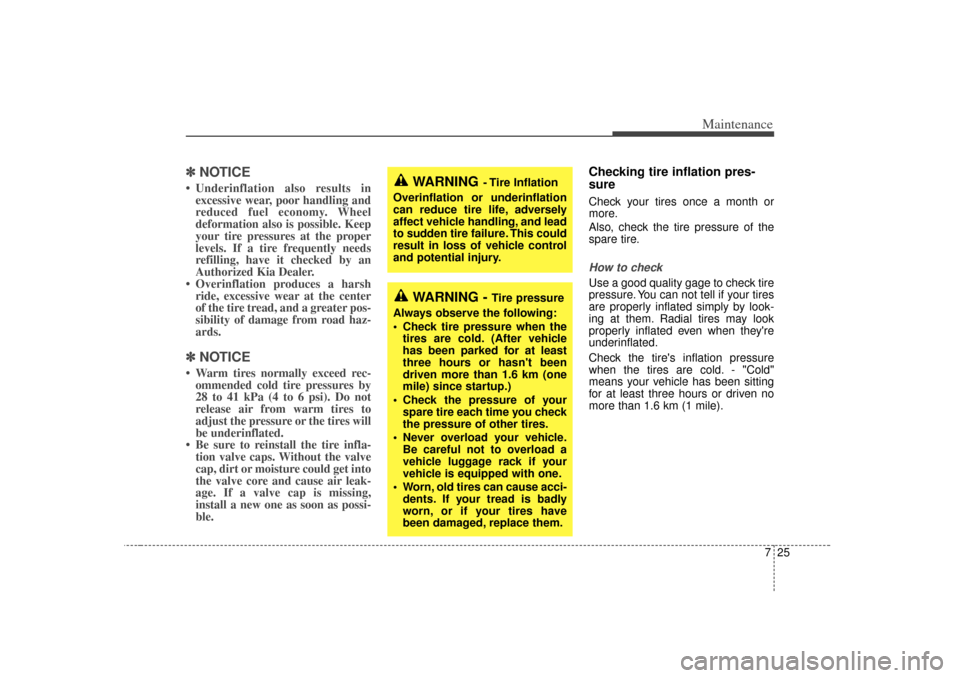
✽NOTICE• Underinflation also results in
excessive wear, poor handling and
reduced fuel economy. Wheel
deformation also is possible. Keep
your tire pressures at the proper
levels. If a tire frequently needs
refilling, have it checked by an
Authorized Kia Dealer.
• Overinflation produces a harsh ride, excessive wear at the center
of the tire tread, and a greater pos-
sibility of damage from road haz-
ards. ✽ ✽ NOTICE• Warm tires normally exceed rec-
ommended cold tire pressures by
28 to 41 kPa (4 to 6 psi). Do not
release air from warm tires to
adjust the pressure or the tires will
be underinflated.
• Be sure to reinstall the tire infla- tion valve caps. Without the valve
cap, dirt or moisture could get into
the valve core and cause air leak-
age. If a valve cap is missing,
install a new one as soon as possi-
ble.
Checking tire inflation pres-
sureCheck your tires once a month or
more.
Also, check the tire pressure of the
spare tire.How to checkUse a good quality gage to check tire
pressure. You can not tell if your tires
are properly inflated simply by look-
ing at them. Radial tires may look
properly inflated even when they're
underinflated.
Check the tire's inflation pressure
when the tires are cold. - "Cold"
means your vehicle has been sitting
for at least three hours or driven no
more than 1.6 km (1 mile).
WARNING
- Tire Inflation
Overinflation or underinflation
can reduce tire life, adversely
affect vehicle handling, and lead
to sudden tire failure. This could
result in loss of vehicle control
and potential injury.
WARNING -
Tire pressure
Always observe the following:
Check tire pressure when the tires are cold. (After vehicle
has been parked for at least
three hours or hasn't been
driven more than 1.6 km (one
mile) since startup.)
Check the pressure of your spare tire each time you check
the pressure of other tires.
Never overload your vehicle. Be careful not to overload a
vehicle luggage rack if your
vehicle is equipped with one.
Worn, old tires can cause acci- dents. If your tread is badly
worn, or if your tires have
been damaged, replace them.
Page 280 of 294
733
Maintenance
Cold Tire Pressure: The amount of
air pressure in a tire, measured in
kilopascals (kPa) or pounds per
square inch (psi) before a tire has
built up heat from driving.
Curb Weight: This means the weight
of a motor vehicle with standard and
optional equipment including the
maximum capacity of fuel, oil and
coolant, but without passengers and
cargo.
DOT Markings: The DOT code
includes the Tire Identification
Number (TIN), an alphanumeric des-
ignator which can also identify the
tire manufacturer, production plant,
brand and date of production.
GVWR: Gross Vehicle Weight Rating
GAWR FRT: Gross Axle Weight
Rating for the front Axle.
GAWR RR: Gross Axle Weight
Rating for the rear axle.Intended Outboard Sidewall
: The
side of an asymmetrical tire, that
must always face outward when
mounted on a vehicle.
Kilopascal (kPa): The metric unit for
air pressure.
Load Index: An assigned number
ranging from 1 to 279 that corre-
sponds to the load carrying capacity
of a tire.
Maximum Inflation Pressure : The
maximum air pressure to which a
cold tire may be inflated. The maxi-
mum air pressure is molded onto the
sidewall.
Maximum Load Rating : The load
rating for a tire at the maximum per-
missible inflation pressure for that
tire.
Maximum Loaded Vehicle Weight :
The sum of curb weight; accessory
weight; vehicle capacity weight; and
production options weight.
Normal Occupant Weight: The
number of occupants a vehicle is
designed to seat multiplied by 68 kg
(150 pounds). Occupant Distribution
: Designated
seating positions.
Outward Facing Sidewall: The side
of a asymmetrical tire that has a par-
ticular side that faces outward when
mounted on a vehicle. The outward
facing sidewall bears white lettering
or bears manufacturer, brand, and/or
model name molding that is higher or
deeper than the same moldings on
the inner facing sidewall.
Passenger (P-Metric) Tire : A tire
used on passenger cars and some
light duty trucks and multipurpose
vehicles.
Recommended Inflation Pressure :
Vehicle manufacturer's recommend-
ed tire inflation pressure and shown
on the tire placard.
Radial Ply tire: A pneumatic tire in
which the ply cords that extend to the
beads are laid at 90 degrees to the
centerline of the tread.
Rim: A metal support for a tire and
upon which the tire beads are seat-
ed.
Sidewall: The portion of a tire
between the tread and the bead.
Page 282 of 294
735
Maintenance
LUBRICANT SPECIFICATIONSRecommended lubricants To help achieve proper engine and powertrain performance and
durability, use only lubricants of the proper quality. The correct
lubricants also help promote engine efficiency that results in
improved fuel economy.
Engine oils labeled Energy Conserving Oil are now available.
Along with other additional benefits, they contribute to fuel
economy by reducing the amount of fuel necessary to over-
come engine friction. Often, these improvements are difficult to
measure in everyday driving, but in a year’s time, they can offer
significant cost and energy savings.
Recommended SAE viscosity number ✽ ✽NOTICEAlways be sure to clean the area around any filler plug, drain
plug, or dipstick before checking or draining any lubricant.
This is especially important in dusty or sandy areas and when
the vehicle is used on unpaved roads. Cleaning the plug and
dipstick areas will prevent dirt and grit from entering the
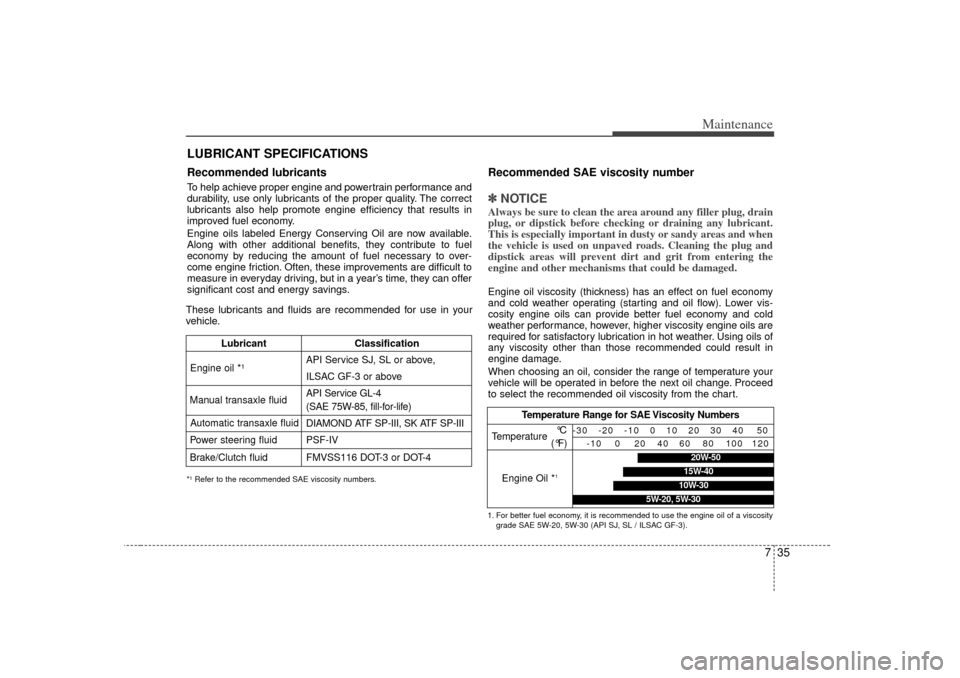
engine and other mechanisms that could be damaged. Engine oil viscosity (thickness) has an effect on fuel economy
and cold weather operating (starting and oil flow). Lower vis-
cosity engine oils can provide better fuel economy and cold
weather performance, however, higher viscosity engine oils are
required for satisfactory lubrication in hot weather. Using oils of
any viscosity other than those recommended could result in
engine damage.
When choosing an oil, consider the range of temperature your
vehicle will be operated in before the next oil change. Proceed
to select the recommended oil viscosity from the chart.
*¹ Refer to the recommended SAE viscosity numbers.These lubricants and fluids are recommended for use in your
vehicle.
Lubricant Classification
API Service SJ, SL or above,
ILSAC GF-3 or above
Manual transaxle fluid API Service GL-4
(SAE 75W-85, fill-for-life)
DIAMOND ATF SP-III, SK ATF SP-III
Power steering fluid PSF-IV
Brake/Clutch fluid FMVSS116 DOT-3 or DOT-4
Engine oil
*¹
Automatic transaxle fluid
Temperature Range for SAE Viscosity Numbers
Temperature
Engine Oil *
1°C
(°F)
-30 -20 -10 0 10 20 30 40 50
-10 0 20 40 60 80 100 120
1. For better fuel economy, it is recommended to use the engine oil of a viscositygrade SAE 5W-20, 5W-30 (API SJ, SL / ILSAC GF-3).
20W-5015W-4010W-30
5W-20, 5W-30
Page 284 of 294
737
Maintenance
Finish damage repair Deep scratches or stone chips in the
painted surface must be repaired
promptly. Exposed metal will quickly rust
and may develop into a major repair
expense.✽ ✽NOTICEIf your vehicle is damaged and requires
any metal repair or replacement, be sure
the body shop applies anti-corrosion
materials to the parts repaired or
replaced. Bright-metal maintenance To remove road tar and insects, use a
tar remover, not a scraper or other
sharp object.
To protect the surfaces of bright-metal parts from corrosion, apply a coating of
wax or chrome preservative and rub to
a high luster.
During winter weather or in coastal areas, cover the bright metal parts with
a heavier coating of wax or preserva-
tive. If necessary, coat the parts with
non-corrosive petroleum jelly or other
protective compound.
Underbody maintenanceCorrosive materials used for ice and
snow removal and dust control may col-
lect on the underbody. If these materials
are not removed, accelerated rusting can
occur on underbody parts such as the
fuel lines, frame, floor pan and exhaust
system, even though they have been
treated with rust protection.
Thoroughly flush the vehicle underbody
and wheel openings with lukewarm or
cold water once a month, after off-road
driving and at the end of each winter. Pay
special attention to these areas because
it is difficult to see all the mud and dirt. It
will do more harm than good to wet down
the road grime without removing it. The
lower edges of doors, rocker panels, and
frame members have drain holes that
should not be allowed to clog with dirt;
trapped water in these areas can cause
rusting.
Aluminum wheel maintenance The aluminum wheels are coated with a
clear protective finish.
Do not use any abrasive cleaner, pol-ishing compound, solvent, or wire
brushes on aluminum wheels. They
may scratch or damage the finish.
Use only a mild soap or neutral deter- gent, and rinse thoroughly with water.
Also, be sure to clean the wheels after
driving on salted roads. This helps pre-
vent corrosion.
Avoid washing the wheels with high- speed car wash brushes.
Do not use any acid detergent. It may damage and corrode the aluminum
wheels coated with a clear protective
finish.
WARNING
After washing the vehicle, test the
brakes while driving slowly to see if
they have been affected by water. If
braking performance is impaired,
dry the brakes by applying them
lightly while maintaining a slow for-
ward speed.
Page 289 of 294
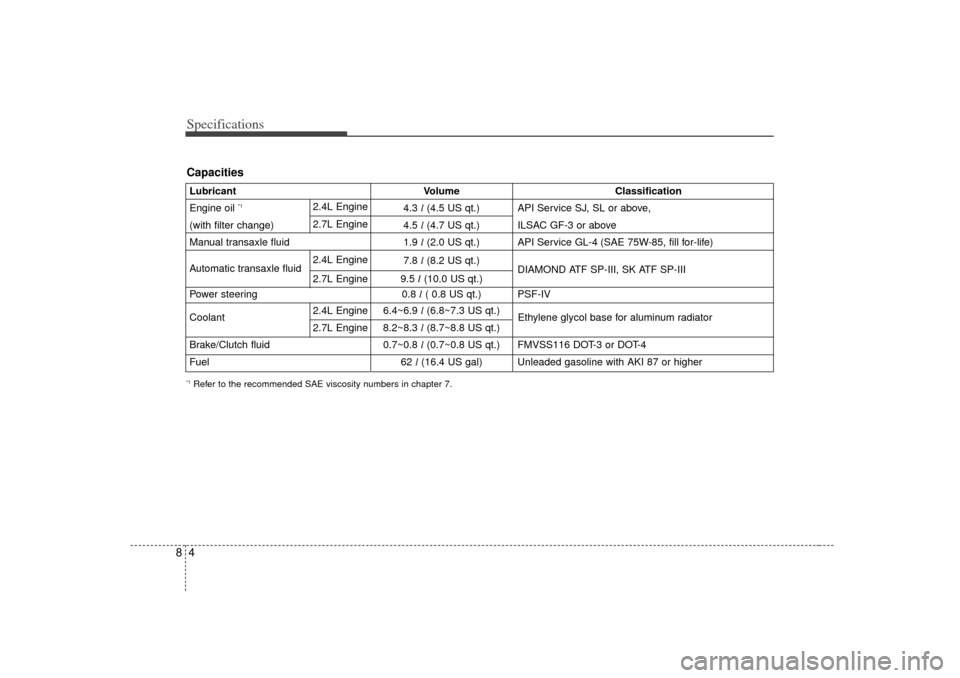
Specifications48*1Refer to the recommended SAE viscosity numbers in chapter 7.LubricantVolume Classification
Engine oil
*1
4.3 l(4.5 US qt.) API Service SJ, SL or above,
(with filter change) 4.5 l (4.7 US qt.) ILSAC GF-3 or above
Manual transaxle fluid 1.9 l(2.0 US qt.) API Service GL-4 (SAE 75W-85, fill for-life)
Automatic transaxle fluid 7.8
l(8.2 US qt.)
9.5 l(10.0 US qt.) DIAMOND ATF SP-III, SK ATF SP-III
Power steering 0.8 l( 0.8 US qt.) PSF-IV
Coolant 6.4~6.9
l(6.8~7.3 US qt.)
Ethylene glycol base for aluminum radiator
8.2~8.3 l(8.7~8.8 US qt.)
Brake/Clutch fluid 0.7~0.8 l (0.7~0.8 US qt.) FMVSS116 DOT-3 or DOT-4
Fuel 62 l(16.4 US gal) Unleaded gasoline with AKI 87 or higher
2.4L Engine
2.7L Engine2.4L Engine
2.7L Engine2.4L Engine
2.7L Engine
Capacities
Page 292 of 294

Index29Air bags-supplemental restraint system ··················\
··3-48
Air cleaner ··················\
··················\
··················\
··············7-18
Antenna ··················\
··················\
··················\
··················\
·3-93
Audio remote control··················\
··················\
···············3-94
Audio system ··················\
··················\
··················\
··········3-95
Automatic climate control··················\
··················\
·······4-55
Automatic transaxle ··················\
··················\
·········4-6, 7-16
Back warning system ··················\
··················\
···············4-37
Battery··················\
··················\
··················\
··················\
···7-21
Before driving··················\
··················\
··················\
···········5-4
Brake fluid ··················\
··················\
··················\
··············7-14
Brake system ··················\
··················\
··················\
··········4-10
Climate control air filter ··················\
··················\
·········7-19
Compass - Z-Nav™ compass ··················\
··················\
··4-36
Cruise control system ··················\
··················\
··············4-18
Defroster ··················\
··················\
··················\
·················4-46\
Door locks ··················\
··················\
··················\
···············3-10
Drive belts ··················\
··················\
··················\
···············7-15Electrical circuit protection ··················\
··················\
······6-6
Electronic stability control ··················\
··················\
······4-21
Emergency starting··················\
··················\
··················\
··6-3
Emission control system ··················\
··················\
············5-2
Engine compartment ··················\
··················\
··········2-4, 7-9
Engine cooling system ··················\
··················\
·············7-12
Engine oil ··················\
··················\
··················\
················7-11
Exterior care··················\
··················\
··················\
···········7-36
Fuel filler lid ··················\
··················\
··················\
···········3-72
Fuel requirements ··················\
··················\
··················\
····5-2
Gauges ··················\
··················\
··················\
··················\
···4-25
Hazard warning flasher ··················\
··················\
··········4-47
Homelink® wireless control system ··················\
·········3-79
Hood ··················\
··················\
··················\
··················\
······3-71
How to use this manual ··················\
··················\
·············1-2ABC
E
D
FGH