ABS KIA Optima 2008 2.G User Guide
[x] Cancel search | Manufacturer: KIA, Model Year: 2008, Model line: Optima, Model: KIA Optima 2008 2.GPages: 289, PDF Size: 4.78 MB
Page 214 of 289
Driving tips12 5✽
✽
NOTICEFailure to sue a trailer wiring harness
can damage your vehicle’s electrical sys-
tem.Driving on grades Reduce speed and shift to a lower gear
before you start down a long or steep
downgrade. If you don’t shift down, you
might have to use your brakes so much
that they would get hot and no longer
operate efficiently.
On a long uphill grade, shift down and
reduce your speed to around 70 km/h (45
mph) to reduce the possibility of engine
and transaxle overheating.
Operating your vehicle in D (Drive) when
towing a trailer will minimize heat build up
and extend the life of your transaxle.
Parking on hills Generally, you should not park your vehi-
cle, with a trailer attached, on a hill.
People can be seriously or fatally injured,
and both your vehicle and the trailer can
be damaged if they begin a downhill.
However, if you ever have to park your
trailer on a hill, here’s how to do it:1. Apply your brakes, but don’t shift into
gear.
2. Have someone place chocks (blocks
of wood or metal intended for this pur-
pose) under the downhill sides of the
trailer wheels.
3. When the wheel chocks are in place,
release the brakes until the chocks
absorb the load.
4. Reapply the brakes. Apply your park-
ing brake, and then shift to P (Park) for
an automatic transaxle.
5. Release the brakes.
CAUTION
When towing a trailer on steep
grades (in excess of 6%) pay close
attention to the engine coolant tem-
perature gauge to ensure the
engine does not overheat. If the
needle of the coolant temperature
gauge moves across the dial
towards “H” (HOT), pull over and
stop as soon as it is safe to do so,
and allow the engine to idle until it
cools down. You may proceed once
the engine has cooled sufficiently.
WARNING
- Parking on a
hill
Parking your vehicle on a hill with a
trailer attached is dangerous. It
could cause serious injury or death,
should the trailer break lose, or
should the trailer drag the vehicle
downhill.
WARNING
- Parking brake
It can be dangerous to get out of
your vehicle if the parking brake is
not firmly set or if the engine is still
running.
In either case the vehicle can move
suddenly. You or others could be
seriously or fatally injured.
Page 227 of 289
69
In case of an emergency
Engine compartment
OMG065006
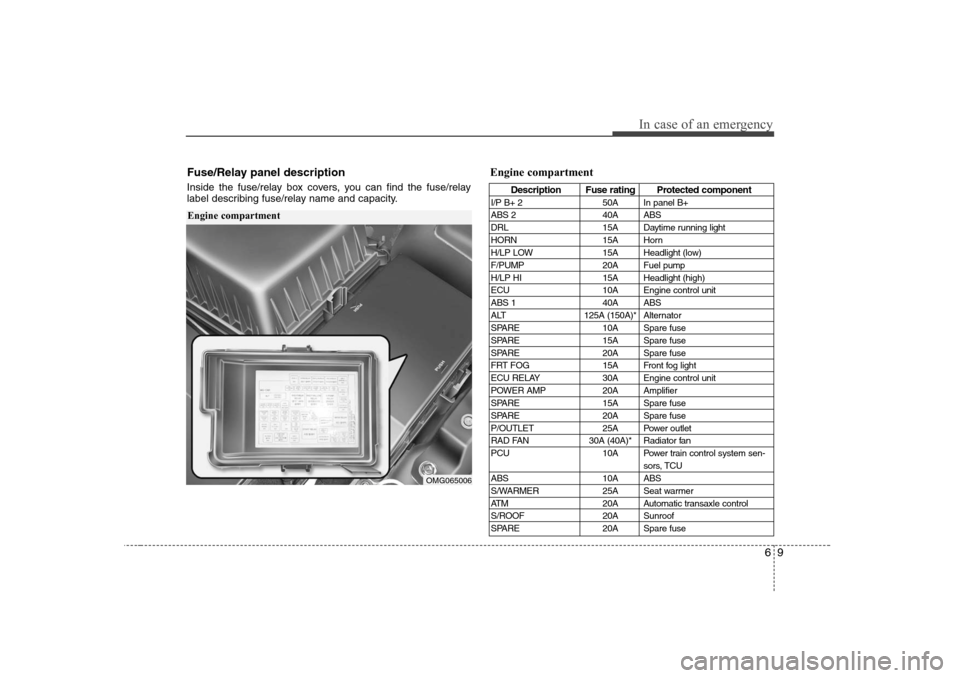
Fuse/Relay panel descriptionInside the fuse/relay box covers, you can find the fuse/relay
label describing fuse/relay name and capacity.
Engine compartment
Description Fuse rating Protected component
I/P B+ 2 50A In panel B+
ABS 2 40A ABS
DRL 15A Daytime running light
HORN 15A Horn
H/LP LOW 15A Headlight (low)
F/PUMP 20A Fuel pump
H/LP HI 15A Headlight (high)
ECU 10A Engine control unit
ABS 1 40A ABS
ALT 125A (150A)* Alternator
SPARE 10A Spare fuse
SPARE 15A Spare fuse
SPARE 20A Spare fuse
FRT FOG 15A Front fog light
ECU RELAY 30A Engine control unit
POWER AMP 20A Amplifier
SPARE 15A Spare fuse
SPARE 20A Spare fuse
P/OUTLET 25A Power outlet
RAD FAN 30A (40A)* Radiator fan
PCU 10A Power train control system sen-
sors, TCU
ABS 10A ABS
S/WARMER 25A Seat warmer
ATM 20A Automatic transaxle control
S/ROOF 20A Sunroof
SPARE 20A Spare fuse
Page 240 of 289
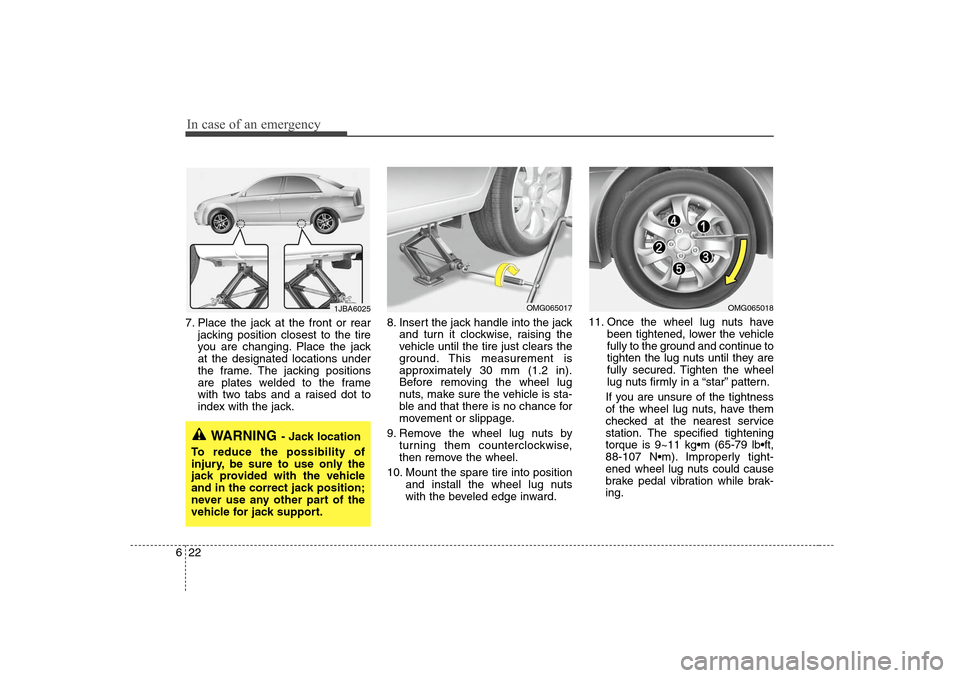
In case of an emergency22 67. Place the jack at the front or rear
jacking position closest to the tire
you are changing. Place the jack
at the designated locations under
the frame. The jacking positions
are plates welded to the frame
with two tabs and a raised dot to
index with the jack.8. Insert the jack handle into the jack
and turn it clockwise, raising the
vehicle until the tire just clears the
ground. This measurement is
approximately 30 mm (1.2 in).
Before removing the wheel lug
nuts, make sure the vehicle is sta-
ble and that there is no chance for
movement or slippage.
9. Remove the wheel lug nuts by
turning them counterclockwise,
then remove the wheel.
10. Mount the spare tire into position
and install the wheel lug nuts
with the beveled edge inward.11. Once the wheel lug nuts have
been tightened, lower the vehicle
fully to the ground and continue to
tighten the lug nuts until they are
fully secured. Tighten the wheel
lug nuts firmly in a “star” pattern.
If you are unsure of the tightness
of the wheel lug nuts, have them
checked at the nearest service
station. The specified tightening
torque is 9~11 kgm (65-79 lbft,
88-107 Nm). Improperly tight-
ened wheel lug nuts could cause
brake pedal vibration while brak-
ing.
WARNING
- Jack location
To reduce the possibility of
injury, be sure to use only the
jack provided with the vehicle
and in the correct jack position;
never use any other part of the
vehicle for jack support.
OMG065017
1JBA6025
OMG065018