OIL KIA Optima 2008 2.G User Guide
[x] Cancel search | Manufacturer: KIA, Model Year: 2008, Model line: Optima, Model: KIA Optima 2008 2.GPages: 289, PDF Size: 4.78 MB
Page 228 of 289
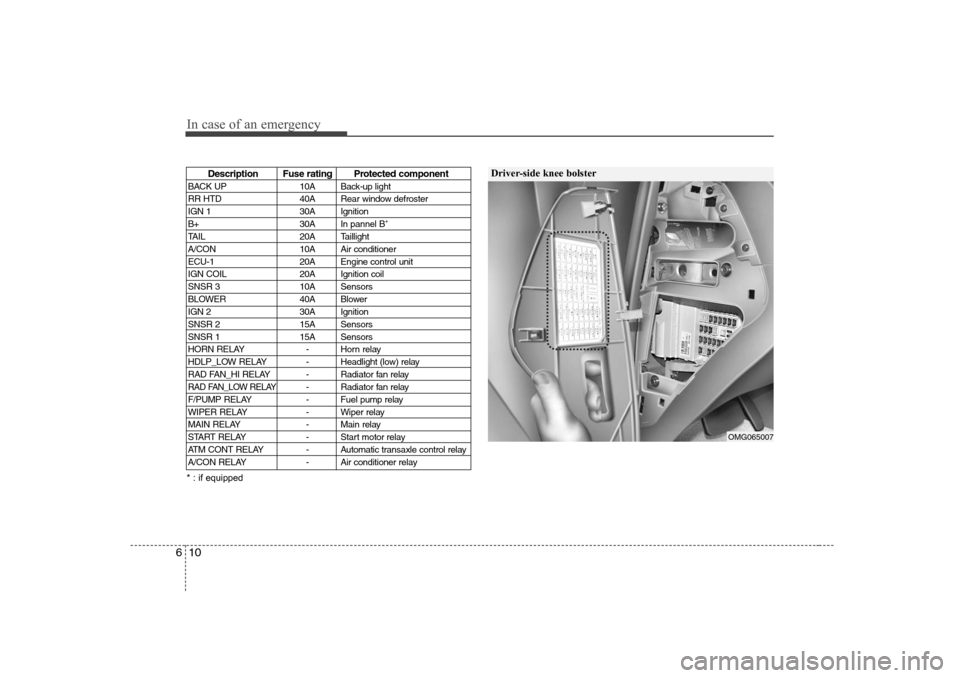
In case of an emergency10 6
OMG065007
Driver-side knee bolster
Description Fuse rating Protected component
BACK UP 10A Back-up light
RR HTD 40A Rear window defroster
IGN 1 30A Ignition
B+ 30A In pannel B
+
TAIL 20A Taillight
A/CON 10A Air conditioner
ECU-1 20A Engine control unit
IGN COIL 20A Ignition coil
SNSR 3 10A Sensors
BLOWER 40A Blower
IGN 2 30A Ignition
SNSR 2 15A Sensors
SNSR 1 15A Sensors
HORN RELAY - Horn relay
HDLP_LOW RELAY - Headlight (low) relay
RAD FAN_HI RELAY - Radiator fan relayRAD FAN_LOW RELAY
- Radiator fan relay
F/PUMP RELAY - Fuel pump relay
WIPER RELAY - Wiper relay
MAIN RELAY - Main relay
START RELAY - Start motor relay
ATM CONT RELAY - Automatic transaxle control relay
A/CON RELAY - Air conditioner relay
* : if equipped
Page 235 of 289
617
In case of an emergency
When your vehicle is being towed
by another vehicle other than a tow
truck (in case of an emergency) Turn the ignition switch to ACC so the
steering wheel isn’t locked.
Place the transaxle shift lever in N
(Neutral).
Release the parking bake.
Vehicles equipped with automatic
transaxles should not exceed 45 km/h
(28 mph) and should not be towed
more than 80 km (50 miles).
Vehicles equipped with manual
transaxle should not be towed in
excess of 88 km/h (55 mph) and
should not be towed more than 645 km
(400 miles).
Press the brake pedal with more force
than normal since you will have
reduced brake performance.
More steering effort will be required
because the power steering system
will be disabled.
If you are driving down a long hill, the
brakes may overheat and brake per-
formance will be reduced. Stop often
and let the brakes cool off.
✽ ✽
NOTICETo prevent internal damage to the
transaxle, never tow your vehicle from
the rear (backwards) with all four tires
in contact with the surface. Tips for towing a stuck vehicleThe following methods are effective
when your vehicle is stuck in mud, sand
or similar substances that prevent the
vehicle from being driven out under its
own power.
Remove the soil and sand, etc. from
the front and the back of the tires.
Place a stone or wood under the tires.
Page 242 of 289
7
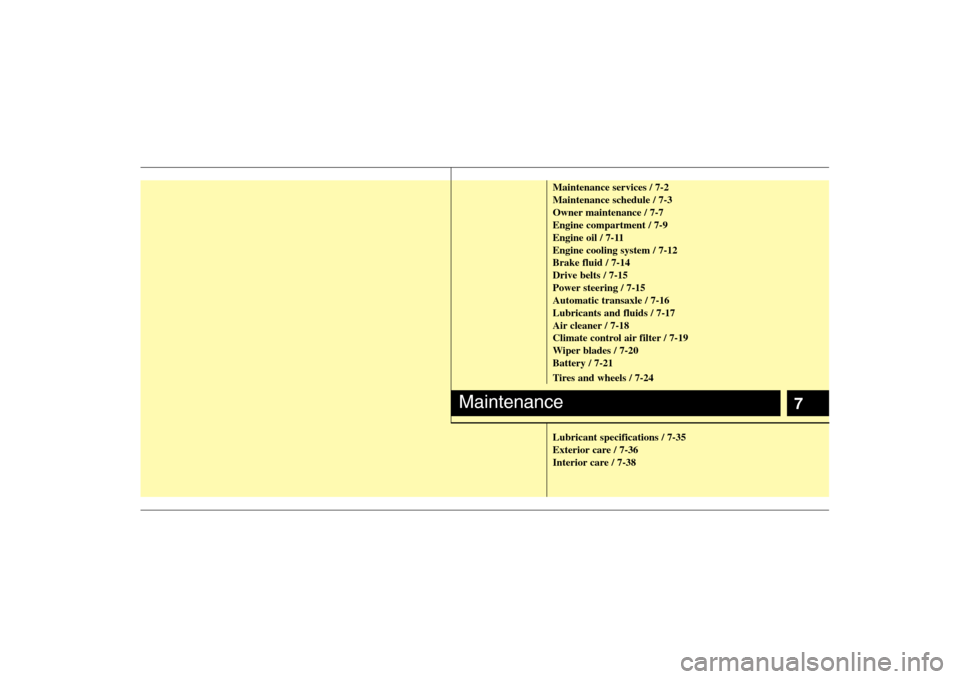
Maintenance services / 7-2
Maintenance schedule / 7-3
Owner maintenance / 7-7
Engine compartment / 7-9
Engine oil / 7-11
Engine cooling system / 7-12
Brake fluid / 7-14
Drive belts / 7-15
Power steering / 7-15
Automatic transaxle / 7-16
Lubricants and fluids / 7-17
Air cleaner / 7-18
Climate control air filter / 7-19
Wiper blades / 7-20
Battery / 7-21
Tires and wheels / 7-24
Lubricant specifications / 7-35
Exterior care / 7-36
Interior care / 7-38
Maintenance
Page 244 of 289
73
Maintenance
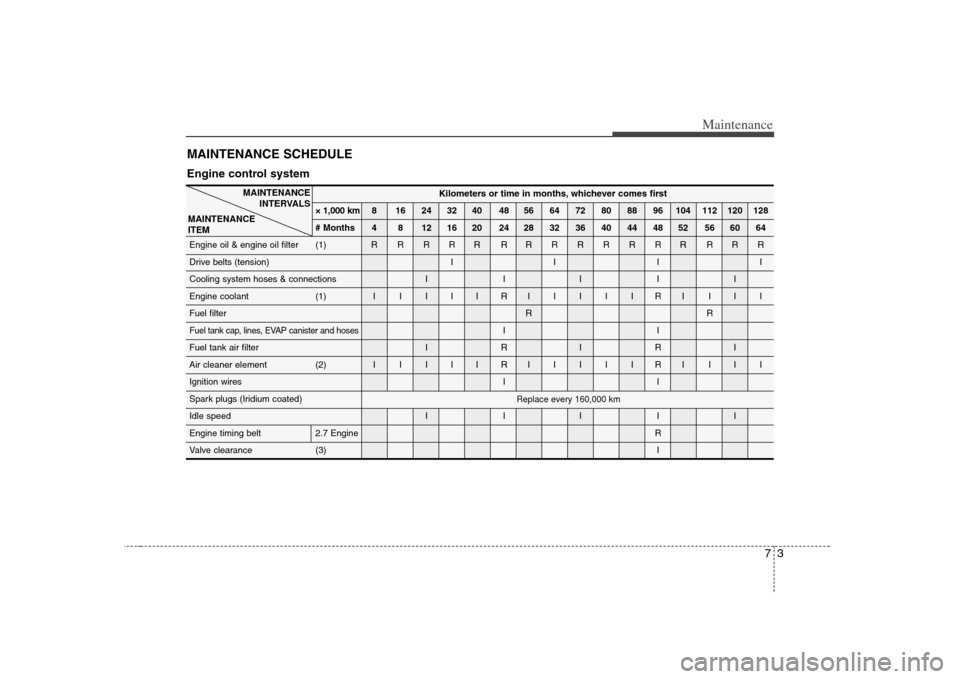
MAINTENANCE SCHEDULE Engine control system
MAINTENANCE
INTERVALS
MAINTENANCE
ITEM
Kilometers or time in months, whichever comes first
× 1,000 km 8 16 24 32 40 48 56 64 72 80 88 96 104 112 120 128
# Months 4 8 12 16 20 24 28 32 36 40 44 48 52 56 60 64
Engine oil & engine oil filter (1) R R R R R RRRRRRRR RRR
Drive belts (tension) I I I I
Cooling system hoses & connections I I I I I
Engine coolant (1) I I I I I RIIIIIRI III
Fuel filterRR
Fuel tank cap, lines, EVAP canister and hoses
II
Fuel tank air filter I R I R I
Air cleaner element (2) I I I I I RIIIIIRI III
Ignition wires I I
Spark plugs (Iridium coated)
Idle speed I I I I I
Engine timing belt 2.7 EngineR
Valve clearance (3)I
Replace every 160,000 km
Page 245 of 289
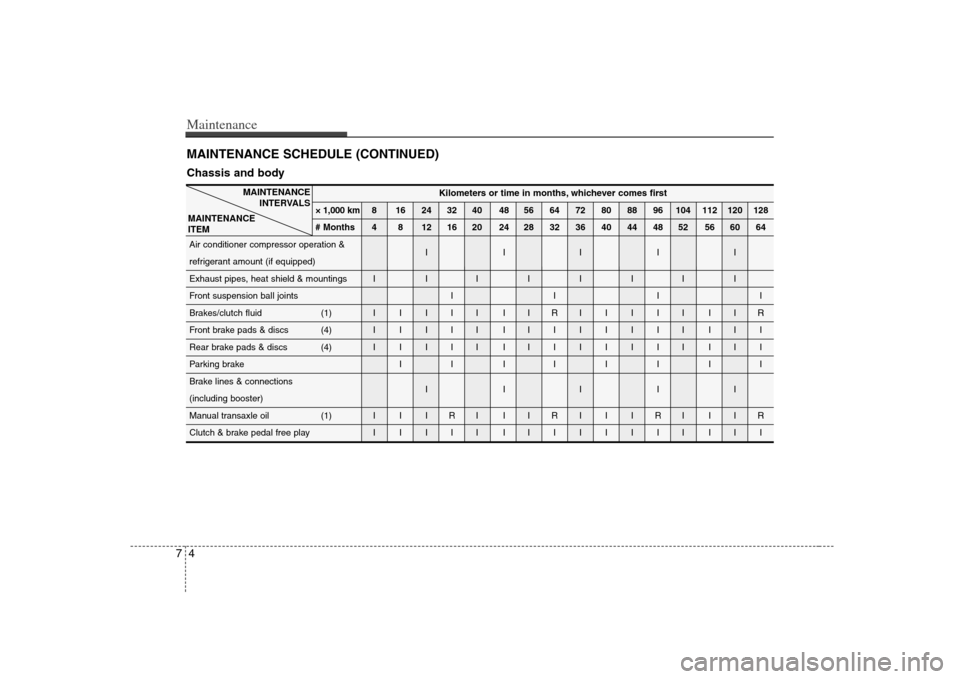
Maintenance4 7MAINTENANCE SCHEDULE (CONTINUED)Chassis and body
Kilometers or time in months, whichever comes first
× 1,000 km 8 16 24 32 40 48 56 64 72 80 88 96 104 112 120 128
# Months 4 8 12 16 20 24 28 32 36 40 44 48 52 56 60 64
Air conditioner compressor operation &
IIIII
refrigerant amount (if equipped)
Exhaust pipes, heat shield & mountings I IIIIIII
Front suspension ball joints I I I I
Brakes/clutch fluid (1) I I I I I I I RIIIII IIR
Front brake pads & discs (4) I I I I I IIIIIIII III
Rear brake pads & discs (4) I I I I I IIIIIIII III
Parking brake I I IIIIII
Brake lines & connections
IIIII
(including booster)
Manual transaxle oil (1) I I I R I I I R I I I R I I I R
Clutch & brake pedal free play I I I I I IIIIIIII III
MAINTENANCE
INTERVALS
MAINTENANCE
ITEM
Page 247 of 289
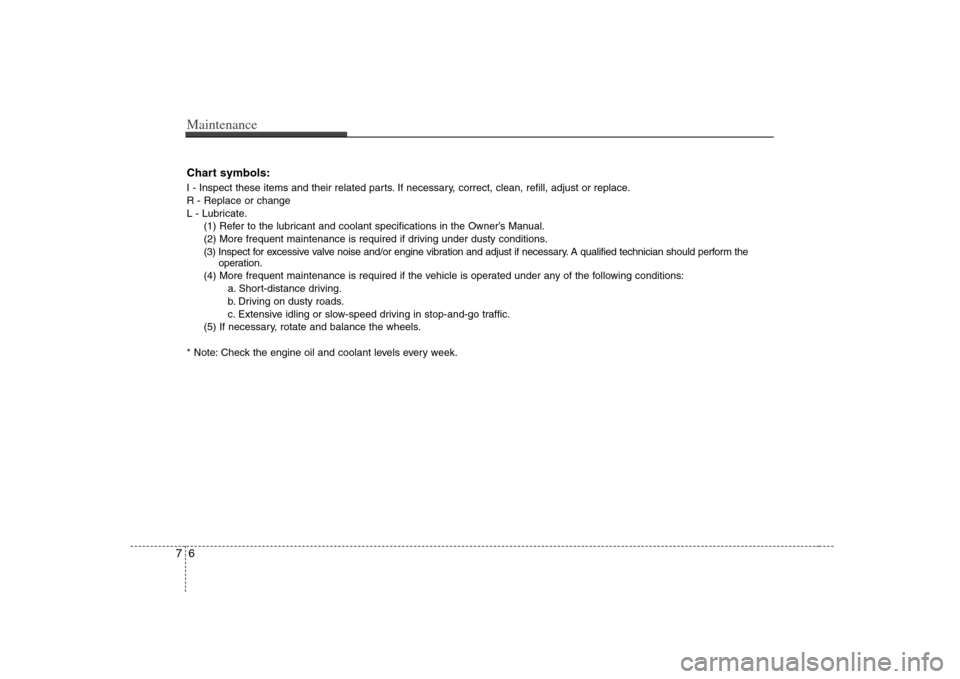
Maintenance6 7Chart symbols:I - Inspect these items and their related parts. If necessary, correct, clean, refill, adjust or replace.
R - Replace or change
L - Lubricate.
(1) Refer to the lubricant and coolant specifications in the Owner’s Manual.
(2) More frequent maintenance is required if driving under dusty conditions.
(3) Inspect for excessive valve noise and/or engine vibration and adjust if necessary. A qualified technician should perform the
operation.
(4) More frequent maintenance is required if the vehicle is operated under any of the following conditions:
a. Short-distance driving.
b. Driving on dusty roads.
c. Extensive idling or slow-speed driving in stop-and-go traffic.
(5) If necessary, rotate and balance the wheels.
* Note: Check the engine oil and coolant levels every week.
Page 248 of 289
77
Maintenance
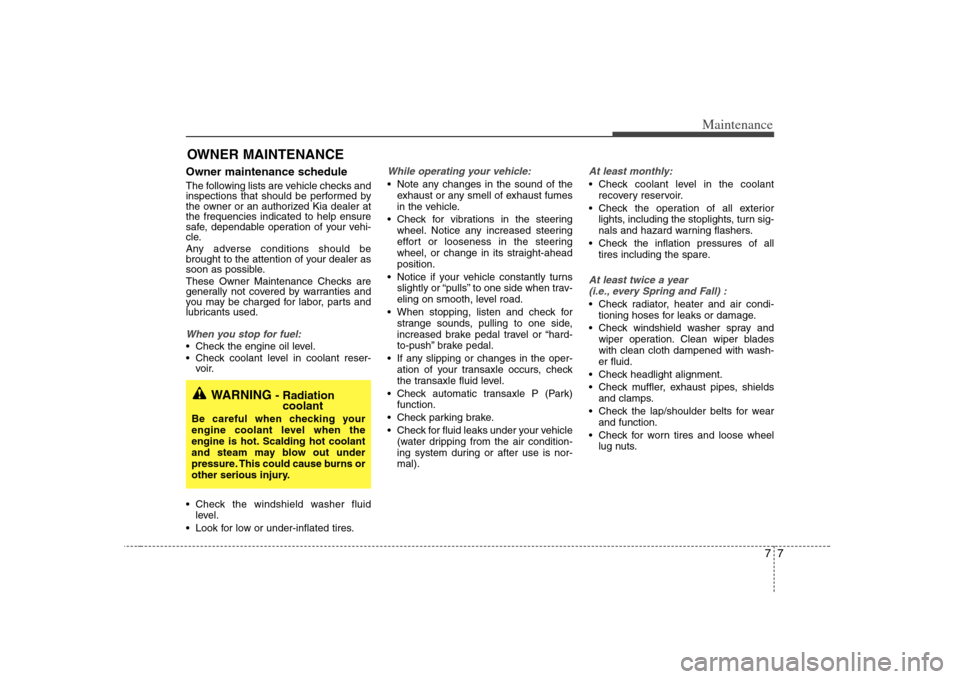
OWNER MAINTENANCE Owner maintenance schedule The following lists are vehicle checks and
inspections that should be performed by
the owner or an authorized Kia dealer at
the frequencies indicated to help ensure
safe, dependable operation of your vehi-
cle.
Any adverse conditions should be
brought to the attention of your dealer as
soon as possible.
These Owner Maintenance Checks are
generally not covered by warranties and
you may be charged for labor, parts and
lubricants used.When you stop for fuel: Check the engine oil level.
Check coolant level in coolant reser-
voir.
Check the windshield washer fluid
level.
Look for low or under-inflated tires.
While operating your vehicle: Note any changes in the sound of the
exhaust or any smell of exhaust fumes
in the vehicle.
Check for vibrations in the steering
wheel. Notice any increased steering
effort or looseness in the steering
wheel, or change in its straight-ahead
position.
Notice if your vehicle constantly turns
slightly or “pulls” to one side when trav-
eling on smooth, level road.
When stopping, listen and check for
strange sounds, pulling to one side,
increased brake pedal travel or “hard-
to-push” brake pedal.
If any slipping or changes in the oper-
ation of your transaxle occurs, check
the transaxle fluid level.
Check automatic transaxle P (Park)
function.
Check parking brake.
Check for fluid leaks under your vehicle
(water dripping from the air condition-
ing system during or after use is nor-
mal).
At least monthly: Check coolant level in the coolant
recovery reservoir.
Check the operation of all exterior
lights, including the stoplights, turn sig-
nals and hazard warning flashers.
Check the inflation pressures of all
tires including the spare.At least twice a year
(i.e., every Spring and Fall) : Check radiator, heater and air condi-
tioning hoses for leaks or damage.
Check windshield washer spray and
wiper operation. Clean wiper blades
with clean cloth dampened with wash-
er fluid.
Check headlight alignment.
Check muffler, exhaust pipes, shields
and clamps.
Check the lap/shoulder belts for wear
and function.
Check for worn tires and loose wheel
lug nuts.
WARNING
- Radiation
coolant
Be careful when checking your
engine coolant level when the
engine is hot. Scalding hot coolant
and steam may blow out under
pressure. This could cause burns or
other serious injury.
Page 250 of 289
79
Maintenance
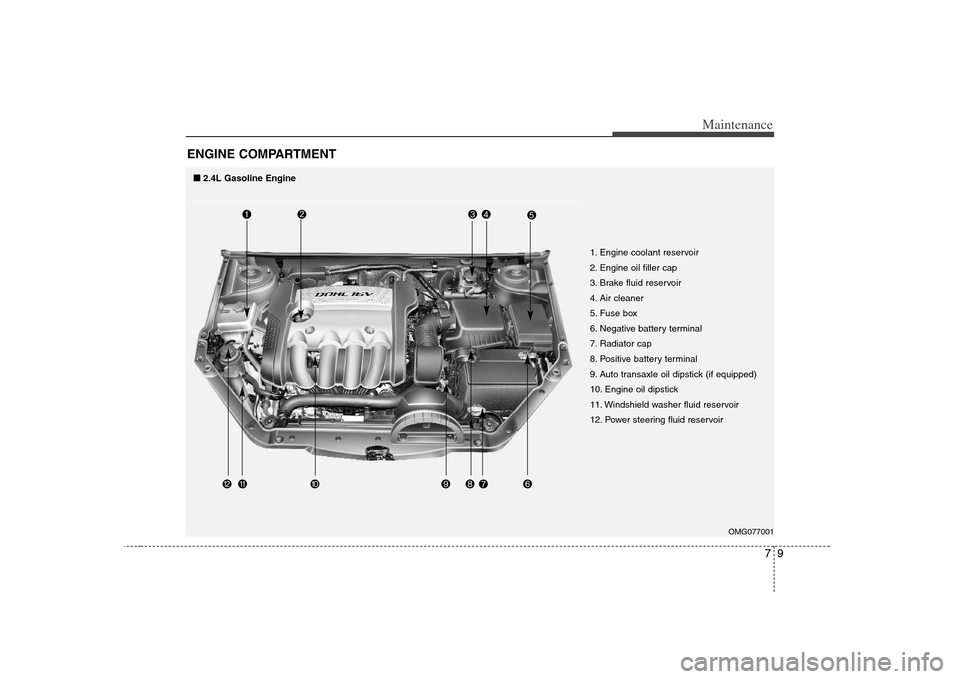
ENGINE COMPARTMENT
OMG077001
1. Engine coolant reservoir
2. Engine oil filler cap
3. Brake fluid reservoir
4. Air cleaner
5. Fuse box
6. Negative battery terminal
7. Radiator cap
8. Positive battery terminal
9. Auto transaxle oil dipstick (if equipped)
10. Engine oil dipstick
11. Windshield washer fluid reservoir
12. Power steering fluid reservoir
■ ■
2.4L Gasoline Engine
Page 251 of 289
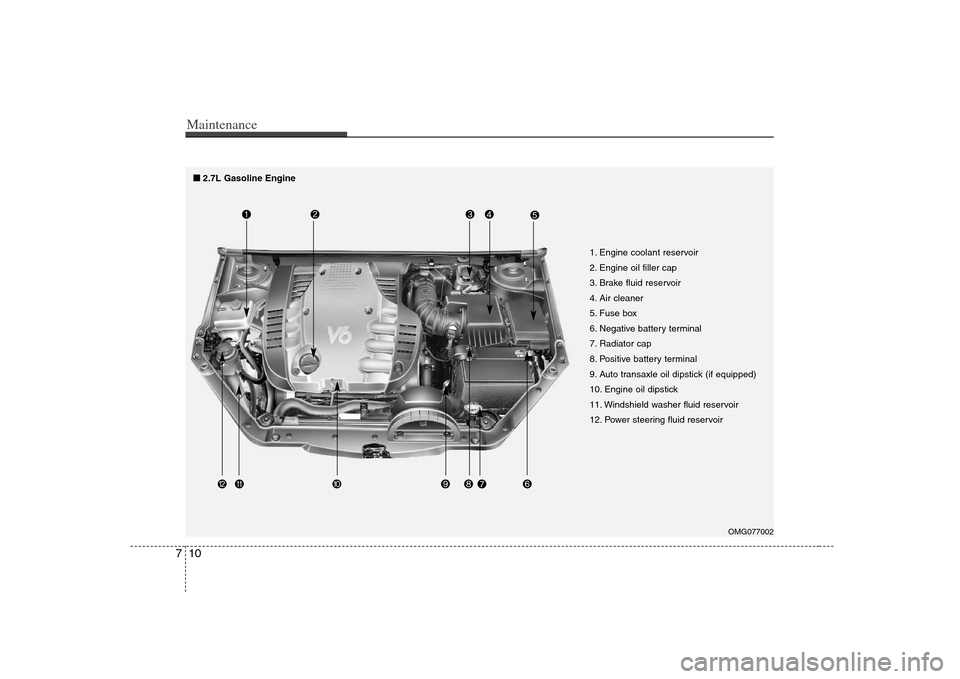
Maintenance10
7
OMG077002
1. Engine coolant reservoir
2. Engine oil filler cap
3. Brake fluid reservoir
4. Air cleaner
5. Fuse box
6. Negative battery terminal
7. Radiator cap
8. Positive battery terminal
9. Auto transaxle oil dipstick (if equipped)
10. Engine oil dipstick
11. Windshield washer fluid reservoir
12. Power steering fluid reservoir
■ ■
2.7L Gasoline Engine
Page 252 of 289
711
Maintenance
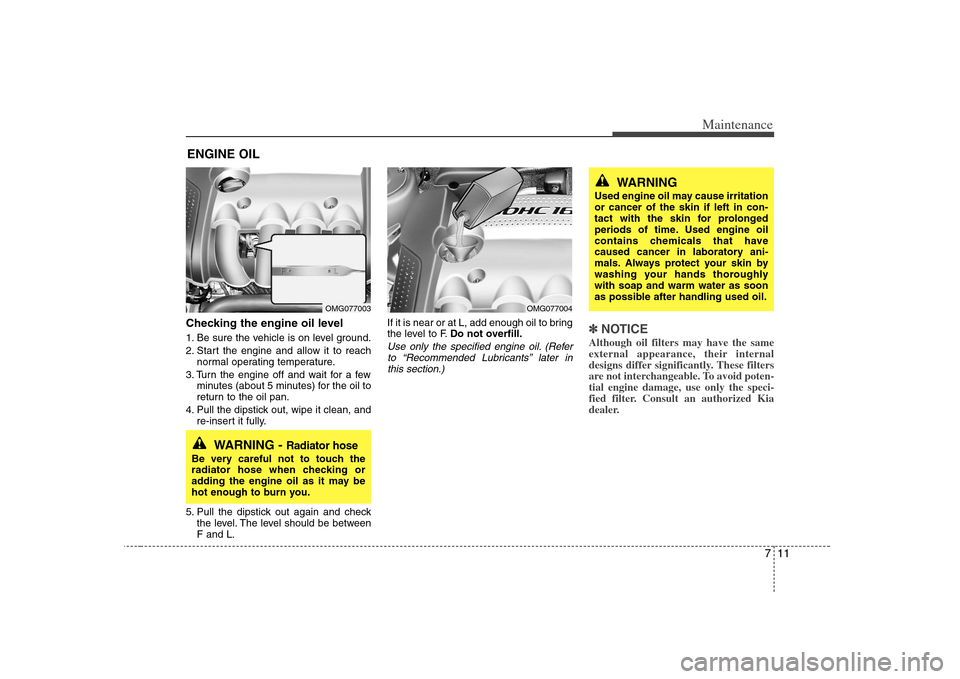
ENGINE OILChecking the engine oil level 1. Be sure the vehicle is on level ground.
2. Start the engine and allow it to reachnormal operating temperature.
3. Turn the engine off and wait for a few minutes (about 5 minutes) for the oil to
return to the oil pan.
4. Pull the dipstick out, wipe it clean, and re-insert it fully.
5. Pull the dipstick out again and check the level. The level should be between
F and L. If it is near or at L, add enough oil to bring
the level to F.
Do not overfill.
Use only the specified engine oil. (Refer
to “Recommended Lubricants” later in this section.)
✽ ✽ NOTICEAlthough oil filters may have the same
external appearance, their internal
designs differ significantly. These filters
are not interchangeable. To avoid poten-
tial engine damage, use only the speci-
fied filter. Consult an authorized Kia
dealer.
WARNING -
Radiator hose
Be very careful not to touch the
radiator hose when checking or
adding the engine oil as it may be
hot enough to burn you.
WARNING
Used engine oil may cause irritation
or cancer of the skin if left in con-
tact with the skin for prolonged
periods of time. Used engine oil
contains chemicals that have
caused cancer in laboratory ani-
mals. Always protect your skin by
washing your hands thoroughly
with soap and warm water as soon
as possible after handling used oil.
OMG077003
OMG077004