parking transmission KIA OPTIMA 2017 User Guide
[x] Cancel search | Manufacturer: KIA, Model Year: 2017, Model line: OPTIMA, Model: KIA OPTIMA 2017Pages: 629, PDF Size: 15.24 MB
Page 407 of 629
Driving your vehicle
50
6
Good braking practices
Check to be sure the parking brake
is not engaged and the parking
brake indicator light is out before
driving away.
Driving through water may get the brakes wet. They can also get wet
when the vehicle is washed. Wet
brakes can be dangerous! Your
vehicle will not stop as quickly if the
brakes are wet. Wet brakes may
cause the vehicle to pull to one side.
To dry the brakes, apply the brakes
lightly until the braking action
returns to normal, taking care to
keep the vehicle under control at all
times. If the braking action does not
return to normal, stop as soon as it
is safe to do so and call an author-
ized Kia dealer for assistance.
Don't coast down hills with the vehicle out of gear. This is extreme-
ly hazardous. Keep the vehicle in
gear at all times, use the brakes to
slow down, then shift to a lower
gear so that engine braking will
help you maintain a safe speed. Don't "ride" the brake pedal.
Resting your foot on the brake
pedal while driving can be danger-
ous because the brakes might
overheat and lose their effective-
ness. It also increases the wear of
the brake components.
If a tire goes flat while you are driv- ing, apply the brakes gently and
keep the vehicle pointed straight
ahead while you slow down. When
you are moving slowly enough for it
to be safe to do so, pull off the road
and stop in a safe place.
If your vehicle is equipped with an Automatic Transaxle / Dual clutch
transmission, don't let your vehicle
creep forward. To avoid creeping
forward, keep your foot firmly on
the brake pedal when the vehicle is
stopped.
Be cautious when parking on a hill. Firmly engage the parking brake
and place the shift lever in P (auto-
matic transaxle). If your vehicle is
facing downhill, turn the front
wheels into the curb to help keep
the vehicle from rolling. If your vehicle is facing uphill, turn
the front wheels away from the
curb to help keep the vehicle from
rolling. If there is no curb or if it is
required by other conditions to
keep the vehicle from rolling, block
the wheels.
Under some conditions your park- ing brake can freeze in the
engaged position. This is most like-
ly to happen when there is an
accumulation of snow or ice
around or near the rear brakes or if
the brakes are wet. If there is a risk
that the parking brake may freeze,
apply it only temporarily while you
put the shift lever in P (automatic
transaxle) and block the rear
wheels so the vehicle cannot roll.
Then release the parking brake.
Do not hold the vehicle on an incline with the accelerator pedal.
This can cause the transaxle to
overheat. Always use the brake
pedal or parking brake.
JF CAN (ENG) 6.qxp 2016-09-21 11:25 Page 50
Page 463 of 629
Driving your vehicle
106
6
Don’t let your parking brake
freeze
Under some conditions your parking
brake can freeze in the engaged
position. This is most likely to happen
when there is an accumulation of
snow or ice around or near the rear
brakes or if the brakes are wet. If
there is a risk the parking brake may
freeze, apply it only temporarily while
you put the gear shift lever in P
(Park, Automatic Transaxle / Dual
clutch transmission) and block the
rear wheels so the vehicle cannot
roll. Then release the parking brake.
Don't let ice and snow accu-
mulate underneath
Under some conditions, snow and
ice can build up under the fenders
and interfere with the steering. When
driving in severe winter conditions
where this may happen, you should
periodically check underneath the
vehicle to be sure the movement of
the front wheels and the steering
components are not obstructed.
Carry emergency equipment
Depending on the severity of the
weather, you should carry appropri-
ate emergency equipment. Some of
the items you may want to carry
include tow straps or chains, flash-
light, emergency flares, sand, shov-
el, jumper cables, window scraper,
gloves, ground cloth, coveralls, blan-
ket, etc.
TRAILER TOWING
We do not recommend using this
vehicle for trailer towing.
JF CAN (ENG) 6.qxp 2016-09-21 11:28 Page 106
Page 476 of 629
77
What to do in an emergency
IF THE ENGINE OVERHEATS
If your temperature gauge indicates
overheating, you experience a loss
of power, or hear loud pinging or
knocking, the engine will probably be
too hot. If this happens, you should:
1.Pull off the road and stop as soonas it is safe to do so.
2.Place the shift lever in P (for Automatic transaxle / Dual clutch
transmission) and set the parking
brake. If the air conditioning is on,
turn it off.
3.If engine coolant is running out under the vehicle or steam is com-
ing out from underneath the hood,
stop the engine. Do not open the
hood until the coolant has stopped
running or the steaming has
stopped. If there is no visible loss
of engine coolant and no steam,
leave the engine running and
check to be sure the engine cool-
ing fan is operating. If the fan is not
running, turn the engine off. 4.Check to see if the water pump
drive belt is missing. If it is not
missing, check to see that it is
tight. If the drive belt seems to be
satisfactory, check for coolant leak-
ing from the radiator, hoses or
under the vehicle. (If the air condi-
tioning had been in use, it is nor-
mal for cold water to be draining
from it when you stop).
5.If the water pump drive belt is bro- ken or engine coolant is leaking
out, stop the engine immediately
and call the nearest authorized Kia
dealer for assistance. 6.If you cannot find the cause of the
overheating, wait until the engine
temperature has returned to nor-
mal. If coolant has been lost, care-
fully add coolant to the reservoir to
bring the fluid level in the reservoir
up to the halfway mark.
7.Proceed with caution, keeping alert for further signs of overheat-
ing. If overheating happens again,
call an authorized Kia dealer for
assistance.
Serious loss of coolant indicates
there is a leak in the cooling system
and this should be checked as soon
as possible by an authorized Kia
dealer.
WARNING - Under the hood
While the engine is running, keep hair,
hands and clothing
away from moving
parts such as the fan
and drive belts to pre-
vent injury.
WARNING - Radiator cap
Do not remove the
radiator cap when the
engine is hot. This may
result in coolant being
blown out of the open-
ing and cause serious
burns.
JF CAN (ENG) 7.qxp 8/25/2016 5:22 PM Page 7
Page 486 of 629
717
What to do in an emergency
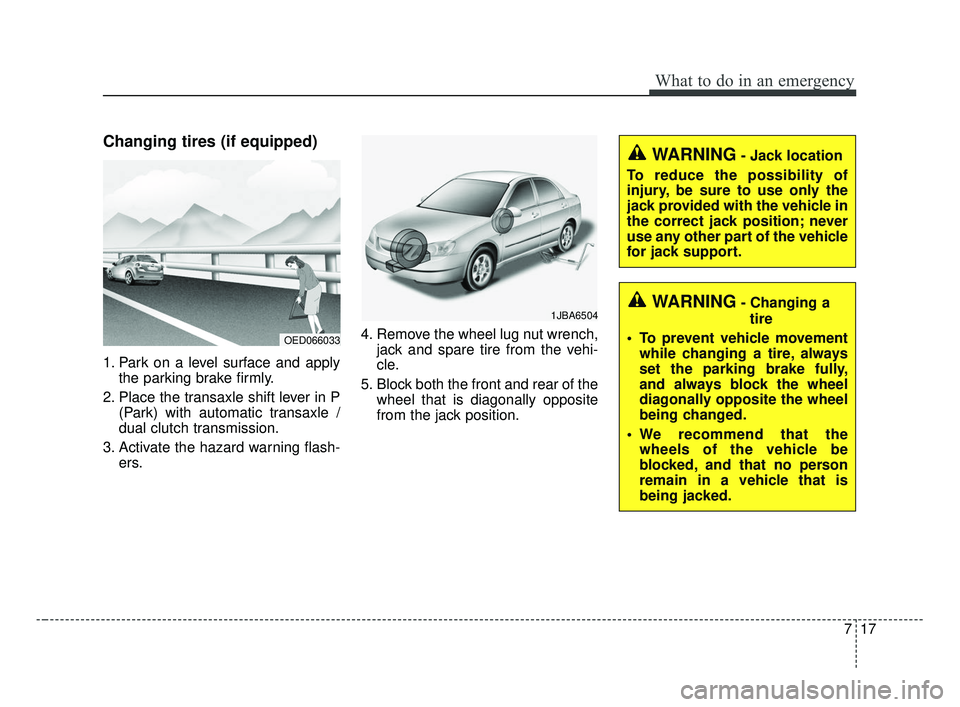
Changing tires (if equipped)
1. Park on a level surface and applythe parking brake firmly.
2. Place the transaxle shift lever in P (Park) with automatic transaxle /
dual clutch transmission.
3. Activate the hazard warning flash- ers. 4. Remove the wheel lug nut wrench,
jack and spare tire from the vehi-
cle.
5. Block both the front and rear of the wheel that is diagonally opposite
from the jack position.
1JBA6504
OED066033
WARNING- Jack location
To reduce the possibility of
injury, be sure to use only the
jack provided with the vehicle in
the correct jack position; never
use any other part of the vehicle
for jack support.
WARNING- Changing a tire
• To prevent vehicle movement while changing a tire, always
set the parking brake fully,
and always block the wheel
diagonally opposite the wheel
being changed.
We recommend that the wheels of the vehicle be
blocked, and that no person
remain in a vehicle that is
being jacked.
JF CAN (ENG) 7.qxp 8/25/2016 5:22 PM Page 17
Page 492 of 629
723
What to do in an emergency
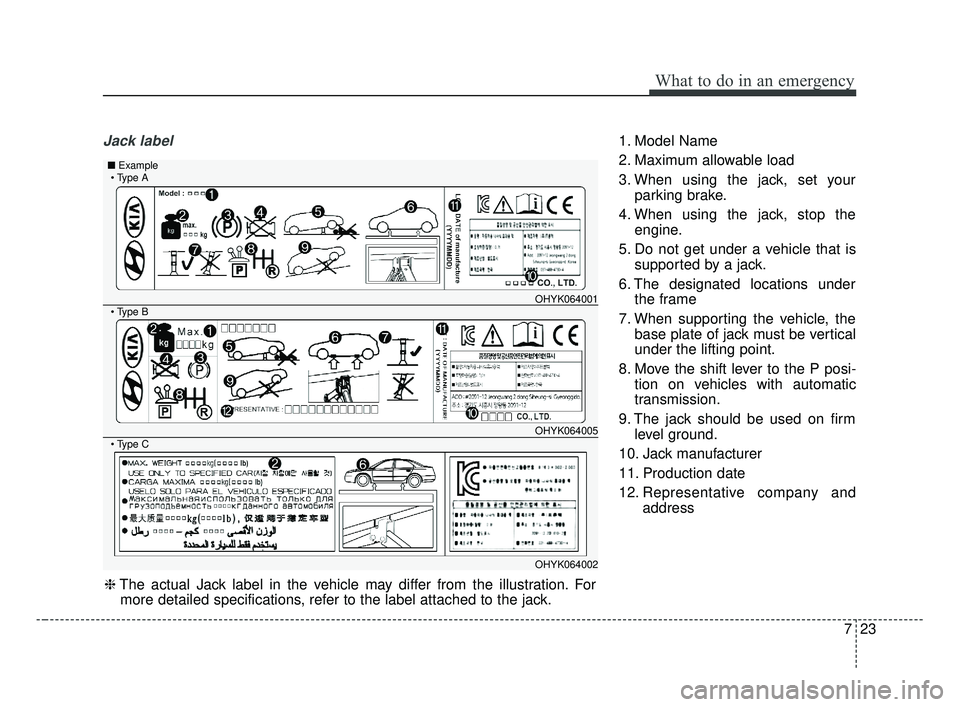
Jack label1. Model Name
2. Maximum allowable load
3. When using the jack, set yourparking brake.
4. When using the jack, stop the engine.
5. Do not get under a vehicle that is supported by a jack.
6. The designated locations under the frame
7. When supporting the vehicle, the base plate of jack must be vertical
under the lifting point.
8. Move the shift lever to the P posi- tion on vehicles with automatic
transmission.
9. The jack should be used on firm level ground.
10. Jack manufacturer
11. Production date
12. Representative company and address
OHYK064001
OHYK064005
OHYK064002
■Example
❈The actual Jack label in the vehicle may differ from the illustration. For
more detailed specifications, refer to the label attached to the jack.
JF CAN (ENG) 7.qxp 8/25/2016 5:23 PM Page 23
Page 515 of 629
Maintenance
12
8
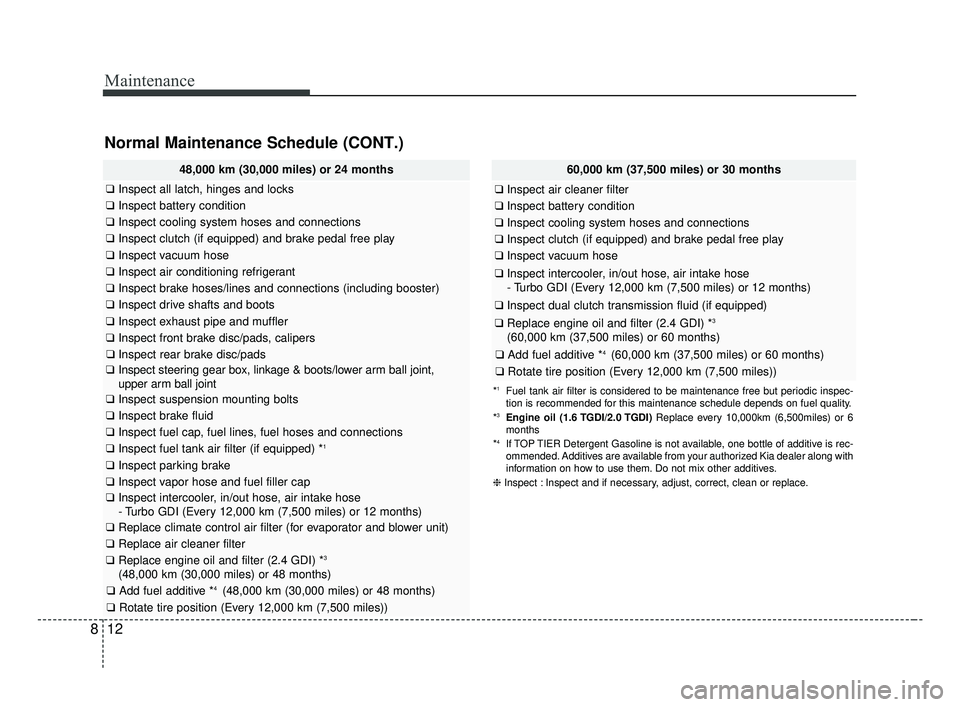
Normal Maintenance Schedule (CONT.)
60,000 km (37,500 miles) or 30 months
❑ Inspect air cleaner filter
❑ Inspect battery condition
❑Inspect cooling system hoses and connections
❑Inspect clutch (if equipped) and brake pedal free play
❑Inspect vacuum hose
❑Inspect intercooler, in/out hose, air intake hose
- Turbo GDI (Every 12,000 km (7,500 miles) or 12 months)
❑Inspect dual clutch transmission fluid (if equipped)
❑Replace engine oil and filter (2.4 GDI) *3
(60,000 km (37,500 miles) or 60 months)
❑ Add fuel additive *4 (60,000 km (37,500 miles) or 60 months)
❑Rotate tire position (Every 12,000 km (7,500 miles))
*1Fuel tank air filter is considered to be maintenance free but periodic inspec-
tion is recommended for this maintenance schedule depends on fuel quality.
*
3Engine oil (1.6 TGDI/2.0 TGDI) Replace every 10,000km (6,500miles) or 6
months
*
4If TOP TIER Detergent Gasoline is not available, one bottle of additive is rec-
ommended. Additives are available from your authorized Kia dealer along with
information on how to use them. Do not mix other additives.
❈ Inspect : Inspect and if necessary, adjust, correct, clean or replace.
48,000 km (30,000 miles) or 24 months
❑Inspect all latch, hinges and locks
❑Inspect battery condition
❑Inspect cooling system hoses and connections
❑Inspect clutch (if equipped) and brake pedal free play
❑Inspect vacuum hose
❑Inspect air conditioning refrigerant
❑Inspect brake hoses/lines and connections (including booster)
❑Inspect drive shafts and boots
❑Inspect exhaust pipe and muffler
❑Inspect front brake disc/pads, calipers
❑Inspect rear brake disc/pads
❑Inspect steering gear box, linkage & boots/lower arm ball joint,
upper arm ball joint
❑Inspect suspension mounting bolts
❑Inspect brake fluid
❑Inspect fuel cap, fuel lines, fuel hoses and connections
❑Inspect fuel tank air filter (if equipped) *1
❑Inspect parking brake
❑Inspect vapor hose and fuel filler cap
❑Inspect intercooler, in/out hose, air intake hose
- Turbo GDI (Every 12,000 km (7,500 miles) or 12 months)
❑ Replace climate control air filter (for evaporator and blower unit)
❑Replace air cleaner filter
❑Replace engine oil and filter (2.4 GDI) *3
(48,000 km (30,000 miles) or 48 months)
❑ Add fuel additive *4 (48,000 km (30,000 miles) or 48 months)
❑Rotate tire position (Every 12,000 km (7,500 miles))
JF CAN (ENG) 8.qxp 2016-09-23 10:23 Page 12
Page 524 of 629
821
Maintenance
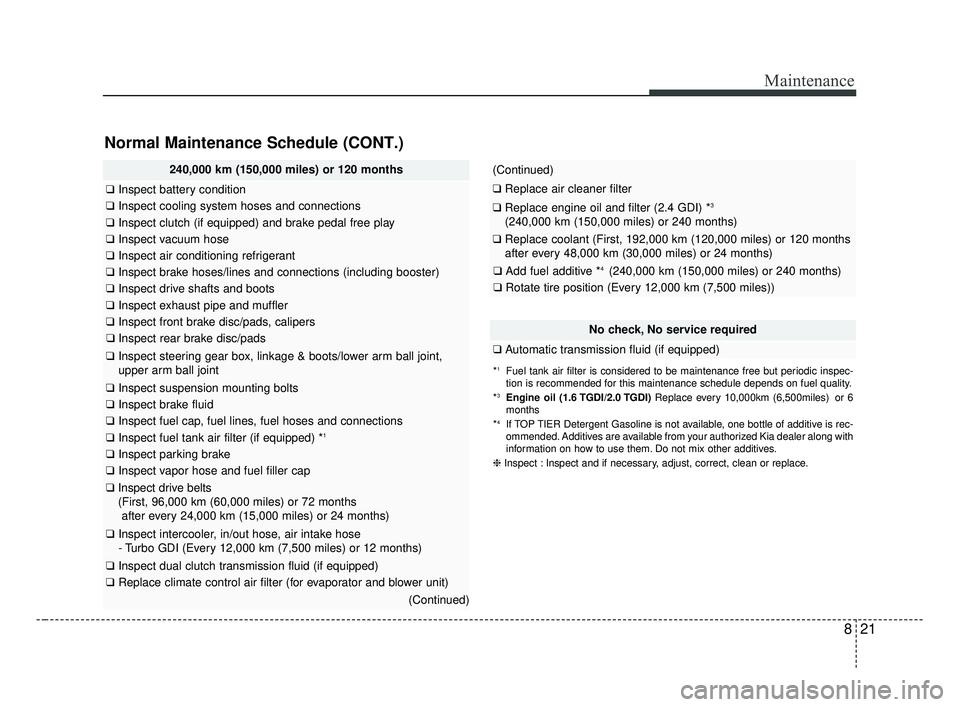
Normal Maintenance Schedule (CONT.)
240,000 km (150,000 miles) or 120 months
❑Inspect battery condition
❑Inspect cooling system hoses and connections
❑Inspect clutch (if equipped) and brake pedal free play
❑Inspect vacuum hose
❑Inspect air conditioning refrigerant
❑Inspect brake hoses/lines and connections (including booster)
❑Inspect drive shafts and boots
❑Inspect exhaust pipe and muffler
❑Inspect front brake disc/pads, calipers
❑Inspect rear brake disc/pads
❑Inspect steering gear box, linkage & boots/lower arm ball joint,
upper arm ball joint
❑ Inspect suspension mounting bolts
❑Inspect brake fluid
❑Inspect fuel cap, fuel lines, fuel hoses and connections
❑Inspect fuel tank air filter (if equipped) *1
❑Inspect parking brake
❑Inspect vapor hose and fuel filler cap
❑Inspect drive belts
(First, 96,000 km (60,000 miles) or 72 months
after every 24,000 km (15,000 miles) or 24 months)
❑ Inspect intercooler, in/out hose, air intake hose
- Turbo GDI (Every 12,000 km (7,500 miles) or 12 months)
❑Inspect dual clutch transmission fluid (if equipped)
❑ Replace climate control air filter (for evaporator and blower unit)
(Continued)
(Continued)
❑Replace air cleaner filter
❑Replace engine oil and filter (2.4 GDI) *3
(240,000 km (150,000 miles) or 240 months)
❑Replace coolant (First, 192,000 km (120,000 miles) or 120 months
after every 48,000 km (30,000 miles) or 24 months)
❑ Add fuel additive *4 (240,000 km (150,000 miles) or 240 months)
❑Rotate tire position (Every 12,000 km (7,500 miles))
No check, No service required
❑Automatic transmission fluid (if equipped)
*1Fuel tank air filter is considered to be maintenance free but periodic inspec-
tion is recommended for this maintenance schedule depends on fuel quality.
*
3Engine oil (1.6 TGDI/2.0 TGDI) Replace every 10,000km (6,500miles) or 6
months
*
4If TOP TIER Detergent Gasoline is not available, one bottle of additive is rec-
ommended. Additives are available from your authorized Kia dealer along with
information on how to use them. Do not mix other additives.
❈ Inspect : Inspect and if necessary, adjust, correct, clean or replace.
JF CAN (ENG) 8.qxp 2016-09-23 10:23 Page 21
Page 525 of 629
Maintenance
22
8
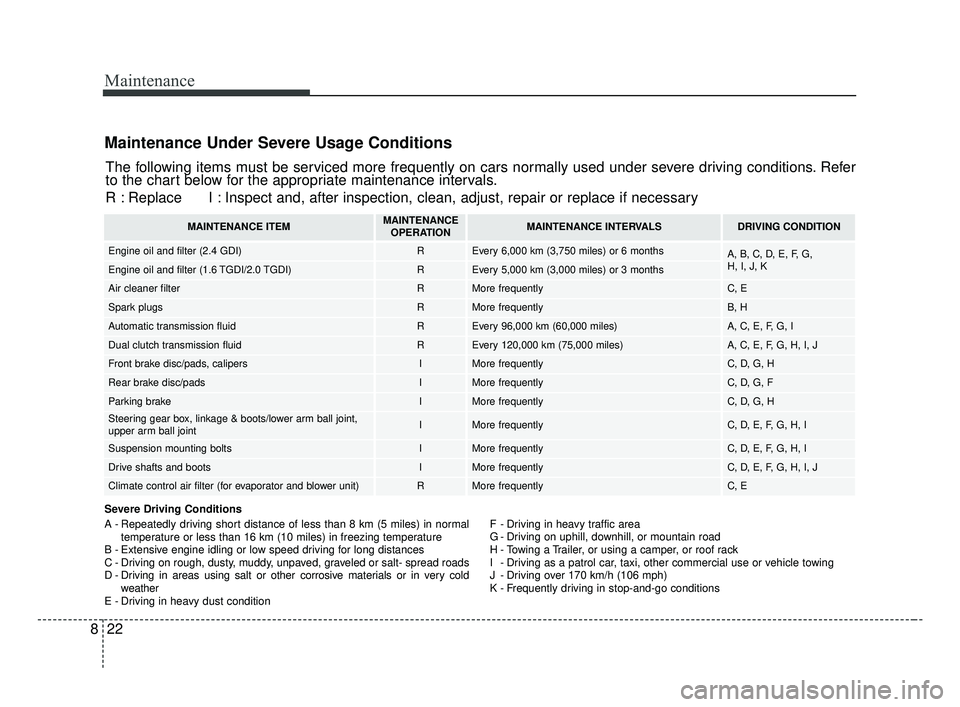
Maintenance Under Severe Usage Conditions
Severe Driving Conditions
A - Repeatedly driving short distance of less than 8 km (5 miles) in normal
temperature or less than 16 km (10 miles) in freezing temperature
B - Extensive engine idling or low speed driving for long distances
C - Driving on rough, dusty, muddy, unpaved, graveled or salt- spread roads
D - Driving in areas using salt or other corrosive materials or in very cold weather
E - Driving in heavy dust condition F - Driving in heavy traffic area
G - Driving on uphill, downhill, or mountain road
H - Towing a Trailer, or using a camper, or roof rack
I - Driving as a patrol car, taxi, other commercial use or vehicle towing
J - Driving over 170 km/h (106 mph)
K - Frequently driving in stop-and-go conditions
The following items must be serviced more frequently on cars normally used under severe driving conditions. Refer
to the chart below for the appropriate maintenance intervals.
R : Replace I : Inspect and, after inspection, clean, adjust, repair or replace if neces\
sary
MAINTENANCE ITEMMAINTENANCE
OPERATIONMAINTENANCE INTERVALSDRIVING CONDITION
Engine oil and filter (2.4 GDI)REvery 6,000 km (3,750 miles) or 6 monthsA, B, C, D, E, F, G,
H, I, J, K
Engine oil and filter (1.6 TGDI/2.0 TGDI)REvery 5,000 km (3,000 miles) or 3 months
Air cleaner filterRMore frequentlyC, E
Spark plugsRMore frequentlyB, H
Automatic transmission fluidREvery 96,000 km (60,000 miles)A, C, E, F, G, I
Dual clutch transmission fluid REvery 120,000 km (75,000 miles)A, C, E, F, G, H, I, J
Front brake disc/pads, calipersIMore frequentlyC, D, G, H
Rear brake disc/padsIMore frequentlyC, D, G, F
Parking brakeIMore frequentlyC, D, G, H
Steering gear box, linkage & boots/lower arm ball joint,
upper arm ball jointIMore frequentlyC, D, E, F, G, H, I
Suspension mounting boltsIMore frequentlyC, D, E, F, G, H, I
Drive shafts and bootsIMore frequentlyC, D, E, F, G, H, I, J
Climate control air filter (for evaporator and blower unit)RMore frequentlyC, E
JF CAN (ENG) 8.qxp 2016-09-23 10:23 Page 22
Page 528 of 629
825
Maintenance
Automatic transaxle fluid
Automatic transaxle fluid should not
be checked under normal usage
conditions.
But in severe conditions, the fluid
should be changed at an authorized
Kia dealer in accordance to the
scheduled maintenance at the begin-
ning of this chapter.
✽ ✽NOTICE
Automatic transaxle fluid color is
basically red.
As the vehicle is driven, the auto-
matic transaxle fluid will begin to
look darker.
It is normal condition and you should
not judge the need to replace the fluid
based upon the changed color.
Dual clutch transmission Fluid
Inspect the dual clutch transmission
fluid according to the maintenance
schedule.
Brake hoses and lines
Visually check for proper installation,
chafing, cracks, deterioration and
any leakage. Replace any deteriorat-
ed or damaged parts immediately.
Brake fluid
Check the brake fluid level in the
brake fluid reservoir. The level should
be between “MIN” and “MAX” marks
on the side of the reservoir. Use only
hydraulic brake fluid conforming to
DOT 3 or DOT 4 specification.
Parking brake
Inspect the parking brake system
including the parking brake pedal
and cables.
CAUTION
Use only specified automatic
transaxle fluid. The use of a non-specified fluid could result in atransaxle malfunction and fail-ure. (Refer to "Recommendedlubricants and capacities" inchapter 9.)
JF CAN (ENG) 8.qxp 2016-09-23 10:23 Page 25