ABS KIA OPTIMA 2017 Owner's Manual
[x] Cancel search | Manufacturer: KIA, Model Year: 2017, Model line: OPTIMA, Model: KIA OPTIMA 2017Pages: 629, PDF Size: 15.24 MB
Page 592 of 629
889
Maintenance
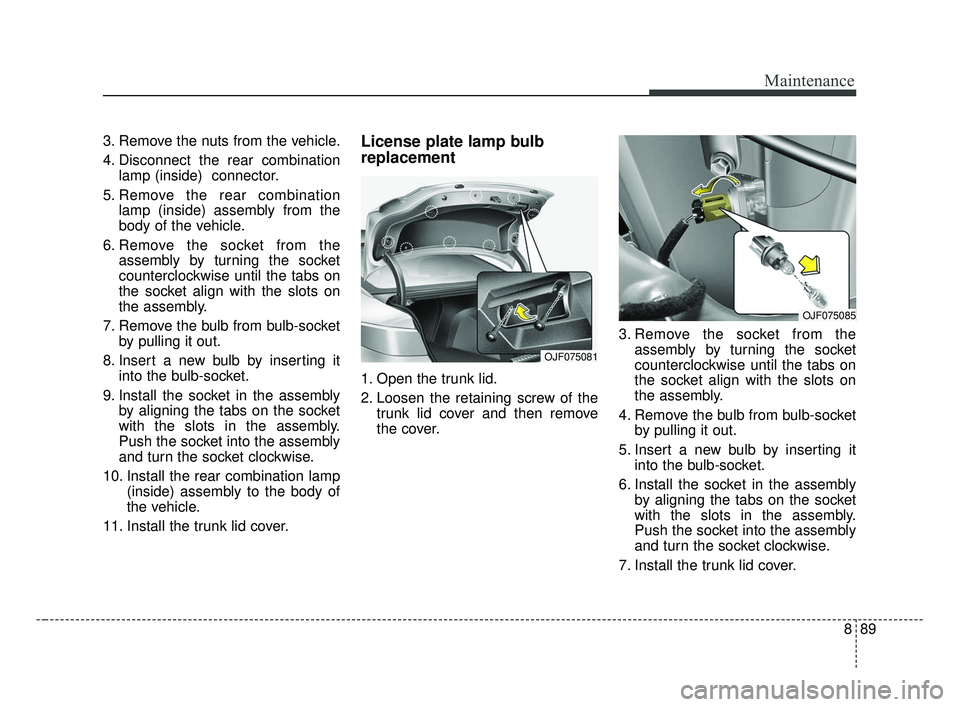
3. Remove the nuts from the vehicle.
4. Disconnect the rear combinationlamp (inside) connector.
5. Remove the rear combination lamp (inside) assembly from the
body of the vehicle.
6. Remove the socket from the assembly by turning the socket
counterclockwise until the tabs on
the socket align with the slots on
the assembly.
7. Remove the bulb from bulb-socket by pulling it out.
8. Insert a new bulb by inserting it into the bulb-socket.
9. Install the socket in the assembly by aligning the tabs on the socket
with the slots in the assembly.
Push the socket into the assembly
and turn the socket clockwise.
10. Install the rear combination lamp (inside) assembly to the body of
the vehicle.
11. Install the trunk lid cover.License plate lamp bulb
replacement
1. Open the trunk lid.
2. Loosen the retaining screw of the trunk lid cover and then remove
the cover. 3. Remove the socket from the
assembly by turning the socket
counterclockwise until the tabs on
the socket align with the slots on
the assembly.
4. Remove the bulb from bulb-socket by pulling it out.
5. Insert a new bulb by inserting it into the bulb-socket.
6. Install the socket in the assembly by aligning the tabs on the socket
with the slots in the assembly.
Push the socket into the assembly
and turn the socket clockwise.
7. Install the trunk lid cover.
OJF075081
OJF075085
JF CAN (ENG) 8.qxp 2016-09-23 10:25 Page 89
Page 594 of 629
891
Maintenance
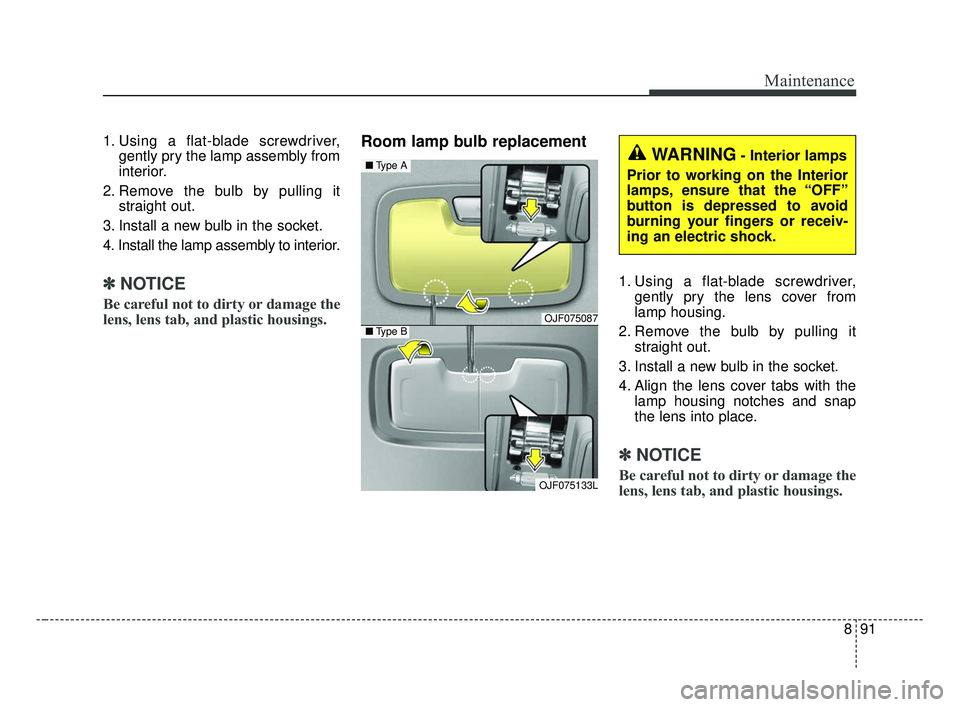
1. Using a flat-blade screwdriver,gently pry the lamp assembly from
interior.
2. Remove the bulb by pulling it straight out.
3. Install a new bulb in the socket.
4. Install the lamp assembly to interior.
✽ ✽ NOTICE
Be careful not to dirty or damage the
lens, lens tab, and plastic housings.
Room lamp bulb replacement
1. Using a flat-blade screwdriver,
gently pry the lens cover from
lamp housing.
2. Remove the bulb by pulling it straight out.
3. Install a new bulb in the socket.
4. Align the lens cover tabs with the lamp housing notches and snap
the lens into place.
✽ ✽NOTICE
Be careful not to dirty or damage the
lens, lens tab, and plastic housings.
WARNING- Interior lamps
Prior to working on the Interior
lamps, ensure that the “OFF”
button is depressed to avoid
burning your fingers or receiv-
ing an electric shock.
OJF075087
OJF075133L
■ Type A
■Type B
JF CAN (ENG) 8.qxp 2016-09-23 10:25 Page 91
Page 595 of 629
Maintenance
92
8
Personal lamp bulb replace-
ment
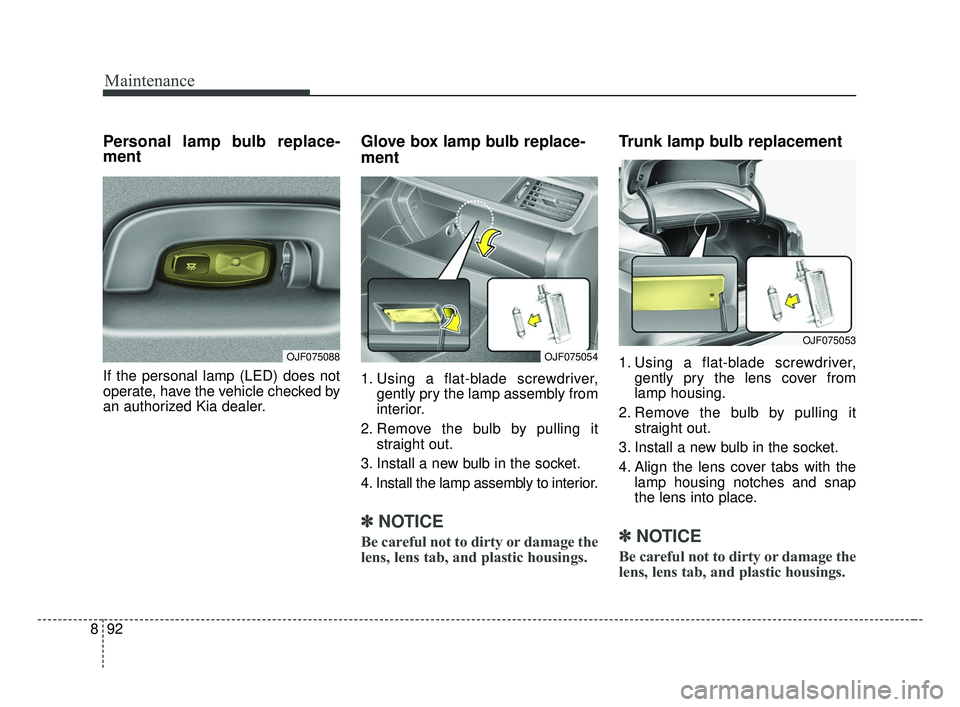
If the personal lamp (LED) does not
operate, have the vehicle checked by
an authorized Kia dealer.
Glove box lamp bulb replace-
ment
1. Using a flat-blade screwdriver,
gently pry the lamp assembly from
interior.
2. Remove the bulb by pulling it straight out.
3. Install a new bulb in the socket.
4. Install the lamp assembly to interior.
✽ ✽ NOTICE
Be careful not to dirty or damage the
lens, lens tab, and plastic housings.
Trunk lamp bulb replacement
1. Using a flat-blade screwdriver,
gently pry the lens cover from
lamp housing.
2. Remove the bulb by pulling it straight out.
3. Install a new bulb in the socket.
4. Align the lens cover tabs with the lamp housing notches and snap
the lens into place.
✽ ✽NOTICE
Be careful not to dirty or damage the
lens, lens tab, and plastic housings.
OJF075088OJF075054
OJF075053
JF CAN (ENG) 8.qxp 2016-09-23 10:25 Page 92
Page 605 of 629
Maintenance
102
8
Canister
Fuel vapors generated inside the fuel
tank are absorbed and stored in the
onboard canister. When the engine is
running, the fuel vapors absorbed in
the canister are drawn into the surge
tank through the purge control sole-
noid valve.
Purge Control Solenoid Valve
(PCSV)
The purge control solenoid valve is
controlled by the Engine Control
Module (ECM); when the engine
coolant temperature is low during
idling, the PCSV closes so that evap-
orated fuel is not taken into the
engine. After the engine warms up
during ordinary driving, the PCSV
opens to introduce evaporated fuel to
the engine.
3. Exhaust emission control system
The Exhaust Emission Control
System is a highly effective system
which controls exhaust emissions
while maintaining good vehicle per-
formance.
Vehicle modifications
This vehicle should not be modified.
Modification of your vehicle could
affect its performance, safety or
durability and may even violate gov-
ernmental safety and emissions reg-
ulations.
In addition, damage or performance
problems resulting from any modifi-
cation may not be covered under
warranty.
If you use unauthorized electronic
devices, it may cause the vehicle to
operate abnormally, wire damage,
battery discharge and fire. For your
safety, do not use unauthorized
electronic devices.
Engine exhaust gas precautions
(carbon monoxide)
Carbon monoxide can be present with other exhaust fumes.
Therefore, if you smell exhaust
fumes of any kind inside your vehi-
cle, have it inspected and repaired
immediately. If you ever suspect
exhaust fumes are coming into
your vehicle, drive it only with all
the windows fully open. Have your
vehicle checked and repaired
immediately.
WARNING - Exhaust
Engine exhaust gases contain
carbon monoxide (CO). Though
colorless and odorless, it is
dangerous and could be lethal if
inhaled. Follow the instructions
on this page to avoid CO poi-
soning.
JF CAN (ENG) 8.qxp 2016-09-23 10:25 Page 102
Page 621 of 629
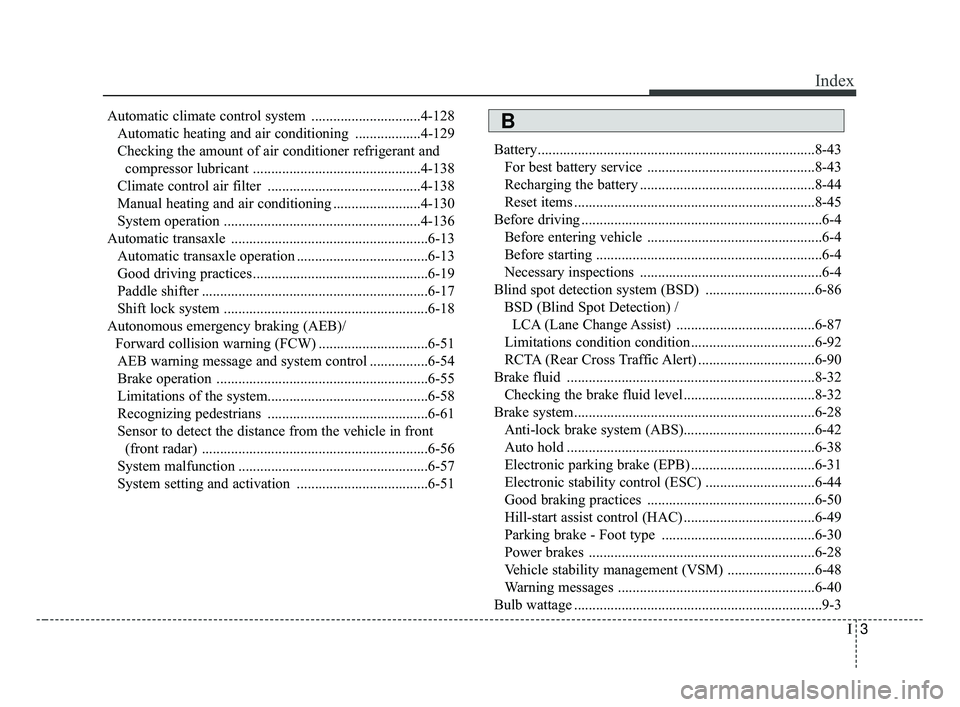
I3
Index
Automatic climate control system ..............................4-128Automatic heating and air conditioning ..................4-129
Checking the amount of air conditioner refrigerant and compressor lubricant ..............................................4-138
Climate control air filter ..........................................4-138
Manual heating and air conditioning ........................4-130
System operation ......................................................4-136
Automatic transaxle ......................................................6-13 Automatic transaxle operation ....................................6-13
Good driving practices ................................................6-19
Paddle shifter ..............................................................6-17
Shift lock system ........................................................6-18
Autonomous emergency braking (AEB)/ Forward collision warning (FCW) ..............................6-51AEB warning message and system control ................6-54
Brake operation ..........................................................6-55
Limitations of the system............................................6-5\
8
Recognizing pedestrians ............................................6-61
Sensor to detect the distance from the vehicle in front (front radar) ..............................................................6-56
System malfunction ....................................................6-57
System setting and activation ....................................6-51 Battery........................................................................\
....8-43
For best battery service ..............................................8-43
Recharging the battery ................................................8-44
Reset items ..................................................................8-45
Before driving ..................................................................6-4 Before entering vehicle ................................................6-4
Before starting ..............................................................6-4
Necessary inspections ..................................................6-4
Blind spot detection system (BSD) ..............................6-86 BSD (Blind Spot Detection) / LCA (Lane Change Assist) ......................................6-87
Limitations condition condition ..................................6-92
RCTA (Rear Cross Traffic Alert) ................................6-90
Brake fluid ....................................................................8-32\
Checking the brake fluid level ....................................8-32
Brake system..................................................................6-28 Anti-lock brake system (ABS)....................................6-42
Auto hold ....................................................................6-38\
Electronic parking brake (EPB) ..................................6-31
Electronic stability control (ESC) ..............................6-44
Good braking practices ..............................................6-50
Hill-start assist control (HAC) ....................................6-49
Parking brake - Foot type ..........................................6-30
Power brakes ..............................................................6-28
Vehicle stability management (VSM) ........................6-48
Warning messages ......................................................6-40
Bulb wattage ....................................................................9-3B
JF CAN (ENG) Index.qxp 8/30/2016 6:11 PM Page 3