brake KIA OPTIMA 2019 Owners Manual
[x] Cancel search | Manufacturer: KIA, Model Year: 2019, Model line: OPTIMA, Model: KIA OPTIMA 2019Pages: 577, PDF Size: 13.79 MB
Page 488 of 577
Maintenance
48
7
Disc brake pads should be inspected
for wear whenever tires are rotated.
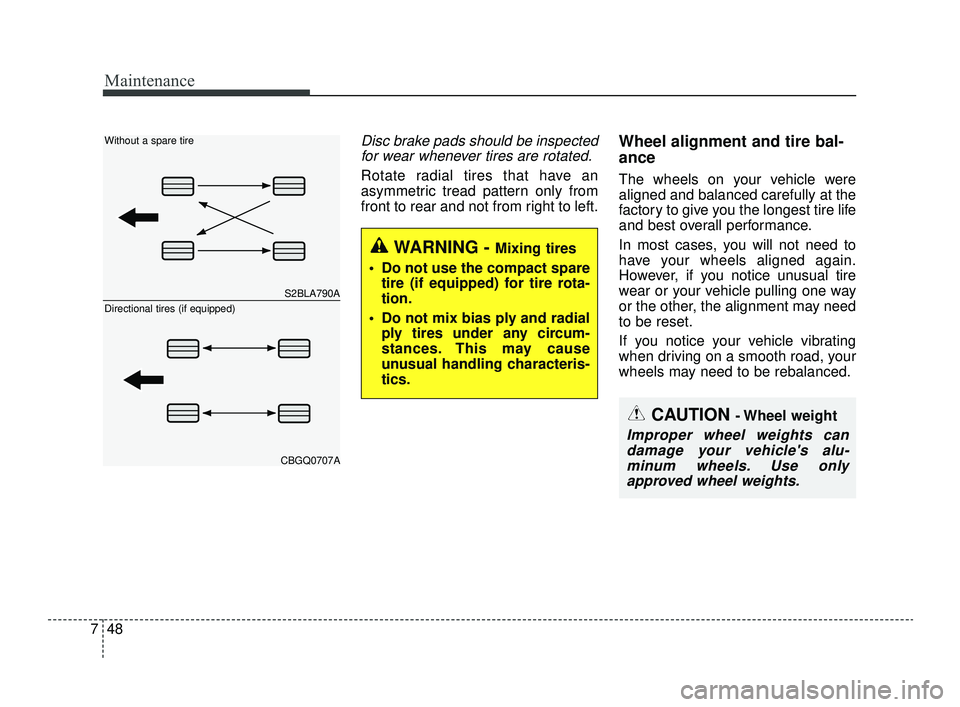
Rotate radial tires that have an
asymmetric tread pattern only from
front to rear and not from right to left.
Wheel alignment and tire bal-
ance
The wheels on your vehicle were
aligned and balanced carefully at the
factory to give you the longest tire life
and best overall performance.
In most cases, you will not need to
have your wheels aligned again.
However, if you notice unusual tire
wear or your vehicle pulling one way
or the other, the alignment may need
to be reset.
If you notice your vehicle vibrating
when driving on a smooth road, your
wheels may need to be rebalanced.
WARNING - Mixing tires
Do not use the compact spare tire (if equipped) for tire rota-
tion.
Do not mix bias ply and radial ply tires under any circum-
stances. This may cause
unusual handling characteris-
tics.
CAUTION - Wheel weight
Improper wheel weights candamage your vehicle's alu-minum wheels. Use onlyapproved wheel weights.
S2BLA790A
CBGQ0707A
Without a spare tire
Directional tires (if equipped)
JFa PE USA 7.qxp 5/17/2018 6:35 PM Page 48
Page 489 of 577
749
Maintenance
Tire replacement
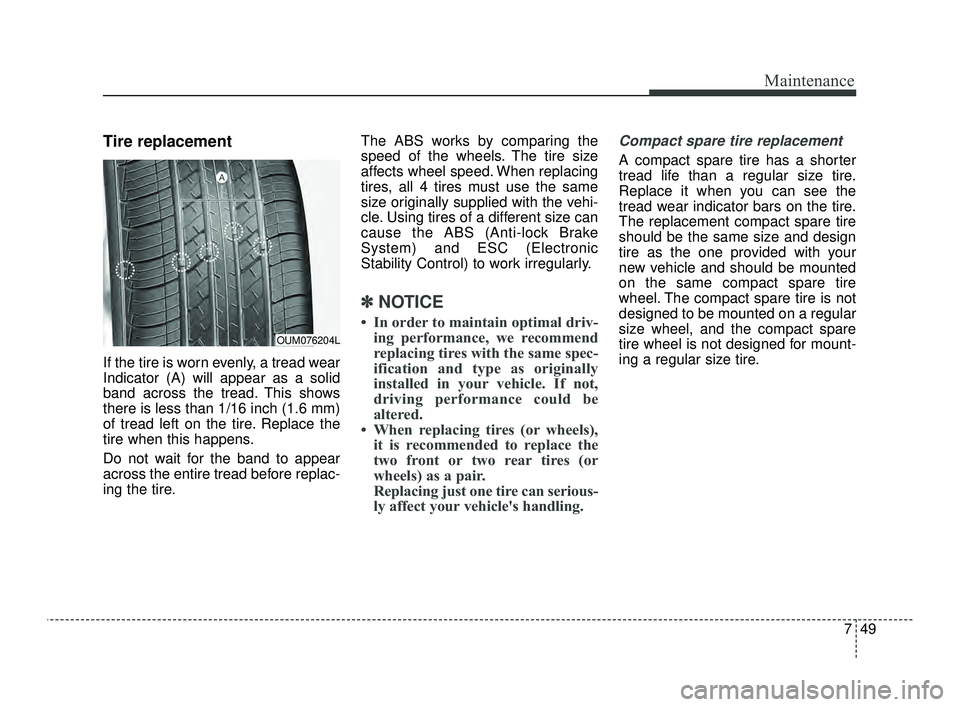
If the tire is worn evenly, a tread wear
Indicator (A) will appear as a solid
band across the tread. This shows
there is less than 1/16 inch (1.6 mm)
of tread left on the tire. Replace the
tire when this happens.
Do not wait for the band to appear
across the entire tread before replac-
ing the tire.The ABS works by comparing the
speed of the wheels. The tire size
affects wheel speed. When replacing
tires, all 4 tires must use the same
size originally supplied with the vehi-
cle. Using tires of a different size can
cause the ABS (Anti-lock Brake
System) and ESC (Electronic
Stability Control) to work irregularly.
✽ ✽
NOTICE
• In order to maintain optimal driv-
ing performance, we recommend
replacing tires with the same spec-
ification and type as originally
installed in your vehicle. If not,
driving performance could be
altered.
• When replacing tires (or wheels), it is recommended to replace the
two front or two rear tires (or
wheels) as a pair.
Replacing just one tire can serious-
ly affect your vehicle's handling.
Compact spare tire replacement
A compact spare tire has a shorter
tread life than a regular size tire.
Replace it when you can see the
tread wear indicator bars on the tire.
The replacement compact spare tire
should be the same size and design
tire as the one provided with your
new vehicle and should be mounted
on the same compact spare tire
wheel. The compact spare tire is not
designed to be mounted on a regular
size wheel, and the compact spare
tire wheel is not designed for mount-
ing a regular size tire.
OUM076204L
JFa PE USA 7.qxp 5/17/2018 6:35 PM Page 49
Page 496 of 577
Maintenance
56
7
Production options weight: The
combined weight of installed regular
production options weighing over 5
lb.(2.3 kg) in excess of the standard
items which they replace, not previ-
ously considered in curb weight or
accessory weight, including heavy
duty brakes, ride levelers, roof rack,
heavy duty battery, and special trim.
Recommended Inflation Pressure:
Vehicle manufacturer's recommend-
ed tire inflation pressure and shown
on the tire placard.
Radial Ply Tire: A pneumatic tire in
which the ply cords that extend to the
beads are laid at 90 degrees to the
centerline of the tread.
Rim: A metal support for a tire and
upon which the tire beads are seat-
ed.
Sidewall: The portion of a tire
between the tread and the bead. Speed Rating:
An alphanumeric
code assigned to a tire indicating the
maximum speed at which a tire can
operate.
Traction: The friction between the
tire and the road surface. The
amount of grip provided.
Tread: The portion of a tire that
comes into contact with the road.
Treadwear Indicators: Narrow
bands, sometimes called "wear
bars," that show across the tread of a
tire when only 1/16 inch of tread
remains.
UTQGS: Uniform Tire Quality
Grading Standards, a tire information
system that provides consumers with
ratings for a tire's traction, tempera-
ture and treadwear. Ratings are
determined by tire manufacturers
using government testing proce-
dures. The ratings are molded into
the sidewall of the tire.
Vehicle Capacity Weight: The num-
ber of designated seating positions
multiplied by 150 lbs. (68kg) plus the
rated cargo and luggage load. Vehicle Maximum Load on the
Tire:
Load on an individual tire due
to curb and accessory weight plus
maximum occupant and cargo
weight.
Vehicle Normal Load on the Tire:
Load on an individual tire that is
determined by distributing to each
axle its share of the curb weight,
accessory weight, and normal occu-
pant weight and driving by 2.
Vehicle Placard: A label permanent-
ly attached to a vehicle showing the
original equipment tire size and rec-
ommended inflation pressure.
JFa PE USA 7.qxp 5/17/2018 6:35 PM Page 56
Page 509 of 577
769
Maintenance
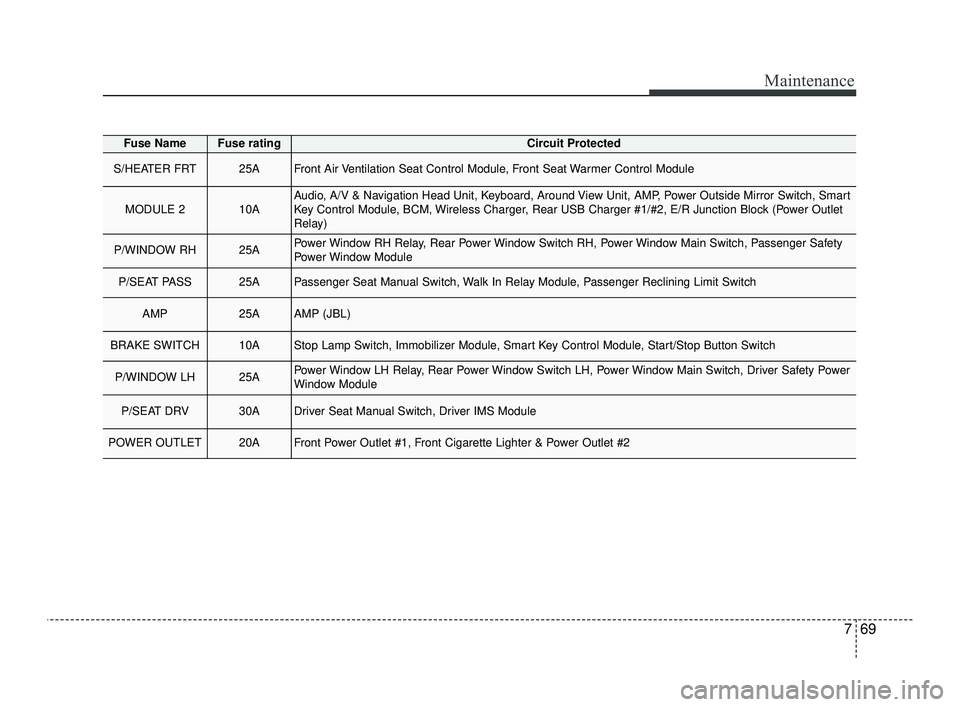
Fuse NameFuse ratingCircuit Protected
S/HEATER FRT25AFront Air Ventilation Seat Control Module, Front Seat Warmer Control Module
MODULE 210AAudio, A/V & Navigation Head Unit, Keyboard, Around View Unit, AMP, Power Outside Mirror Switch, Smart
Key Control Module, BCM, Wireless Charger, Rear USB Charger #1/#2, E/R Junction Block (Power Outlet
Relay)
P/WINDOW RH25APower Window RH Relay, Rear Power Window Switch RH, Power Window Main Switch, Passenger Safety
Power Window Module
P/SEAT PASS25APassenger Seat Manual Switch, Walk In Relay Module, Passenger Reclining Limit Switch
AMP25AAMP (JBL)
BRAKE SWITCH10AStop Lamp Switch, Immobilizer Module, Smart Key Control Module, Start/Stop Button Switch
P/WINDOW LH25APower Window LH Relay, Rear Power Window Switch LH, Power Window Main Switch, Driver Safety Power
Window Module
P/SEAT DRV30ADriver Seat Manual Switch, Driver IMS Module
POWER OUTLET20AFront Power Outlet #1, Front Cigarette Lighter & Power Outlet #2
JFa PE USA 7.qxp 5/17/2018 6:35 PM Page 69
Page 513 of 577
773
Maintenance
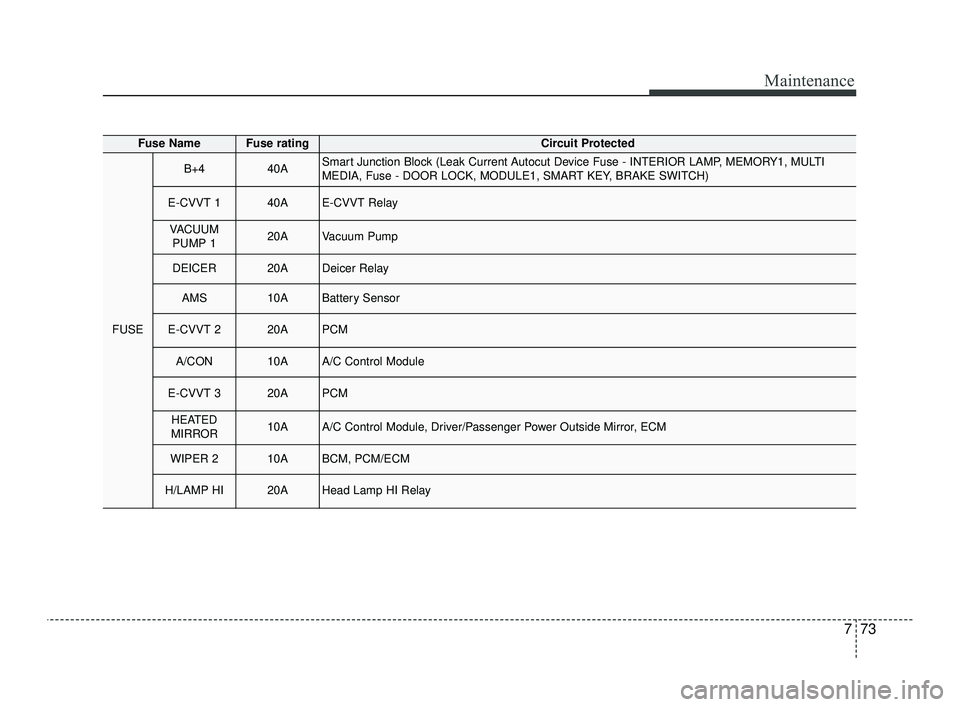
Fuse NameFuse ratingCircuit Protected
FUSE
B+440ASmart Junction Block (Leak Current Autocut Device Fuse - INTERIOR LAMP, MEMORY1, MULTI
MEDIA, Fuse - DOOR LOCK, MODULE1, SMART KEY, BRAKE SWITCH)
E-CVVT 140AE-CVVT Relay
VACUUMPUMP 120AVacuum Pump
DEICER20ADeicer Relay
AMS10ABattery Sensor
E-CVVT 220APCM
A/CON10AA/C Control Module
E-CVVT 320APCM
HEATED
MIRROR10AA/C Control Module, Driver/Passenger Power Outside Mirror, ECM
WIPER 210ABCM, PCM/ECM
H/LAMP HI20AHead Lamp HI Relay
JFa PE USA 7.qxp 5/17/2018 6:36 PM Page 73
Page 516 of 577
Maintenance
76
7
LIGHT BULBS
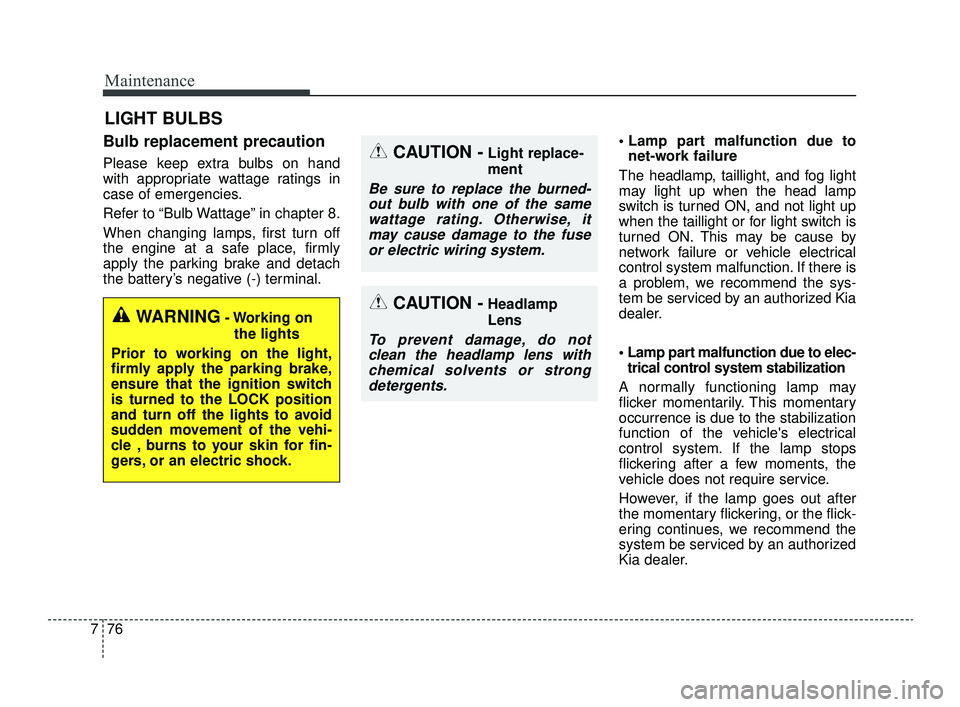
Bulb replacement precaution
Please keep extra bulbs on hand
with appropriate wattage ratings in
case of emergencies.
Refer to “Bulb Wattage” in chapter 8.
When changing lamps, first turn off
the engine at a safe place, firmly
apply the parking brake and detach
the battery’s negative (-) terminal.
net-work failure
The headlamp, taillight, and fog light
may light up when the head lamp
switch is turned ON, and not light up
when the taillight or for light switch is
turned ON. This may be cause by
network failure or vehicle electrical
control system malfunction. If there is
a problem, we recommend the sys-
tem be serviced by an authorized Kia
dealer.
trical control system stabilization
A normally functioning lamp may
flicker momentarily. This momentary
occurrence is due to the stabilization
function of the vehicle's electrical
control system. If the lamp stops
flickering after a few moments, the
vehicle does not require service.
However, if the lamp goes out after
the momentary flickering, or the flick-
ering continues, we recommend the
system be serviced by an authorized
Kia dealer.
WARNING- Working on the lights
Prior to working on the light,
firmly apply the parking brake,
ensure that the ignition switch
is turned to the LOCK position
and turn off the lights to avoid
sudden movement of the vehi-
cle , burns to your skin for fin-
gers, or an electric shock.
CAUTION -Light replace-
ment
Be sure to replace the burned- out bulb with one of the samewattage rating. Otherwise, itmay cause damage to the fuseor electric wiring system.
CAUTION -Headlamp
Lens
To prevent damage, do notclean the headlamp lens withchemical solvents or strongdetergents.
JFa PE USA 7.qxp 5/17/2018 6:36 PM Page 76
Page 535 of 577
795
Maintenance
Waxing
Wax the vehicle when water will no
longer bead on the paint.
Always wash and dry the vehicle
before waxing. Use a good quality
liquid or paste wax, and follow the
manufacturer’s instructions. Wax all
metal trim to protect it and to main-
tain its luster.
Removing oil, tar, and similar materi-
als with a spot remover will usually
strip the wax from the finish. Be sure
to re-wax these areas even if the rest
of the vehicle does not yet need wax-
ing.
Do not apply wax on embossed
unpainted unit, as it may tarnish the
unit.
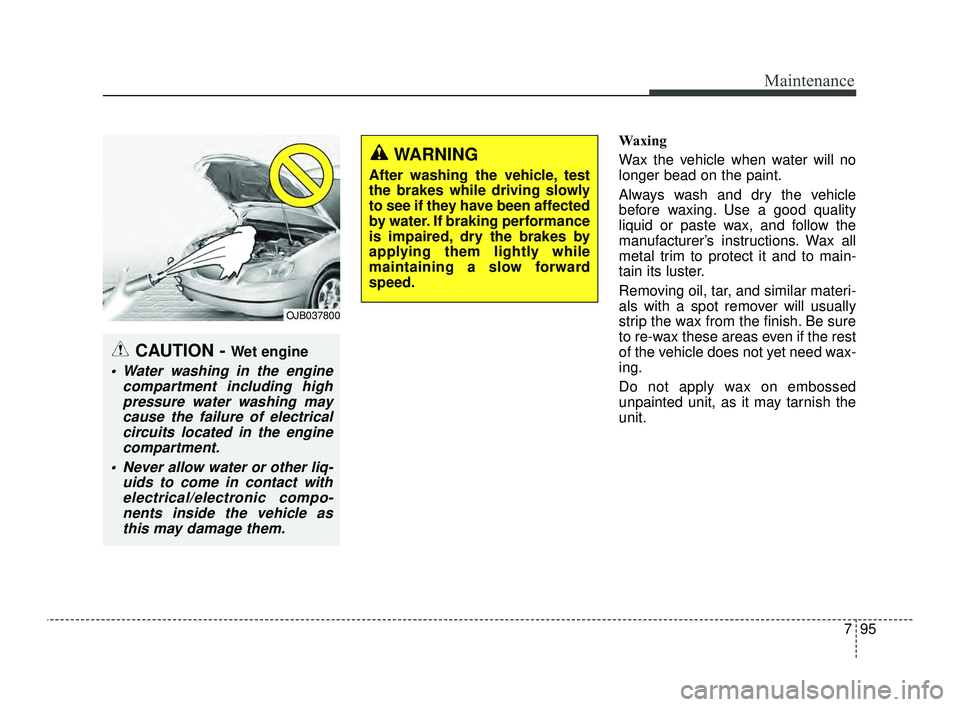
OJB037800
CAUTION - Wet engine
Water washing in the enginecompartment including highpressure water washing maycause the failure of electricalcircuits located in the enginecompartment.
Never allow water or other liq- uids to come in contact withelectrical/electronic compo-nents inside the vehicle asthis may damage them.
WARNING
After washing the vehicle, test
the brakes while driving slowly
to see if they have been affected
by water. If braking performance
is impaired, dry the brakes by
applying them lightly while
maintaining a slow forward
speed.
JFa PE USA 7.qxp 5/17/2018 6:38 PM Page 95
Page 537 of 577
797
Maintenance
Do a thorough washing of theundercarriage at the end of the
winter.
Use professional service techni- cians or governmental inspection
stations to annually inspect for cor-
rosion.
Immediately seek an inspection of your vehicle if you become visually
aware of corrosion flaking or scal-
ing or if you become aware of a
change in vehicle performance,
such as soft or spongey brakes,
fluids leaking, impairment of direc-
tional control, suspension noises
or rattling metal straps.Aluminum wheel maintenance
The aluminum wheels are coated
with a clear protective finish.
Do not use any abrasive cleaner,polishing compound, solvent, or
wire brushes on aluminum wheels.
They may scratch the finish.
Clean the wheel when it has cooled.
Use only a mild soap or neutral detergent, and rinse thoroughly
with water. Also, be sure to clean
the wheels after driving on salted
roads. This helps prevent corro-
sion.
Avoid washing the wheels with highspeed vehicle wash brushes.
Do not use any alkaline or acid detergents It may damage and cor-
rode the aluminum wheels coated
with a clear protective finish.
Corrosion protection
Protecting your vehicle from corrosion
By using the most advanced design
and construction practices to combat
corrosion, we produce vehicles of
the highest quality. However, this is
only part of the job. To achieve the
long-term corrosion resistance your
vehicle can deliver, the owner's
cooperation and assistance is also
required.
Common causes of corrosion
The most common causes of corro-
sion on your vehicle are:
Road salt, dirt and moisture that isallowed to accumulate underneath
the vehicle.
Removal of paint or protective coatings by stones, gravel, abra-
sion or minor scrapes and dents
which leave unprotected metal
exposed to corrosion.
JFa PE USA 7.qxp 5/17/2018 6:38 PM Page 97
Page 553 of 577
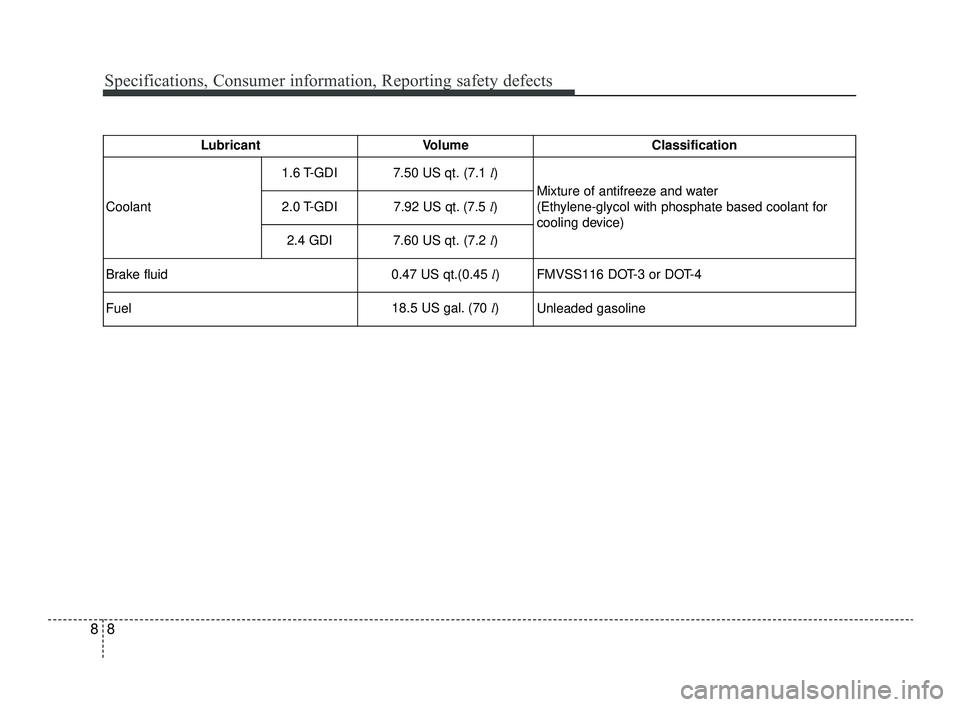
Specifications, Consumer information, Reporting safety defects
88
LubricantVolumeClassification
Coolant 1.6 T-GDI
7.50 US qt. (7.1
l)
Mixture of antifreeze and water
(Ethylene-glycol with phosphate based coolant for
cooling device)
2.0 T-GDI
7.92 US qt. (7.5
l)
2.4 GDI
7.60 US qt. (7.2 l)
Brake fluid
0.47 US qt.(0.45 l) FMVSS116 DOT-3 or DOT-4
Fuel18.5 US gal. (70l)Unleaded gasoline
JFa PE USA 8.qxp 5/17/2018 6:42 PM Page 8
Page 563 of 577

Index
2I
Adding equipment to or modifying your air bag-equippedvehicle . . . . . . . . . . . . . . . . . . . . . . . . . . . . . . . . . . . 3-\
72
Adjusting outside rearview mirror . . . . . . . . . . . . . . . . 4-56
Air bag inflation conditions . . . . . . . . . . . . . . . . . . . . . 3-67
Air bag non-inflation conditions . . . . . . . . . . . . . . . . . 3-69
Air bag warning label . . . . . . . . . . . . . . . . . . . . . . . . . . 3-72
Air bag warning light . . . . . . . . . . . . . . . . . . . . . . . . . . 3-48
Air bags. . . . . . . . . . . . . . . . . . . . . . . . . . . . . . . . . . . . \
. 3-45 Operation . . . . . . . . . . . . . . . . . . . . . . . . . . . . . . . . . 3-46
Air bag warning light . . . . . . . . . . . . . . . . . . . . . . . . 3-48
SRS components and functions . . . . . . . . . . . . . . . . 3-49
Occupant detection system. . . . . . . . . . . . . . . . . . . . 3-52
Driver's and passenger's front air bag . . . . . . . . . . . 3-60
Side air bag. . . . . . . . . . . . . . . . . . . . . . . . . . . . . . . . 3-63
Curtain air bag . . . . . . . . . . . . . . . . . . . . . . . . . . . . . 3-65
Air bag inflation conditions . . . . . . . . . . . . . . . . . . . 3-67
Air bag non-inflation conditions . . . . . . . . . . . . . . . 3-69
SRS Care . . . . . . . . . . . . . . . . . . . . . . . . . . . . . . . . . 3-71
Adding equipment to or modifying your air bag-equipped vehicle . . . . . . . . . . . . . . . . . . . . 3-72
Air bag warning label. . . . . . . . . . . . . . . . . . . . . . . . 3-72
Air cleaner . . . . . . . . . . . . . . . . . . . . . . . . . . . . . . . . . . 7-34\
Filter replacement. . . . . . . . . . . . . . . . . . . . . . . . . . . 7-34
Air conditioning system lubricants. . . . . . . . . . . . . . . . . 8-6
Air ventilation seat . . . . . . . . . . . . . . . . . . . . . . . . . . . 4-152
Antenna . . . . . . . . . . . . . . . . . . . . . . . . . . . . . . . . . . . . \
4-157 Anti-lock Brake System (ABS) . . . . . . . . . . . . . . . . . . 5-50
Appearance care . . . . . . . . . . . . . . . . . . . . . . . . . . . . . . 7-94
Exterior care . . . . . . . . . . . . . . . . . . . . . . . . . . . . . . . 7-94
Interior care . . . . . . . . . . . . . . . . . . . . . . . . . . . . . . . 7-99
Armrest . . . . . . . . . . . . . . . . . . . . . . . . . . . . . . . . . . . . \
. 3-18
Assist mode. . . . . . . . . . . . . . . . . . . . . . . . . . . . . . . . . . 4-66\
Audio system . . . . . . . . . . . . . . . . . . . . . . . . . . . . . . . 4-157 Antenna . . . . . . . . . . . . . . . . . . . . . . . . . . . . . . . . . 4-157
Auto defogging system . . . . . . . . . . . . . . . . . . . . . . . . 4-146
Auto hold . . . . . . . . . . . . . . . . . . . . . . . . . . . . . . . . . . . 5-\
46
Auto light . . . . . . . . . . . . . . . . . . . . . . . . . . . . . . . . . . 4-10\
4
Automatic climate control system . . . . . . . . . . . . . . . 4-131 Automatic heating and air conditioning. . . . . . . . . 4-132
Manual heating and air conditioning . . . . . . . . . . . 4-133
System operation . . . . . . . . . . . . . . . . . . . . . . . . . . 4-139
Climate control air filter. . . . . . . . . . . . . . . . . . . . . 4-141
Air Conditioning refrigerant label . . . . . . . . . . . . . 4-142
Checking the amount of air conditioner refrigerant and compressor lubricant . . . . . . . . . . . . . . . . . . . . . . 4-141
Automatic heating and air conditioning . . . . . . . . . . . 4-132
Automatic transaxle . . . . . . . . . . . . . . . . . . . . . . . . . . . 5-14 Automatic transaxle operation . . . . . . . . . . . . . . . . . 5-14
Good driving practices . . . . . . . . . . . . . . . . . . . . . . . 5-21
A
JFa PE USA Index.qxp 5/17/2018 6:44 PM Page 2