seats KIA OPTIMA 2019 Owner's Manual
[x] Cancel search | Manufacturer: KIA, Model Year: 2019, Model line: OPTIMA, Model: KIA OPTIMA 2019Pages: 577, PDF Size: 13.79 MB
Page 242 of 577
Features of your vehicle
152
4
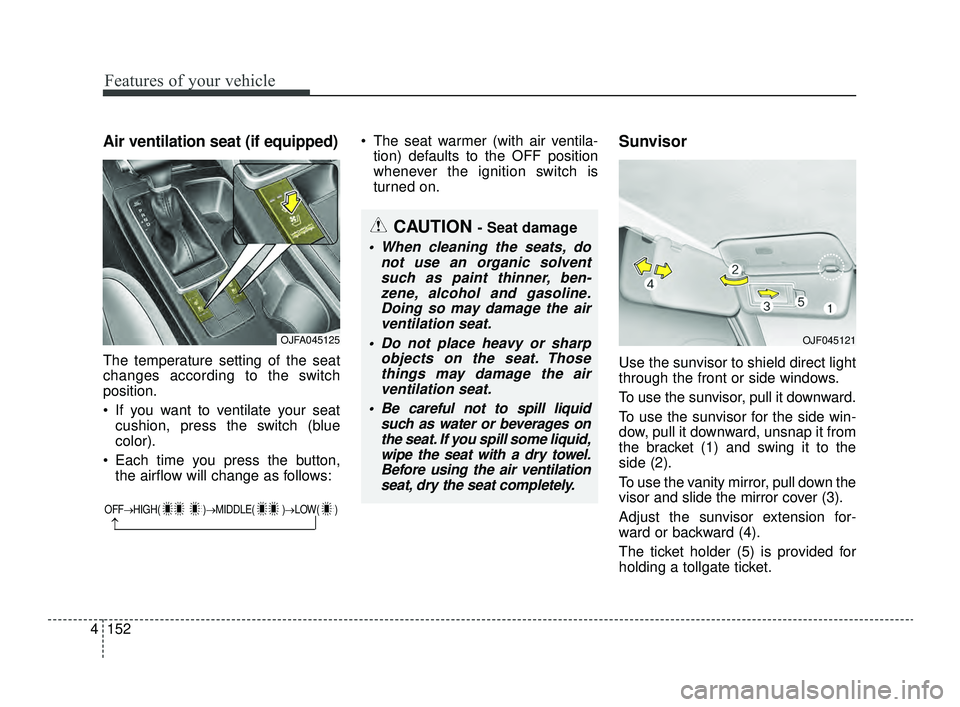
Air ventilation seat (if equipped)
The temperature setting of the seat
changes according to the switch
position.
If you want to ventilate your seat
cushion, press the switch (blue
color).
Each time you press the button, the airflow will change as follows: The seat warmer (with air ventila-
tion) defaults to the OFF position
whenever the ignition switch is
turned on.
Sunvisor
Use the sunvisor to shield direct light
through the front or side windows.
To use the sunvisor, pull it downward.
To use the sunvisor for the side win-
dow, pull it downward, unsnap it from
the bracket (1) and swing it to the
side (2).
To use the vanity mirror, pull down the
visor and slide the mirror cover (3).
Adjust the sunvisor extension for-
ward or backward (4).
The ticket holder (5) is provided for
holding a tollgate ticket.
OFF→ HIGH( )→ MIDDLE( )→LOW( )
→
CAUTION - Seat damage
When cleaning the seats, do
not use an organic solventsuch as paint thinner, ben-zene, alcohol and gasoline.Doing so may damage the airventilation seat.
Do not place heavy or sharp objects on the seat. Thosethings may damage the airventilation seat.
Be careful not to spill liquid such as water or beverages onthe seat. If you spill some liquid,wipe the seat with a dry towel.Before using the air ventilationseat, dry the seat completely.
OJFA045125OJF045121
JFa PE USA 4.qxp 5/18/2018 7:26 PM Page 152
Page 403 of 577
5151
Driving your vehicle
Steps For Determining CorrectLoad Limit -
1. Locate the statement “The com- bined weight of occupants and
cargo should never exceed XXX
kg or XXX lbs.” on your vehicle's
placard.
2. Determine the combined weight of the driver and passengers that will
be riding in your vehicle.
3. Subtract the combined weight of the driver and passengers from
XXX kg or XXX lbs.
4. The resulting figure equals the available amount of cargo and lug-
gage load capacity. For example, if
the “XXX” amount equals 1400
lbs. and there will be five 150 lb
passengers in your vehicle, the
amount of available cargo and lug-
gage load capacity is 650 lbs.
(1400-750 (5 x 150) = 650 lbs.) 5. Determine the combined weight of
luggage and cargo being loaded
on the vehicle. That weight may
not safely exceed the available
cargo and luggage load capacity
calculated in Step 4.
6. If your vehicle will be towing a trail- er, load from your trailer will be
transferred to your vehicle. Consult
this manual to determine how this
reduces the available cargo and
luggage load capacity of your
vehicle.
WARNING - Loose cargo
Do not travel with unsecured
blunt objects in the passenger
compartment of your vehicle
(e.g. suit cases or unsecured
child seats). These items may
strike occupant during a sud-
den stop or crash.
JFa PE USA 5.QXP 6/15/2018 1:45 PM Page 151
Page 494 of 577

Maintenance
54
7
Temperature -A, B & C
The temperature grades are A (the
highest), B and C representing the
tire’s resistance to the generation of
heat and its ability to dissipate heat
when tested under controlled condi-
tions on a specified indoor laboratory
test wheel.
Sustained high temperature can
cause the material of the tire to
degenerate and reduce tire life, and
excessive temperature can lead to
sudden tire failure. The grade C cor-
responds to a level of performance
which all passenger car tires must
meet under the Federal Motor
Vehicle Safety Standard No. 109.
Grades B and A represent higher
levels of performance on the labora-
tory test wheel than the minimum
required by law. Tire terminology and definitions
Air Pressure:
The amount of air
inside the tire pressing outward on
the tire. Air pressure is expressed in
kilopascal (kPa) or pounds per
square inch (psi).
Accessory Weight: This means the
combined weight of optional acces-
sories. Some examples of optional
accessories are, automatic transmis-
sion, power seats, and air condition-
ing.
Aspect Ratio: The relationship of a
tire's height to its width.
Belt: A rubber coated layer of cords
that is located between the plies and
the tread. Cords may be made from
steel or other reinforcing materials.
Bead: The tire bead contains steel
wires wrapped by steel cords that
hold the tire onto the rim.
Bias Ply Tire: A pneumatic tire in
which the plies are laid at alternate
angles less than 90 degrees to the
centerline of the tread. Cold Tire Pressure:
The amount of
air pressure in a tire, measured in
kilopascals (kPa) or pounds per
square inch (psi) before a tire has
built up heat from driving.
Curb Weight: This means the weight
of a motor vehicle with standard and
optional equipment including the
maximum capacity of fuel, oil and
coolant, but without passengers and
cargo.
DOT Markings: A code molded into
the sidewall of a tire signifying that
the tire is in compliance with the U.S.
Department of Transportation motor
vehicle safety standards. The DOT
code includes the Tire Identification
Number (TIN), an alphanumeric des-
ignator which can also identify the
tire manufacturer, production plant,
brand and date of production.
JFa PE USA 7.qxp 5/17/2018 6:35 PM Page 54
Page 540 of 577
Maintenance
100
7
Cleaning the upholstery and inte-
rior trim
Vinyl
Remove dust and loose dirt from
vinyl with a whisk broom or vacuum
cleaner. Clean vinyl surfaces with a
vinyl cleaner.
Fabric
Remove dust and loose dirt from fab-
ric with a whisk broom or vacuum
cleaner. Clean with a mild soap solu-
tion recommended for upholstery or
carpets. Remove fresh spots imme-
diately with a fabric spot cleaner. If
fresh spots do not receive immediate
attention, the fabric can be stained
and its color can be affected. Also, its
fire-resistant properties can be
reduced if the material is not proper-
ly maintained.
Using anything but recommended
cleaners and procedures may affect
the fabric’s appearance and fire-
resistant properties.
Cleaning the lap/shoulder beltwebbing
Clean the belt webbing with any mild
soap solution recommended for
cleaning upholstery or carpet. Follow
the instructions provided with the
soap. Do not bleach or re-dye the
webbing because this may weaken it.
Cleaning the interior windowglass
If the interior glass surfaces of the
vehicle become fogged (that is, cov-
ered with an oily, greasy or waxy
film), they should be cleaned with a
glass cleaner. Follow the directions
on the glass cleaner container.
CAUTION- Rear window
Do not scrape or scratch theinside of the rear window. Thismay result in damage of the rearwindow defroster grid.
CAUTION - Electrical
components
Never allow water or other liq-uids to come in contact withelectrical/electronic compo-nents inside the vehicle as thismay damage them.
CAUTION - Leather
When cleaning leather products(steering wheel, seats etc.), useneutral detergents or low alco-hol content solutions. If you usehigh alcohol content solutionsor acid/alkaline detergents, thecolor of the leather may fade orthe surface may get stripped off.
JFa PE USA 7.qxp 5/17/2018 6:38 PM Page 100
Page 541 of 577
7101
Maintenance
Taking care of leather seats (if equipped)
Vacuum the seat periodically to remove dust and sand on the seat.
It will prevent abrasion or damage of
the leather and maintain its quality.
Wipe the natural leather seat cover often with dry or soft cloth.
Sufficient use of a leather protec- tive may prevent abrasion of the
cover and helps maintain the color.
Be sure to read the instructions
and consult a specialist when
using leather coating or protective
agents.
Leather with bright colors(beige, cream beige) is easily contaminat-
ed and clear in appearance. Clean
the seats frequently.
Avoid wiping with wet cloth. It may cause the surface to crack.
Cleaning the leather seats
(if equipped)
Remove all contaminations instant- ly. Refer to instructions below for
removal of each contaminant.
Cosmetic products(sunscreen, foundation, etc.)
- Apply cleansing cream on a clothand wipe the contaminated point.
Wipe off the cream with a wet
cloth and remove water with a dry
cloth.
Beverages(coffee, soft drink, etc.) - Apply a small amount of neutraldetergent and wipe until contami-
nations do not smear.
Oil - Remove oil instantly withabsorbable cloth and wipe with
stain remover for natural leather
only.
Chewing gum - Harden the gum with ice andremove gradually.
Fabric seat cover using precau-
tions (if equipped)
Please clean the fabric seats regu-
larly with a vacuum cleaner in con-
sideration of fabric material charac-
teristics. If they are heavily soiled
with beverage stains, etc., use a suit-
able interior cleaner. To prevent dam-
age to seat covers, wipe off the seat
covers down to the seams with a
large wiping motion and moderate
pressure using a soft sponge or
microfiber cloth.
Velcro closures on clothing or sharp
objects may cause snagging or
scratches on the surface of the
seats. Make sure not to rub such
objects against the surface.
JFa PE USA 7.qxp 5/17/2018 6:38 PM Page 101
Page 573 of 577
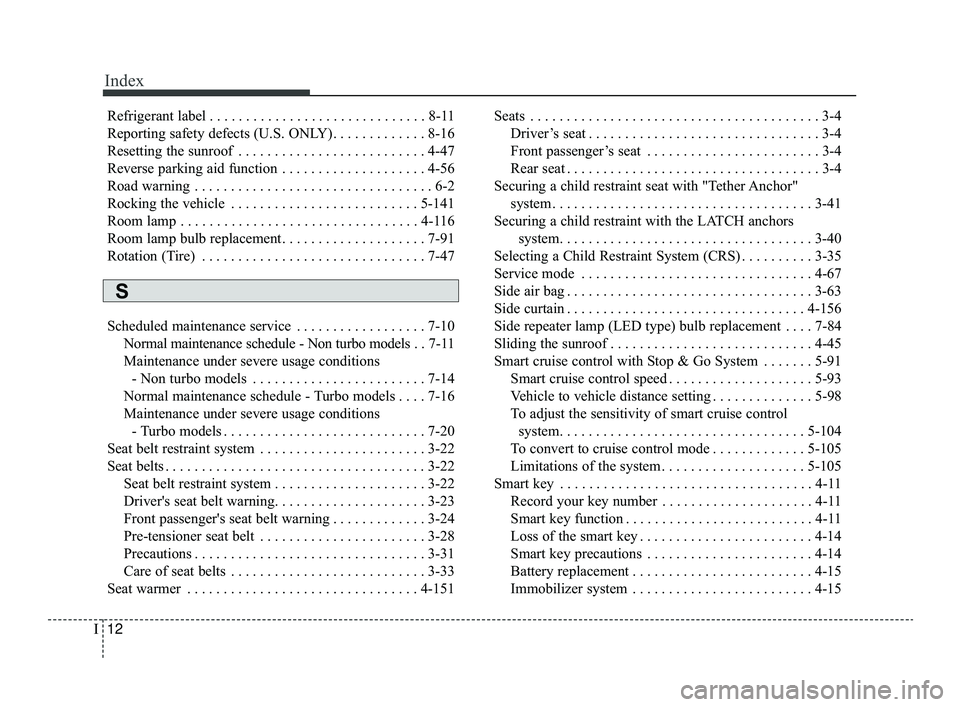
Index
12I
Refrigerant label . . . . . . . . . . . . . . . . . . . . . . . . . . . . . . 8-11
Reporting safety defects (U.S. ONLY). . . . . . . . . . . . . 8-16
Resetting the sunroof . . . . . . . . . . . . . . . . . . . . . . . . . . 4-47
Reverse parking aid function . . . . . . . . . . . . . . . . . . . . 4-56
Road warning . . . . . . . . . . . . . . . . . . . . . . . . . . . . . . . . . 6-2
Rocking the vehicle . . . . . . . . . . . . . . . . . . . . . . . . . . 5-141
Room lamp . . . . . . . . . . . . . . . . . . . . . . . . . . . . . . . . . 4-116
Room lamp bulb replacement. . . . . . . . . . . . . . . . . . . . 7-91
Rotation (Tire) . . . . . . . . . . . . . . . . . . . . . . . . . . . . . . . 7-47
Scheduled maintenance service . . . . . . . . . . . . . . . . . . 7-10Normal maintenance schedule - Non turbo models . . 7-11
Maintenance under severe usage conditions - Non turbo models . . . . . . . . . . . . . . . . . . . . . . . . 7-14
Normal maintenance schedule - Turbo models . . . . 7-16
Maintenance under severe usage conditions - Turbo models . . . . . . . . . . . . . . . . . . . . . . . . . . . . 7-20
Seat belt restraint system . . . . . . . . . . . . . . . . . . . . . . . 3-22
Seat belts . . . . . . . . . . . . . . . . . . . . . . . . . . . . . . . . . . . . \
3-22 Seat belt restraint system . . . . . . . . . . . . . . . . . . . . . 3-22
Driver's seat belt warning. . . . . . . . . . . . . . . . . . . . . 3-23
Front passenger's seat belt warning . . . . . . . . . . . . . 3-24
Pre-tensioner seat belt . . . . . . . . . . . . . . . . . . . . . . . 3-28
Precautions . . . . . . . . . . . . . . . . . . . . . . . . . . . . . . . . 3-31
Care of seat belts . . . . . . . . . . . . . . . . . . . . . . . . . . . 3-33
Seat warmer . . . . . . . . . . . . . . . . . . . . . . . . . . . . . . . . 4-151 Seats . . . . . . . . . . . . . . . . . . . . . . . . . . . . . . . . . . . . \
. . . . 3-4
Driver’s seat . . . . . . . . . . . . . . . . . . . . . . . . . . . . . . . . 3-4
Front passenger’s seat . . . . . . . . . . . . . . . . . . . . . . . . 3-4
Rear seat . . . . . . . . . . . . . . . . . . . . . . . . . . . . . . . . . . . 3-\
4
Securing a child restraint seat with "Tether Anchor" system . . . . . . . . . . . . . . . . . . . . . . . . . . . . . . . . . . . . \
3-41
Securing a child restraint with the LATCH anchors system. . . . . . . . . . . . . . . . . . . . . . . . . . . . . . . . . . . 3-\
40
Selecting a Child Restraint System (CRS) . . . . . . . . . . 3-35
Service mode . . . . . . . . . . . . . . . . . . . . . . . . . . . . . . . . 4-67
Side air bag . . . . . . . . . . . . . . . . . . . . . . . . . . . . . . . . . . 3-63\
Side curtain . . . . . . . . . . . . . . . . . . . . . . . . . . . . . . . . . 4-156
Side repeater lamp (LED type) bulb replacement . . . . 7-84
Sliding the sunroof . . . . . . . . . . . . . . . . . . . . . . . . . . . . 4-45
Smart cruise control with Stop & Go System . . . . . . . 5-91 Smart cruise control speed . . . . . . . . . . . . . . . . . . . . 5-93
Vehicle to vehicle distance setting . . . . . . . . . . . . . . 5-98
To adjust the sensitivity of smart cruise control system. . . . . . . . . . . . . . . . . . . . . . . . . . . . . . . . . . 5-10\
4
To convert to cruise control mode . . . . . . . . . . . . . 5-105
Limitations of the system . . . . . . . . . . . . . . . . . . . . 5-105
Smart key . . . . . . . . . . . . . . . . . . . . . . . . . . . . . . . . . . . 4-\
11 Record your key number . . . . . . . . . . . . . . . . . . . . . 4-11
Smart key function . . . . . . . . . . . . . . . . . . . . . . . . . . 4-11
Loss of the smart key . . . . . . . . . . . . . . . . . . . . . . . . 4-14
Smart key precautions . . . . . . . . . . . . . . . . . . . . . . . 4-14
Battery replacement . . . . . . . . . . . . . . . . . . . . . . . . . 4-15
Immobilizer system . . . . . . . . . . . . . . . . . . . . . . . . . 4-15
S
JFa PE USA Index.qxp 5/17/2018 6:44 PM Page 12