service KIA Optima Hybrid 2011 3.G Owner's Guide
[x] Cancel search | Manufacturer: KIA, Model Year: 2011, Model line: Optima Hybrid, Model: KIA Optima Hybrid 2011 3.GPages: 394, PDF Size: 8.63 MB
Page 296 of 394

73
Maintenance
MAINTENANCE SERVICES
You should exercise the utmost care to
prevent damage to your vehicle and
injury to yourself whenever performing
any maintenance or inspection proce-
dures.
Should you have any doubts concerning
the inspection or servicing of your vehi-
cle, we strongly recommend that you
have an authorized Kia dealer perform
this work.
An authorized Kia dealer has factory-
trained technicians and genuine Kia
parts to service your vehicle properly. For
expert advice and quality service, see an
authorized Kia dealer.
Inadequate, incomplete or insufficient
servicing may result in operational prob-
lems with your vehicle that could lead to
vehicle damage, an accident, or person-
al injury.Owner’s responsibility
✽ ✽NOTICE
Maintenance Service and Record
Retention are the owner's responsibility.
You should retain documents that show
proper maintenance has been per-
formed on your vehicle in accordance
with the scheduled maintenance service
charts shown on the following pages.
You need this information to establish
your compliance with the servicing and
maintenance requirements of your vehi-
cle warranties.
Detailed warranty information is pro-
vided in your Warranty & Consumer
Information manual.
Repairs and adjustments required as a
result of improper maintenance or a lack
of required maintenance are not covered.
We recommend you have your vehicle
maintained and repaired by an author-
ized Kia dealer. An authorized Kia dealer
meets Kia’s high service quality stan-
dards and receives technical support
from Kia in order to provide you with a
high level of service satisfaction.
Page 297 of 394

Maintenance
47
Owner maintenance precautions
Improper or incomplete service may
result in problems. This section gives
instructions only for the maintenance
items that are easy to perform.
As explained earlier in this section, sev-
eral procedures can be done only by an
authorized Kia dealer with special tools.
✽ ✽NOTICE
Improper owner maintenance during
the warranty period may affect warran-
ty coverage. For details, read the sepa-
rate Warranty & Consumer
Information manual provided with the
vehicle. If you're unsure about any serv-
icing or maintenance procedure, have it
done by an authorized Kia dealer.
WARNING- Maintenance
work
Do not wear jewelry or loose cloth-
ing while working under the hood
of your vehicle with the engine run-
ning. These can become entangled
in moving parts, if you must run the
engine while working under the
hood, make certain that you
remove all jewelry (especially rings,
bracelets, watches, and necklaces)
and all neckties, scarves, and simi-
lar loose clothing before getting
near the engine or cooling fans.
WARNING
When you open the engine hood,
turn the Hybrid system off. If not, it
may result in death or serious
injury because of the high voltage
flow.
WARNING
After repair of the hydraulic brake
system, the air must be bled from
the system. Contact your
Authorized Kia Dealer for bleeding
of the brake system.
Page 300 of 394

77
Maintenance
SCHEDULED MAINTENANCE SERVICE
Follow the Normal Maintenance
Schedule if the vehicle is usually operat-
ed where none of the following conditions
apply. If any of the following conditions
apply, follow the Maintenance Under
Severe Usage Conditions.
Repeated short distance driving.
Driving in dusty conditions or sandyareas.
Extensive use of brakes.
Driving in areas where salt or other corrosive materials are being used.
Driving on rough or muddy roads.
Driving in mountainous areas.
Extended periods of idling or low speed operation.
Driving for a prolonged period in cold temperatures and/or extremely humid
climates.
More than 50% driving in heavy city traffic during hot weather above 32°C
(90°F).If your vehicle is operated under theabove conditions, you should inspect,replace or refill more frequently than thefollowing Normal Maintenance Schedule.After 120 months or 240,000 km(150,000 miles) continue to follow theprescribed maintenance intervals.
Page 301 of 394

Maintenance
87
NORMAL MAINTENANCE SCHEDULE
The following maintenance services must be performed to ensure good emission control and performance. Keep receipts for all
vehicle emission services to protect your warranty. Where both mileage and time are shown, the frequency of service is deter-
mined by whichever occurs first.
24,000 km or 12 months
❑Inspect air cleaner filter
❑Inspect HSG belt (24,000 km or 24 months)
❑ Inspect vacuum hose
❑Inspect air conditioning refrigerant
❑Inspect brake hoses and lines
❑Inspect drive shafts and boots
❑Inspect exhaust pipe and muffler
❑Inspect front brake disc/pads, calipers and rotors
❑Inspect rear brake disc/pads
(Continued)
(Continued)
❑Inspect steering gear box, linkage & boots/lower arm ball
joint, upper arm ball joint
❑ Inspect suspension mounting bolts
❑Replace climate control air filter
(for evaporator and blower unit)
❑Replace engine oil and filter (24,000 km or 24 months)
❑ Add fuel additive *1 (Every 12,000 km or 12 months)
36,000 km or 18 months
❑ Inspect air cleaner filter
❑Inspect HSG belt (36,000 km or 36 months)
❑ Inspect vacuum hose
❑Replace engine oil and filter (36,000 km or 36 months)
❑Add fuel additive *1 (Every 12,000 km or 12 months)
12,000 km or 6 months
❑ Inspect air cleaner filter
❑Inspect HSG belt (12,000 km or 12 months)
❑ Inspect vacuum hose
❑Replace engine oil and filter (12,000 km or 12 months)
❑Add fuel additive *1 (Every 12,000 km or 12 months)
*1: If TOP TIER Detergent Gasoline is not available, one bottle of addi-
tive is recommended. Additives are available from your authorized
Kia dealer along with information on how to use them. Do not mix
other additives.
❈ Inspect : Inspect and if necessary, adjust, correct, clean or replace.
Page 310 of 394

717
Maintenance
240,000 km or 120 months
❑Inspect air conditioning refrigerant
❑Inspect brake fluid
❑Inspect brake hoses and lines
❑Inspect drive shafts and boots
❑Inspect exhaust pipe and muffler
❑Inspect front brake disc/pads, calipers and rotors
❑Inspect fuel filter *1
❑Inspect fuel lines, fuel hoses and connections
❑Inspect fuel tank air filter (if equipped) *1
❑Inspect HSG belt (240,000 km or 240 months)
❑ Inspect parking brake
❑Inspect rear brake disc/pads
❑Inspect steering gear box, linkage & boots/lower arm ball
joint, upper arm ball joint
❑ Inspect suspension mounting bolts
❑Inspect vacuum hose
❑Inspect vapor hose and fuel filler cap
❑Inspect W/pump belt (auto-tensioner, HSG, w/pump)
(First, 96,000 km or 72 months after every 24,000 km or
24 months)
❑ Inspect inverter coolant hose
❑Replace climate control air filter
(for evaporator and blower unit)
❑ Replace air cleaner filter
(Continued)
(Continued)
❑Replace engine oil and filter (240,000 km or 240 months)
❑Replace engine coolant (First, 192,000 km or 120 months
after every 48,000 km or 24 months)
❑Replace inverter coolant (First, 192,000 km or 120 months
after every 48,000 km or 24 months)
❑Add fuel additive *2 (Every 12,000 km or 12 months)
NORMAL MAINTENANCE SCHEDULE (CONT.)
No check, No service required
❑ Automatic transaxle fluid
*1: Fuel filter & Fuel tank air filter are considered to be maintenance
free but periodic inspection is recommended for this maintenance
schedule depends on fuel quality. If there are some important safe-
ty matters like fuel flow restriction, surging, loss of power, hard
starting problem etc, replace the fuel filter immediately regardless
of maintenance schedule and consult an authorized Kia dealer for
details.
*
2: If TOP TIER Detergent Gasoline is not available, one bottle of addi- tive is recommended. Additives are available from your authorized
Kia dealer along with information on how to use them. Do not mix
other additives.
❈ Inspect : Inspect and if necessary, adjust, correct, clean or replace.
Page 311 of 394

Maintenance
18
7
MAINTENANCE UNDER SEVERE USAGE CONDITIONS
SEVERE DRIVING CONDITIONS
A - Repeatedly driving short distance of less than 8 km in normal tempera-
ture or less than 16 km in freezing temperature
B - Extensive engine idling or low speed driving for long distances
C - Driving on rough, dusty, muddy, unpaved, graveled or salt- spread roads
D - Driving in areas using salt or other corrosive materials or in very cold weather
E - Driving in sandy areas F - Driving in heavy traffic area over 32°C (90°F)
G - Driving on uphill, downhill, or mountain road
H - Towing a Trailer, or using a camper, or roof rack
I - Driving as a patrol car, taxi, other commercial use or vehicle towing
J - Driving over 170 km/h (106 mph)
K - Frequently driving in stop-and-go conditions
L - Frequently driving in rainy areas
The following items must be serviced more frequently on cars normally used under severe driving conditions. Refer to the chart
below for the appropriate maintenance intervals.
R : Replace I : Inspect and, after inspection, clean, adjust, repair or replace if neces\
sary
MAINTENANCE ITEMMAINTENANCE
OPERATIONMAINTENANCE INTERVALSDRIVING CONDITION
ENGINE OIL AND FILTERREVERY 6,000 KM OR 6 MONTHSA, B, C, D, E, F, G, H, I, K
AIR CLEANER FILTERRMORE FREQUENTLYC, E
SPARK PLUGSRMORE FREQUENTLYB, H
AUTOMATIC TRANSAXLE FLUIDREVERY 96,000 KMA, C, E, F, G, I
HSG BELTREVERY 48,000 KM or 24 MONTHS C, D, E, K, L
IEVERY 6,000 KM or 6 MONTHS C, D, E, K, L
FRONT BRAKE DISC/PADS, CALIPERSIMORE FREQUENTLYC, D, G, H
REAR BRAKE DISC/PADSIMORE FREQUENTLYC, D, G, F
PARKING BRAKEIMORE FREQUENTLYC, D, G, H
STEERING GEAR BOX, LINKAGE & BOOTS/
LOWER ARM BALL JOINT, UPPER ARM BALL
JOINTIEVERY 12,000 KM OR 6 MONTHSC, D, E, F, G, H, I
DRIVE SHAFTS AND BOOTSIMORE FREQUENTLYC, D, E, F, G, H, I, J
CLIMATE CONTROL AIR FILTER
(FOR EVAPORATOR AND BLOWER UNIT)RMORE FREQUENTLYC, E
Page 328 of 394
735
Maintenance
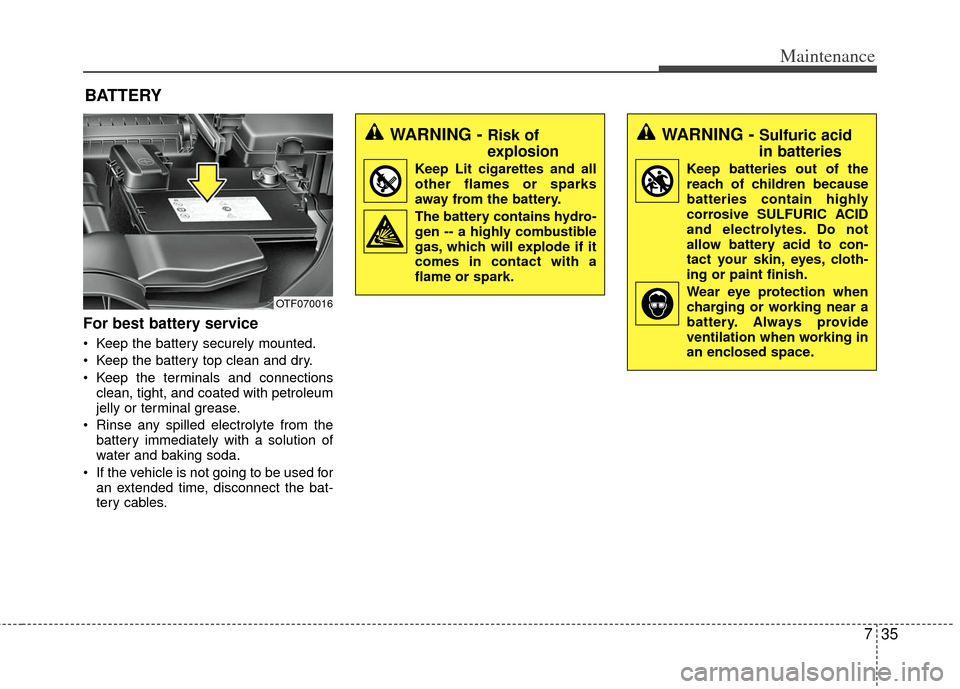
BATTERY
For best battery service
Keep the battery securely mounted.
Keep the battery top clean and dry.
Keep the terminals and connectionsclean, tight, and coated with petroleum
jelly or terminal grease.
Rinse any spilled electrolyte from the battery immediately with a solution of
water and baking soda.
If the vehicle is not going to be used for an extended time, disconnect the bat-
tery cables.
WARNING - Risk of
explosion
Keep Lit cigarettes and all
other flames or sparks
away from the battery.
The battery contains hydro-
gen -- a highly combustible
gas, which will explode if it
comes in contact with a
flame or spark.
WARNING - Sulfuric acid
in batteries
Keep batteries out of the
reach of children because
batteries contain highly
corrosive SULFURIC ACID
and electrolytes. Do not
allow battery acid to con-
tact your skin, eyes, cloth-
ing or paint finish.
Wear eye protection when charging or working near a
battery. Always provide
ventilation when working in
an enclosed space.
OTF070016
Page 339 of 394

Maintenance
46
7
7. Uniform tire quality grading
Quality grades can be found where
applicable on the tire sidewall
between tread shoulder and maxi-
mum section width.
For example:
TREADWEAR 440
TRACTION A
TEMPERATURE A
Tread wear
The tread wear grade is a compara-
tive rating based on the wear rate of
the tire when tested under controlled
conditions on a specified govern-
ment test course. For example, a tire
graded 150 would wear one-and-a-
half times (1½) as well on the gov-
ernment course as a tire graded 100.
The relative performance of tires
depends upon the actual conditions
of their use, however, and may
depart significantly from the norm
due to variations in driving habits,
service practices and differences in
road characteristics and climate. Tires degrade over time, even when
they are not being used. Regardless
of the remaining tread, we recom-
mend that tires be replaced after
approximately six (6) years of nor-
mal service. Heat caused by hot cli-
mates or frequent high loading con-
ditions can accelerate the aging
process.
These grades are molded on the
side-walls of passenger vehicle tires.
The tires available as standard or
optional equipment on your vehicles
may vary with respect to grade.
Traction - AA, A, B & C
The traction grades, from highest to
lowest, are AA, A, B and C. Those
grades represent the tires ability to
stop on wet pavement as measured
under controlled conditions on spec-
ified government test surfaces of
asphalt and concrete. A tire marked
C may have poor traction perform-
ance.
The traction grade assigned to this
tire is based on straight-ahead brak-
ing traction tests, and does not
include acceleration, cornering,
hydroplaning, or peak traction char-
acteristics.
Page 368 of 394

5
Specifications, Consumer information, Reporting safety defects
RECOMMENDED LUBRICANTS AND CAPACITIES
To help achieve proper engine and powertrain performance and durability, use only lubricants of the proper quality. The correct
lubricants also help promote engine efficiency that results in improved fuel economy.
These lubricants and fluids are recommended for use in your vehicle.
*
1Refer to the recommended SAE viscosity numbers on the next page.
*2Engine oils labeled Energy Conserving Oil are now available. Along with other additional benefits, they contribute to fuel econ-
omy by reducing the amount of fuel necessary to overcome engine friction. Often, these improvements are difficult to measure
in everyday driving, but in a year’s time, they can offer significant cost and energy savings.
*
3If the API service SM engine oil is not available in your country, you are able to use API service SL.
LubricantVolumeClassification
Engine oil *1 *2
(drain and refill)
Recommended
(or equivalent)4.76 US qt. (4.5 l)API Service SM*3,
ILSAC GF-4 or above
Automatic transaxle fluid6.87 US qt. (6.5 l)MICHANG ATF SP-IV, SK ATF SP-IV
NOCA ATF SP-IV, KIA genuine ATF SP-IV
Coolant 6.97~7.29 US qt. (6.6~6.9 l)Mixture of antifreeze and water (Ethylene glycol base
coolant for aluminum radiator)
Inverter coolant2.39 US qt. (2.26 l)Mixture of antifreeze and water (Ethylene glycol basecoolant for aluminum radiator)
Brake fluid0.7~0.8 US qt.
(0.7~0.8 l)FMVSS116 DOT-3 or DOT-4
Fuel17.2 US gal. (65 l)Unleaded gasoline
8
Page 369 of 394

Specifications, Consumer information, Reporting safety defects
68
Recommended SAE viscosity
number Engine oil viscosity (thickness) has an
effect on fuel economy and cold weather
operating (engine start and engine oil
flowability). Lower viscosity engine oils
can provide better fuel economy and cold
weather performance, however, higher
viscosity engine oils are required for sat-
isfactory lubrication in hot weather. Using
oils of any viscosity other than those rec-
ommended could result in engine dam-
age.When choosing an oil, consider the
range of temperature your vehicle will be
operated in before the next oil change.
Proceed to select the recommended oil
viscosity from the chart.
CAUTION
Always be sure to clean the area
around any filler plug, drain plug, ordipstick before checking or drain-ing any lubricant. This is especiallyimportant in dusty or sandy areasand when the vehicle is used on unpaved roads. Cleaning the plugand dipstick areas will prevent dirtand grit from entering the engineand other mechanisms that couldbe damaged.
Temperature Range for SAE Viscosity Numbers
Temperature
Engine Oil *
1
°C
(°F)-30 -20 -10 0 10 20 30 40 50 -10 0 20 40 60 80 100 120
1. For better fuel economy, it is recommended to use theengine oil of a viscosity grade SAE 5W-20 (API Service SM
/ ILSAC GF-4). However, if the engine oil is not available,
select the proper engine oil using the engine oil viscosity
chart.
10W-30
5W-20, 5W-30