lock KIA Optima Hybrid 2011 3.G Owner's Manual
[x] Cancel search | Manufacturer: KIA, Model Year: 2011, Model line: Optima Hybrid, Model: KIA Optima Hybrid 2011 3.GPages: 394, PDF Size: 8.63 MB
Page 11 of 394
Your vehicle at a glance
22
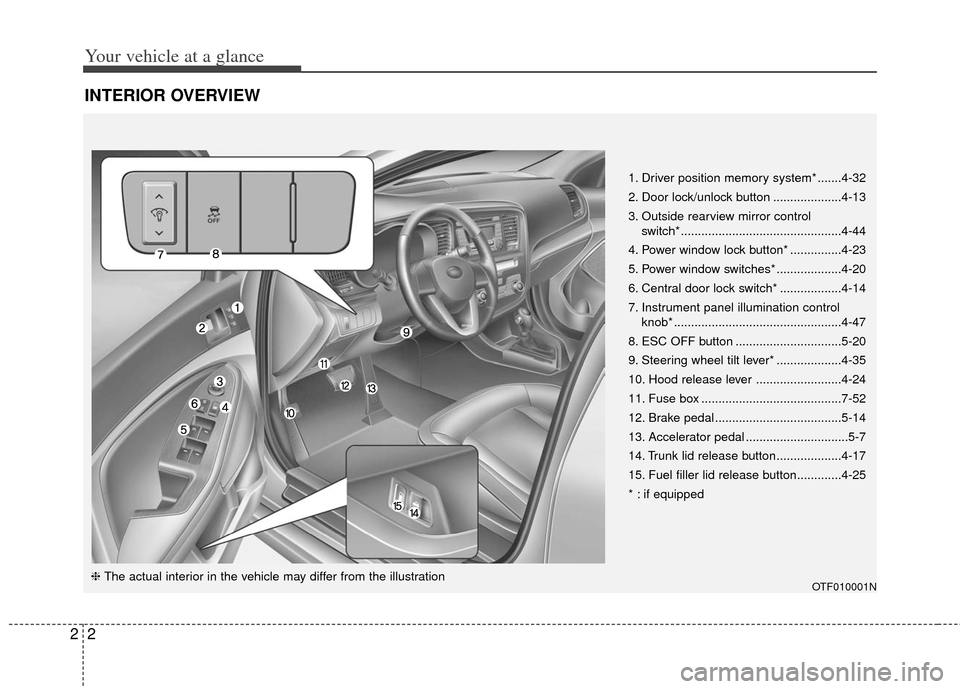
INTERIOR OVERVIEW
1. Driver position memory system* .......4-32
2. Door lock/unlock button ....................4-13
3. Outside rearview mirror control switch* ...............................................4-44
4. Power window lock button* ...............4-23
5. Power window switches* ...................4-20
6. Central door lock switch* ..................4-14
7. Instrument panel illumination control knob* .................................................4-47
8. ESC OFF button ...............................5-20
9. Steering wheel tilt lever* ...................4-35
10. Hood release lever .........................4-24
11. Fuse box .........................................7-52
12. Brake pedal .....................................5-14
13. Accelerator pedal ..............................5-7
14. Trunk lid release button...................4-17
15. Fuel filler lid release button.............4-25
* : if equipped
OTF010001N❈ The actual interior in the vehicle may differ from the illustration
Page 12 of 394
23
Your vehicle at a glance
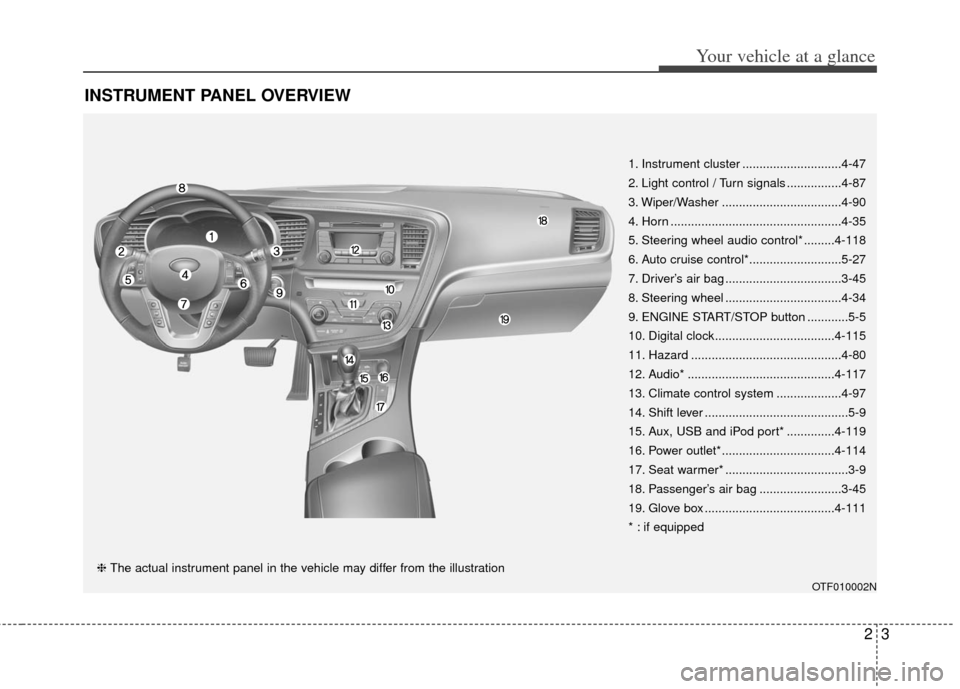
INSTRUMENT PANEL OVERVIEW
OTF010002N
1. Instrument cluster .............................4-47
2. Light control / Turn signals ................4-87
3. Wiper/Washer ...................................4-90
4. Horn ..................................................4-35
5. Steering wheel audio control* .........4-118
6. Auto cruise control*...........................5-27
7. Driver’s air bag ..................................3-45
8. Steering wheel ..................................4-34
9. ENGINE START/STOP button ............5-5
10. Digital clock ...................................4-115
11. Hazard ............................................4-80
12. Audio* ...........................................4-117
13. Climate control system ...................4-97
14. Shift lever ..........................................5-9
15. Aux, USB and iPod port* ..............4-119
16. Power outlet* .................................4-114
17. Seat warmer* ....................................3-9
18. Passenger’s air bag ........................3-45
19. Glove box ......................................4-111
* : if equipped
❈ The actual instrument panel in the vehicle may differ from the illustration
Page 17 of 394
33
Safety features of your vehicle
WARNING - Driver’s seat
Never attempt to adjust the seatwhile the vehicle is moving of
your vehicle. This could result in
loss of control of your vehicle.
Do not allow anything to interfere with the normal position of the
seatback. Storing items against a
seatback or in any other way
interfering with proper locking of
a seatback.
Sit as far back as possible from the steering wheel while still
maintaining comfortable control
of your vehicle. A distance of at
least 10" from your chest to the
steering wheel is recommended.
Failure to do so can result in
airbag inflation injuries to the
driver.
WARNING - Uprighting
seat
Do not press the release lever on a
manual seatback without holding
and controlling the seatback. The
seatback will spring upright possi-
bly impacting you or other passen-
gers.
WARNING - Loose objects
Do not place anything in the dri-
ver's foot well or under the front
seats. Loose objects in the driver's
foot area could interfere with the
operation of the foot pedals.
WARNING -
Driver responsibility for
passengers
The driver must advise the passen-
ger to keep the seatback in an
upright position whenever the vehi-
cle is in motion. If a seat is reclined
during an accident, the restraint
system's ability to restrain will be
greatly reduced.
WARNING - Seat cushion
Occupants should never sit on seat
cushions. The passenger's hips
may slide under the lap portion of
the seat belt during an accident or
a sudden stop.
Page 18 of 394
Safety features of your vehicle
43
Front seat adjustment
Forward and backward
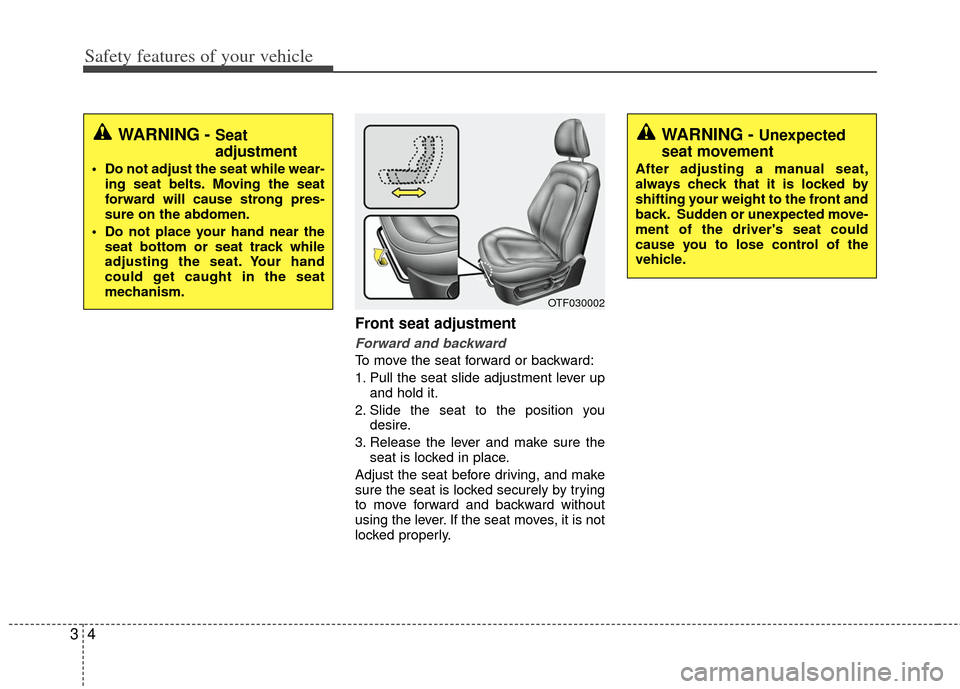
To move the seat forward or backward:
1. Pull the seat slide adjustment lever upand hold it.
2. Slide the seat to the position you desire.
3. Release the lever and make sure the seat is locked in place.
Adjust the seat before driving, and make
sure the seat is locked securely by trying
to move forward and backward without
using the lever. If the seat moves, it is not
locked properly.
WARNING - Seat
adjustment
Do not adjust the seat while wear- ing seat belts. Moving the seat
forward will cause strong pres-
sure on the abdomen.
Do not place your hand near the seat bottom or seat track while
adjusting the seat. Your hand
could get caught in the seat
mechanism.
WARNING - Unexpected
seat movement
After adjusting a manual seat,
always check that it is locked by
shifting your weight to the front and
back. Sudden or unexpected move-
ment of the driver's seat could
cause you to lose control of the
vehicle.
OTF030002
Page 19 of 394
35
Safety features of your vehicle
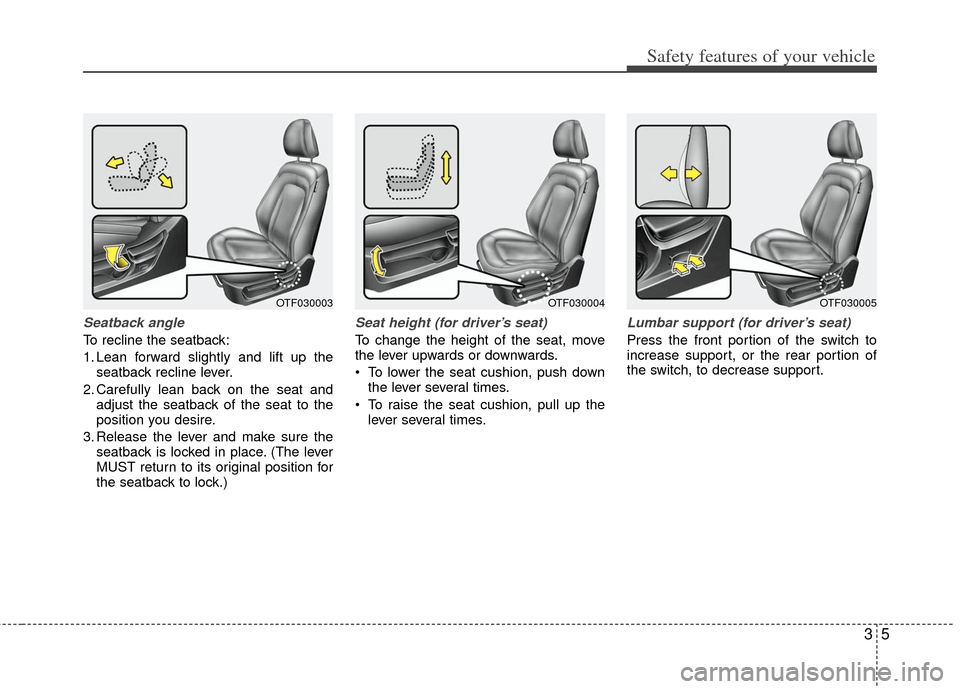
Seatback angle
To recline the seatback:
1. Lean forward slightly and lift up theseatback recline lever.
2. Carefully lean back on the seat and adjust the seatback of the seat to the
position you desire.
3. Release the lever and make sure the seatback is locked in place. (The lever
MUST return to its original position for
the seatback to lock.)
Seat height (for driver’s seat)
To change the height of the seat, move
the lever upwards or downwards.
• To lower the seat cushion, push downthe lever several times.
To raise the seat cushion, pull up the lever several times.
Lumbar support (for driver’s seat)
Press the front portion of the switch to
increase support, or the rear portion of
the switch, to decrease support.
OTF030003OTF030004OTF030005
Page 25 of 394
311
Safety features of your vehicle
CAUTION
The climate control seat is a sup-plementary cooling/heating sys-tem. Use the climate control seatwhen the climate control systemis on. Using the climate control seat for prolonged periods of timewith the climate control systemoff could cause the climate con-trol seat performance to impair.
When cleaning the seats, do not use an organic solvent such aspaint thinner, benzene, alcoholand gasoline. Doing so may dam-age the surface of the seats.
Do not spill liquid such as water or beverages on the surface ofthe front seats and seatbacks, orthe air vent holes may be blocked and prevented from workingproperly.
Do not place materials such as plastic bags or newspapers underthe seats. The air vent may notwork properly as the air intakecan be blocked.
(Continued)
(Continued) When the air vent does not oper- ate, restart the vehicle. If there isno change, have your vehicleinspected by an authorized Kiadealer.WARNING
Passengers should use extreme
caution when using the climate
control seat to warm due to the
possibility of excess heating or
burns. The occupants must be able
to feel if the seat is becoming too
warm and to turn the seat warmer
off. In particular, the driver must
exercise extreme care for the fol-
lowing types of passengers:
1. Infants, children, elderly or dis- abled persons, or hospital outpa-
tients
2. Persons with sensitive skin or those that burn easily
3. Fatigued individuals
4. Intoxicated individuals
5. Individuals taking medication that can cause drowsiness or
sleepiness (sleeping pills, cold
tablets, etc.)
Page 28 of 394
Safety features of your vehicle
14
3
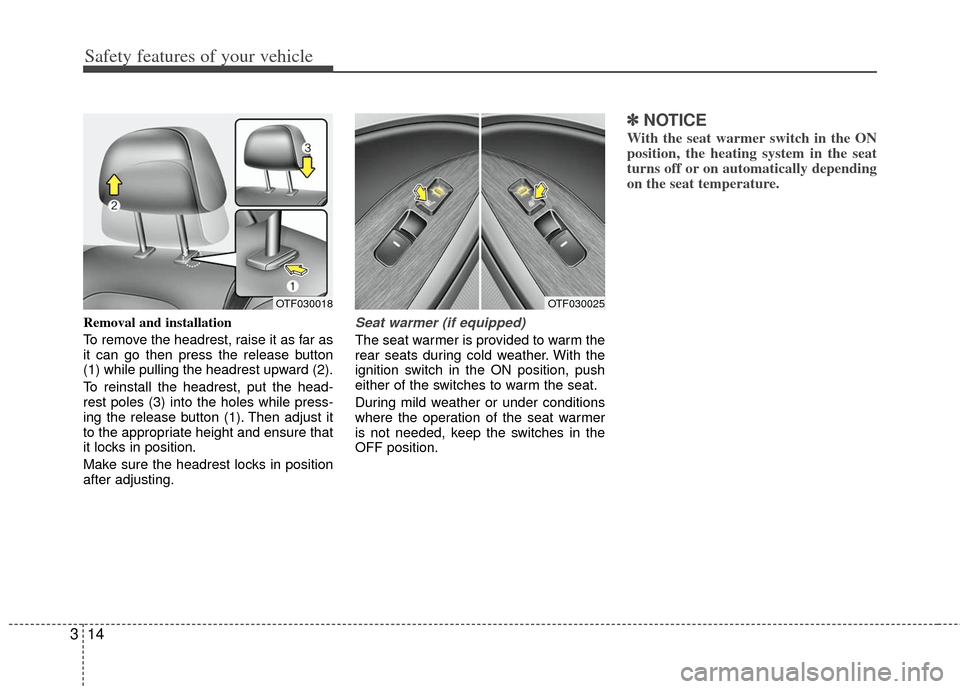
Removal and installation
To remove the headrest, raise it as far as
it can go then press the release button
(1) while pulling the headrest upward (2).
To reinstall the headrest, put the head-
rest poles (3) into the holes while press-
ing the release button (1). Then adjust it
to the appropriate height and ensure that
it locks in position.
Make sure the headrest locks in position
after adjusting.Seat warmer (if equipped)
The seat warmer is provided to warm the
rear seats during cold weather. With the
ignition switch in the ON position, push
either of the switches to warm the seat.
During mild weather or under conditions
where the operation of the seat warmer
is not needed, keep the switches in the
OFF position.
✽ ✽
NOTICE
With the seat warmer switch in the ON
position, the heating system in the seat
turns off or on automatically depending
on the seat temperature.
OTF030018OTF030025
Page 32 of 394
Safety features of your vehicle
18
3
*1The seat belt warning light will go off if
the vehicle speed decreases below 5
km/h (3 mph). If the vehicle speed
increases above 5 km/h (3 mph), the
warning light will blink again.
You can find the front passenger's seat belt warning light on the center fascia
panel.
Although the front passenger seat is not occupied, the seat belt warning
light will blink for 6 seconds.
The seat belt warning light can blink when a briefcase or purse is placed on
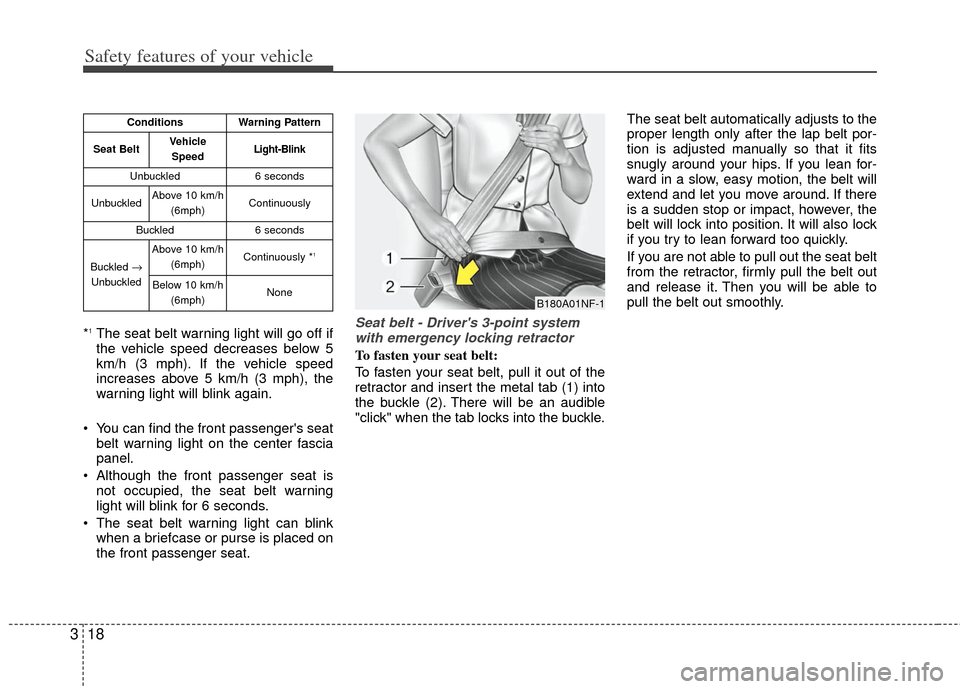
the front passenger seat.Seat belt - Driver's 3-point systemwith emergency locking retractor
To fasten your seat belt:
To fasten your seat belt, pull it out of the
retractor and insert the metal tab (1) into
the buckle (2). There will be an audible
"click" when the tab locks into the buckle. The seat belt automatically adjusts to the
proper length only after the lap belt por-
tion is adjusted manually so that it fits
snugly around your hips. If you lean for-
ward in a slow, easy motion, the belt will
extend and let you move around. If there
is a sudden stop or impact, however, the
belt will lock into position. It will also lock
if you try to lean forward too quickly.
If you are not able to pull out the seat belt
from the retractor, firmly pull the belt out
and release it. Then you will be able to
pull the belt out smoothly.
ConditionsWarning Pattern
Seat BeltVehicle
SpeedLight-Blink
Unbuckled6 seconds
UnbuckledAbove 10 km/h (6mph)Continuously
Buckled6 seconds
Buckled →
Unbuckled
Above 10 km/h (6mph)Continuously *1
Below 10 km/h(6mph)NoneB180A01NF-1
Page 33 of 394
319
Safety features of your vehicle
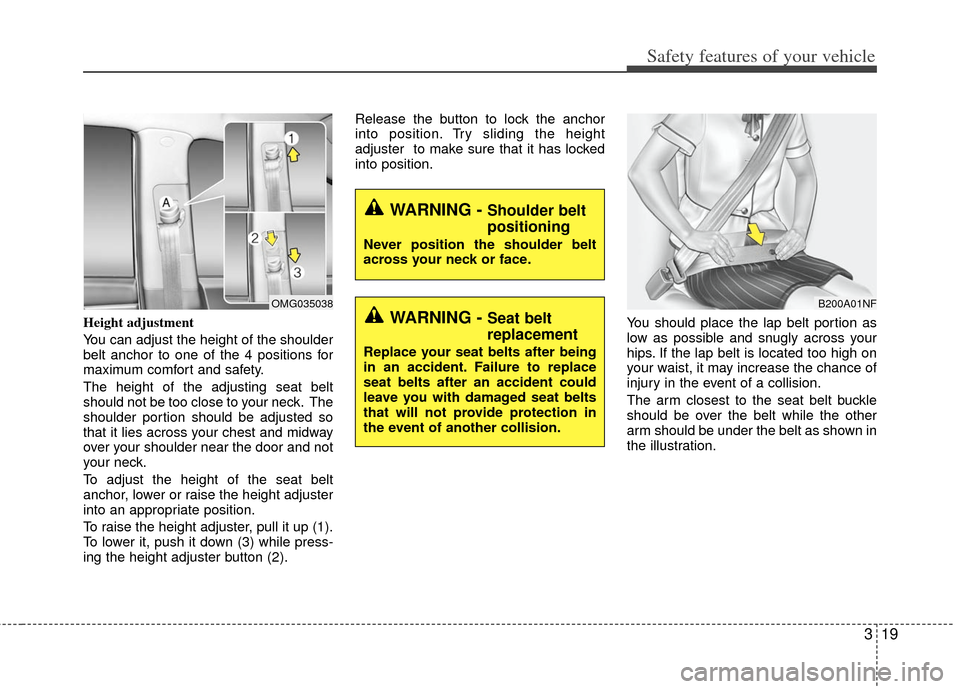
Height adjustment
You can adjust the height of the shoulder
belt anchor to one of the 4 positions for
maximum comfort and safety.
The height of the adjusting seat belt
should not be too close to your neck. The
shoulder portion should be adjusted so
that it lies across your chest and midway
over your shoulder near the door and not
your neck.
To adjust the height of the seat belt
anchor, lower or raise the height adjuster
into an appropriate position.
To raise the height adjuster, pull it up (1).
To lower it, push it down (3) while press-
ing the height adjuster button (2).Release the button to lock the anchor
into position. Try sliding the height
adjuster to make sure that it has locked
into position.
You should place the lap belt portion as
low as possible and snugly across your
hips. If the lap belt is located too high on
your waist, it may increase the chance of
injury in the event of a collision.
The arm closest to the seat belt buckle
should be over the belt while the other
arm should be under the belt as shown in
the illustration.
WARNING - Shoulder belt
positioning
Never position the shoulder belt
across your neck or face.
WARNING - Seat belt
replacement
Replace your seat belts after being
in an accident. Failure to replace
seat belts after an accident could
leave you with damaged seat belts
that will not provide protection in
the event of another collision.
B200A01NFOMG035038
Page 34 of 394
Safety features of your vehicle
20
3
Seat belts - Front passenger and rear
seat 3-point system with combinationlocking retractor
To fasten your seat belt:
Combination retractor type seat belts are
installed in the rear seat positions to help
accommodate the installation of child
restraint systems. Although a combina-
tion retractor is also installed in the front
passenger seat position, it is strongly
recommended that children always be
seated in the rear seat. NEVER place
any infant restraint system in the front
seat of the vehicle.
This type of seat belt combines the fea-
tures of both an emergency locking
retractor seat belt and an automatic lock-
ing retractor seat belt. To fasten your seat
belt, pull it out of the retractor and insert
the metal tab into the buckle. There will
be an audible "click" when the tab locks
into the buckle. When not securing a
child restraint, the seat belt operates in
the same way as the driver's seat belt
(Emergency Locking Retractor Type).
It automatically adjusts to the proper
length only after the lap belt portion of
the seat belt is adjusted manually so that
it fits snugly around your hips. When the seat belt is fully extended from
the retractor to allow the installation of a
child restraint system, the seat belt oper-
ation changes to allow the belt to retract,
but not to extend (Automatic Locking
Retractor Type). Refer to “Using a child
restraint system” in this section.
To convert from the automatic locking
feature to the emergency locking opera-
tion mode, allow the unbuckled seat belt
to fully retract.
When using the rear center seat belt, the
buckle with the “CENTER” mark must be
used.
OBH038023N