air conditioning KIA Optima Hybrid 2013 3.G User Guide
[x] Cancel search | Manufacturer: KIA, Model Year: 2013, Model line: Optima Hybrid, Model: KIA Optima Hybrid 2013 3.GPages: 394, PDF Size: 8.63 MB
Page 183 of 394
Features of your vehicle
112
4
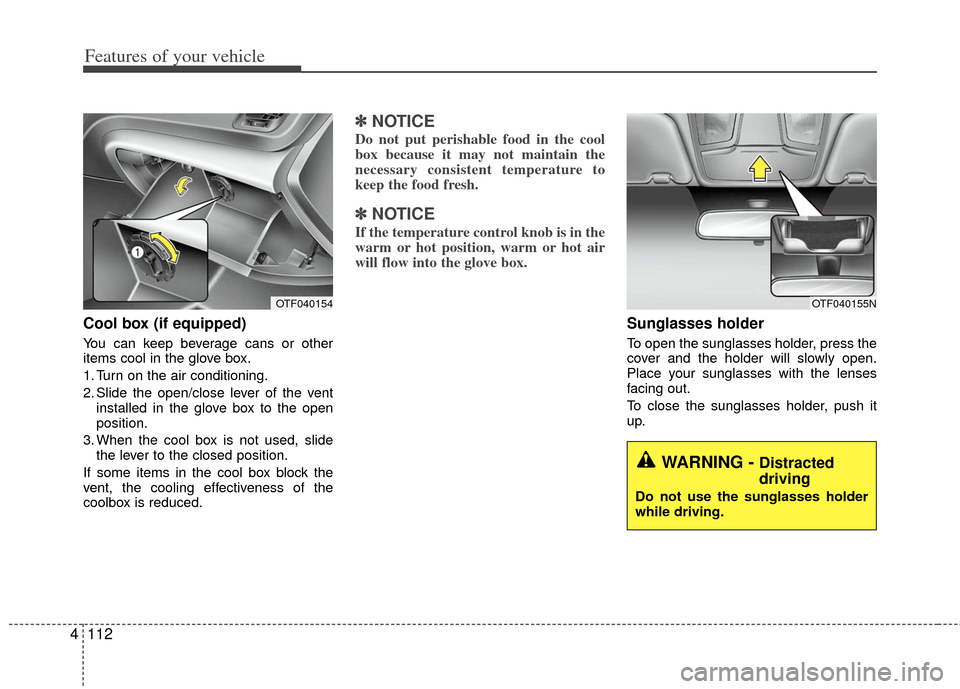
Cool box (if equipped)
You can keep beverage cans or other
items cool in the glove box.
1. Turn on the air conditioning.
2. Slide the open/close lever of the vent
installed in the glove box to the open
position.
3. When the cool box is not used, slide the lever to the closed position.
If some items in the cool box block the
vent, the cooling effectiveness of the
coolbox is reduced.
✽ ✽ NOTICE
Do not put perishable food in the cool
box because it may not maintain the
necessary consistent temperature to
keep the food fresh.
✽ ✽NOTICE
If the temperature control knob is in the
warm or hot position, warm or hot air
will flow into the glove box.
Sunglasses holder
To open the sunglasses holder, press the
cover and the holder will slowly open.
Place your sunglasses with the lenses
facing out.
To close the sunglasses holder, push it
up.
OTF040154OTF040155N
WARNING - Distracted
driving
Do not use the sunglasses holder
while driving.
Page 213 of 394
Features of your vehicle
142
4
■Talking on the Phone
When talking on the phone, “Active Call”
message and the other party’s phone
number (if available) are displayed on the
audio.
- Press button on the steering wheel.
✽ ✽
NOTICE
In the following situations, you or the
other party may have difficulty hearing
each other:
1. Speaking at the same time, your voice
may not reach each other parties. (This
is not a malfunction.) Speak alternate-
ly with the other party on the phone.
2. Keep the volume to a low level. High- level volume may result in distortion
and echo.
3. When driving on a rough road.
4. When driving at high speeds.
5. When the window is open.
6. When the air conditioning vents are facing the microphone.
7. When the sound of the air condition- ing fan is loud.
■Bluetooth®Audio Music Streaming
The audio system supports Bluetooth®
A2DP (Audio Advanced Distribution
Profile) and AVRCP (Audio Video
Remote Control Profile) technologies.
Both profiles provide steaming of music
via compatible “PAIRED”
Bluetooth®
wireless technology Cellular phone.
To stream music from the
Bluetooth®
wireless technology cellular phone, play
your music files on your cellular phone
according to your cellular phone user’s
manual and press the button on
the audio system until “MP3 play” is dis-
played on the LCD.
The audio system head unit displays
‘MP3 MODE’.
NOTE:
all music and sound files your cellu-
lar phone supports can be played
by the audio system.
Bluetooth®wireless technology
compatible cellular phones must
include A2DP and AVRCP capabili-
ties.
AVRCP compatible
Bluetooth®cellular phones may not
play music through the audio sys-
tem initially. These cellular phones
may need to have the
Bluetooth®
wireless technology streaming
enabled, for example;
i.e : Menu
➟Filemanager➟Music➟Option➟Play via Bluetooth
cellular phone for more information.
To cancel
Bluetooth®wireless tech-
nology cellular phone music
streaming, stop music playback on
the cellular phone or change the
audio mode to AM/FM, SIRIUS, CD,
iPod, ect.
CD/AUX
Page 253 of 394
Driving your vehicle
32
5
Use your air conditioning sparingly.
The air conditioning system is operat-
ed by engine power so your fuel econ-
omy is reduced when you use it.
Open windows at high speeds can reduce fuel economy.
Fuel economy is less in crosswinds and headwinds. To help offset some of
this loss, slow down when driving in
these conditions.
Keeping a vehicle in good operating con-
dition is important both for economy and
safety. Therefore, have an authorized Kia
dealer perform scheduled inspections
and maintenance.
WARNING - Engine off
during motion
Never turn the engine off to coast
down hills or anytime the vehicle is
in motion. The power steering and
power brakes will not function
properly without the engine run-
ning. In addition, turning off the
ignition while driving could engage
the steering wheel lock resulting in
loss of vehicle steering. Keep the
engine on and downshift to an
appropriate gear for engine braking
effect.
Page 273 of 394
67
What to do in an emergency
IF THE ENGINE OVERHEATS
If your temperature gauge indicates over-
heating, you will experience a loss of
power, or hear loud pinging or knocking,
the engine is probably too hot. If this hap-
pens, you should:
1. Pull off the road and stop as soon as itis safe to do so.
2. Place the shift lever in P (automatic transaxle) or neutral (manual
transaxle) and set the parking brake. If
the air conditioning is on, turn it off.
3. If engine coolant is running out under the vehicle or steam is coming out from
underneath the hood, stop the engine.
Do not open the hood until the coolant
has stopped running or the steaming
has stopped. If there is no visible loss
of engine coolant and no steam, leave
the engine running and check to be
sure the engine cooling fan is operat-
ing. If the fan is not running, turn the
engine off.
4. Check to see if the water pump drive belt is missing. If it is not missing,
check to see that it is tight. If the drive
belt seems to be satisfactory, check for
coolant leaking from the radiator,
hoses or under the vehicle. (If the air
conditioning had been in use, it is nor-
mal for cold water to be draining from it
when you stop). 5. If the water pump drive belt is broken
or engine coolant leaks, stop the
engine immediately and call the near-
est authorized Kia dealer for assis-
tance. 6. If you cannot find the cause of the
overheating, wait until the engine tem-
perature has returned to normal. Then,
if coolant has been lost, carefully add
coolant to the reservoir to bring the
fluid level in the reservoir up to the
halfway mark.
7. Proceed with caution, keeping alert for further signs of overheating. If over-
heating happens again, call an author-
ized Kia dealer for assistance.
Serious loss of coolant indicates there is
a leak in the cooling system and this
should be checked as soon as possible
by an authorized Kia dealer.
WARNING - Under the
hood
While the engine is running, keep
hair, hands and clothing away from
moving parts such as the fan and
drive belts.
WARNING - Radiator cap
Do not remove the radiator cap
when the engine is hot. This can
allow coolant to be blown out of the
opening and cause serious burns.
Page 299 of 394
Maintenance
67
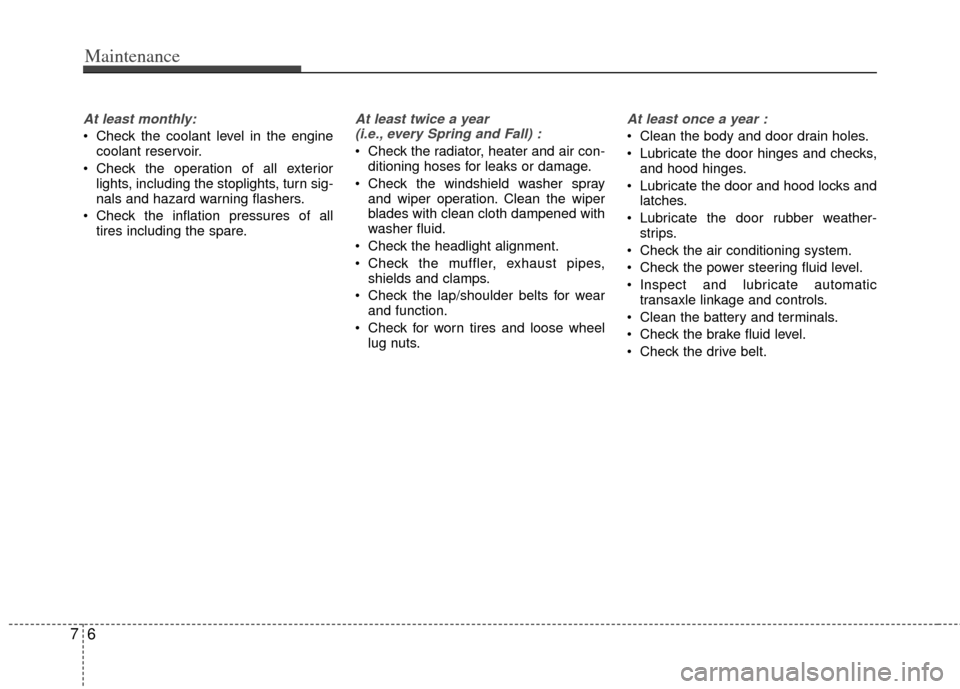
At least monthly:
Check the coolant level in the enginecoolant reservoir.
Check the operation of all exterior lights, including the stoplights, turn sig-
nals and hazard warning flashers.
Check the inflation pressures of all tires including the spare.
At least twice a year (i.e., every Spring and Fall) :
Check the radiator, heater and air con- ditioning hoses for leaks or damage.
Check the windshield washer spray and wiper operation. Clean the wiper
blades with clean cloth dampened with
washer fluid.
Check the headlight alignment.
Check the muffler, exhaust pipes, shields and clamps.
Check the lap/shoulder belts for wear and function.
Check for worn tires and loose wheel lug nuts.
At least once a year :
Clean the body and door drain holes.
Lubricate the door hinges and checks,and hood hinges.
Lubricate the door and hood locks and latches.
Lubricate the door rubber weather- strips.
Check the air conditioning system.
Check the power steering fluid level.
Inspect and lubricate automatic transaxle linkage and controls.
Clean the battery and terminals.
Check the brake fluid level.
Check the drive belt.
Page 301 of 394
Maintenance
87
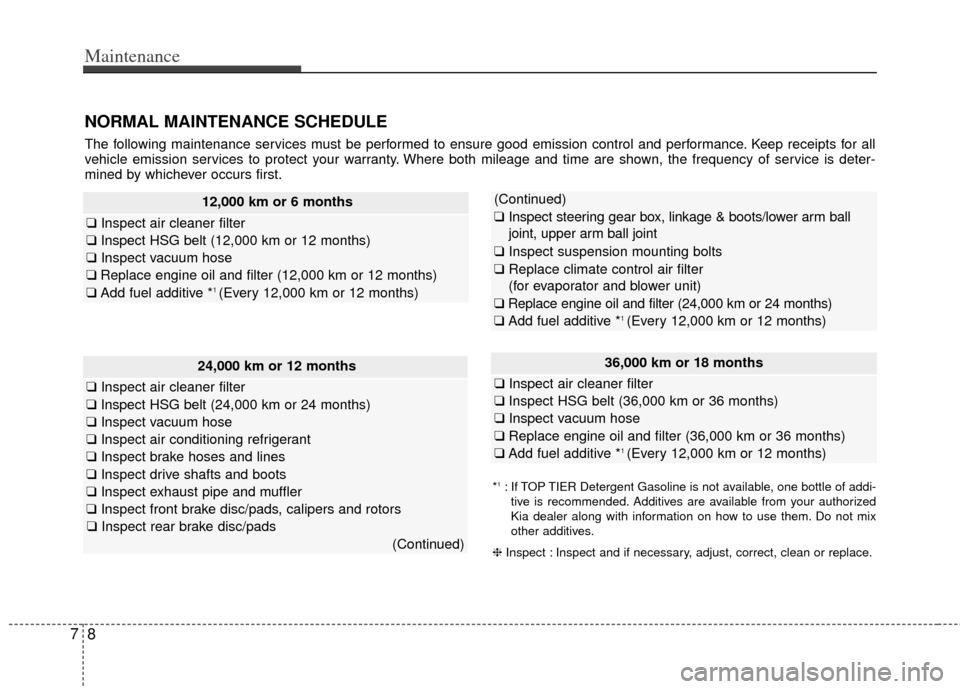
NORMAL MAINTENANCE SCHEDULE
The following maintenance services must be performed to ensure good emission control and performance. Keep receipts for all
vehicle emission services to protect your warranty. Where both mileage and time are shown, the frequency of service is deter-
mined by whichever occurs first.
24,000 km or 12 months
❑Inspect air cleaner filter
❑Inspect HSG belt (24,000 km or 24 months)
❑ Inspect vacuum hose
❑Inspect air conditioning refrigerant
❑Inspect brake hoses and lines
❑Inspect drive shafts and boots
❑Inspect exhaust pipe and muffler
❑Inspect front brake disc/pads, calipers and rotors
❑Inspect rear brake disc/pads
(Continued)
(Continued)
❑Inspect steering gear box, linkage & boots/lower arm ball
joint, upper arm ball joint
❑ Inspect suspension mounting bolts
❑Replace climate control air filter
(for evaporator and blower unit)
❑Replace engine oil and filter (24,000 km or 24 months)
❑ Add fuel additive *1 (Every 12,000 km or 12 months)
36,000 km or 18 months
❑ Inspect air cleaner filter
❑Inspect HSG belt (36,000 km or 36 months)
❑ Inspect vacuum hose
❑Replace engine oil and filter (36,000 km or 36 months)
❑Add fuel additive *1 (Every 12,000 km or 12 months)
12,000 km or 6 months
❑ Inspect air cleaner filter
❑Inspect HSG belt (12,000 km or 12 months)
❑ Inspect vacuum hose
❑Replace engine oil and filter (12,000 km or 12 months)
❑Add fuel additive *1 (Every 12,000 km or 12 months)
*1: If TOP TIER Detergent Gasoline is not available, one bottle of addi-
tive is recommended. Additives are available from your authorized
Kia dealer along with information on how to use them. Do not mix
other additives.
❈ Inspect : Inspect and if necessary, adjust, correct, clean or replace.
Page 302 of 394
79
Maintenance
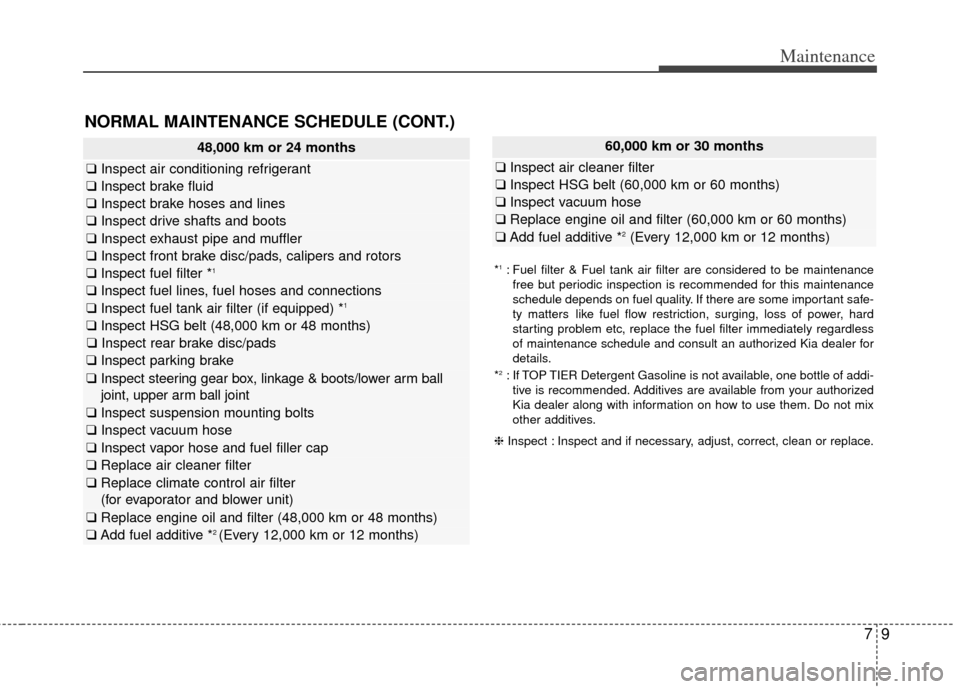
NORMAL MAINTENANCE SCHEDULE (CONT.)
60,000 km or 30 months
❑Inspect air cleaner filter
❑Inspect HSG belt (60,000 km or 60 months)
❑Inspect vacuum hose
❑Replace engine oil and filter (60,000 km or 60 months)
❑Add fuel additive *2(Every 12,000 km or 12 months)
*1: Fuel filter & Fuel tank air filter are considered to be maintenance
free but periodic inspection is recommended for this maintenance
schedule depends on fuel quality. If there are some important safe-
ty matters like fuel flow restriction, surging, loss of power, hard
starting problem etc, replace the fuel filter immediately regardless
of maintenance schedule and consult an authorized Kia dealer for
details.
*
2: If TOP TIER Detergent Gasoline is not available, one bottle of addi- tive is recommended. Additives are available from your authorized
Kia dealer along with information on how to use them. Do not mix
other additives.
❈ Inspect : Inspect and if necessary, adjust, correct, clean or replace.
48,000 km or 24 months
❑Inspect air conditioning refrigerant
❑Inspect brake fluid
❑ Inspect brake hoses and lines
❑Inspect drive shafts and boots
❑Inspect exhaust pipe and muffler
❑Inspect front brake disc/pads, calipers and rotors
❑Inspect fuel filter *1
❑Inspect fuel lines, fuel hoses and connections
❑Inspect fuel tank air filter (if equipped) *1
❑Inspect HSG belt (48,000 km or 48 months)
❑ Inspect rear brake disc/pads
❑Inspect parking brake
❑Inspect steering gear box, linkage & boots/lower arm ball
joint, upper arm ball joint
❑Inspect suspension mounting bolts
❑ Inspect vacuum hose
❑Inspect vapor hose and fuel filler cap
❑Replace air cleaner filter
❑Replace climate control air filter
(for evaporator and blower unit)
❑Replace engine oil and filter (48,000 km or 48 months)
❑Add fuel additive *2 (Every 12,000 km or 12 months)
Page 303 of 394
Maintenance
10
7
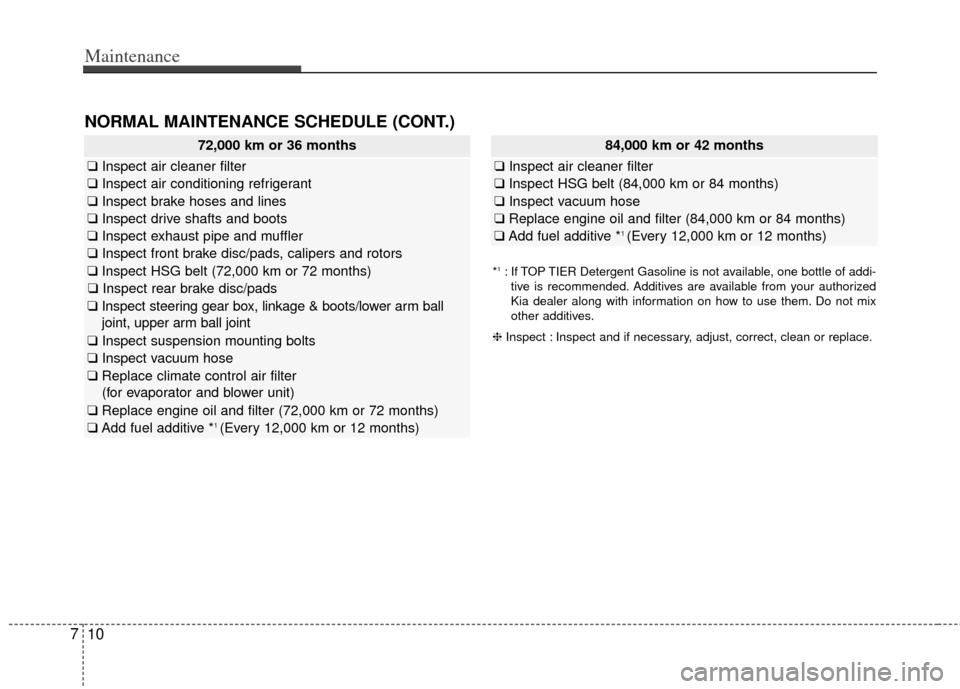
72,000 km or 36 months
❑ Inspect air cleaner filter
❑Inspect air conditioning refrigerant
❑Inspect brake hoses and lines
❑Inspect drive shafts and boots
❑Inspect exhaust pipe and muffler
❑Inspect front brake disc/pads, calipers and rotors
❑Inspect HSG belt (72,000 km or 72 months)
❑ Inspect rear brake disc/pads
❑Inspect steering gear box, linkage & boots/lower arm ball
joint, upper arm ball joint
❑ Inspect suspension mounting bolts
❑Inspect vacuum hose
❑Replace climate control air filter
(for evaporator and blower unit)
❑Replace engine oil and filter (72,000 km or 72 months)
❑Add fuel additive *1 (Every 12,000 km or 12 months)
NORMAL MAINTENANCE SCHEDULE (CONT.)
84,000 km or 42 months
❑ Inspect air cleaner filter
❑Inspect HSG belt (84,000 km or 84 months)
❑ Inspect vacuum hose
❑Replace engine oil and filter (84,000 km or 84 months)
❑Add fuel additive *1 (Every 12,000 km or 12 months)
*1: If TOP TIER Detergent Gasoline is not available, one bottle of addi-
tive is recommended. Additives are available from your authorized
Kia dealer along with information on how to use them. Do not mix
other additives.
❈ Inspect : Inspect and if necessary, adjust, correct, clean or replace.
Page 304 of 394
711
Maintenance
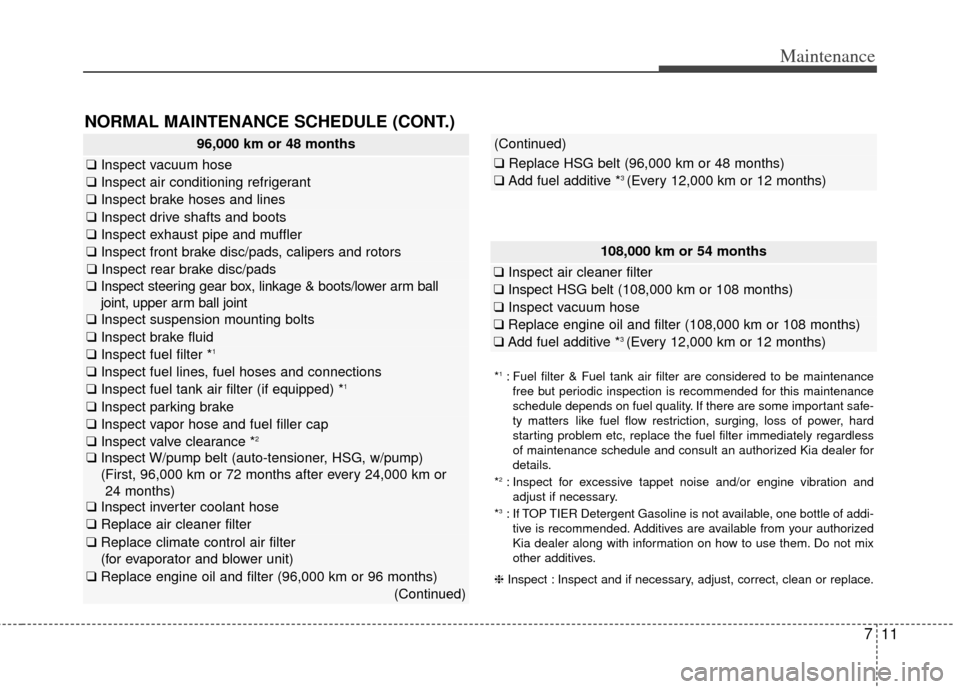
96,000 km or 48 months
❑Inspect vacuum hose
❑Inspect air conditioning refrigerant
❑Inspect brake hoses and lines
❑Inspect drive shafts and boots
❑Inspect exhaust pipe and muffler
❑Inspect front brake disc/pads, calipers and rotors
❑Inspect rear brake disc/pads
❑Inspect steering gear box, linkage & boots/lower arm ball
joint, upper arm ball joint
❑ Inspect suspension mounting bolts
❑Inspect brake fluid
❑Inspect fuel filter *1
❑Inspect fuel lines, fuel hoses and connections
❑Inspect fuel tank air filter (if equipped) *1
❑Inspect parking brake
❑Inspect vapor hose and fuel filler cap
❑Inspect valve clearance *2
❑Inspect W/pump belt (auto-tensioner, HSG, w/pump)
(First, 96,000 km or 72 months after every 24,000 km or
24 months)
❑ Inspect inverter coolant hose
❑ Replace air cleaner filter
❑Replace climate control air filter
(for evaporator and blower unit)
❑Replace engine oil and filter (96,000 km or 96 months)
(Continued)
(Continued)
❑Replace HSG belt (96,000 km or 48 months)
❑Add fuel additive *3 (Every 12,000 km or 12 months)
108,000 km or 54 months
❑ Inspect air cleaner filter
❑Inspect HSG belt (108,000 km or 108 months)
❑ Inspect vacuum hose
❑Replace engine oil and filter (108,000 km or 108 months)
❑Add fuel additive *3 (Every 12,000 km or 12 months)
NORMAL MAINTENANCE SCHEDULE (CONT.)
*1: Fuel filter & Fuel tank air filter are considered to be maintenance
free but periodic inspection is recommended for this maintenance
schedule depends on fuel quality. If there are some important safe-
ty matters like fuel flow restriction, surging, loss of power, hard
starting problem etc, replace the fuel filter immediately regardless
of maintenance schedule and consult an authorized Kia dealer for
details.
*
2: Inspect for excessive tappet noise and/or engine vibration and adjust if necessary.
*
3: If TOP TIER Detergent Gasoline is not available, one bottle of addi- tive is recommended. Additives are available from your authorized
Kia dealer along with information on how to use them. Do not mix
other additives.
❈ Inspect : Inspect and if necessary, adjust, correct, clean or replace.
Page 305 of 394
Maintenance
12
7
NORMAL MAINTENANCE SCHEDULE (CONT.)
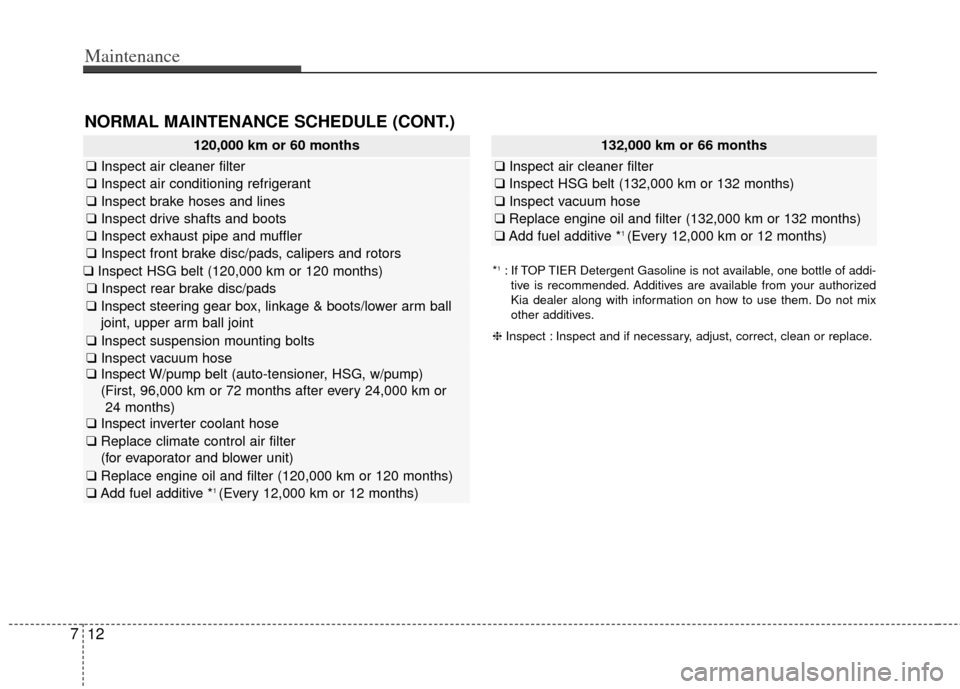
120,000 km or 60 months
❑ Inspect air cleaner filter
❑Inspect air conditioning refrigerant
❑Inspect brake hoses and lines
❑Inspect drive shafts and boots
❑Inspect exhaust pipe and muffler
❑Inspect front brake disc/pads, calipers and rotors
❑Inspect HSG belt (120,000 km or 120 months)
❑ Inspect rear brake disc/pads
❑Inspect steering gear box, linkage & boots/lower arm ball
joint, upper arm ball joint
❑ Inspect suspension mounting bolts
❑Inspect vacuum hose
❑Inspect W/pump belt (auto-tensioner, HSG, w/pump)
(First, 96,000 km or 72 months after every 24,000 km or
24 months)
❑ Inspect inverter coolant hose
❑Replace climate control air filter
(for evaporator and blower unit)
❑Replace engine oil and filter (120,000 km or 120 months)
❑Add fuel additive *1 (Every 12,000 km or 12 months)
132,000 km or 66 months
❑ Inspect air cleaner filter
❑Inspect HSG belt (132,000 km or 132 months)
❑ Inspect vacuum hose
❑Replace engine oil and filter (132,000 km or 132 months)
❑Add fuel additive *1 (Every 12,000 km or 12 months)
*1: If TOP TIER Detergent Gasoline is not available, one bottle of addi-
tive is recommended. Additives are available from your authorized
Kia dealer along with information on how to use them. Do not mix
other additives.
❈ Inspect : Inspect and if necessary, adjust, correct, clean or replace.