warning KIA Optima Hybrid 2013 3.G User Guide
[x] Cancel search | Manufacturer: KIA, Model Year: 2013, Model line: Optima Hybrid, Model: KIA Optima Hybrid 2013 3.GPages: 394, PDF Size: 8.63 MB
Page 31 of 394
317
Safety features of your vehicle
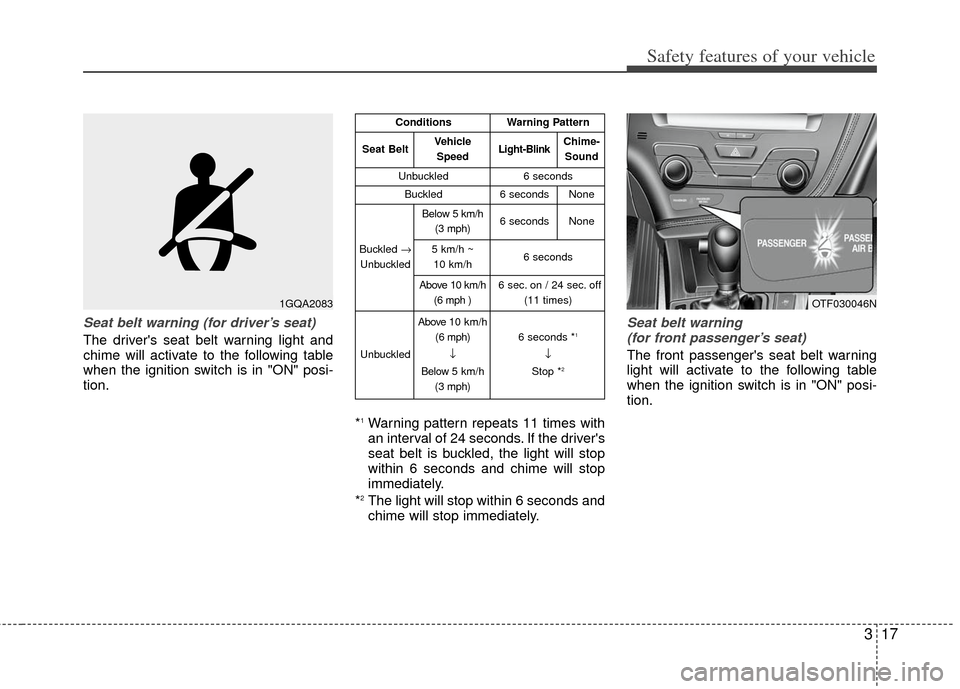
Seat belt warning (for driver’s seat)
The driver's seat belt warning light and
chime will activate to the following table
when the ignition switch is in "ON" posi-
tion.*
1Warning pattern repeats 11 times with
an interval of 24 seconds. If the driver's
seat belt is buckled, the light will stop
within 6 seconds and chime will stop
immediately.
*
2The light will stop within 6 seconds and
chime will stop immediately.
Seat belt warning (for front passenger’s seat)
The front passenger's seat belt warning
light will activate to the following table
when the ignition switch is in "ON" posi-
tion.
1GQA2083
ConditionsWarning Pattern
Seat BeltVehicle
SpeedLight-BlinkChime-Sound
Unbuckled6 seconds
Buckled6 secondsNone
Buckled →
Unbuckled
Below 5 km/h (3 mph)6 secondsNone
5 km/h ~10 km/h6 seconds
Above 10 km/h (6 mph )6 sec. on / 24 sec. off (11 times)
Unbuckled
Above 10 km/h(6 mph)
↓
Below 5 km/h (3 mph)6 seconds *1
↓
Stop *2
OTF030046N
Page 32 of 394
Safety features of your vehicle
18
3
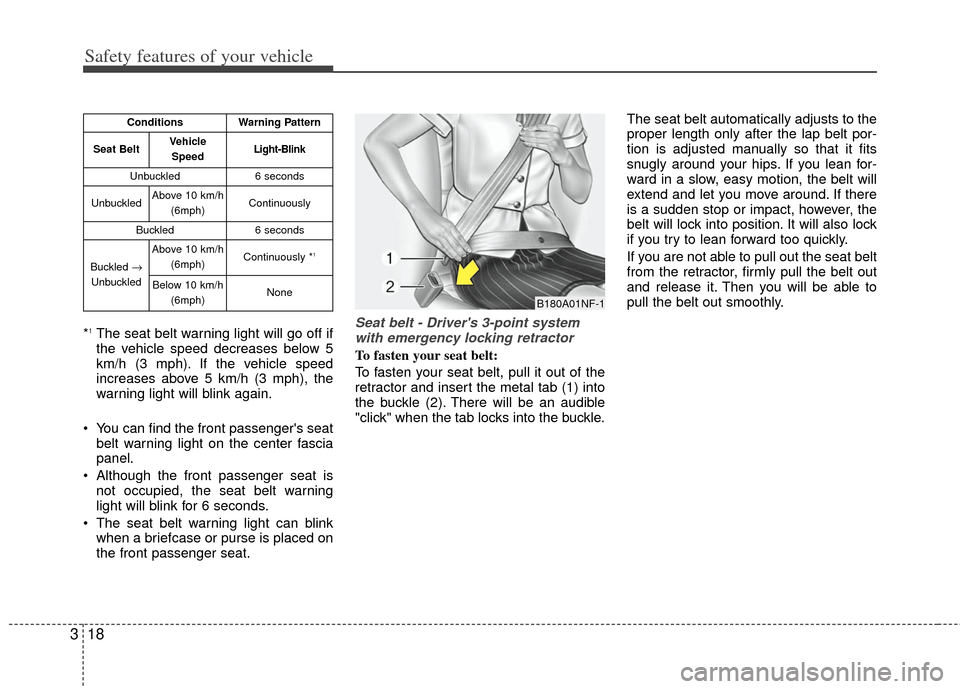
*1The seat belt warning light will go off if
the vehicle speed decreases below 5
km/h (3 mph). If the vehicle speed
increases above 5 km/h (3 mph), the
warning light will blink again.
You can find the front passenger's seat belt warning light on the center fascia
panel.
Although the front passenger seat is not occupied, the seat belt warning
light will blink for 6 seconds.
The seat belt warning light can blink when a briefcase or purse is placed on
the front passenger seat.Seat belt - Driver's 3-point systemwith emergency locking retractor
To fasten your seat belt:
To fasten your seat belt, pull it out of the
retractor and insert the metal tab (1) into
the buckle (2). There will be an audible
"click" when the tab locks into the buckle. The seat belt automatically adjusts to the
proper length only after the lap belt por-
tion is adjusted manually so that it fits
snugly around your hips. If you lean for-
ward in a slow, easy motion, the belt will
extend and let you move around. If there
is a sudden stop or impact, however, the
belt will lock into position. It will also lock
if you try to lean forward too quickly.
If you are not able to pull out the seat belt
from the retractor, firmly pull the belt out
and release it. Then you will be able to
pull the belt out smoothly.
ConditionsWarning Pattern
Seat BeltVehicle
SpeedLight-Blink
Unbuckled6 seconds
UnbuckledAbove 10 km/h (6mph)Continuously
Buckled6 seconds
Buckled →
Unbuckled
Above 10 km/h (6mph)Continuously *1
Below 10 km/h(6mph)NoneB180A01NF-1
Page 33 of 394
319
Safety features of your vehicle
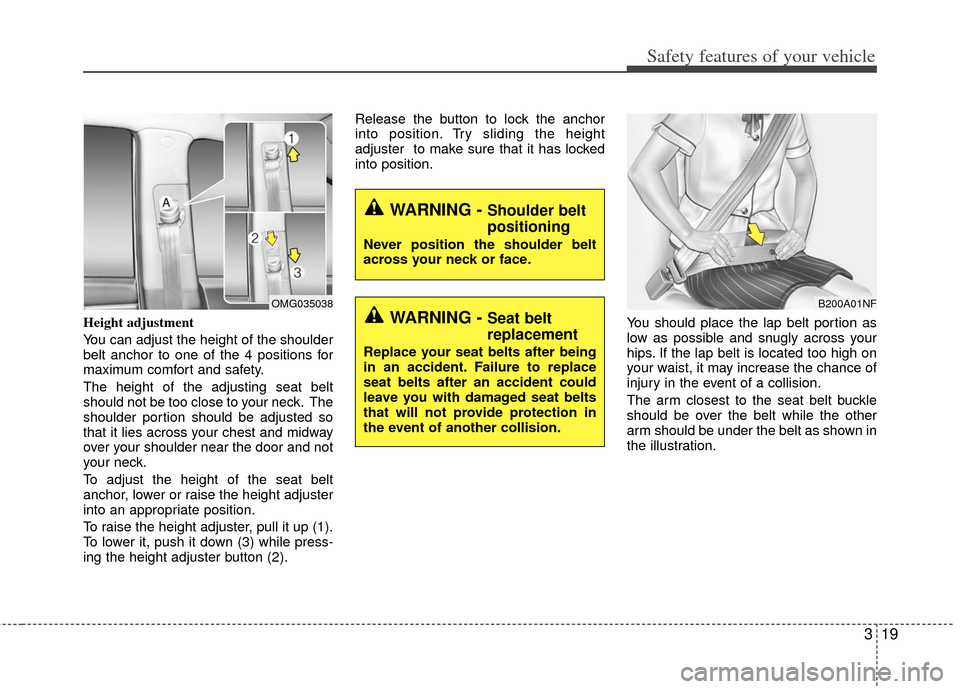
Height adjustment
You can adjust the height of the shoulder
belt anchor to one of the 4 positions for
maximum comfort and safety.
The height of the adjusting seat belt
should not be too close to your neck. The
shoulder portion should be adjusted so
that it lies across your chest and midway
over your shoulder near the door and not
your neck.
To adjust the height of the seat belt
anchor, lower or raise the height adjuster
into an appropriate position.
To raise the height adjuster, pull it up (1).
To lower it, push it down (3) while press-
ing the height adjuster button (2).Release the button to lock the anchor
into position. Try sliding the height
adjuster to make sure that it has locked
into position.
You should place the lap belt portion as
low as possible and snugly across your
hips. If the lap belt is located too high on
your waist, it may increase the chance of
injury in the event of a collision.
The arm closest to the seat belt buckle
should be over the belt while the other
arm should be under the belt as shown in
the illustration.
WARNING - Shoulder belt
positioning
Never position the shoulder belt
across your neck or face.
WARNING - Seat belt
replacement
Replace your seat belts after being
in an accident. Failure to replace
seat belts after an accident could
leave you with damaged seat belts
that will not provide protection in
the event of another collision.
B200A01NFOMG035038
Page 36 of 394
Safety features of your vehicle
22
3
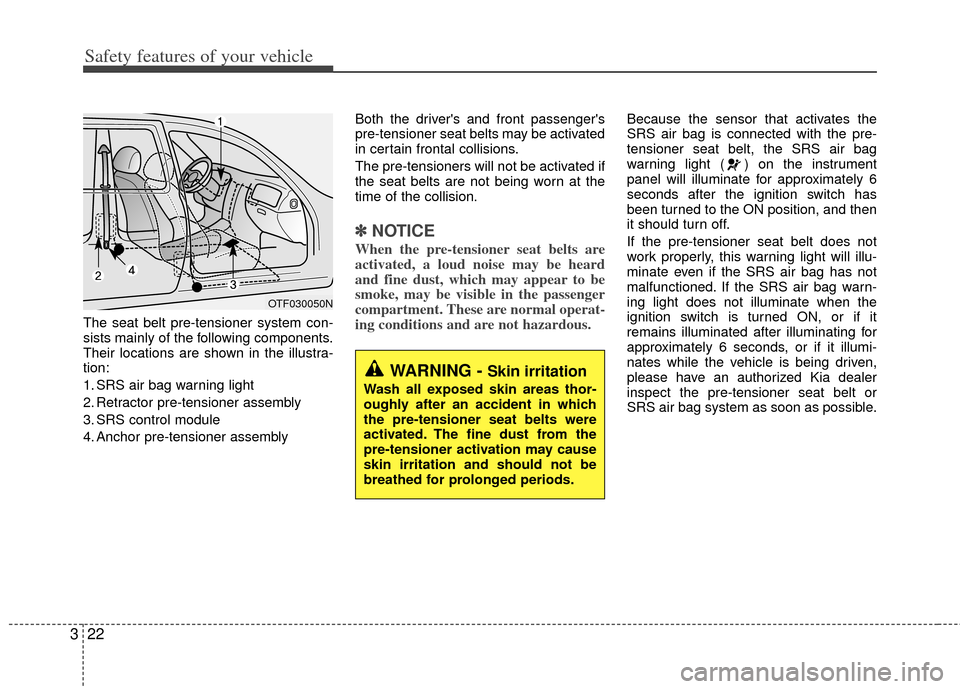
The seat belt pre-tensioner system con-
sists mainly of the following components.
Their locations are shown in the illustra-
tion:
1. SRS air bag warning light
2. Retractor pre-tensioner assembly
3. SRS control module
4. Anchor pre-tensioner assembly Both the driver's and front passenger's
pre-tensioner seat belts may be activated
in certain frontal collisions.
The pre-tensioners will not be activated if
the seat belts are not being worn at the
time of the collision.
✽ ✽
NOTICE
When the pre-tensioner seat belts are
activated, a loud noise may be heard
and fine dust, which may appear to be
smoke, may be visible in the passenger
compartment. These are normal operat-
ing conditions and are not hazardous.
Because the sensor that activates the
SRS air bag is connected with the pre-
tensioner seat belt, the SRS air bag
warning light ( ) on the instrument
panel will illuminate for approximately 6
seconds after the ignition switch has
been turned to the ON position, and then
it should turn off.
If the pre-tensioner seat belt does not
work properly, this warning light will illu-
minate even if the SRS air bag has not
malfunctioned. If the SRS air bag warn-
ing light does not illuminate when the
ignition switch is turned ON, or if it
remains illuminated after illuminating for
approximately 6 seconds, or if it illumi-
nates while the vehicle is being driven,
please have an authorized Kia dealer
inspect the pre-tensioner seat belt or
SRS air bag system as soon as possible.
OTF030050N
WARNING - Skin irritation
Wash all exposed skin areas thor-
oughly after an accident in which
the pre-tensioner seat belts were
activated. The fine dust from the
pre-tensioner activation may cause
skin irritation and should not be
breathed for prolonged periods.
Page 37 of 394
323
Safety features of your vehicle
✽
✽NOTICE
Do not attempt to service or repair the
pre-tensioner seat belt system in any
manner. Do not attempt to inspect or
replace the pre-tensioner seat belts
yourself. This must be done by an
authorized Kia dealer.
Pre-tensioners are designed to operate
only one time. After activation, pre-ten-
sioner seat belts must be replaced. If the
pre-tensioner must be replaced, contact
an authorized Kia dealer.
Seat belt precautions
Infant or small child
You should be aware of the specific
requirements in your country. Child
and/or infant seats must be properly
placed and installed in the rear seat. For
more information about the use of these
restraints, refer to “Child restraint sys-
tem” in this section.
WARNING - Hot
pretensioner
Do not touch the pre-tensioner seat
belt assemblies for several minutes
after they have been activated.
When the pre-tensioner seat belt
mechanism fires during a collision
the pre-tensioner becomes hot and
can burn you.
Page 38 of 394
Safety features of your vehicle
24
3
Larger children
Children who are too large for child
restraint systems should always occupy
the rear seat and use the available
lap/shoulder belts. The lap portion should
be fastened and snugged on the hips
and as low as possible. Check if the belt
fits periodically. A child's squirming could
put the belt out of position. Children are
given the most safety in the event of an
accident when they are restrained by a
proper restraint system in the rear seat. If
a larger child (over age 12) must be seat-
ed in the front seat, the child should be
securely restrained by the available
lap/shoulder belt and the seat should be
placed in the rearmost position. Children
age 12 and under should be restrained
securely in the rear seat. NEVER place a
child age 12 and under in the front seat.
NEVER place a rear facing child seat in
the front seat of a vehicle. If the shoulder belt portion slightly touch-
es the child’s neck or face, try placing the
child closer to the center of the vehicle. If
the shoulder belt still touches their face
or neck they need to be returned to a
child restraint system.
Restraint of pregnant women
Pregnant women should wear lap/shoul-
der belt assemblies whenever possible
according to specific recommendations
by their doctors. The lap portion of the
belt should be worn AS SNUGLY AND
LOW AS POSSIBLE.
WARNING - Small children
Do not allow small children to ride
in the vehicle without an appropri-
ate child restraint system.WARNING - Pregnant
women
Pregnant women must never place
the lap portion of the seat belt
above or on the abdomen where
the fetus is located. The force of the
seat belt during a collision will
crush the fetus.
Page 40 of 394
Safety features of your vehicle
26
3
CHILD RESTRAINT SYSTEM
Children riding in the car should sit in the
rear seat and must always be properly
restrained to minimize the risk of injury in
an accident, sudden stop or sudden
maneuver. According to accident statis-
tics, children are safer when properly
restrained in the rear seats than in the
front seat. Larger children who are not in
a child restraint should use one of the
seat belts provided.
You should be aware of the specific
requirements in your country. Child
and/or infant safety seats must be prop-
erly placed and installed in the rear seat.
You must use a commercially available
child restraint system that meets the
requirements of the safety standards of
your country.
Child restraint systems are designed to
be secured in vehicle seats by seat belt,
or by a tether anchor and/or LATCH
anchors (if equipped).
Children could be injured or killed in a
crash if their restraints are not properly
secured. For small children and babies, a
child seat or infant seat must be used. Before buying a particular child restraint
system, make sure it fits your vehicle
seat and seat belts, and fits your child.
Follow all the instructions provided by the
manufacturer when installing the child
restraint system.
When the child restraint system is not in
use, store it in the luggage area or fasten
it with a seat belt so that it will not be
thrown forward in case of a sudden stop
or an accident.
WARNING - Restraint
location
Never install a child or infant seat
on the front passenger's seat.
A child riding in the front passen-
ger seat can be forcefully struck by
an inflating airbag.
WARNING - Hot child
restraint
A child restraint system can
become very hot if it is left in a
closed vehicle on a sunny day. Be
sure to check the seat cover, buck-
les and latches before placing a
child in the restraint system.
Page 41 of 394
327
Safety features of your vehicle
Using a child restraint system
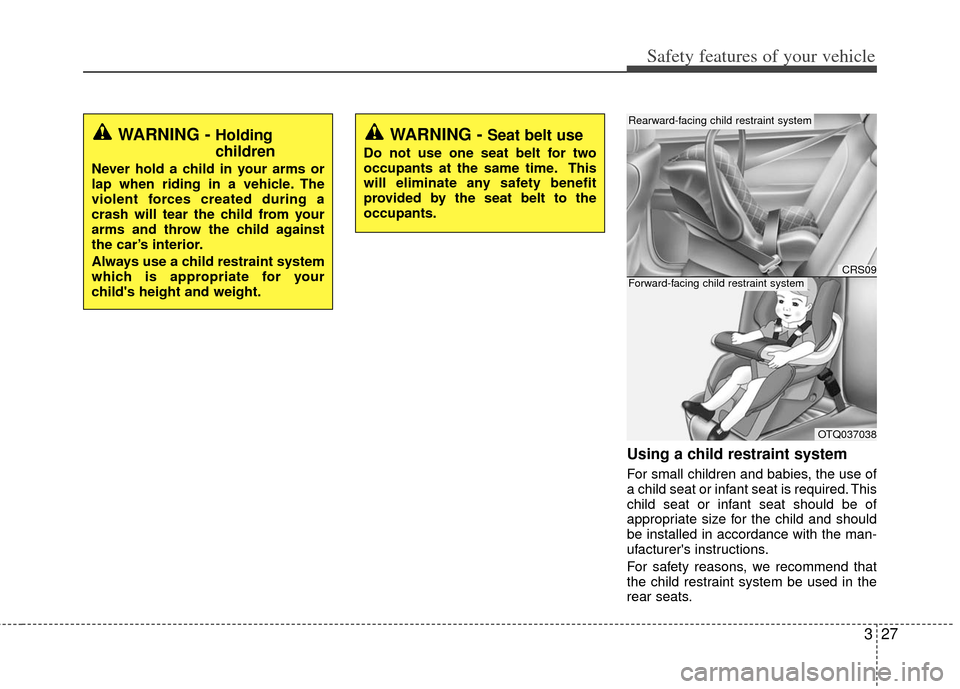
For small children and babies, the use of
a child seat or infant seat is required. This
child seat or infant seat should be of
appropriate size for the child and should
be installed in accordance with the man-
ufacturer's instructions.
For safety reasons, we recommend that
the child restraint system be used in the
rear seats.
WARNING - Holding
children
Never hold a child in your arms or
lap when riding in a vehicle. The
violent forces created during a
crash will tear the child from your
arms and throw the child against
the car’s interior.
Always use a child restraint system
which is appropriate for your
child's height and weight.
WARNING - Seat belt use
Do not use one seat belt for two
occupants at the same time. This
will eliminate any safety benefit
provided by the seat belt to the
occupants.
CRS09
OTQ037038
Rearward-facing child restraint system
Forward-facing child restraint system
Page 42 of 394
Safety features of your vehicle
28
3
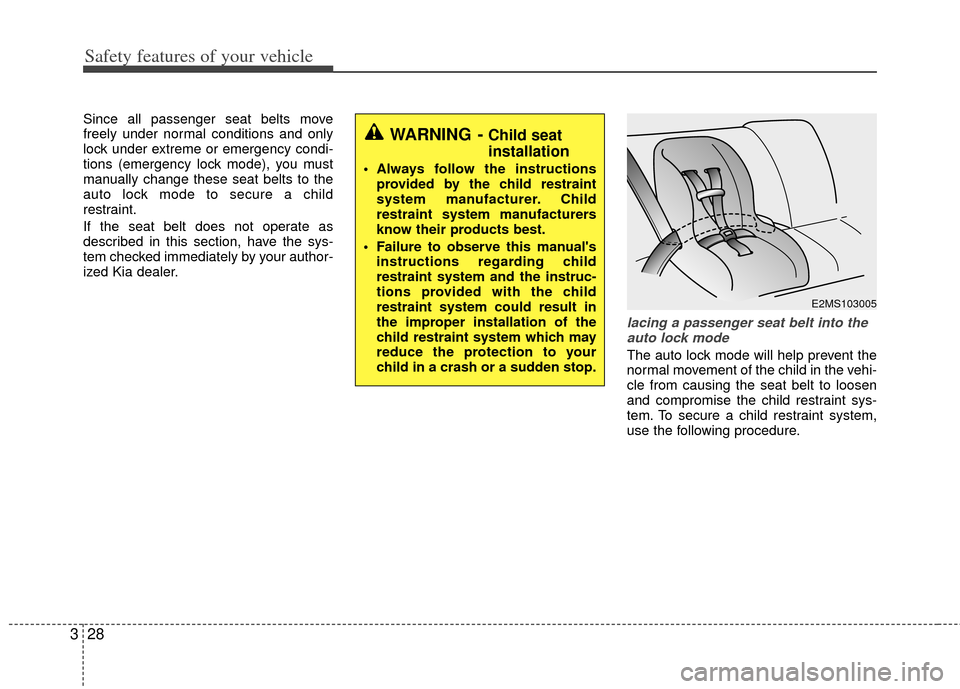
Since all passenger seat belts move
freely under normal conditions and only
lock under extreme or emergency condi-
tions (emergency lock mode), you must
manually change these seat belts to the
auto lock mode to secure a child
restraint.
If the seat belt does not operate as
described in this section, have the sys-
tem checked immediately by your author-
ized Kia dealer.
lacing a passenger seat belt into the
auto lock mode
The auto lock mode will help prevent the
normal movement of the child in the vehi-
cle from causing the seat belt to loosen
and compromise the child restraint sys-
tem. To secure a child restraint system,
use the following procedure.
WARNING - Child seat
installation
Always follow the instructions provided by the child restraint
system manufacturer. Child
restraint system manufacturers
know their products best.
Failure to observe this manual's instructions regarding child
restraint system and the instruc-
tions provided with the child
restraint system could result in
the improper installation of the
child restraint system which may
reduce the protection to your
child in a crash or a sudden stop.
E2MS103005
Page 44 of 394
Safety features of your vehicle
30
3
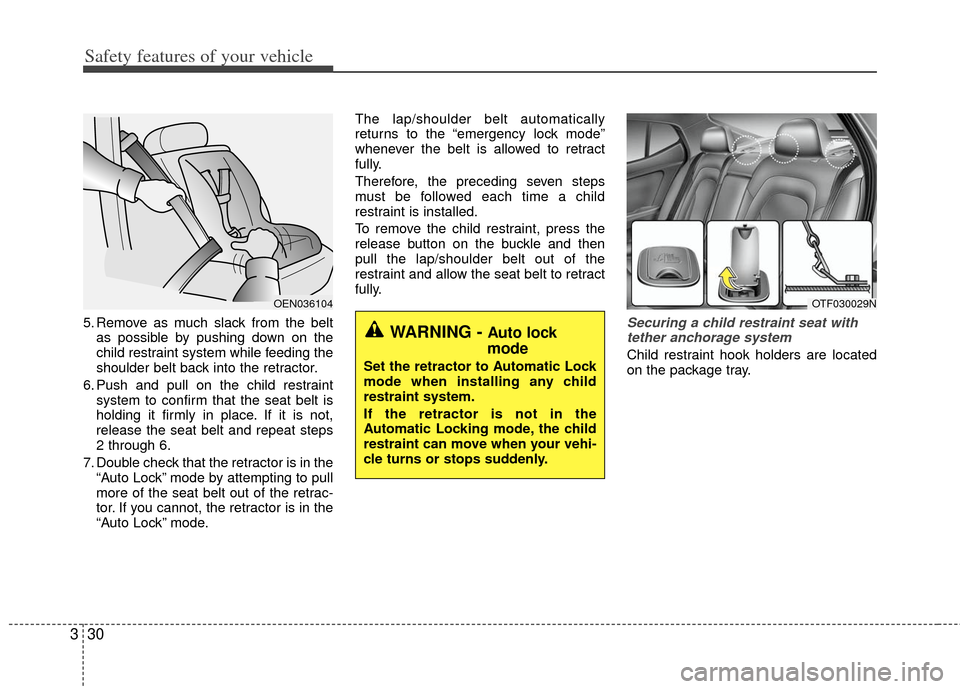
5. Remove as much slack from the belt
as possible by pushing down on the
child restraint system while feeding the
shoulder belt back into the retractor.
6. Push and pull on the child restraint system to confirm that the seat belt is
holding it firmly in place. If it is not,
release the seat belt and repeat steps
2 through 6.
7. Double check that the retractor is in the “Auto Lock” mode by attempting to pull
more of the seat belt out of the retrac-
tor. If you cannot, the retractor is in the
“Auto Lock” mode. The lap/shoulder belt automatically
returns to the “emergency lock mode”
whenever the belt is allowed to retract
fully.
Therefore, the preceding seven steps
must be followed each time a child
restraint is installed.
To remove the child restraint, press the
release button on the buckle and then
pull the lap/shoulder belt out of the
restraint and allow the seat belt to retract
fully.Securing a child restraint seat with
tether anchorage system
Child restraint hook holders are located
on the package tray.
OEN036104
WARNING - Auto lock
mode
Set the retractor to Automatic Lock
mode when installing any child
restraint system.
If the retractor is not in the
Automatic Locking mode, the child
restraint can move when your vehi-
cle turns or stops suddenly.
OTF030029N