wheel KIA OPTIMA HYBRID 2015 Owners Manual
[x] Cancel search | Manufacturer: KIA, Model Year: 2015, Model line: OPTIMA HYBRID, Model: KIA OPTIMA HYBRID 2015Pages: 495, PDF Size: 13.38 MB
Page 432 of 495
Maintenance
60
7
Tire chains
Tire chains, if necessary, should be
installed on the front wheels.
Be sure that the chains are installed
in accordance with the manufactur-
er's instructions.
To minimize tire and chain wear, do
not continue to use tire chains when
they are no longer needed.
When driving on roads covered
with snow or ice, drive at less than
20 mph (30 km/h).
Use the SAE “S” class or wire chains.
If you hear noise caused by chains contacting the body, retighten the
chain to avoid contact with the
vehicle body.
To prevent body damage, retighten the chains after driving 0.3~0.6
miles (0.5~1.0 km).
Do not use tire chains on vehicles equipped with aluminum wheels.
In unavoidable circumstances, use
a wire type chain.
Use wire chains less than 0.59 inches (15 mm) to prevent damage
to the chain’s connection.
Radial-ply tires
Radial-ply tires provide improved
tread life, road hazard resistance and
smoother high speed ride. The radi-
al-ply tires used on this vehicle are
of belted construction and are select-
ed to complement the ride and han-
dling characteristics of your vehicle.
Radial-ply tires have the same load
carrying capacity as bias-ply or bias
belted tires of the same size and use
the same recommended inflation
pressure. Mixing of radial-ply tires
with bias-ply or bias belted tires is
not recommended. Any combina-
tions of radial-ply and bias-ply or bias
belted tires when used on the same
vehicle will seriously deteriorate
vehicle handling. The best rule to fol-
low is: identical radial-ply tires should
always be used as a set of four. Longer wearing tires can be more
susceptible to irregular tread wear. It
is very important to follow the tire
rotation interval shown in this section
to achieve the tread life potential of
these tires. Cuts and punctures in
radial-ply tires are repairable only in
the tread area, because of sidewall
flexing. Consult your tire dealer for
radial-ply tire repairs.
Page 433 of 495
761
Maintenance
Low aspect ratio tire
(if equipped)
Low aspect ratio tires, whose aspect
ratio is lower than 50, are provided
for sporty looks.
Because the low aspect ratio tires
are optimized for handling and brak-
ing, it may be more uncomfortable to
ride in and there is more noise com-
pare with normal tires.
CAUTION
Because the sidewall of the lowaspect ratio tire is shorter thanthe normal, the wheel and tire ofthe low aspect ratio tire is easi-er to be damaged. So, follow theinstructions below.
- When driving on a rough road or off road, drive cautiouslybecause tires and wheels maybe damaged. And after driv-ing, inspect tires and wheels.
- When passing over a pothole, speed bump, manhole, or curbstone, drive slowly so that thetires and wheels are not dam-aged.
- If the tire is impacted, we rec- ommend that you inspect thetire condition or contact anauthorized Kia dealer.
- To prevent damage to the tire, inspect the tire condition andpressure every 1,900 miles(3,000 km).
CAUTION
It is not easy to recognize the tire damage with your owneyes. But if there is the slight-est hint of tire damage, eventhough you cannot see the tiredamage with your own eyes,have the tire checked orreplaced because the tiredamage may cause air leak-age from the tire.
If the tire is damaged by driv- ing on a rough road, off road,pothole, manhole, or curbstone, it will not be covered bythe warranty.
You can find out the tire infor- mation on the tire sidewall.
Page 442 of 495
Maintenance
70
7
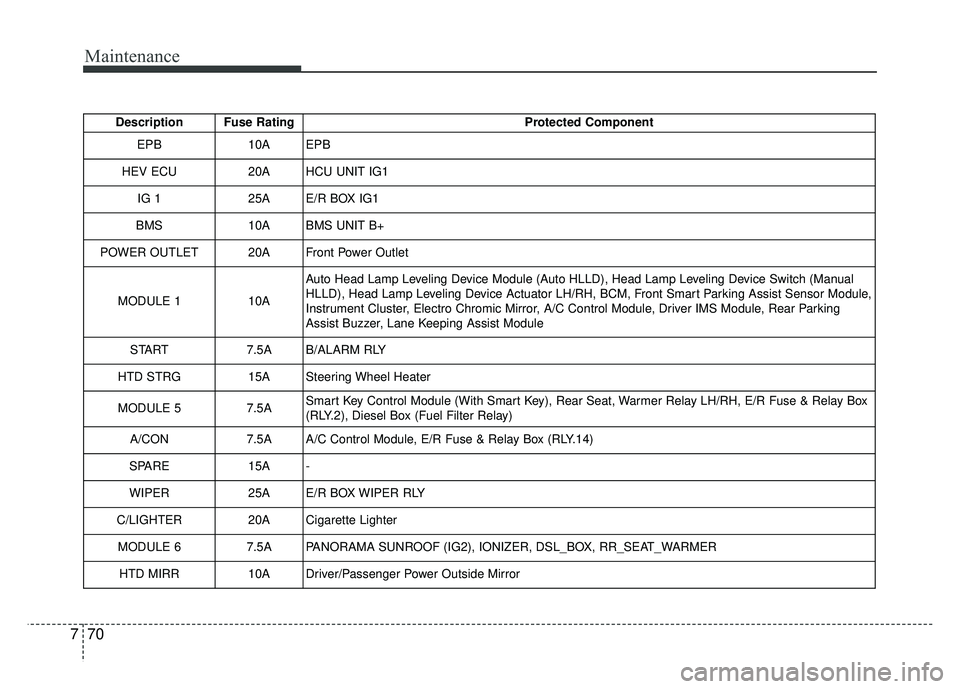
Description Fuse Rating Protected Component
EPB10AEPB
HEV ECU20AHCU UNIT IG1
IG 125AE/R BOX IG1
BMS 10A BMS UNIT B+
POWER OUTLET 20A Front Power Outlet
MODULE 1 10AAuto Head Lamp Leveling Device Module (Auto HLLD), Head Lamp Leveling Device Switch (Manual
HLLD), Head Lamp Leveling Device Actuator LH/RH, BCM, Front Smart Parking Assist Sensor Module,
Instrument Cluster, Electro Chromic Mirror, A/C Control Module, Driver IMS Module, Rear Parking
Assist Buzzer, Lane Keeping Assist Module
START 7.5A B/ALARM RLY
HTD STRG 15A Steering Wheel Heater
MODULE 5 7.5ASmart Key Control Module (With Smart Key), Rear Seat, Warmer Relay LH/RH, E/R Fuse & Relay Box
(RLY.2), Diesel Box (Fuel Filter Relay)
A/CON 7.5A A/C Control Module, E/R Fuse & Relay Box (RLY.14)
SPARE 15A -
WIPER 25A E/R BOX WIPER RLY
C/LIGHTER 20A Cigarette Lighter
MODULE 6 7.5A PANORAMA SUNROOF (IG2), IONIZER, DSL_BOX, RR_SEAT_WARMER
HTD MIRR 10A Driver/Passenger Power Outside Mirror
Page 461 of 495
789
Maintenance
Finish damage repair
Deep scratches or stone chips in the
painted surface must be repaired
promptly. Exposed metal will quickly
rust and may develop into a major
repair expense.
If your vehicle is damaged and
requires any metal repair or replace-
ment, be sure the body shop applies
anti-corrosion materials to the parts
repaired or replaced.
Bright-metal maintenance
To remove road tar and insects,use a tar remover, not a scraper or
other sharp object.
To protect the surfaces of bright- metal parts from corrosion, apply a
coating of wax or chrome preser-
vative and rub to a high luster.
During winter weather or in coastal areas, cover the bright metal parts
with a heavier coating of wax or
preservative. If necessary, coat the
parts with non-corrosive petroleum
jelly or other protective compound.
Underbody maintenance
Corrosive materials used for ice and
snow removal and dust control may
collect on the underbody. If these
materials are not removed, acceler-
ated rusting can occur on underbody
parts such as the fuel lines, frame,
floor pan and exhaust system, even
though they have been treated with
rust protection.
Thoroughly flush the vehicle under-
body and wheel openings with luke-
warm or cold water once a month,
after off-road driving and at the end
of each winter. Pay special attention
to these areas because it is difficult
to see all the mud and dirt. It will do
more harm than good to wet down
the road grime without removing it.
The lower edges of doors, rocker pan-
els, and frame members have drain
holes that should not be allowed to
clog with dirt; trapped water in these
areas can cause rusting.
Page 462 of 495
Maintenance
90
7
Aluminum wheel maintenance
The aluminum wheels are coated
with a clear protective finish.
Do not use any abrasive cleaner,
polishing compound, solvent, or
wire brushes on aluminum wheels.
They may scratch or damage the
finish.
Clean the wheel when it has cooled.
Use only a mild soap or neutral detergent, and rinse thoroughly
with water. Also, be sure to clean
the wheels after driving on salted
roads. This helps prevent corro-
sion.
Avoid washing the wheels with high-speed car wash brushes.
Do not use any alkaline or acid detergent. It may damage and cor-
rode the aluminum wheels coated
with a clear protective finish.
Corrosion protection
Protecting your vehicle from corro-
sion
By using the most advanced design
and construction practices to combat
corrosion, we produce vehicles of
the highest quality. However, this is
only part of the job. To achieve the
long-term corrosion resistance your
vehicle can deliver, the owner's
cooperation and assistance is also
required.
Common causes of corrosion
The most common causes of corro-
sion on your vehicle are:
Road salt, dirt and moisture that isallowed to accumulate underneath
the vehicle.
coatings by stones, gravel, abra-
sion or minor scrapes and dents
which leave unprotected metal
exposed to corrosion. High-corrosion areas
If you live in an area where your vehi-
cle is regularly exposed to corrosive
materials, corrosion protection is
particularly important. Some of the
common causes of accelerated cor-
rosion are road salts, dust control
chemicals, ocean air and industrial
pollution.
Moisture breeds corrosion
Moisture creates the conditions in
which corrosion is most likely to
occur. For example, corrosion is
accelerated by high humidity, partic-
ularly when temperatures are just
above freezing. In such conditions,
the corrosive material is kept in con-
tact with the vehicle surfaces by
moisture that is slow to evaporate.
Mud is particularly corrosive
because it dries slowly and holds
moisture in contact with the vehicle.
Although the mud appears to be dry,
it can still retain the moisture and
promote corrosion.
Page 464 of 495
Maintenance
92
7
Keep paint and trim in good con-
dition
Scratches or chips in the finish
should be covered with "touch-up"
paint as soon as possible to reduce
the possibility of corrosion. If bare
metal is showing through, the atten-
tion of a qualified body and paint
shop is recommended.
Bird droppings : Bird droppings are
highly corrosive and may damage
painted surfaces in just a few hours.
Always remove bird droppings as
soon as possible.
Don't neglect the interior
Moisture can collect under the floor
mats and carpeting and cause corro-
sion. Check under the mats periodi-
cally to be sure the carpeting is dry.
Use particular care if you carry fertil-
izers, cleaning materials or chemi-
cals in the car.
These should be carried only in
proper containers and any spills or
leaks should be cleaned up, flushed
with clean water and thoroughly
dried.Interior care
Interior general precautions
Prevent chemicals such as perfume,
cosmetic oil, sun cream, hand clean-
er, and air freshener from contacting
the interior parts because they may
cause damage or discoloration. If
they do contact the interior parts,
wipe them off immediately. See the
instructions for the proper way to
clean vinyl.
CAUTION- Electrical
components
Never allow water or other liq-uids to come in contact withelectrical/electronic compo-nents inside the vehicle as thismay damage them.
CAUTION - Leather
When cleaning leather products(steering wheel, seats etc.), useneutral detergents or low alco-hol content solutions. If you usehigh alcohol content solutionsor acid/alkaline detergents, thecolor of the leather may fade orthe surface may get stripped off.
Page 470 of 495
Specifications, Consumer information, Reporting safety defects
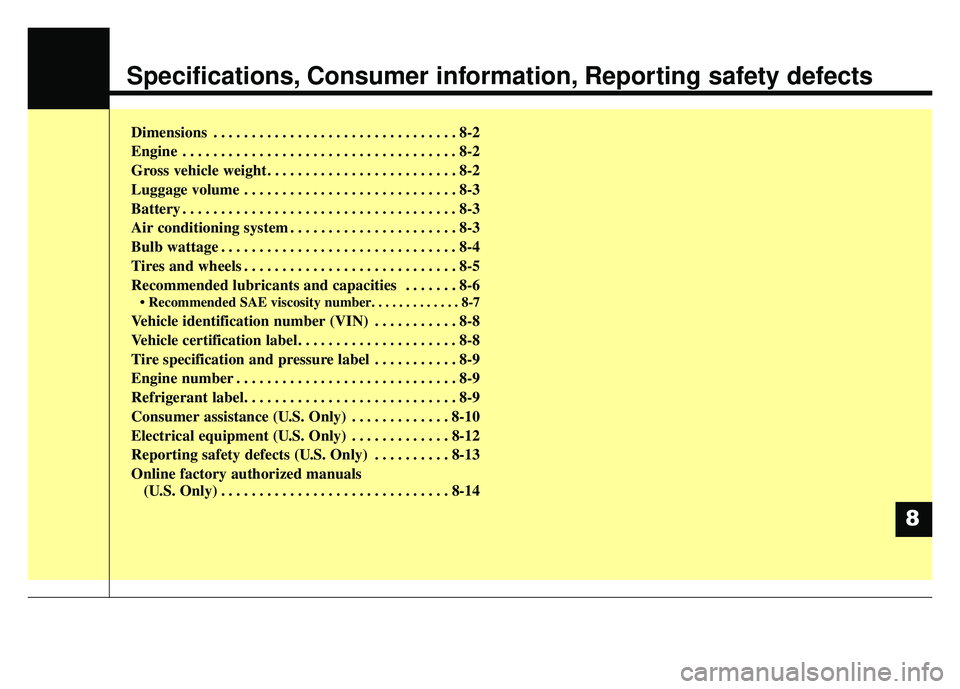
Dimensions . . . . . . . . . . . . . . . . . . . . . . . . . . . . . . . . 8-2
Engine . . . . . . . . . . . . . . . . . . . . . . . . . . . . . . . . . . . . \
8-2
Gross vehicle weight. . . . . . . . . . . . . . . . . . . . . . . . . 8-2
Luggage volume . . . . . . . . . . . . . . . . . . . . . . . . . . . . 8-3
Battery . . . . . . . . . . . . . . . . . . . . . . . . . . . . . . . . . . . . \
8-3
Air conditioning system . . . . . . . . . . . . . . . . . . . . . . 8-3
Bulb wattage . . . . . . . . . . . . . . . . . . . . . . . . . . . . . . . 8-4
Tires and wheels . . . . . . . . . . . . . . . . . . . . . . . . . . . . 8-5
Recommended lubricants and capacities . . . . . . . 8-6
• Recommended SAE viscosity number. . . . . . . . . . . . . 8-7
Vehicle identification number (VIN) . . . . . . . . . . . 8-8
Vehicle certification label. . . . . . . . . . . . . . . . . . . . . 8-8
Tire specification and pressure label . . . . . . . . . . . 8-9
Engine number . . . . . . . . . . . . . . . . . . . . . . . . . . . . . 8-9
Refrigerant label. . . . . . . . . . . . . . . . . . . . . . . . . . . . 8-9
Consumer assistance (U.S. Only) . . . . . . . . . . . . . 8-10
Electrical equipment (U.S. Only) . . . . . . . . . . . . . 8-12
Reporting safety defects (U.S. Only) . . . . . . . . . . 8-13
Online factory authorized manuals (U.S. Only) . . . . . . . . . . . . . . . . . . . . . . . . . . . . . . 8-14
8
Page 471 of 495
![KIA OPTIMA HYBRID 2015 Owners Manual GROSS VEHICLE WEIGHT
Specifications, Consumer information, Reporting safety defects
28
DIMENSIONS
ItemGasoline 2.4L
Displacement [cu.in(cc)] 143.96 cu.in (2,359 cc)
Bore x Stroke [in(mm)] 3.46 x 3.82](/img/2/55003/w960_55003-470.png "KIA OPTIMA HYBRID 2015 Owners Manual GROSS VEHICLE WEIGHT
Specifications, Consumer information, Reporting safety defects
28
DIMENSIONS
ItemGasoline 2.4L
Displacement [cu.in(cc)] 143.96 cu.in (2,359 cc)
Bore x Stroke [in(mm)] 3.46 x 3.82")
GROSS VEHICLE WEIGHT
Specifications, Consumer information, Reporting safety defects
28
DIMENSIONS
ItemGasoline 2.4L
Displacement [cu.in(cc)] 143.96 cu.in (2,359 cc)
Bore x Stroke [in(mm)] 3.46 x 3.82 in (88 x 97 mm)
Firing order 1
→ 3 → 4 → 2
No. of cylinders 4, In-line
Itemin. (mm)
Overall length 190.7 (4,845)
Overall width 72.0 (1,830)
Overall height 57.1 (1,450)
Front tread 63.0 (1,601)*
1/62.8 (1,595)*2
Rear tread63.0 (1,601)*1/62.8 (1,595)*2
Wheelbase 110.0 (2,795)
*1: with R16 tire
*2: with R17 tire
ENGINE
ltem Gasoline 2.4L
Gross vehicle weight A/T4,586 lbs (2,080 kg)
Page 474 of 495
85
Specifications, Consumer information, Reporting safety defects
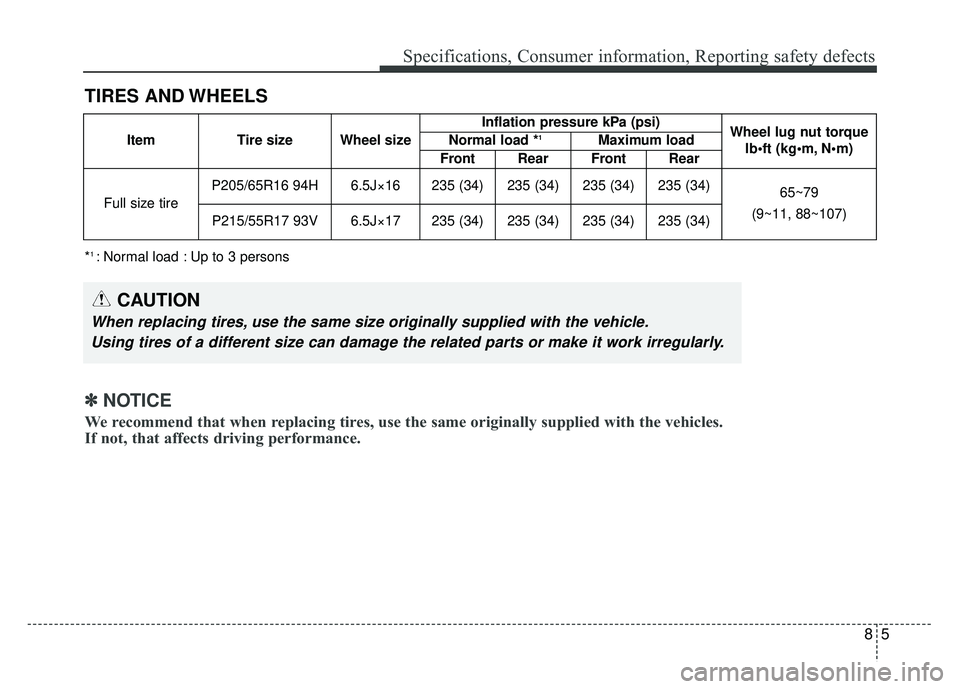
TIRES AND WHEELS
CAUTION
When replacing tires, use the same size originally supplied with the vehicle.Using tires of a different size can damage the related parts or make it work irregularly.
*1 : Normal load : Up to 3 persons Item Tire size Wheel size
Inflation pressure kPa (psi)
Wheel lug nut torque
Normal load *
1Maximum load
Front Rear Front Rear
Full size tire P205/65R16 94H 6.5J×16 235 (34) 235 (34) 235 (34) 235 (34)
65~79
(9~11, 88~107)
P215/55R17 93V 6.5J×17 235 (34) 235 (34) 235 (34) 235 (34)
✽
✽ NOTICE
We recommend that when replacing tires, use the same originally supplied with the vehicles.
If not, that affects driving performance.
Page 485 of 495

Index
2I
Active ECO . . . . . . . . . . . . . . . . . . . . . . . . . . . . . . . . . . 5-43\
Air bag warning label . . . . . . . . . . . . . . . . . . . . . . . . . . 3-56
Air bag warning light . . . . . . . . . . . . . . . . . . . . . . . . . . 3-37
Air bags. . . . . . . . . . . . . . . . . . . . . . . . . . . . . . . . . . . . \
. 3-34Operation . . . . . . . . . . . . . . . . . . . . . . . . . . . . . . . . . 3-35
Air bag warning light . . . . . . . . . . . . . . . . . . . . . . . . 3-37
SRS components and functions . . . . . . . . . . . . . . . . 3-38
Occupant detection system. . . . . . . . . . . . . . . . . . . . 3-40
Driver's and passenger's front air bag . . . . . . . . . . . 3-45
Side air bag. . . . . . . . . . . . . . . . . . . . . . . . . . . . . . . . 3-48
Curtain air bag . . . . . . . . . . . . . . . . . . . . . . . . . . . . . 3-49
Inflation and non-inflation conditions . . . . . . . . . . 3-50
SRS Care . . . . . . . . . . . . . . . . . . . . . . . . . . . . . . . . . 3-55
Air bag warning label. . . . . . . . . . . . . . . . . . . . . . . . 3-56
Air cleaner . . . . . . . . . . . . . . . . . . . . . . . . . . . . . . . . . . 7-39\
Air ventilation seat . . . . . . . . . . . . . . . . . . . . . . . . . . . . 3-12
Airconditioning system Automatic climatecontrol system. . . . . . . . . . . . . . 4-102
Alarm system . . . . . . . . . . . . . . . . . . . . . . . . . . . . . . . . 4-12
Antenna see the Glass antenna . . . . . . . . . . . . . . . . . . 4-126
Anti-lock brake system (ABS) . . . . . . . . . . . . . . . . . . . 5-30
Appearance care . . . . . . . . . . . . . . . . . . . . . . . . . . . . . . 7-87 Exterior care . . . . . . . . . . . . . . . . . . . . . . . . . . . . . . . 7-87
Interior care . . . . . . . . . . . . . . . . . . . . . . . . . . . . . . . 7-92
Armrest (rear) . . . . . . . . . . . . . . . . . . . . . . . . . . . . . . . . 3-15
Audio system . . . . . . . . . . . . . . . . . . . . . . . . . . . . . . . 4-126 Glass antenna . . . . . . . . . . . . . . . . . . . . . . . . . . . . . 4-126
Steering wheel audio controls . . . . . . . . . . . . . . . . 4-127
Aux, USB and iPod®port . . . . . . . . . . . . . . . . . . . 4-128
Auto defogging system . . . . . . . . . . . . . . . . . . . . . . . . 4-117
Auto Hold . . . . . . . . . . . . . . . . . . . . . . . . . . . . . . . . . . . 5-\
27
Auto light position . . . . . . . . . . . . . . . . . . . . . . . . . . . . 4-90
Automatic climate control system . . . . . . . . . . . . . . . 4-102 Automatic heating and air conditioning. . . . . . . . . 4-103
Manual heating and air conditioning . . . . . . . . . . . 4-104
Air conditioning . . . . . . . . . . . . . . . . . . . . . . . . . . . 4-110
Automatic transaxle . . . . . . . . . . . . . . . . . . . . . . . . . . . 5-12 Sports mode . . . . . . . . . . . . . . . . . . . . . . . . . . . . . . . 5-14
Shift-lock override . . . . . . . . . . . . . . . . . . . . . . . . . . 5-16
Aux, USB and iPod
®port. . . . . . . . . . . . . . . . . . . . . . 4-128
Back-Up Warning System . . . . . . . . . . . . . . . . . . . . . . 4-83 Operation . . . . . . . . . . . . . . . . . . . . . . . . . . . . . . . . . 4-83
Non-operational conditions . . . . . . . . . . . . . . . . . . . 4-84
Battery. . . . . . . . . . . . . . . . . . . . . . . . . . . . . . . . . . . . \
. . 7-45
Battery saver function . . . . . . . . . . . . . . . . . . . . . . . . . . 4-88
Before driving . . . . . . . . . . . . . . . . . . . . . . . . . . . . . . . . . 5-4
Blind spot detection system(BSD) . . . . . . . . . . . . . . . . 5-44 BSD (Blind Spot Detection)/LCA (Lane Change Assist) . . . . . . . . . . . . . . . . . . 5-45
RCTA (Rear cross traffic alert) . . . . . . . . . . . . . . . . 5-47
Brake system. . . . . . . . . . . . . . . . . . . . . . . . . . . . . . . . . 5-17
A
B