Jump KIA OPTIMA HYBRID 2017 Owners Manual
[x] Cancel search | Manufacturer: KIA, Model Year: 2017, Model line: OPTIMA HYBRID, Model: KIA OPTIMA HYBRID 2017Pages: 604, PDF Size: 13.16 MB
Page 48 of 604
H42
COMPONENTS OF THE HYBRID/PLUG-IN HYBRID VEHICLE(CONT.)
When the hybrid vehicle shuts
off
When the high voltage battery or 12-
volt battery discharges, or fuel tank is
empty, the hybrid system may not
operate.
If the Hybrid system stops operating
while the vehicle is moving, reduce
the vehicle speed gradually. Pull
your vehicle off the road in a safe
area, and shift the transmission in to
Park (P) position and;
1. Turn on the hazard warning flashers.
2. Set the start button at OFF, and tryto start the Hybrid system by
applying the brake pedal and
pushing the start button.
3. If the Hybrid system will not oper- ate, refer to "EMERGENCY
STARTING" in chapter 7.
Before you try to jump start the vehi-
cle, confirm the fuel level. If the fuel
level is low add more fuel before
attempting as emergency start.
WARNING
If a submersion in water occurs:
If your vehicle was flooded and
has soaked carpeting or water
on the flooring, you should not
try to start the Hybrid system.
Never touch the high voltage
cables, connectors and pack-
age modules, because an elec-
trical shock may occur causing
injury or death. High Voltage
cables are orange in color.
We recommend that the car
towed to an authorized Kia dealer.
WARNING - Accident
Vehicle
Never touch electric wires or
cable. If exposed electric wires
or cables are visible inside or
outside of your vehicle, an elec-
tric shock may occur.
WARNING - Putting out
fire
Never use a small quantity of
water to put out a fire in your
vehicle. If a fire occurs, evacu-
ate the car immediately and
contact the fire department.
Page 370 of 604
633
Driving your vehicle
Even with the anti-lock brake sys-tem, your vehicle still requires suf-
ficient stopping distance. Always
maintain a safe distance from the
vehicle in front of you.
Always slow down when cornering. The anti-lock brake system cannot
prevent accidents resulting from
excessive speeds.
On loose or uneven road surfaces, operation of the anti-lock brake
system may result in a longer stop-
ping distance than for vehicles
equipped with a conventional
brake system. The ABS warning light will stay on for
approximately 3 seconds after the
engine start/stop button is ON.
During that time, the ABS will go
through self-diagnosis and the light
will go off if everything is normal. If
the light stays on, you may have a
problem with your ABS. Contact an
authorized Kia dealer as soon as
possible. When you drive on a road having
poor traction, such as an icy road,
and have operated your brakes
continuously, the ABS will be active
continuously and the ABS warning
light may illuminate. Pull your vehi-
cle over to a safe place and stop
the engine.
Restart the engine. If the ABS warning light goes off, then your
ABS system is normal. Otherwise,
you may have a problem with the
ABS. Contact an authorized Kia
dealer as soon as possible.
✽ ✽ NOTICE
When you jump start your vehicle
because of a drained battery, the
engine may not run as smoothly and
the ABS warning light may turn on at
the same time. This happens because
of low battery voltage. It does not
mean your ABS has malfunctioned.
• Do not pump your brakes!
• Have the battery recharged before
driving the vehicle.
W-78
Page 435 of 604
Driving your vehicle
98
6
To keep locks from freezing
To keep the locks from freezing,
squirt an approved de-icer fluid or
glycerine into the key opening. If a
lock is covered with ice, squirt it with
an approved de-icing fluid to remove
the ice. If the lock is frozen internally,
you may be able to thaw it out by
using a heated key. Handle the heat-
ed key with care to avoid injury.
Use approved window washer
anti-freeze in system
To keep the water in the window
washer system from freezing, add an
approved window washer anti-freeze
solution in accordance with instruc-
tions on the container. Window wash-
er anti-freeze is available from an
authorized Kia dealer and most auto
parts outlets. Do not use engine
coolant or other types of anti-freeze
as these may damage the paint fin-
ish.
Don’t let your parking brake
freeze
Under some conditions your parking
brake can freeze in the engaged
position. This is most likely to happen
when there is an accumulation of
snow or ice around or near the rear
brakes or if the brakes are wet. If
there is a risk the parking brake may
freeze, apply it only temporarily while
you put the gear shift lever in P (Park,
Automatic Transaxle) and block the
rear wheels so the vehicle cannot roll.
Then release the parking brake.
Don't let ice and snow accu-
mulate underneath
Under some conditions, snow and
ice can build up under the fenders
and interfere with the steering. When
driving in severe winter conditions
where this may happen, you should
periodically check underneath the
vehicle to be sure the movement of
the front wheels and the steering
components are not obstructed.
Carry emergency equipment
Depending on the severity of the
weather, you should carry appropri-
ate emergency equipment. Some of
the items you may want to carry
include tow straps or chains, flash-
light, emergency flares, sand, shov-
el, jumper cables, window scraper,
gloves, ground cloth, coveralls, blan-
ket, etc.
TRAILER TOWING
We do not recommend using this
vehicle for trailer towing.
Page 441 of 604
What to do in an emergency
Road warning . . . . . . . . . . . . . . . . . . . . . . . . . . . . . . 7-2
• Hazard warning flasher . . . . . . . . . . . . . . . . . . . . . . . . 7-2
In case of an emergency while driving . . . . . . . . . . 7-3
• If the engine stalls at a crossroad or crossing. . . . . . . 7-3
• If you have a flat tire while driving . . . . . . . . . . . . . . . 7-3
• If the engine stalls while driving . . . . . . . . . . . . . . . . . 7-3
If the engine will not start . . . . . . . . . . . . . . . . . . . . 7-4
• If engine doesn't turn over or turns over slowly . . . . 7-4
• If engine turns over normally but does not start . . . . 7-4
Emergency starting . . . . . . . . . . . . . . . . . . . . . . . . . 7-5
• Jump starting . . . . . . . . . . . . . . . . . . . . . . . . . . . . . . . . . 7-5
• Push-starting . . . . . . . . . . . . . . . . . . . . . . . . . . . . . . . . . 7-6
If the engine overheats . . . . . . . . . . . . . . . . . . . . . . . 7-7
Tire Pressure Monitoring System (TPMS) . . . . . . 7-9
• Check tire pressure . . . . . . . . . . . . . . . . . . . . . . . . . . . . 7-9
• Low tire pressure position telltale . . . . . . . . . . . . . . . 7-11
• Changing a tire with TPMS . . . . . . . . . . . . . . . . . . . . 7-13
If you have a flat tire (With Tire Mobility Kit). . 7-16
• Introduction . . . . . . . . . . . . . . . . . . . . . . . . . . . . . . . . . 7-16
• Notes on the safe use of the Tire Mobility Kit . . . . . 7-17
• Components of the Tire Mobility Kit . . . . . . . . . . . . 7-18
• Using the Tire Mobility Kit . . . . . . . . . . . . . . . . . . . . 7-19
• Distributing the sealant. . . . . . . . . . . . . . . . . . . . . . . . 7-22
• Checking the tire inflation pressure . . . . . . . . . . . . . 7-22
• Technical Data . . . . . . . . . . . . . . . . . . . . . . . . . . . . . . . 7-23
Towing . . . . . . . . . . . . . . . . . . . . . . . . . . . . . . . . . . . 7-\
24
• Towing service . . . . . . . . . . . . . . . . . . . . . . . . . . . . . . . 7-24
• Removable towing hook . . . . . . . . . . . . . . . . . . . . . . . 7-25
• Emergency towing . . . . . . . . . . . . . . . . . . . . . . . . . . . . 7-26
If an accident occurs . . . . . . . . . . . . . . . . . . . . . . . 7-29
7
Page 444 of 604
What to do in an emergency
47
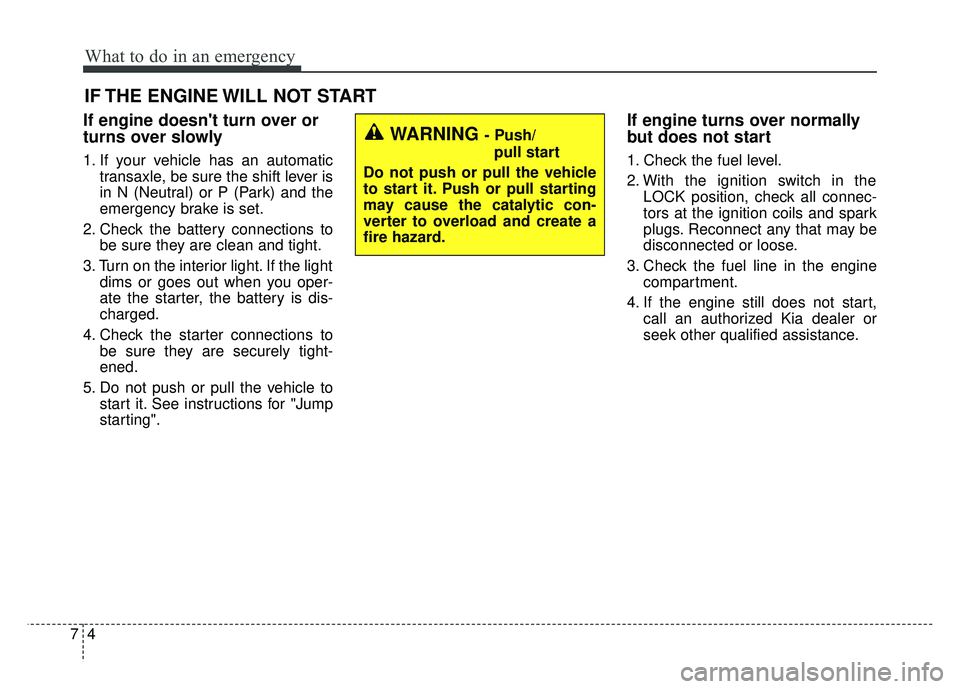
IF THE ENGINE WILL NOT START
If engine doesn't turn over or
turns over slowly
1. If your vehicle has an automatictransaxle, be sure the shift lever is
in N (Neutral) or P (Park) and the
emergency brake is set.
2. Check the battery connections to be sure they are clean and tight.
3. Turn on the interior light. If the light dims or goes out when you oper-
ate the starter, the battery is dis-
charged.
4. Check the starter connections to be sure they are securely tight-
ened.
5. Do not push or pull the vehicle to start it. See instructions for "Jump
starting".
If engine turns over normally
but does not start
1. Check the fuel level.
2. With the ignition switch in theLOCK position, check all connec-
tors at the ignition coils and spark
plugs. Reconnect any that may be
disconnected or loose.
3. Check the fuel line in the engine compartment.
4. If the engine still does not start, call an authorized Kia dealer or
seek other qualified assistance.
WARNING - Push/
pull start
Do not push or pull the vehicle
to start it. Push or pull starting
may cause the catalytic con-
verter to overload and create a
fire hazard.
Page 445 of 604
75
What to do in an emergency
EMERGENCY STARTING
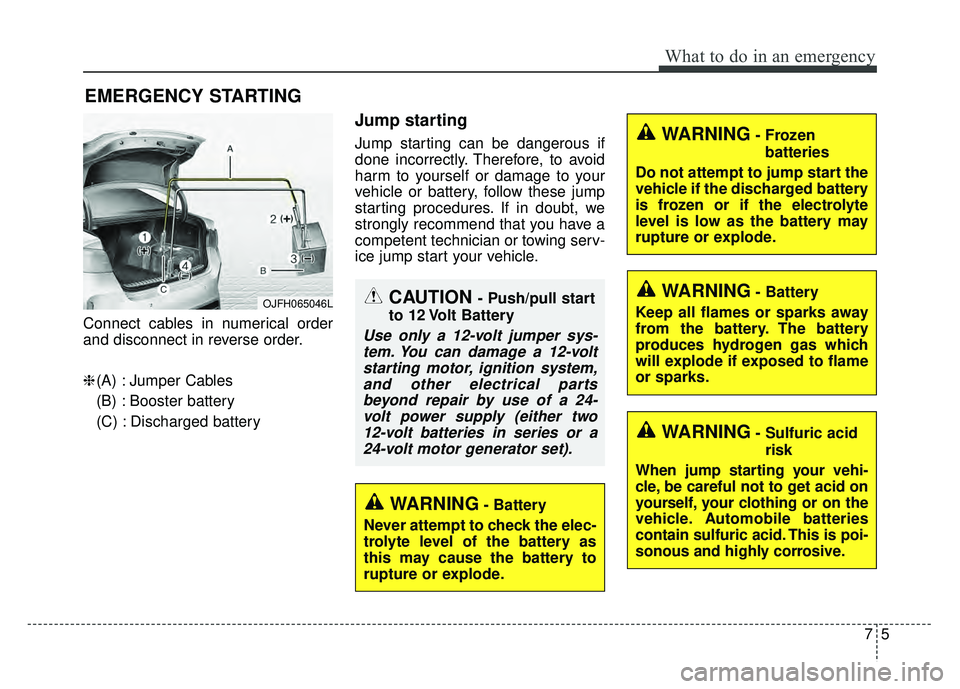
Connect cables in numerical order
and disconnect in reverse order.
❈(A) : Jumper Cables
(B) : Booster battery
(C) : Discharged battery
Jump starting
Jump starting can be dangerous if
done incorrectly. Therefore, to avoid
harm to yourself or damage to your
vehicle or battery, follow these jump
starting procedures. If in doubt, we
strongly recommend that you have a
competent technician or towing serv-
ice jump start your vehicle.
CAUTION - Push/pull start
to 12 Volt Battery
Use only a 12-volt jumper sys- tem. You can damage a 12-voltstarting motor, ignition system,and other electrical partsbeyond repair by use of a 24-volt power supply (either two12-volt batteries in series or a24-volt motor generator set).
WARNING- Battery
Never attempt to check the elec-
trolyte level of the battery as
this may cause the battery to
rupture or explode.
WARNING- Frozen batteries
Do not attempt to jump start the
vehicle if the discharged battery
is frozen or if the electrolyte
level is low as the battery may
rupture or explode.
WARNING- Sulfuric acid risk
When jump starting your vehi-
cle, be careful not to get acid on
yourself, your clothing or on the
vehicle. Automobile batteries
contain sulfuric acid. This is poi-
sonous and highly corrosive.
WARNING- Battery
Keep all flames or sparks away
from the battery. The battery
produces hydrogen gas which
will explode if exposed to flame
or sparks.OJFH065046L
Page 446 of 604
What to do in an emergency
67
Jump starting procedure
1.Make sure the booster battery is12-volt and that its negative termi-
nal is grounded.
2.If the booster battery is in another vehicle, do not allow the vehicles to
come in contact.
3.Turn off all unnecessary electrical loads.
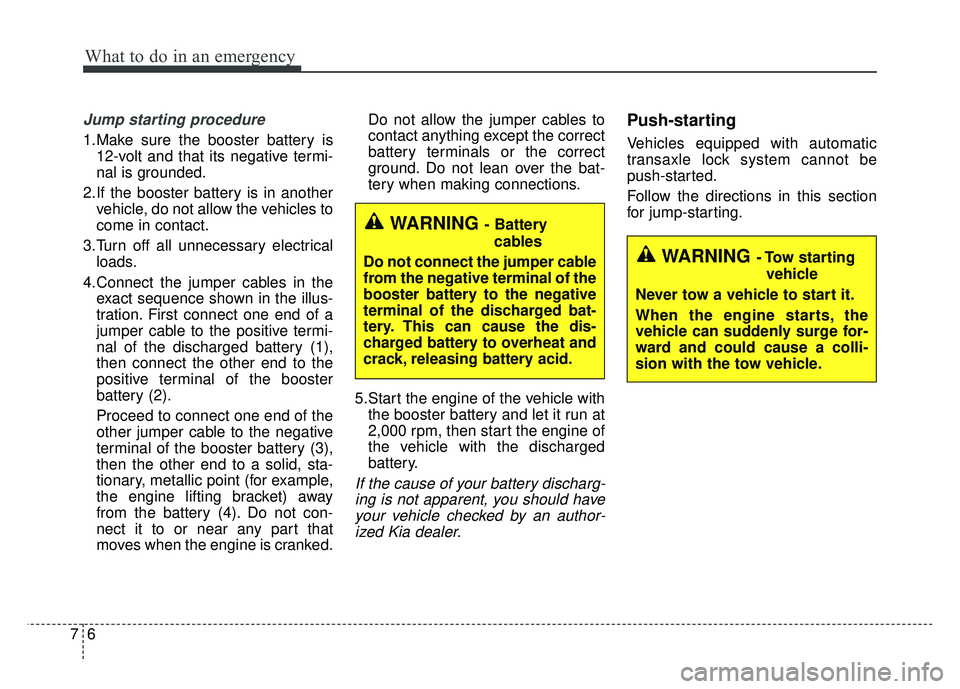
4.Connect the jumper cables in the exact sequence shown in the illus-
tration. First connect one end of a
jumper cable to the positive termi-
nal of the discharged battery (1),
then connect the other end to the
positive terminal of the booster
battery (2).
Proceed to connect one end of the
other jumper cable to the negative
terminal of the booster battery (3),
then the other end to a solid, sta-
tionary, metallic point (for example,
the engine lifting bracket) away
from the battery (4). Do not con-
nect it to or near any part that
moves when the engine is cranked. Do not allow the jumper cables to
contact anything except the correct
battery terminals or the correct
ground. Do not lean over the bat-
tery when making connections.
5.Start the engine of the vehicle with the booster battery and let it run at
2,000 rpm, then start the engine of
the vehicle with the discharged
battery.
If the cause of your battery discharg-ing is not apparent, you should haveyour vehicle checked by an author-ized Kia dealer.
Push-starting
Vehicles equipped with automatic
transaxle lock system cannot be
push-started.
Follow the directions in this section
for jump-starting.
WARNING - Tow starting
vehicle
Never tow a vehicle to start it.
When the engine starts, the
vehicle can suddenly surge for-
ward and could cause a colli-
sion with the tow vehicle.
WARNING - Battery cables
Do not connect the jumper cable
from the negative terminal of the
booster battery to the negative
terminal of the discharged bat-
tery. This can cause the dis-
charged battery to overheat and
crack, releasing battery acid.
Page 585 of 604
911
Specifications, Consumer information, Reporting safety defects
Roadside Assistance is provided on all new current
model year Kia Vehicles from the date the vehicle is deliv-
ered to the first retail buyer or otherwise put into use (in-
service date), whichever is earlier, for a period of 60
months or 60,000 miles, whichever is earlier, subject to
the terms, conditions and exclusions set forth in the Kia
Warranty and Consumer Information Manual applicable
to your model year vehicle.
KMA reserves the right to limit or deny services or other
benefits to any owner or driver when, in KMA's judgment,
the claims and/or service requests are excessive in fre-
quency or type of occurrence.
Toll free consumer assistance
Kia's toll-free Consumer Assistance hot line is staffed
from 5:00 AM to 6:00 PM PST, Monday through Friday
and is accessible by dialing 1-800-333-4Kia (4542).
For more information regarding assistance available,
please refer to your Kia Warranty & Consumer
Information Manual.
Emergency roadside assistance
Kia's toll free Roadside Assistance hot line is staffed 24
hours a day, 365 days a year and is accessible by dialing
1-800-333-4Kia (4542).
Please note that you must provide your Vehicle
Identification Number (VIN) to verify coverage at the time
of your call. The VIN can be found on the dash of your
vehicle on the driver’s side, on the door jamb of the dri-
ver’s door, your vehicle’s registration or proof of insur-
ance card.
Kia utilizes a network of over 30,000 roadside assistance
providers. Should you accidentally run out of fuel, require
a battery jump, or need help changing a tire, a Kia
Roadside Assistance Representative will dispatch some-
one to deliver a small quantity of gas, change a flat tire
with your inflated spare, or arrange a battery jump to
allow you to proceed to your destination. We have access
to a network of over 10,000 locksmiths to help you should
you become locked out of your Kia.
In the event that mechanical difficulty renders your vehi-
cle undriveable due to a warranty-related concern, Kia’s
Roadside Assistance Representative will arrange to
transport your vehicle to the nearest Kia dealer or to an
authorized Kia alternative service location.
CONSUMER ASSISTANCE (U.S. ONLY)
Page 594 of 604
I5
Index
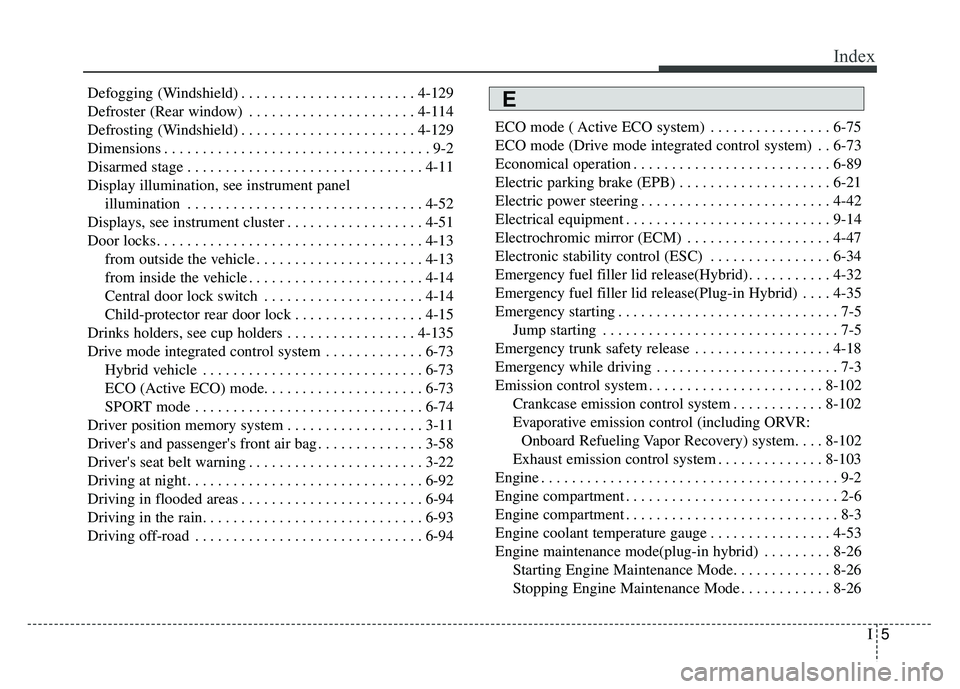
Defogging (Windshield) . . . . . . . . . . . . . . . . . . . . . . . 4-129
Defroster (Rear window) . . . . . . . . . . . . . . . . . . . . . . 4-114
Defrosting (Windshield) . . . . . . . . . . . . . . . . . . . . . . . 4-129
Dimensions . . . . . . . . . . . . . . . . . . . . . . . . . . . . . . . . . . . 9-\
2
Disarmed stage . . . . . . . . . . . . . . . . . . . . . . . . . . . . . . . 4-11
Display illumination, see instrument panelillumination . . . . . . . . . . . . . . . . . . . . . . . . . . . . . . . 4-52
Displays, see instrument cluster . . . . . . . . . . . . . . . . . . 4-51
Door locks. . . . . . . . . . . . . . . . . . . . . . . . . . . . . . . . . . . 4-\
13 from outside the vehicle . . . . . . . . . . . . . . . . . . . . . . 4-13
from inside the vehicle . . . . . . . . . . . . . . . . . . . . . . . 4-14
Central door lock switch . . . . . . . . . . . . . . . . . . . . . 4-14
Child-protector rear door lock . . . . . . . . . . . . . . . . . 4-15
Drinks holders, see cup holders . . . . . . . . . . . . . . . . . 4-135
Drive mode integrated control system . . . . . . . . . . . . . 6-73 Hybrid vehicle . . . . . . . . . . . . . . . . . . . . . . . . . . . . . 6-73
ECO (Active ECO) mode. . . . . . . . . . . . . . . . . . . . . 6-73
SPORT mode . . . . . . . . . . . . . . . . . . . . . . . . . . . . . . 6-74
Driver position memory system . . . . . . . . . . . . . . . . . . 3-11
Driver's and passenger's front air bag . . . . . . . . . . . . . . 3-58
Driver's seat belt warning . . . . . . . . . . . . . . . . . . . . . . . 3-22
Driving at night . . . . . . . . . . . . . . . . . . . . . . . . . . . . . . . 6-92
Driving in flooded areas . . . . . . . . . . . . . . . . . . . . . . . . 6-94
Driving in the rain. . . . . . . . . . . . . . . . . . . . . . . . . . . . . 6-93
Driving off-road . . . . . . . . . . . . . . . . . . . . . . . . . . . . . . 6-94 ECO mode ( Active ECO system) . . . . . . . . . . . . . . . . 6-75
ECO mode (Drive mode integrated control system) . . 6-73
Economical operation . . . . . . . . . . . . . . . . . . . . . . . . . . 6-89
Electric parking brake (EPB) . . . . . . . . . . . . . . . . . . . . 6-21
Electric power steering . . . . . . . . . . . . . . . . . . . . . . . . . 4-42
Electrical equipment . . . . . . . . . . . . . . . . . . . . . . . . . . . 9-14
Electrochromic mirror (ECM) . . . . . . . . . . . . . . . . . . . 4-47
Electronic stability control (ESC) . . . . . . . . . . . . . . . . 6-34
Emergency fuel filler lid release(Hybrid) . . . . . . . . . . . 4-32
Emergency fuel filler lid release(Plug-in Hybrid) . . . . 4-35
Emergency starting . . . . . . . . . . . . . . . . . . . . . . . . . . . . . 7-5
Jump starting . . . . . . . . . . . . . . . . . . . . . . . . . . . . . . . 7-5
Emergency trunk safety release . . . . . . . . . . . . . . . . . . 4-18
Emergency while driving . . . . . . . . . . . . . . . . . . . . . . . . 7-3
Emission control system . . . . . . . . . . . . . . . . . . . . . . . 8-102 Crankcase emission control system . . . . . . . . . . . . 8-102
Evaporative emission control (including ORVR:Onboard Refueling Vapor Recovery) system. . . . 8-102
Exhaust emission control system . . . . . . . . . . . . . . 8-103
Engine . . . . . . . . . . . . . . . . . . . . . . . . . . . . . . . . . . . . \
. . . 9-2
Engine compartment . . . . . . . . . . . . . . . . . . . . . . . . . . . . 2-6
Engine compartment . . . . . . . . . . . . . . . . . . . . . . . . . . . . 8-3
Engine coolant temperature gauge . . . . . . . . . . . . . . . . 4-53
Engine maintenance mode(plug-in hybrid) . . . . . . . . . 8-26 Starting Engine Maintenance Mode. . . . . . . . . . . . . 8-26
Stopping Engine Maintenance Mode . . . . . . . . . . . . 8-26E
Page 597 of 604
Index
8I
If an accident occurs . . . . . . . . . . . . . . . . . . . . . . . . . . . 7-29
Important safety precautions . . . . . . . . . . . . . . . . . . . . . 3-2
Indicator Lights. . . . . . . . . . . . . . . . . . . . . . . . . . . . . . . 4-90
Inside rearview mirror . . . . . . . . . . . . . . . . . . . . . . . . . 4-46
Instrument cluster . . . . . . . . . . . . . . . . . . . . . . . . . . . . . 4-51Instrument Cluster Control. . . . . . . . . . . . . . . . . . . . 4-52
LCD Display Control . . . . . . . . . . . . . . . . . . . . . . . . 4-52
LCD Display . . . . . . . . . . . . . . . . . . . . . . . . . . . . . . 4-58
LCD Modes . . . . . . . . . . . . . . . . . . . . . . . . . . . . . . . 4-58
Service Mode . . . . . . . . . . . . . . . . . . . . . . . . . . . . . . 4-59
User settings mode . . . . . . . . . . . . . . . . . . . . . . . . . . 4-61
Trip computer . . . . . . . . . . . . . . . . . . . . . . . . . . . . . . 4-67
Trip modes . . . . . . . . . . . . . . . . . . . . . . . . . . . . . . . . 4-67
Turn By Turn Mode . . . . . . . . . . . . . . . . . . . . . . . . . 4-71
ASCC/LDWS Mode . . . . . . . . . . . . . . . . . . . . . . . . 4-72
A/V Mode. . . . . . . . . . . . . . . . . . . . . . . . . . . . . . . . . 4-72
Warning and Indicator lights . . . . . . . . . . . . . . . . . . 4-82
Warning lights . . . . . . . . . . . . . . . . . . . . . . . . . . . . . 4-82
Indicator Lights . . . . . . . . . . . . . . . . . . . . . . . . . . . . 4-90
Instrument panel overview . . . . . . . . . . . . . . . . . . . . . . . 2-5
Interior care. . . . . . . . . . . . . . . . . . . . . . . . . . . . . . . . . . 8-99\
Interior features. . . . . . . . . . . . . . . . . . . . . . . . . . . . . . 4-135 Cup holder . . . . . . . . . . . . . . . . . . . . . . . . . . . . . . . 4-135
Seat warmer . . . . . . . . . . . . . . . . . . . . . . . . . . . . . . 4-136
Air ventilation seat . . . . . . . . . . . . . . . . . . . . . . . . . 4-137
Sunvisor . . . . . . . . . . . . . . . . . . . . . . . . . . . . . . . . . 4-137 Power outlet . . . . . . . . . . . . . . . . . . . . . . . . . . . . . . 4-138
Clothes hanger . . . . . . . . . . . . . . . . . . . . . . . . . . . . 4-140
Floor mat anchor(s) . . . . . . . . . . . . . . . . . . . . . . . . 4-140
Side curtain. . . . . . . . . . . . . . . . . . . . . . . . . . . . . . . 4-141
USB charger . . . . . . . . . . . . . . . . . . . . . . . . . . . . . . 4-139
Interior light . . . . . . . . . . . . . . . . . . . . . . . . . . . . . . . . 4-110 Automatic turn off function . . . . . . . . . . . . . . . . . . 4-110
Map lamp . . . . . . . . . . . . . . . . . . . . . . . . . . . . . . . . 4-111
Room lamp . . . . . . . . . . . . . . . . . . . . . . . . . . . . . . . 4-110
Trunk room lamp . . . . . . . . . . . . . . . . . . . . . . . . . . 4-112
Glove box lamp . . . . . . . . . . . . . . . . . . . . . . . . . . . 4-112
Vanity mirror lamp . . . . . . . . . . . . . . . . . . . . . . . . . 4-112
Interior overview. . . . . . . . . . . . . . . . . . . . . . . . . . . . . . . 2-4
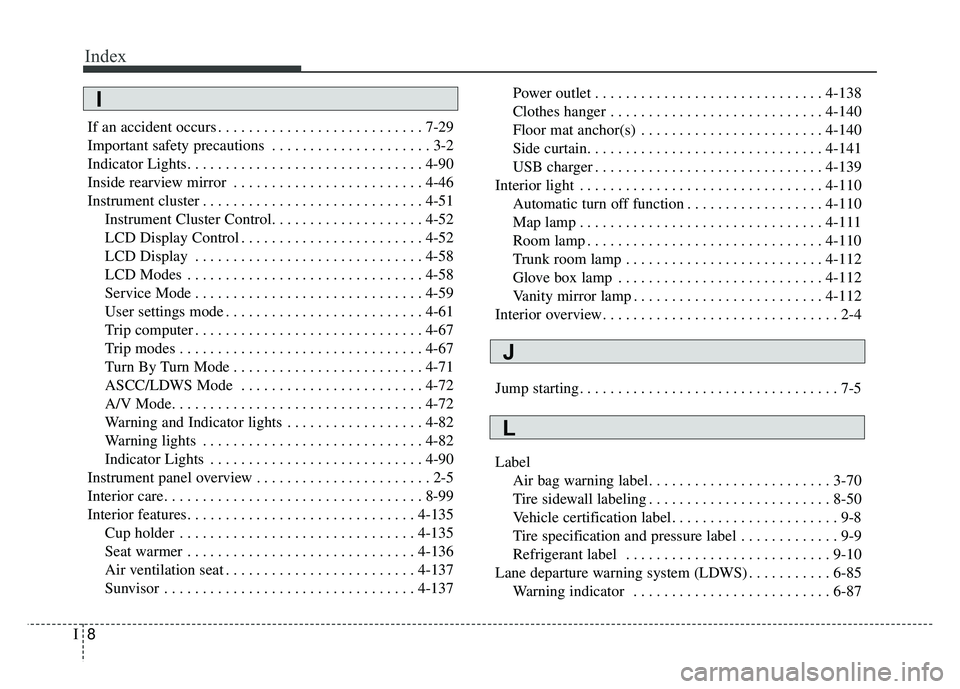
Jump starting. . . . . . . . . . . . . . . . . . . . . . . . . . . . . . . . . . 7-5
Label Air bag warning label. . . . . . . . . . . . . . . . . . . . . . . . 3-70
Tire sidewall labeling . . . . . . . . . . . . . . . . . . . . . . . . 8-50
Vehicle certification label. . . . . . . . . . . . . . . . . . . . . . 9-8
Tire specification and pressure label . . . . . . . . . . . . . 9-9
Refrigerant label . . . . . . . . . . . . . . . . . . . . . . . . . . . 9-10
Lane departure warning system (LDWS) . . . . . . . . . . . 6-85 Warning indicator . . . . . . . . . . . . . . . . . . . . . . . . . . 6-87
J
L
I