brake fluid KIA OPTIMA PHEV 2018 Owner's Manual
[x] Cancel search | Manufacturer: KIA, Model Year: 2018, Model line: OPTIMA PHEV, Model: KIA OPTIMA PHEV 2018Pages: 547, PDF Size: 11.56 MB
Page 443 of 547
831
Maintenance
BRAKE FLUID
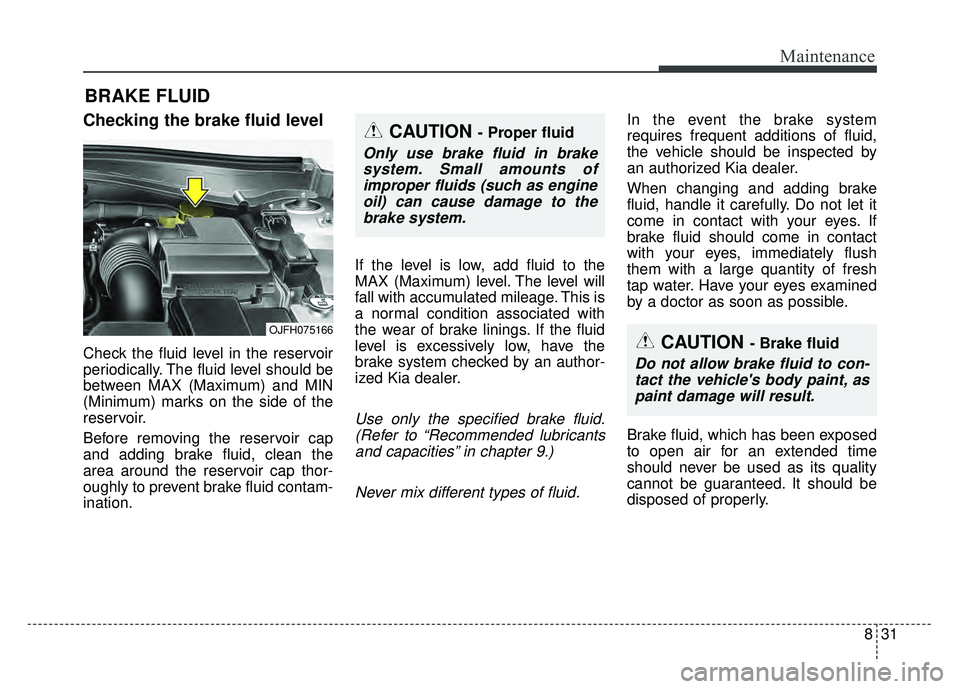
Checking the brake fluid level
Check the fluid level in the reservoir
periodically. The fluid level should be
between MAX (Maximum) and MIN
(Minimum) marks on the side of the
reservoir.
Before removing the reservoir cap
and adding brake fluid, clean the
area around the reservoir cap thor-
oughly to prevent brake fluid contam-
ination.If the level is low, add fluid to the
MAX (Maximum) level. The level will
fall with accumulated mileage. This is
a normal condition associated with
the wear of brake linings. If the fluid
level is excessively low, have the
brake system checked by an author-
ized Kia dealer.
Use only the specified brake fluid.
(Refer to “Recommended lubricantsand capacities” in chapter 9.)
Never mix different types of fluid.
In the event the brake system
requires frequent additions of fluid,
the vehicle should be inspected by
an authorized Kia dealer.
When changing and adding brake
fluid, handle it carefully. Do not let it
come in contact with your eyes. If
brake fluid should come in contact
with your eyes, immediately flush
them with a large quantity of fresh
tap water. Have your eyes examined
by a doctor as soon as possible.
Brake fluid, which has been exposed
to open air for an extended time
should never be used as its quality
cannot be guaranteed. It should be
disposed of properly.
OJFH075166CAUTION - Brake fluid
Do not allow brake fluid to con-tact the vehicle's body paint, aspaint damage will result.
CAUTION - Proper fluid
Only use brake fluid in brakesystem. Small amounts ofimproper fluids (such as engineoil) can cause damage to thebrake system.
Page 508 of 547
Maintenance
96
8
Finish damage repair
Deep scratches or stone chips in the
painted surface must be repaired
promptly. Exposed metal will quickly
rust and may develop into a major
repair expense.
If your vehicle is damaged and
requires any metal repair or replace-
ment, be sure the body shop applies
anti-corrosion materials to the parts
repaired or replaced.
Bright-metal maintenance
To remove road tar and insects,
use a tar remover, not a scraper or
other sharp object.
To protect the surfaces of bright- metal parts from corrosion, apply a
coating of wax or chrome preser-
vative and rub to a high luster.
During winter weather or in coastal areas, cover the bright metal parts
with a heavier coating of wax or
preservative. If necessary, coat the
parts with non-corrosive petroleum
jelly or other protective compound.
Underbody maintenance
Road salt and other corrosive chemi-
cals are used in cold weather states to
melt snow and prevent ice accumula-
tion. If these chemicals are not regu-
larly removed, they will corrode the
vehicle underbody and over time dam-
age fuel lines, the fuel tank retention
system, the vehicle suspension, the
exhaust system, and even the body
frame. The National Highway Traffic
Safety Administration has warned all
vehicle owners of all brands of the
need to take the following steps:
Wash the undercarriage of yourvehicle regularly during the winter
and whenever your vehicle has
been exposed to such salts or
chemicals.
Do a thorough washing of the undercarriage at the end of the
winter.
Use professional service techni- cians or governmental inspection
stations to annually inspect for cor-
rosion. Immediately seek an inspection of
your vehicle if you become visually
aware of corrosion flaking or scal-
ing or if you become aware of a
change in vehicle performance,
such as soft or spongey brakes,
fluids leaking, impairment of direc-
tional control, suspension noises
or rattling metal straps.
Aluminum wheel maintenance
The aluminum wheels are coated
with a clear protective finish.
Do not use any abrasive cleaner,polishing compound, solvent, or
wire brushes on aluminum wheels.
They may scratch the finish.
Clean the wheel when it has cooled.
Use only a mild soap or neutral detergent, and rinse thoroughly with
water. Also, be sure to clean the
wheels after driving on salted roads.
This helps prevent corrosion.
Page 523 of 547
Specifications, Consumer information, Reporting safety defects
69
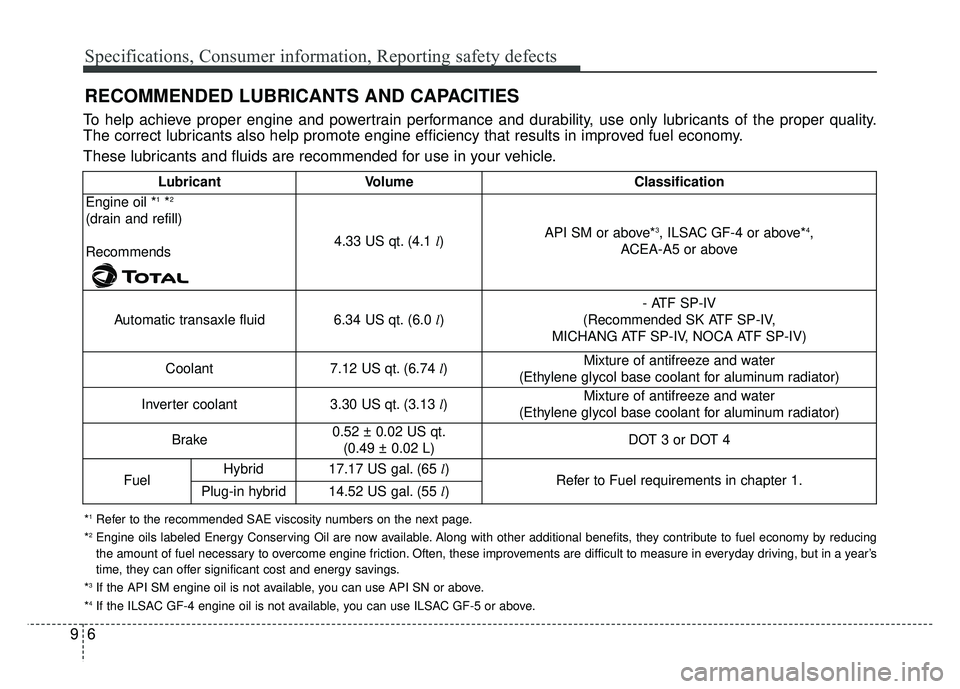
RECOMMENDED LUBRICANTS AND CAPACITIES
To help achieve proper engine and powertrain performance and durability, use only lubricants of the proper quality.
The correct lubricants also help promote engine efficiency that results in improved fuel economy.
These lubricants and fluids are recommended for use in your vehicle.
*1Refer to the recommended SAE viscosity numbers on the next page.
*2Engine oils labeled Energy Conserving Oil are now available. Along with other additional benefits, they contribute to fuel econo my by reducing
the amount of fuel necessary to overcome engine friction. Often, these improvements are difficult to measure in everyday driving, but in a year’s
time, they can offer significant cost and energy savings.
*
3If the API SM engine oil is not available, you can use API SN or above.
*4If the ILSAC GF-4 engine oil is not available, you can use ILSAC GF-5 or above.
Lubricant VolumeClassification
Engine oil *1*2
(drain and refill)
Recommends
4.33 US qt. (4.1 l)API SM or above*3, ILSAC GF-4 or above*4,
ACEA-A5 or above
Automatic transaxle fluid6.34 US qt. (6.0 l)
- ATF SP-IV
(Recommended SK ATF SP-IV,
MICHANG ATF SP-IV, NOCA ATF SP-IV)
Coolant7.12 US qt. (6.74 l)Mixture of antifreeze and water
(Ethylene glycol base coolant for aluminum radiator)
Inverter coolant3.30 US qt. (3.13 l)Mixture of antifreeze and water
(Ethylene glycol base coolant for aluminum radiator)
Brake0.52 ± 0.02 US qt. (0.49 ± 0.02 L)DOT 3 or DOT 4
FuelHybrid17.17 US gal. (65 l)Refer to Fuel requirements in chapter 1.Plug-in hybrid14.52 US gal. (55 l)
Page 535 of 547
I3
Index
Automatic turn off function . . . . . . . . . . . . . . . . . . . . 4-110
Automatic ventilation . . . . . . . . . . . . . . . . . . . . . . . . . 4-124
Autonomous Emergency Braking (AEB) . . . . . . . . . . . 6-41System setting and activation . . . . . . . . . . . . . . . . . . 6-41
AEB warning message and system control . . . . . . . 6-44
Brake operation . . . . . . . . . . . . . . . . . . . . . . . . . . . . 6-45
Sensor to detect the distance from the vehicle infront (front radar) . . . . . . . . . . . . . . . . . . . . . . . . . . 6-46
System malfunction . . . . . . . . . . . . . . . . . . . . . . . . . 6-47
Limitation of the system . . . . . . . . . . . . . . . . . . . . . 6-48
Recognizing pedestrians. . . . . . . . . . . . . . . . . . . . . . 6-51
Back-up lamp bulb replacement . . . . . . . . . . . . . . . . . . 8-89
Battery. . . . . . . . . . . . . . . . . . . . . . . . . . . . . . . . . . . . \
. . 8-42 For best battery service . . . . . . . . . . . . . . . . . . . . . . 8-42
Recharging the battery . . . . . . . . . . . . . . . . . . . . . . . 8-43
Reset items . . . . . . . . . . . . . . . . . . . . . . . . . . . . . . . . 8-44
Battery saver function . . . . . . . . . . . . . . . . . . . . . . . . . 4-100
Before driving . . . . . . . . . . . . . . . . . . . . . . . . . . . . . . . . . 6-4
Blind Spot Detection System(BSD) . . . . . . . . . . . . . . . 6-77 BSD (Blind Spot Detection) /LCA (Lane Change Assist) . . . . . . . . . . . . . . . . . . 6-78
RCTA (Rear cross traffic alert) . . . . . . . . . . . . . . . . 6-81
Limitations condition . . . . . . . . . . . . . . . . . . . . . . . . 6-83
Bonnet see the hood . . . . . . . . . . . . . . . . . . . . . . . . . . . 4-27 Brake system. . . . . . . . . . . . . . . . . . . . . . . . . . . . . . . . . 6-18
Power brakes . . . . . . . . . . . . . . . . . . . . . . . . . . . . . . 6-18
Parking brake . . . . . . . . . . . . . . . . . . . . . . . . . . . . . 6-20
Electric parking brake (EPB) . . . . . . . . . . . . . . . . . . 6-21
AUTO HOLD . . . . . . . . . . . . . . . . . . . . . . . . . . . . . . 6-28
Anti-lock brake system (ABS) . . . . . . . . . . . . . . . . . 6-32
Electronic stability control (ESC) . . . . . . . . . . . . . . 6-34
Vehicle stability management (VSM) . . . . . . . . . . . 6-38
Hill-start assist control (HAC) . . . . . . . . . . . . . . . . . 6-39
Brakes fluid. . . . . . . . . . . . . . . . . . . . . . . . . . . . . . . . . . 8-31\
Checking the brake fluid level . . . . . . . . . . . . . . . . . 8-31
Bulb replacement . . . . . . . . . . . . . . . . . . . . . . . . . . . . . 8-80
Bulb replacement precaution . . . . . . . . . . . . . . . . . . . . 8-80
Bulb wattage . . . . . . . . . . . . . . . . . . . . . . . . . . . . . . . . . . 9-3
Button start/stop, see engine start/stop button . . . . . . . . 6-6
California Perchlorate notice . . . . . . . . . . . . . . . . . . . 8-105
Camera (Rear view) . . . . . . . . . . . . . . . . . . . . . . . . . . . 4-99
Capacities (Lubricants) . . . . . . . . . . . . . . . . . . . . . . . . . . 9-6
Care Care of seat belts . . . . . . . . . . . . . . . . . . . . . . . . . . . 3-31
SRS Care . . . . . . . . . . . . . . . . . . . . . . . . . . . . . . . . . 3-69
Tire care . . . . . . . . . . . . . . . . . . . . . . . . . . . . . . . . . . 8-45\
Exterior care . . . . . . . . . . . . . . . . . . . . . . . . . . . . . . . 8-94
Interior care . . . . . . . . . . . . . . . . . . . . . . . . . . . . . . . 8-99
Care of seat belts . . . . . . . . . . . . . . . . . . . . . . . . . . . . . 3-31
B
C
Page 538 of 547

Index
6I
Engine start/stop button . . . . . . . . . . . . . . . . . . . . . . . . . 6-6Illuminated engine start/stop button. . . . . . . . . . . . . . 6-6
Engine start/stop button position . . . . . . . . . . . . . . . . 6-6
Starting the hybrid system . . . . . . . . . . . . . . . . . . . . . 6-8
Engine start/stop button illumination . . . . . . . . . . . . . . . 6-6
Engine start/stop button position . . . . . . . . . . . . . . . . . . 6-6
Engine will not start . . . . . . . . . . . . . . . . . . . . . . . . . . . . 7-4
Evaporative emission control (including ORVR: Onboard Refueling Vapor Recovery) system . . . . . 8-102
Exhaust emission control system . . . . . . . . . . . . . . . . 8-103
Explanation of scheduled maintenance items . . . . . . . 8-20 Engine oil and filter . . . . . . . . . . . . . . . . . . . . . . . . . 8-20
Hybrid starter & generator belt . . . . . . . . . . . . . . . . 8-20
Fuel filter (for gasoline) . . . . . . . . . . . . . . . . . . . . . . 8-20
Fuel lines, fuel hoses and connections . . . . . . . . . . . 8-20
Vapor hose and fuel filler cap . . . . . . . . . . . . . . . . . 8-20
Vacuum crankcase ventilation hoses . . . . . . . . . . . . 8-20
Air cleaner filter . . . . . . . . . . . . . . . . . . . . . . . . . . . . 8-21
Spark plugs . . . . . . . . . . . . . . . . . . . . . . . . . . . . . . . . 8-21
Cooling system . . . . . . . . . . . . . . . . . . . . . . . . . . . . . 8-21
Coolant (Engine / Inverter) . . . . . . . . . . . . . . . . . . . 8-21
Automatic transaxle fluid . . . . . . . . . . . . . . . . . . . . . 8-21
Brake hoses and lines . . . . . . . . . . . . . . . . . . . . . . . . 8-21
Brake fluid . . . . . . . . . . . . . . . . . . . . . . . . . . . . . . . . 8-22
Parking brake . . . . . . . . . . . . . . . . . . . . . . . . . . . . . . 8-22
Brake discs, pads, calipers and rotors . . . . . . . . . . . 8-22
Exhaust pipe and muffler . . . . . . . . . . . . . . . . . . . . . 8-23
Suspension mounting bolts . . . . . . . . . . . . . . . . . . . 8-23 Steering gear box, linkage & boots/
lower arm ball joint . . . . . . . . . . . . . . . . . . . . . . . . 8-23
Drive shafts and boots . . . . . . . . . . . . . . . . . . . . . . . 8-23
Air conditioning refrigerant . . . . . . . . . . . . . . . . . . . 8-23
Exterior care . . . . . . . . . . . . . . . . . . . . . . . . . . . . . . . . . 8-94
Exterior overview (Front) . . . . . . . . . . . . . . . . . . . . . . . . 2-2
Exterior overview (Rear) . . . . . . . . . . . . . . . . . . . . . . . . 2-3
Flat tires, see tire mobility kit. . . . . . . . . . . . . . . . . . . . 7-16
Floor mat anchor(s) . . . . . . . . . . . . . . . . . . . . . . . . . . 4-140
Fluid Checking fluid levels . . . . . . . . . . . . . . . . . . . . . . . . 8-23
Brake fluid . . . . . . . . . . . . . . . . . . . . . . . . . . . . . . . . 8-31
Washer fluid . . . . . . . . . . . . . . . . . . . . . . . . . . . . . . . 8-32
Folding the outside rearview mirror . . . . . . . . . . . . . . . 4-50
"Front passenger andrear seat 3-point system withcombination locking retractor" . . . . . . . . . . . . . 3-25
Front passenger's seat belt warning . . . . . . . . . . . . . . . 3-23
Front seat adjustment (manual) . . . . . . . . . . . . . . . . . . . 3-7
Front seat adjustment (power) . . . . . . . . . . . . . . . . . . . . 3-8
Front turn signal lamp bulb replacement . . . . . . . . . . . 8-85
Fuel filler lid (Hybrid) . . . . . . . . . . . . . . . . . . . . . . . . . 4-29 Emergency fuel filler lid release . . . . . . . . . . . . . . . 4-32
Fuel filler lid (Plug-in Hybrid) . . . . . . . . . . . . . . . . . . . 4-33 Emergency fuel filler lid release . . . . . . . . . . . . . . . 4-35
Fuel Gauge . . . . . . . . . . . . . . . . . . . . . . . . . . . . . . . . . . 4-55\
F